An automatic feeder makes one promise that matters: the right amount of food, at the right time, whether you are in the next room or three time zones away. The catch is that automatic cat feeder portions are not a universal unit. One listing counts a portion in grams, another treats it as a fraction of a cup, and a third simply says "portion" and leaves the arithmetic to you. Program the wrong number and a cat that should be eating a measured breakfast gets a small mountain, while a cat on a weight loss plan gets a garnish. This guide covers what a portion really means, how hopper size and bowl design change the outcome, and how to calibrate a machine with a kitchen scale instead of hope.
Quick answer
Automatic cat feeder portions explained in one line: a portion is the fixed dose the dispenser drops each time it cycles, and the setting you control is how many of those doses land in the bowl per meal. That dose is not standardized. Two feeders both set to four portions can deliver visibly different amounts of kibble, because the increment behind the word differs from one maker to the next. The reliable approach is to weigh what a single portion dispenses, work out your cat's daily food target in grams or calories, then set meals and portions to hit that number. No product page replaces that one calibration step.
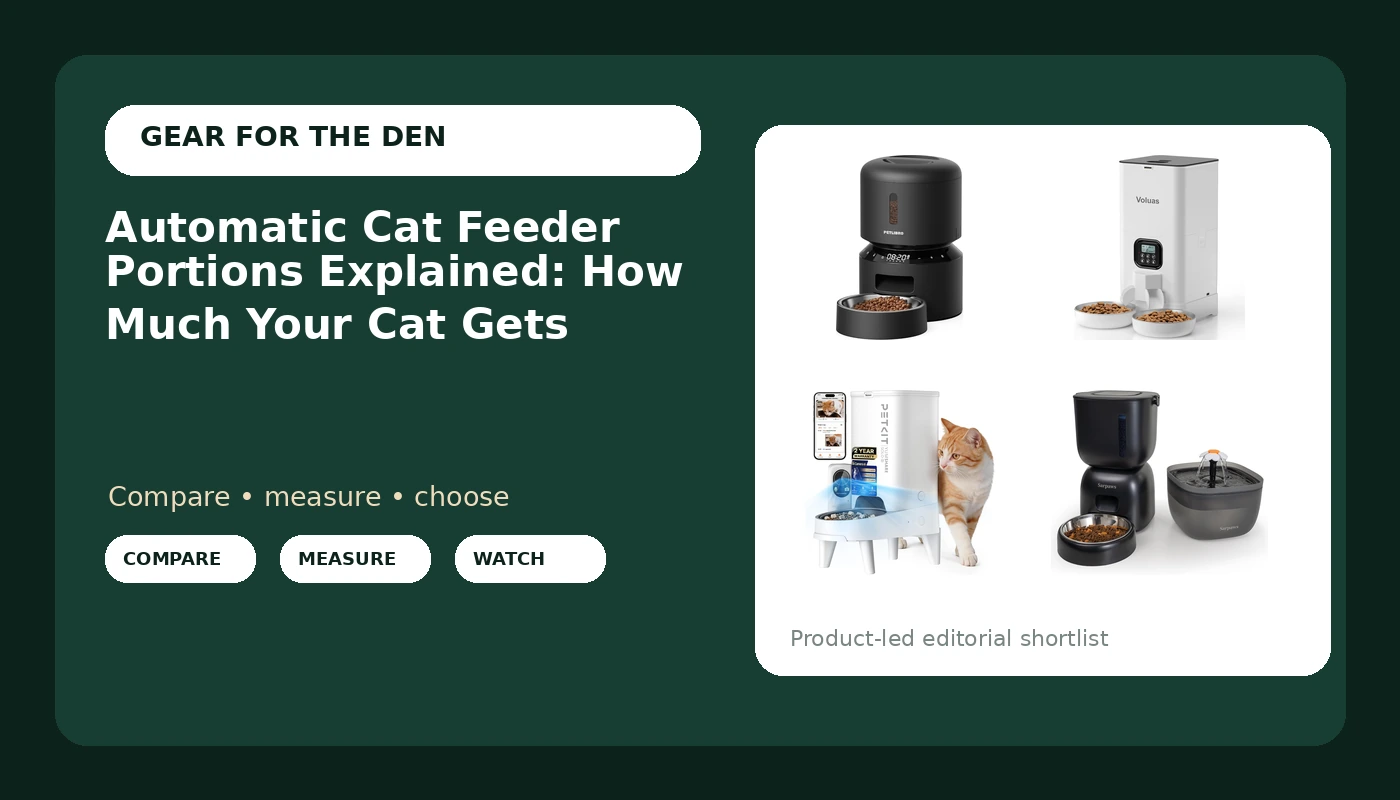
Four useful options
| Model | Best fit | What stands out |
|---|---|---|
| PETLIBRO Automatic Cat Feeder, Timed Dry Food Dispenser for Cat & Small Dog | A single cat on a simple timed routine | Timed dry food dispensing in a unit sized for cats and small dogs |
| VOLUAS Automatic Cat Feeder for Two Cats with Dual Stainless Bowls, 6L | Two cats that eat at the same time | Dual stainless bowls paired with a 6L hopper |
| PETKIT Upgraded Multi-Cat Recognition Automatic Cat Feeder with Camera | Multi-cat homes with a food thief | Individual cat recognition plus a built-in camera |
| Automatic Cat Feeder and Water Dispenser FW1 | Owners who want food and water handled together | Feeder and water dispenser in one, wire or battery power, locking lid, desiccant bag, four daily meals, and a 10s voice recorder |
The straightforward timed pick: PETLIBRO Automatic Cat Feeder, Timed Dry Food Dispenser for Cat & Small Dog
The appeal of a timed dispenser is that the rules stay visible. You choose the meal times, you choose how many portions each meal gets, and the machine repeats that pattern every day without an app or a subscription. The trade-off is that it feeds the bowl, not the cat. In a two-cat home the faster animal finishes first and pushes the slower one aside, and the unit has no way of knowing which cat it just fed. In a one-cat household that limitation costs nothing, which is why this style is the sensible starting point for anyone who simply wants breakfast to appear at 6 a.m.
The two-cat split-bowl pick: VOLUAS Automatic Cat Feeder for Two Cats with Dual Stainless Bowls, 6L
Two bowls are not the same as two diets. They reduce crowding and give each cat its own landing zone, and stainless steel rinses clean more easily than plastic, but a determined cat can still cross over and finish the neighbor's share. What the 6L hopper buys you is time between refills, which matters if you travel or would rather not check kibble levels every other day. For portion planning, the dual-bowl layout makes bowl width and whisker clearance worth checking before you commit. A bowl that presses against a cat's whiskers can make it eat hesitantly and leave food behind, which then looks like a portion problem when it is really a bowl problem.
The recognition pick: PETKIT Upgraded Multi-Cat Recognition Automatic Cat Feeder with Camera
This is the option for the household where one cat is on a diet and the other is not. Recognition based feeding means the unit is built to identify which cat is at the bowl, so a schedule can follow the individual animal rather than the shared dish, and the camera gives you a way to check what actually happened instead of guessing from an empty bowl. Before buying, read how recognition works on the exact listing you are considering, and check any stated microchip range against your cat's chip if the feeder relies on one. Compatibility is the detail that decides whether a recognition feeder works in your home or only in the product photos.
The feeder and water combo: Automatic Cat Feeder and Water Dispenser FW1
The FW1 covers both halves of the routine in a single purchase: a food dispenser and a water dispenser, powered by wire or by battery, with a locking lid, a desiccant bag to keep kibble crisp, programmable portion control across four daily meals, and a 10s voice recorder you can use to call your cat to the bowl. The water side is where a combo unit earns or loses its place. Water capacity decides how often you refill, pump noise decides whether the unit is audible from the bedroom at 2 a.m., and filter type decides what you will be buying on a recurring basis. Test the recorded message early. Some cats come running to a familiar voice; others treat it as an unexplained noise and avoid the bowl for a week.
Prices and availability may change. Product images, names, and retailer links are matched to verified listings. No current price, rating, stock status, or measured result is stated here without current evidence.
How automatic cat feeder portions are measured
Every dispenser turns the word portion into a mechanical act. A rotating impeller, a sliding gate, or an auger moves a fixed volume of kibble out of the hopper and into the chute. Because that volume is fixed, the weight it represents is not. Kibble comes in different sizes, shapes, and densities, so a scoop that holds twenty grams of one food may hold fifteen of another. Add the variation between brands and it becomes clear why automatic cat feeder portions have to be measured in your kitchen rather than assumed from a spec sheet.
The calibration routine takes five minutes. Set the feeder to dispense one portion, catch the output in a bowl, and weigh it on a kitchen scale. Repeat three or four times and average the results, since single drops vary slightly depending on how kibble settles in the hopper. That average is your real portion size, and it is the number you use for every calculation that follows. Without a kitchen scale, a measuring cup is a rougher substitute, but volume shifts with kibble shape in a way that weight does not.
Two mechanical details change the delivered amount as well. The first is the hopper. A partly empty hopper feeds slightly differently from a full one, and very small kibble can slip through gaps that larger kibble cannot. The second is the chute and bowl arrangement: kibble that bounces off a narrow bowl and lands on the floor is food your cat never ate, which is one reason bowl width and whisker clearance matter as much as the timer does.
Turning a portion count into a daily feeding plan
Once you know what one portion weighs, the rest is arithmetic and observation. Start with a daily target from your veterinarian, because calorie needs depend on weight, age, activity, and whether your cat is neutered. Many adult cats land somewhere around 200 to 250 calories a day, but that is a starting point for a conversation with your vet rather than a prescription, and indoor cats, seniors, and kittens all sit outside that range.
- Weigh one dispensed portion on a kitchen scale and write the number down.
- Convert your cat's daily food target into grams using the calorie information printed on the food label.
- Divide that daily total by the portion weight to get the number of portions your cat needs each day.
- Split those portions across meal times, leaving enough gap that the bowl is empty between meals.
- Track body condition and weight for two to three weeks, then adjust the portion count one step at a time.
If two cats share one feeder, the plan needs an honest look at who actually eats what. A split-bowl unit helps only if both cats get to their own bowl, and a recognition feeder helps only if the schedule is set per cat. Otherwise you are measuring a household average rather than an individual cat, and one cat's weight trend will tell you which way the error runs.
Setting up the feeder so the portions land where you want
- Place the feeder on a hard, level surface. A desk mat or silicone placemat under the unit catches the kibble that bounces out of the bowl and stops the whole thing from sliding when a cat leans on it.
- Check bowl width and whisker clearance before you buy. A bowl that presses against the whiskers is a common reason a cat eats slowly, dribbles food, or walks away mid-meal.
- On a combo unit, treat water capacity, pump noise, and filter type as three separate decisions. A large reservoir and a quiet pump matter more in a bedroom than in a kitchen, and filters are a recurring cost.
- Refresh the desiccant bag on schedule and wash the bowl and chute weekly. Kibble oils build up and change how food slides through the mechanism.
- Run a full day of scheduled meals while you are home before you rely on the feeder overnight or on a trip, and keep a simple backup plan in case the power or the batteries fail.
- Elevation angle is a comfort choice rather than a portion one, but a raised bowl can help an older cat with a stiff neck eat a full meal instead of leaving the last third behind.
If you arrived here after typing autodesk matic cat feeder portions or autofloor matic cat feeder portions, the answer is the same one described above: portion is a brand-specific unit, and only a scale settles what it means for your cat.
Which option should you choose?
Choose the PETLIBRO Automatic Cat Feeder, Timed Dry Food Dispenser for Cat & Small Dog when you have one cat and want a plain timed routine with no extra hardware. Choose the VOLUAS Automatic Cat Feeder for Two Cats with Dual Stainless Bowls, 6L when two cats eat at the same time and you want separate bowls plus a bigger hopper. Choose the PETKIT Upgraded Multi-Cat Recognition Automatic Cat Feeder with Camera when one cat steals from another and you want the feeder to tell them apart. Choose the FW1 feeder and water dispenser when you would rather buy food and water in one unit, with battery backup and a recorded mealtime call.
None of these units decides how much your cat should eat. That number comes from your cat's weight, condition, and your vet's guidance, and the feeder only executes it. The details in this article describe what the product listings state, not measurements taken in a test kitchen, so treat portion weights as something you verify on your own scale before you trust a schedule.
The bottom line
Automatic cat feeder portions are a brand-specific unit wrapped in a friendly word, and the fix is not a better product page but a five-minute calibration. Weigh one portion, convert your cat's daily target into portions, spread them across the day, and check the results on a scale every few weeks. The hardware choice follows from your household: a simple timed unit for one cat, a dual-bowl feeder for two cats eating together, a recognition feeder with a camera when one cat guards the bowl, and a feeder and water combo when you want both jobs handled by one device. Pick the option that matches how your cats actually eat, then let the scale, not the label, decide what a portion means.