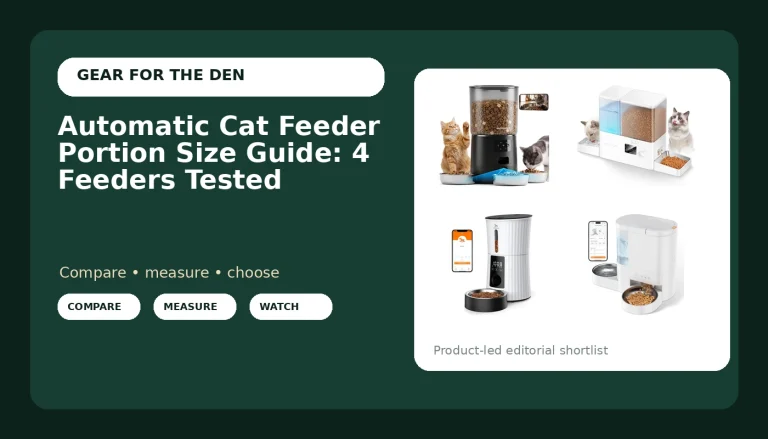
There is a particular kind of guilt that arrives around 5:40 on a Tuesday, when you are still forty minutes from home and your cat has been staring at an empty bowl since lunch. The automatic cat feeder vs manual feeding question almost always shows up in that gap, between a job that runs long and an animal with no concept of a commute. I have spent years writing about pet gear, and this corner of it splits cleanly into two camps. Neither camp wins outright, and the households that get it right usually borrow from both.
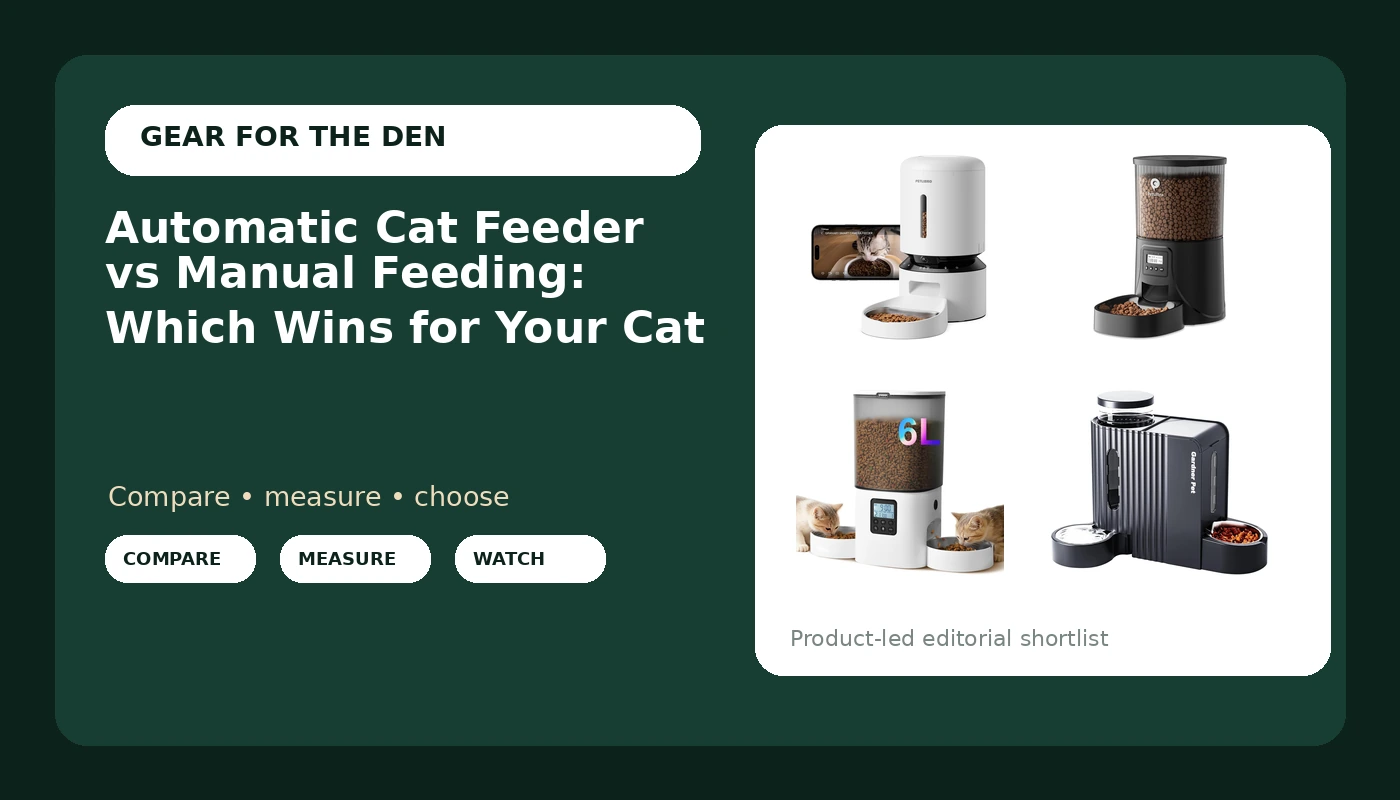
Manual feeding is a relationship. You see exactly how much the cat eats, you notice the morning it slows down, and you can stir a supplement into a portion or switch proteins without reprogramming anything. Automatic feeding is a system. It delivers the same amount at the same time whether you are home, sick, stuck at an airport, or sleeping through an alarm. The gear below covers the system half: three timed or camera-equipped dispensers and one gravity set that needs no electricity at all.
For most cat households, the right answer is a timed automatic feeder for the dry food and a human for everything else: wet food, treats, medication, and the daily once-over that tells you something is off. That split gives you the schedule consistency cats seem to want without handing over the parts of feeding that carry real information.
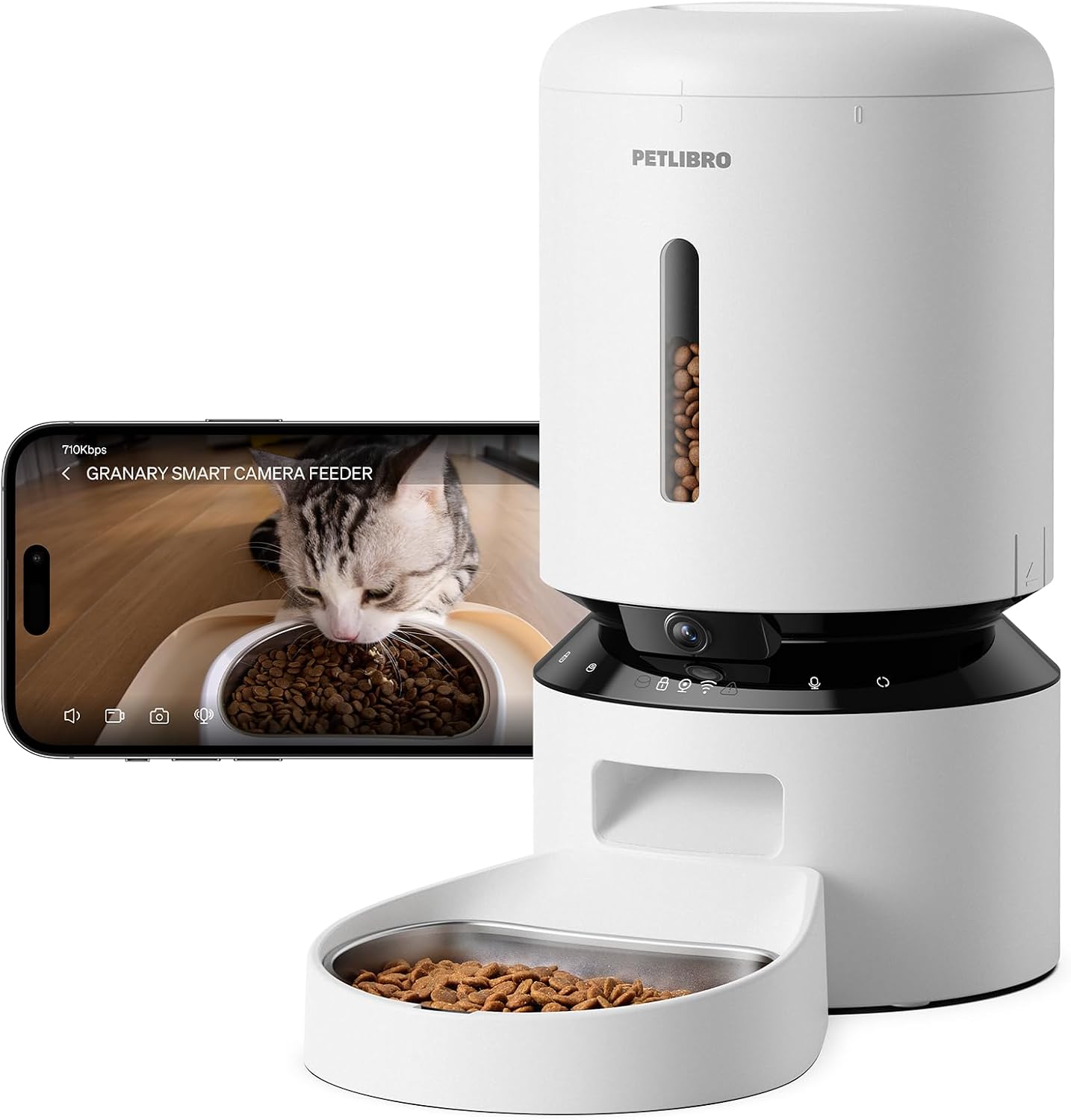
PETLIBRO Automatic Cat Feeder with Camera, 1080P HD Video & Night Vision
Camera with night vision lets you confirm the drop and watch the cat eat from anywhere
The most complex of the four, and its main trick depends on your Wi-Fi staying up
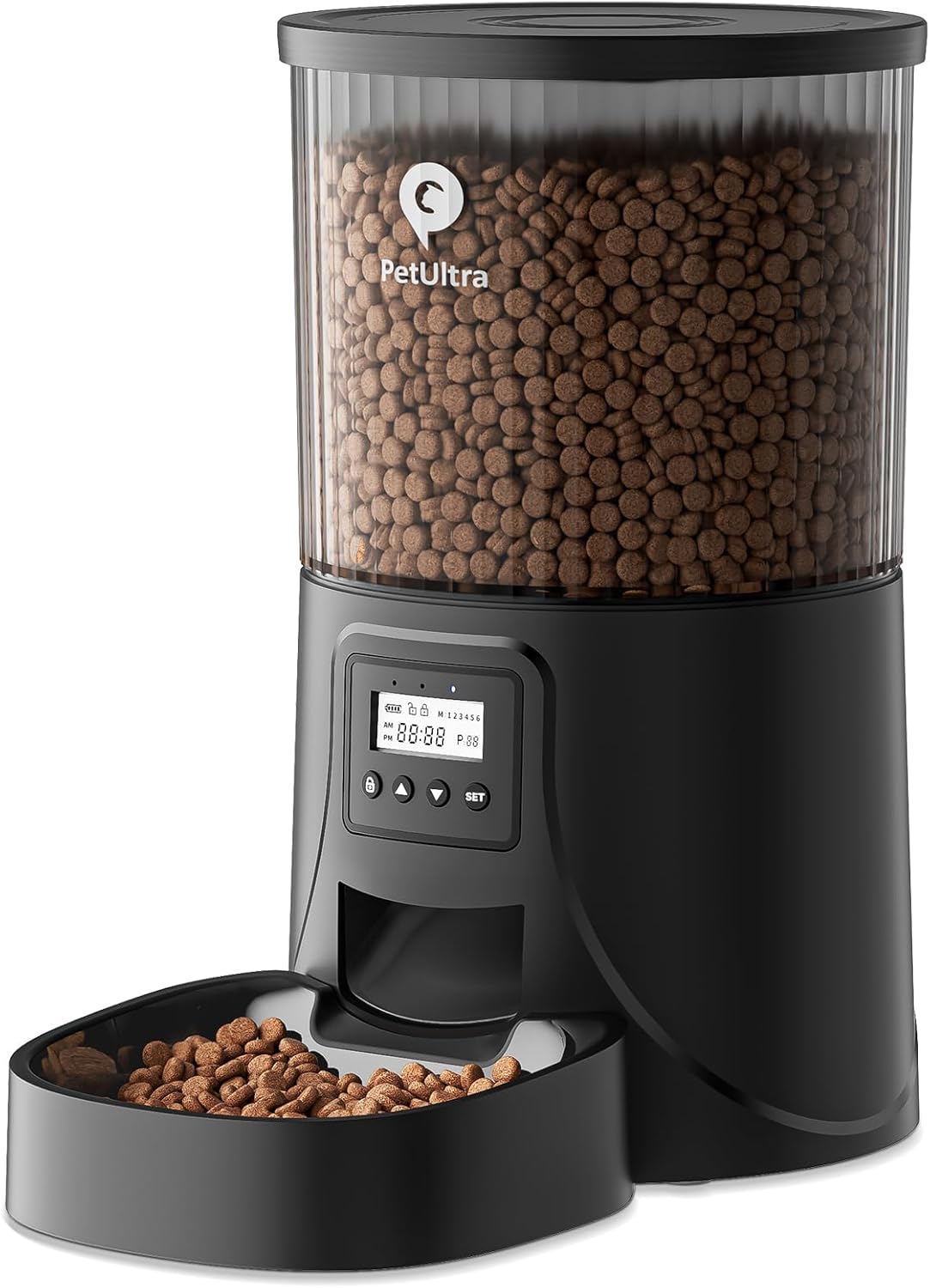
PETULTRA Automatic Cat Feeder: 4L Timed Cats Food Dispenser Programmable
Straightforward programmable timed feeding in a compact hopper, no app required
Solves exactly one problem, with no water side and no camera
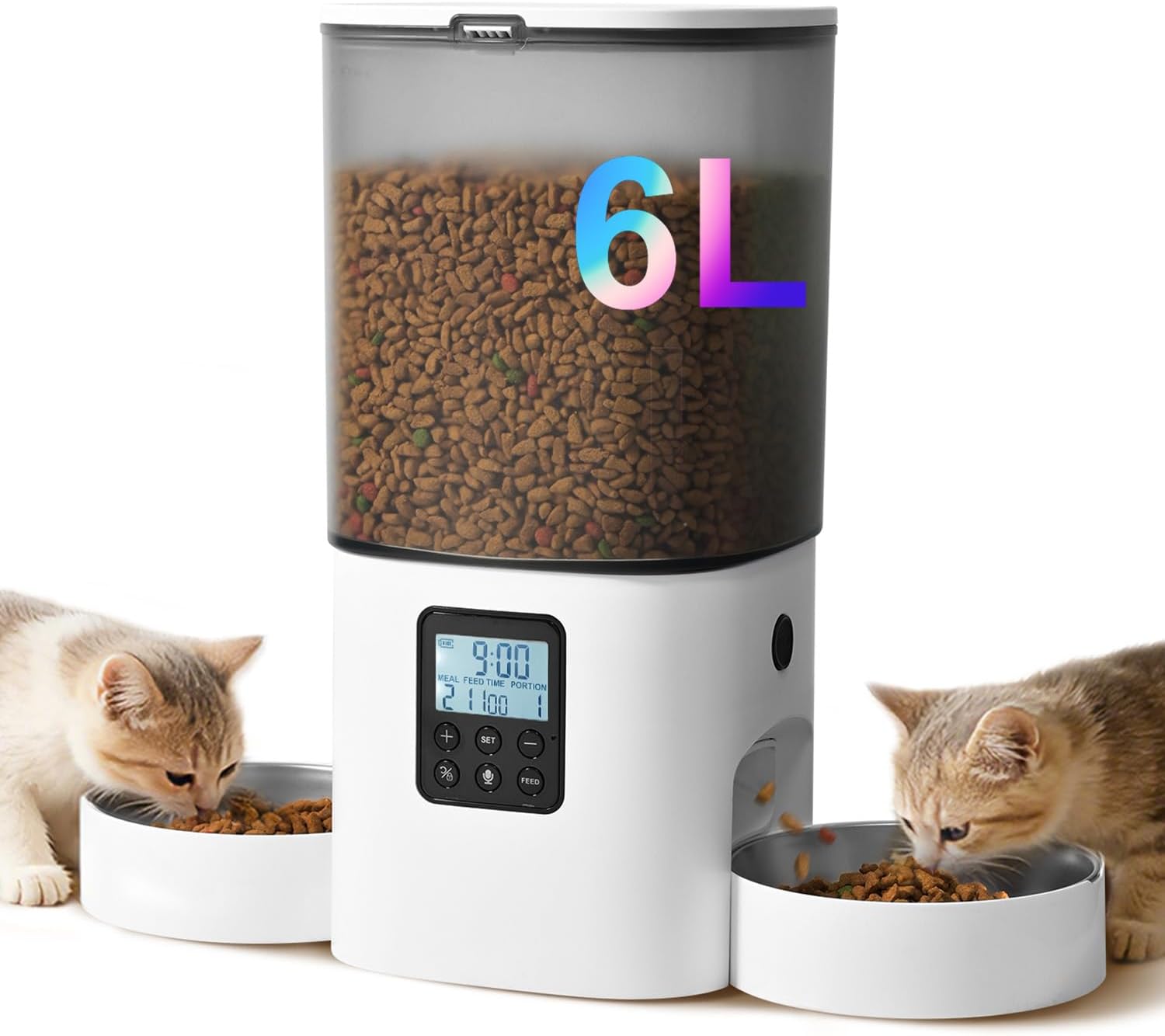
ANDOLL HOME 6L Automatic Cat Feeder, 2 Pets Timed Cat Dry Food Dispenser
Large hopper and a two-pet layout for multi-cat houses and long stretches between refills
Timed dry food only, and a shared serving area hides which cat ate what
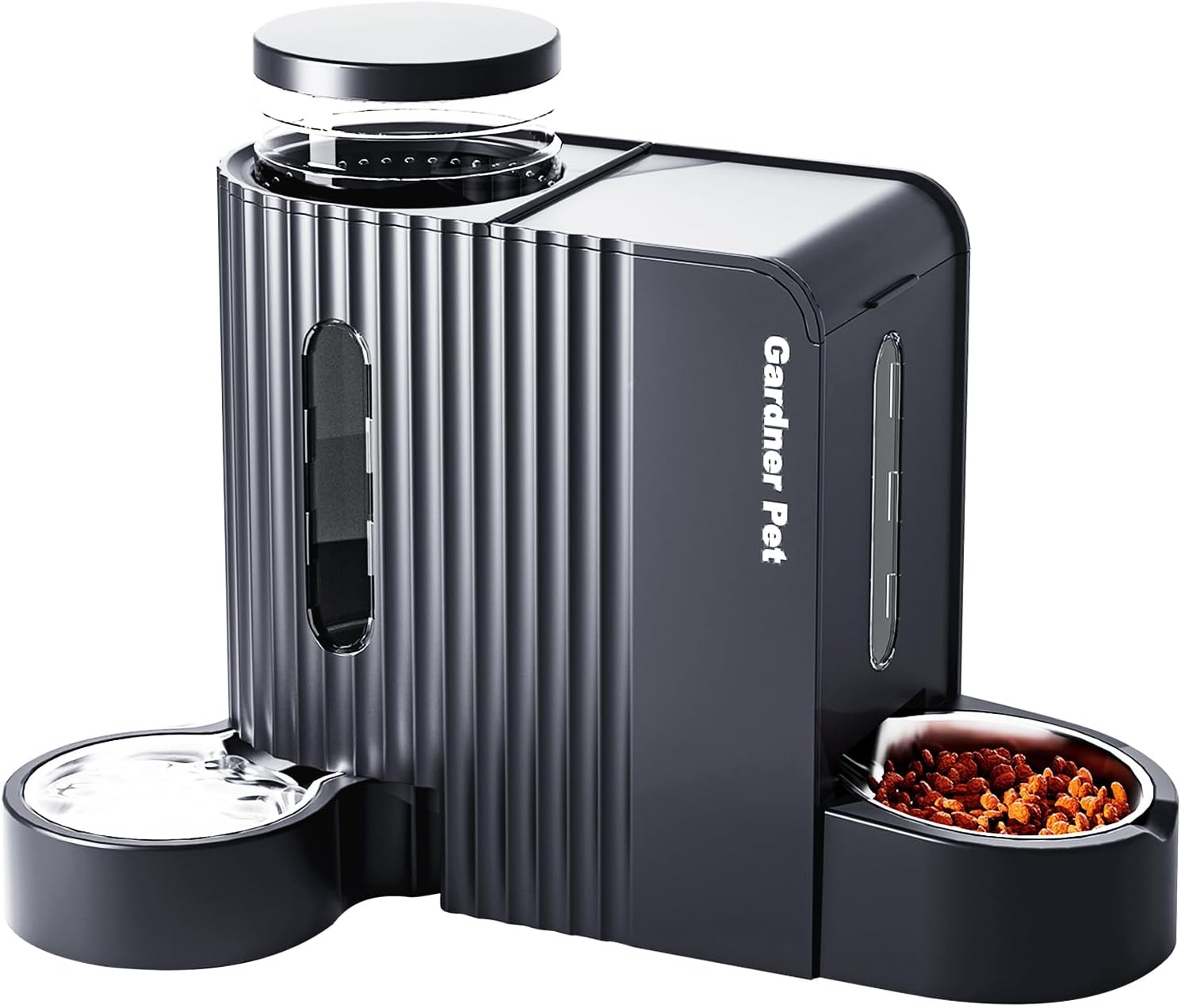
Gravity Automatic Cat Feeder, Water & Food Dispenser Set, Stainless Bowls
No power, no programming, no app, plus stainless bowls that rinse clean
No portion control and no schedule, so a bored cat can graze all day
Prices and availability may change.
How I judge an automatic feeder
The questions that separate a feeder you keep from one you resell are unglamorous and specific. Does the portion size step in small enough increments to match what your cat actually eats, or does it jump in lurches that leave food sitting in the bowl? How wide is the bowl, and does the rim crowd the cat's whiskers? Whisker clearance is the quiet reason some cats refuse a dish that looks perfectly reasonable to a human. Does the hopper seal well enough that kibble does not go stale between refills, and does the whole food path come apart for washing without a screwdriver and a prayer?
Power is the other question nobody asks until the lights go out. A feeder that runs only on wall power is a feeder that stops working during a storm, which is exactly when you are not home to notice. Battery backup, or at least a memory that survives an outage, is the difference between a system and a gadget.
Finally, every feeder in this comparison runs on dry food, so kibble size matters. A dispenser with a narrow chute will jam on large kibble or on the odd shaped piece, and a jam at 6 a.m. is the same as no feeder at all. If your cat eats wet food, no machine here replaces you, and none of them claim to.
Timed programmable feeders: the scheduled workhorses
Timed feeders are the plainest version of the idea. You set a clock, you set a portion size, and the machine drops food on schedule whether or not anyone is awake. Two of the four picks here live in that lane.
The PETULTRA Automatic Cat Feeder is the compact, programmable option, with a 4 liter hopper and a straightforward timed program. Four liters is a comfortable stretch of dry food for a single cat, which turns refilling into a calendar chore rather than a scramble. It solves one problem, and it solves it without an app. Check current Amazon price.
The ANDOLL HOME 6L Automatic Cat Feeder takes the same idea and scales it up. Six liters and a two-pet design make it the better fit for a multi-cat house, or for anyone who would rather not think about refilling during a two-week trip. A two-pet layout usually means a wider or split serving area, which is helpful for cats that eat side by side, though it also means you cannot tell from the bowl who ate what. Check current Amazon price.
The trade-offs are the same for both. No water side, no camera, and no way to know the food actually landed unless you are standing there. If you want proof, you need the camera model.
Camera feeders: the remote check-in
The PETLIBRO Automatic Cat Feeder with Camera, 1080P HD Video & Night Vision is the one that answers the question the others leave open. A camera pointed at the bowl, plus night vision for the hours when cats actually eat, means you can confirm from a phone that the portion dropped, that the cat showed up, and that nobody else finished it first. Check current Amazon price.
That matters in a few specific situations. A cat on medication that has to eat on schedule. A two-cat household where one cat is a food thief and the other is losing weight. A long trip with a pet sitter who comes once a day. In each case the camera is not a luxury feature, it is the entire reason to buy this feeder instead of a plain timed one.
The cost is complexity. More electronics, more app updates, more that depends on your home network, and more counter space than a bare dispenser. The honest framing: this feeder does not feed your cat better than the PETULTRA does. It tells you more about what happened, and for some households that information is worth the extra moving parts.
Gravity feeders: no power, no schedule, no app
The Gravity Automatic Cat Feeder, Water & Food Dispenser Set, Stainless Bowls is the odd one out, and it is the one I would put in a house with a cat that self-regulates. There is no clock, no program, no battery. Kibble falls from the hopper as the bowl empties, and water moves from the reservoir into the water bowl the same way. The stainless bowls rinse clean and do not hold onto smells the way plastic does. Check current Amazon price.
Because it draws nothing, it keeps working when the power does not, which makes it a genuinely useful backup rather than a novelty. The water capacity of the reservoir is the spec that decides how often you top it up, and on a set like this you want to change the water on a schedule of your own even if the bowl never empties.
The catch is the thing that makes it simple: no portion size control. A cat that free-feeds politely is fine. A cat that eats because it is bored will treat a gravity feeder as a buffet, and you will not see the weight creep until a vet scale does. There is also no schedule, so a cat that wakes you at 4 a.m. will keep waking you at 4 a.m. Gravity is a delivery method, not a routine.
Automatic cat feeder vs manual feeding: the difference that actually matters
The manual feeding vs automatic cat feeder debate usually gets framed as convenience versus care, and that framing is wrong. In practice, automatic cat feeder vs manual feeding is a trade between consistency and observation, and those are not the same currency.
Manual feeding gives you data. You know how much went in, how fast it disappeared, and whether the cat met you at the bowl the way it did yesterday. Appetite is one of the earliest signals a cat gives you that something is off, and it is the signal you lose first when a machine takes over. That is the strongest argument for manual feeding, and no dispenser in this comparison beats it.
Automatic feeding gives you a clock. Cats are creatures of routine, and a feeder that drops a portion at 6 a.m. every day removes the 5 a.m. wake-up, the drifting dinner time on late workdays, and the negotiation with a cat that has learned that yelling works. If you have ever fed a cat at 4:50 in the morning because it was easier than arguing, you already know what that is worth.
The difference between automatic cat feeder and manual feeding shows up most clearly in multi-cat homes. One machine feeding two cats hides who is eating, which is the one piece of health information you actually want. Two feeders, or one feeder plus a human at dinner, restores it.
The hybrid that works for most people: an automatic feeder owns breakfast, a human owns dinner. The machine handles the schedule, you handle the wet food, the medication, and the once-a-day look at the cat. Nothing in this category replaces that look.
The specs worth reading before you buy
Most of the spec sheet is noise. These are the lines that change daily life.
Portion size. The smallest increment a feeder can drop matters more than the biggest. If your cat eats a small amount four times a day, a feeder that only does large portions is a feeder that overfeeds.
Bowl width and whisker clearance. Cats have whiskers that are sensitive to pressure. A bowl that is wide and shallow, with enough whisker clearance that the rim never touches, gets used. A deep narrow dish often does not, no matter how good the food is.
Elevation angle. A slightly raised bowl is easier on an older cat's neck and joints. Check that the platform is stable, because a raised bowl that slides across the floor is worse than one on the ground.
Water capacity. On a gravity set, this is the number that decides your refill rhythm. On a fountain, it decides how often you haul the whole thing to the sink.
Pump noise and filter type. If you are adding a fountain alongside any of these feeders, pump noise is the spec that decides whether the thing lives in the kitchen or the hallway, and filter type decides what you are buying every month. Both matter more than the shape of the plastic.
Microchip range. Microchip-activated feeders are a separate product class from everything here, but the read range is the spec that decides whether a nervous cat gets to eat. Check it carefully if you go that route.
Hopper seal and cleaning. Kibble goes stale in a hopper that does not seal, and a food path you cannot wash will eventually smell like the food it held. Neither shows up in a product photo.
Should you start with a gravity feeder or a timed one?
Start with the cat, not the machine. Choosing an automatic cat feeder or manual feeding as your primary method is the first decision, and it is mostly about your schedule, not your cat's personality. The automatic cat feeder vs manual feeding call gets easier once you separate the two. The second decision is which automatic design fits.
Pick the gravity set if your cat free-feeds without gaining weight, if you want a water station and a food station in one purchase, or if you want something that keeps working during an outage. It is the lowest-cost way to stop thinking about bowls, and it asks nothing of your Wi-Fi.
Pick a timed feeder if your cat overeats, if your household runs on a schedule you cannot keep, or if you have a cat that treats 4 a.m. as a feeding cue. The PETULTRA handles a single cat without fuss. The ANDOLL HOME handles a bigger hopper and a second cat.
Pick the camera feeder if you travel, if you have a cat on medication, or if you have ever driven home early because you were not sure the sitter showed up.
And keep feeding at least one meal by hand. The machine can own the schedule. You should still own the relationship, and the ten seconds it takes to set a bowl down is where you notice that the cat is a little slower than it was last week.
What I am watching next
The direction of this category is easy to read. Portion accuracy keeps improving at the low end, which is the change that matters most, because a budget feeder that measures correctly beats an expensive one that does not. Stainless bowls are finally replacing plastic on mid-range models, a small upgrade that makes a real difference to cats with chin acne and to anyone who has scrubbed a plastic bowl.
The other trend is battery backup moving from a premium feature to a baseline one. A feeder that forgets its schedule after a brownout is a feeder you do not trust, and buyers have started treating that as a dealbreaker rather than a footnote.
The thing I would like to see next is better data. A camera feeder tells you the food dropped. A feeder that logged how much the cat actually ate, meal by meal, would tell you something a vet could use. Nobody in this comparison does that yet.