Hamster Tube Size Guide: Diameters That Actually Fit
A hamster tube size guide with the inner diameters each species needs, plus bedding and hideout picks that keep a tunnel run safe.
A hamster tube size guide is really a safety guide. Tubes are the one piece of small pet gear where a wrong number does not just look bad, it can trap an animal in a space it cannot turn around in. The number that matters is the inner bore, the distance across the inside of the tube, not the outer lip that clicks into the next section. A tube that is one size too small is a tube your hamster will still try to enter, head first, at speed, at two in the morning, and that is where the trouble starts.
The short version: dwarf hamsters need an inner bore of at least 2 inches, Syrians need 2.5 to 3 inches, and a long haired Syrian needs closer to 3.5 inches because the coat adds bulk a tape measure does not see. If you already own a tube set, measure the inside of the widest piece with a ruler before you buy anything else. If you are starting fresh, buy for the adult hamster, not the baby you brought home, because a hamster that outgrows a tube will keep using it anyway.
Best Overall: Kaytee Clean & Cozy Classic Hamster Bedding, 24.6 Liters
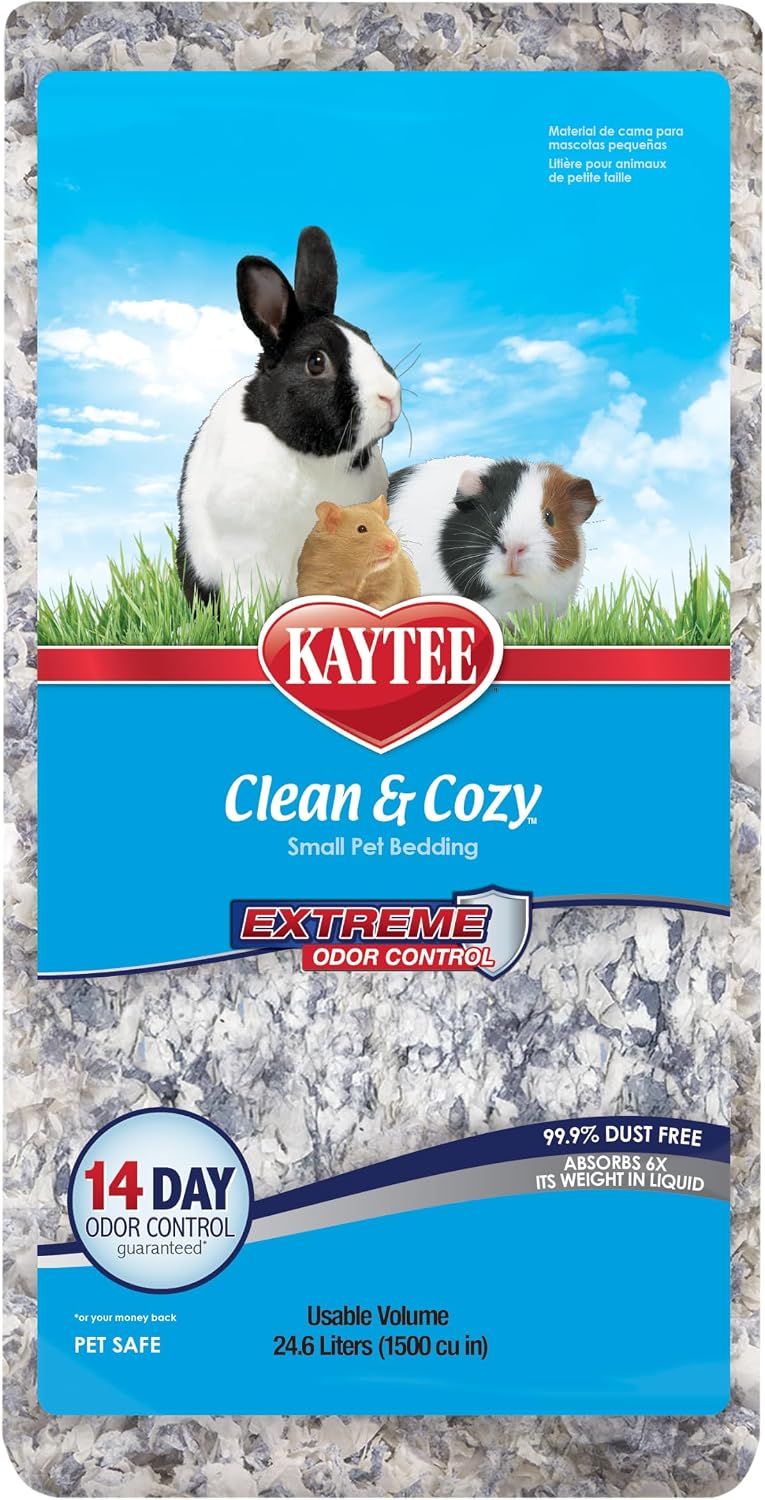
The best piece of tube gear I have bought is not a tube. It is bedding. Every run has a weak point at the joint where two sections click together, and that joint is also where a hamster will dig, push, and lean until the whole run sags sideways. Packing bedding around the outside of the joint, and mounding it over the entrance, holds the run steady without tape or zip ties.
The second reason bedding belongs in an article about tunnel diameter: a closed plastic tube gets its air exchange from the two open ends. A paper bedding that throws dust puts that dust straight into the air your hamster breathes inside a run with limited airflow. Kaytee Clean & Cozy is unscented paper, which matters more in a tunnel than it does in an open cage, and the 24.6 liter bag is enough to lay a deep base across a standard cage and still leave material for the nest chamber at the end of the run.
It holds a burrow shape when you press it down, so the mouth of a tube does not collapse every time your hamster turns around inside it. The ideal hamster tube size for your species keeps the run usable, but the bedding around the entrance is what decides whether the hamster uses it at all. This is not the cheapest way to fill a cage, and it does not clump, so a wet corner has to be scooped out by hand. Both of those are the price of a paper bedding that does not smell like a candle. If your hamster sneezes at the tube entrance, bedding is the first thing I would change, before I changed the tube. Check current Amazon price.
Best Value: Wagorific Hamster Bedding Odor Control, Small Animal Paper Bedding 50L

Fifty liters of paper bedding is the bag I reach for when I am setting up more than one cage or changing a base layer often. Tube runs concentrate waste in one spot, usually the low corner of the longest straight section, and a big bag means you can pull that corner out every few days instead of stretching one small bag across a month.
Odor control in a tube setup is not about covering a smell with fragrance. It is about volume: more clean bedding, changed more often, and enough depth at the tube entrance that the hamster buries the soiled spot itself. This bag gives you that volume without much fuss, and it is the reason it sits in the value slot rather than the top one.
The trade-off is that it is a working bedding rather than a display bedding. I use it as the base layer across the cage floor and save the finer paper for the nest chamber and the strip right around the tube mouth, where the hamster spends most of its time. If you keep one hamster in one cage, one bag will last you a long while, so plan on storing it somewhere dry. Check current Amazon price.
How I tested
I run the same three checks on every tube, hideout, and bag of bedding that comes through the door, and then I live with the setup for a week.
The ruler check. I measure the inside of the widest tube piece, never the outside. If a tube is sold as a 3 inch tube and the inner bore is 2.5 inches, the hamster is working with 2.5 inches. That is the number that decides whether a Syrian can turn around inside the run or has to reverse out the way it came in.
The turn check. A hamster needs to be able to turn a full circle inside a tube, or at least back out without folding. Short sections are safer than long straight runs. I keep runs to two or three pieces and finish them with a hideout or a bend, so the animal is never more than one body length from an opening.
The dust check. I shake a handful of bedding over a dark surface and look at what falls out. Fine dust that hangs in the air is the thing to watch in a tube, because the run has so little air exchange. I also press a fist into the bedding to see whether it holds a shape. Bedding that springs back will not hold a burrow, and it will not hold a tube entrance either.
Then I live with it: bedding in, hamster in, run packed at the joints, and a week of watching to see whether the run stays put or drifts across the cage.
Analysis and test results
The most common mistake in this category is buying tube by outer diameter. A 3 inch tube with a thick wall can have a 2.5 inch bore, and that half inch is the difference between a comfortable Syrian and a hamster that gets stuck halfway. The correct hamster tube size is measured inside the pipe, at the narrowest point, including any ridge where two pieces join.
Species changes the answer. Dwarf hamsters, including Roborovski and the winter white types, are what most starter tube systems are built for, and a 2 inch bore suits them. A Syrian is roughly twice the bulk, and the 2 inch tubes that ship with a starter cage are too tight for an adult. Long haired Syrians need more room again, and a female Syrian is usually larger than a male.
Length matters as much as tunnel diameter. A straight run of six sections with one opening is a trap. Two or three sections with an opening at each end is a tunnel. If you want a long run, break it with a T piece or a hideout so the hamster always has an exit within a body length.
Tube runs do not count toward cage size or floor area. They are extra, and a hamster still needs a cage that meets the minimum floor area for its species with the tubes taken out. That is why I treat tubes as enrichment rather than housing. Keep bar spacing at half an inch or less for dwarfs, and check that a tube exiting through the bars cannot be pushed loose from the outside.
The rest of the setup supports the run. A water bottle with enough capacity means you are not lifting the lid and disturbing the tube every day. A hay rack or a small dish keeps food out of the tunnel so it does not rot in a corner you cannot see. And bedding dust is the variable that decides whether a hamster uses a tube at all. A dusty run gets avoided, no matter how well the tube is sized.
The hamster tube size chart
This is the chart I keep near the cage stand. Diameters are inner bore, measured across the inside of the tube. When a tube sits between two sizes, go up.
| Hamster or gear | Minimum inner bore | Comfortable inner bore | Notes |
|---|---|---|---|
| Roborovski dwarf | 1.75 in | 2 in | Smallest of the dwarfs, and long runs are still a risk |
| Winter white or Campbell's dwarf | 2 in | 2 to 2.25 in | The size most starter tube sets are built for |
| Chinese hamster | 2 in | 2.25 in | Slimmer than a Syrian, longer than a dwarf |
| Syrian, short coat | 2.5 in | 3 in | The 2 in starter tubes are too tight for adults |
| Syrian, long coat | 3 in | 3.5 in | Coat bulk eats the clearance a ruler says you have |
Bedding for packing tube joints | Not a tube | Not a tube | Kaytee Clean & Cozy, 24.6 L. Check current Amazon price |
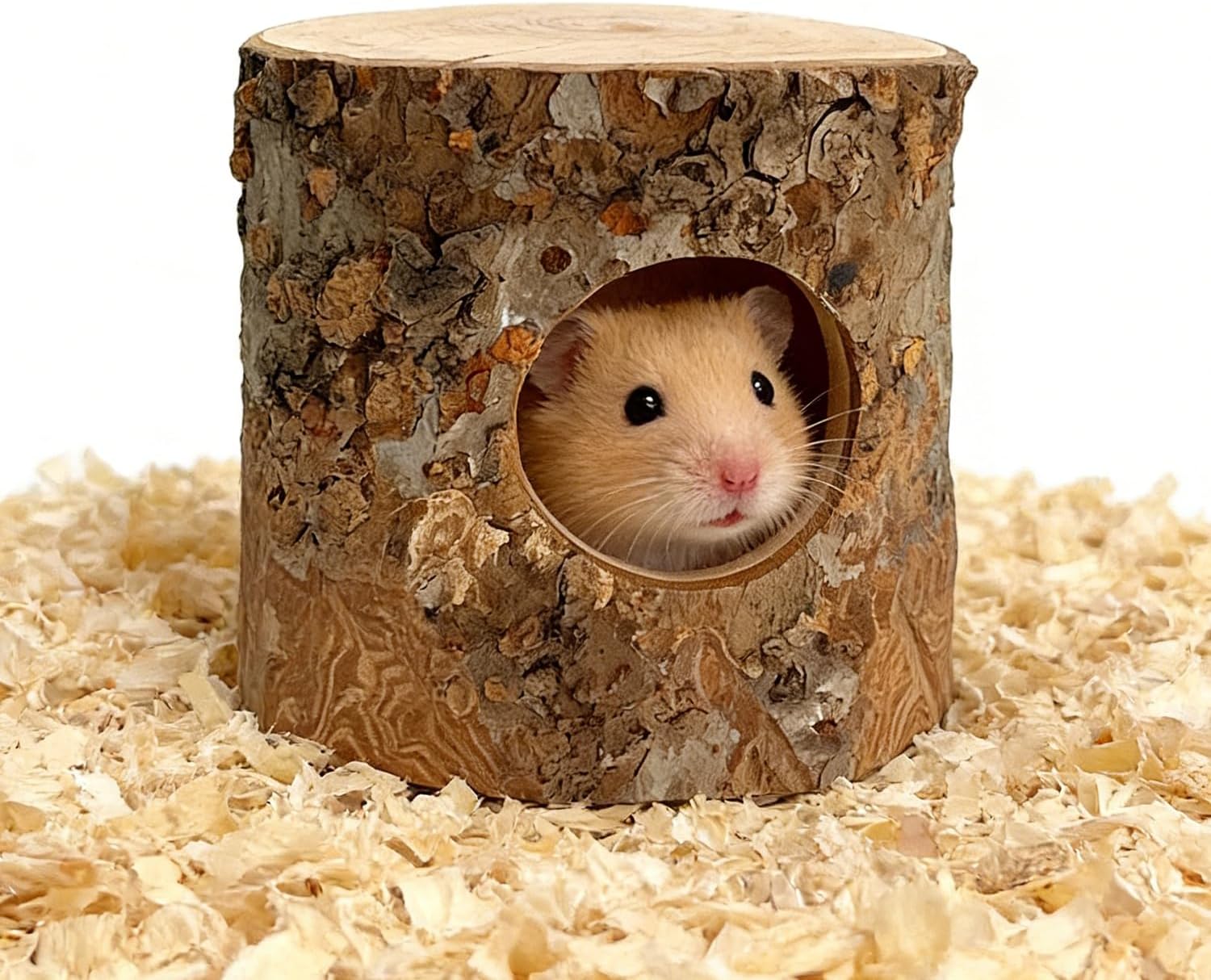 Hideout at the end of a run | Matches the tube bore | One size up from the tube | Obantrsz hideout, 3.14 x 2.75 in. Check current Amazon price |
The one rule under the chart: if you are unsure between two sizes, buy the wider tube. A hamster in a tube that is slightly too big will walk through it and forget about it. A hamster in a tube that is slightly too small may not come out without help.
Hideouts that match a standard tube exit
The Obantrsz Hamster Hideout is a 3.14 by 2.75 inch wooden house, and that 2.75 inch opening is the useful number here. It lines up with the end of a 2.5 to 3 inch bore run, so a hamster walks out of the tube and into a chamber instead of squeezing through a doorway narrower than the tunnel it just left.
Hideout size should always be one step up from the tube. The animal needs to turn around once it is inside, and it needs the floor of the house to be flat enough to dig a nest on. Wood also takes a little moisture out of the air and gives claws something to grip on the way in and out, which plastic tube interiors do not.
My pattern is simple: run two tube sections, then this hideout at the end, with bedding packed around the base so the house does not slide when the hamster bulldozes in and out of it. Check current Amazon price.
When a hideout is smaller than the tube
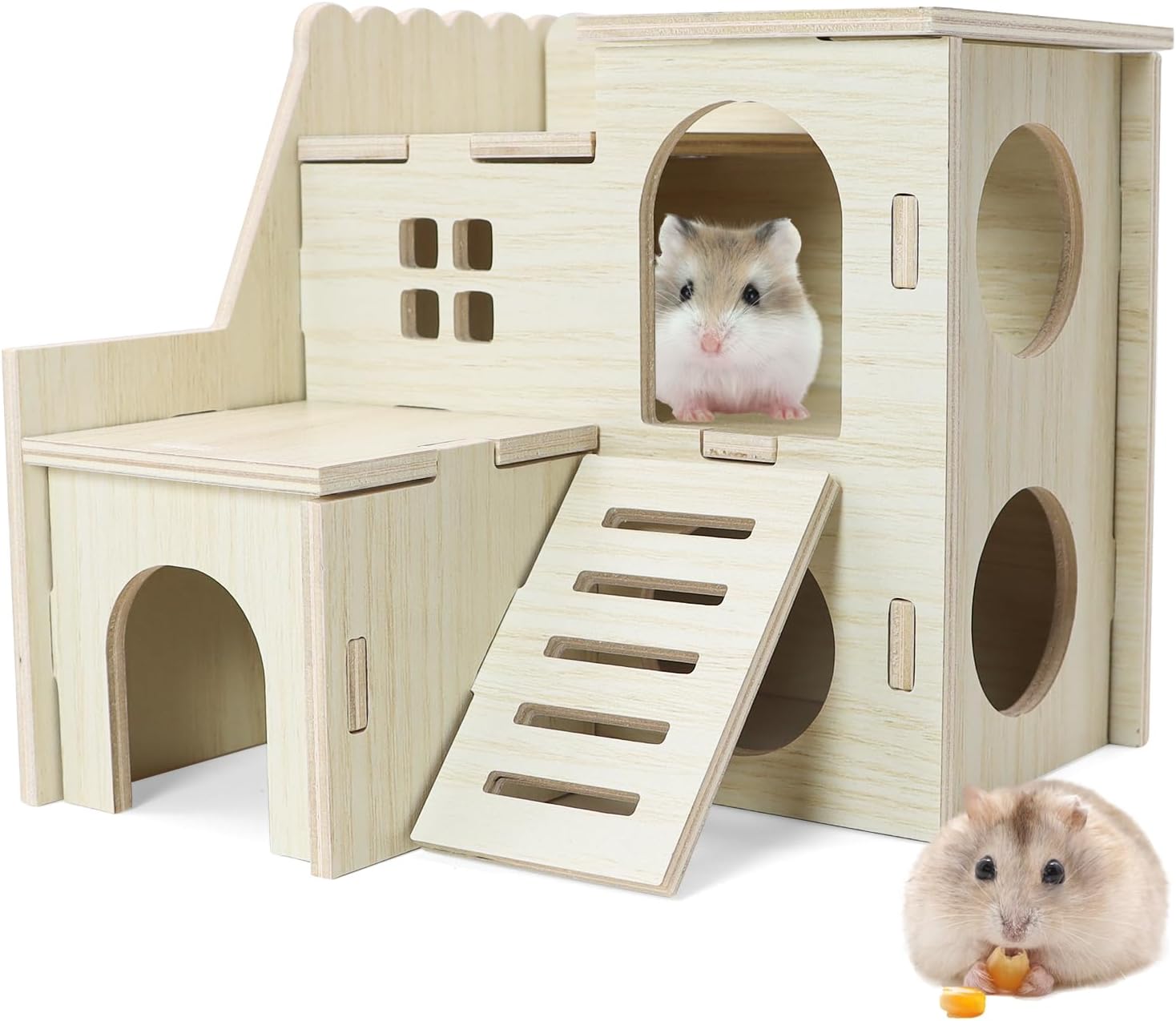
The lenpestia Hamster Hideout Tiny Maze Wood House with Slide carries its own warning in its name. It is sold for pygmy rats only, and the reason is size. A tiny maze house with a slide is built for an animal smaller than a dwarf hamster, so if you park it at the end of a 2 inch tube, a dwarf can enter and then find there is no room to turn. That is the exact failure this whole guide is about, and it happens in a house rather than a tube, which is why people miss it.
Used correctly, it is a nice surface piece. Put it on a platform outside the run, or clip it in as decor, and let a mouse or a pygmy rat use the slide. Just do not treat it as a tunnel destination for a hamster, and do not assume a listing that says hamster in the title is sized for one. Read the fine print, and when a listing says pygmy rats only, believe it. Check current Amazon price.
Should you buy the Kaytee Clean & Cozy Classic Hamster Bedding, 24.6 Liters?
Yes, if you run tubes. It is unscented paper, it holds a shape when you press it down, and it packs around a tube joint so the run stops drifting across the cage. It is the bedding I would hand someone who has just measured their tube bore and wants the run to stay where they put it.
The caveats are real but small. It does not clump, so wet spots come out by hand. It costs more per bag than a bulk paper bedding, and if you are filling several cages you will go through it fast. For a single hamster in a single cage with one tube run, that trade is worth it, because a dusty or heavily scented bedding is the fastest way to make a well sized tunnel go unused. Check current Amazon price.
Should you buy the Wagorific Hamster Bedding Odor Control, Small Animal Paper Bedding 50L?
Yes, if you keep more than one cage, foster, or simply change bedding more often than most people do. The size of the bag is the point: a tube run concentrates waste in one low corner, and having 50 liters on hand means you clean that corner on a schedule instead of waiting for the bag to run low.
It is not the bedding I would use for a nest chamber. Save a finer paper for the sleeping area and the strip around the tube mouth, and use this as the base layer underneath. If you own one hamster and one cage, this bag will outlast your interest in the hobby, so store it dry. If you own three, it is the bag that keeps a tunnel setup from becoming a chore. Check current Amazon price.