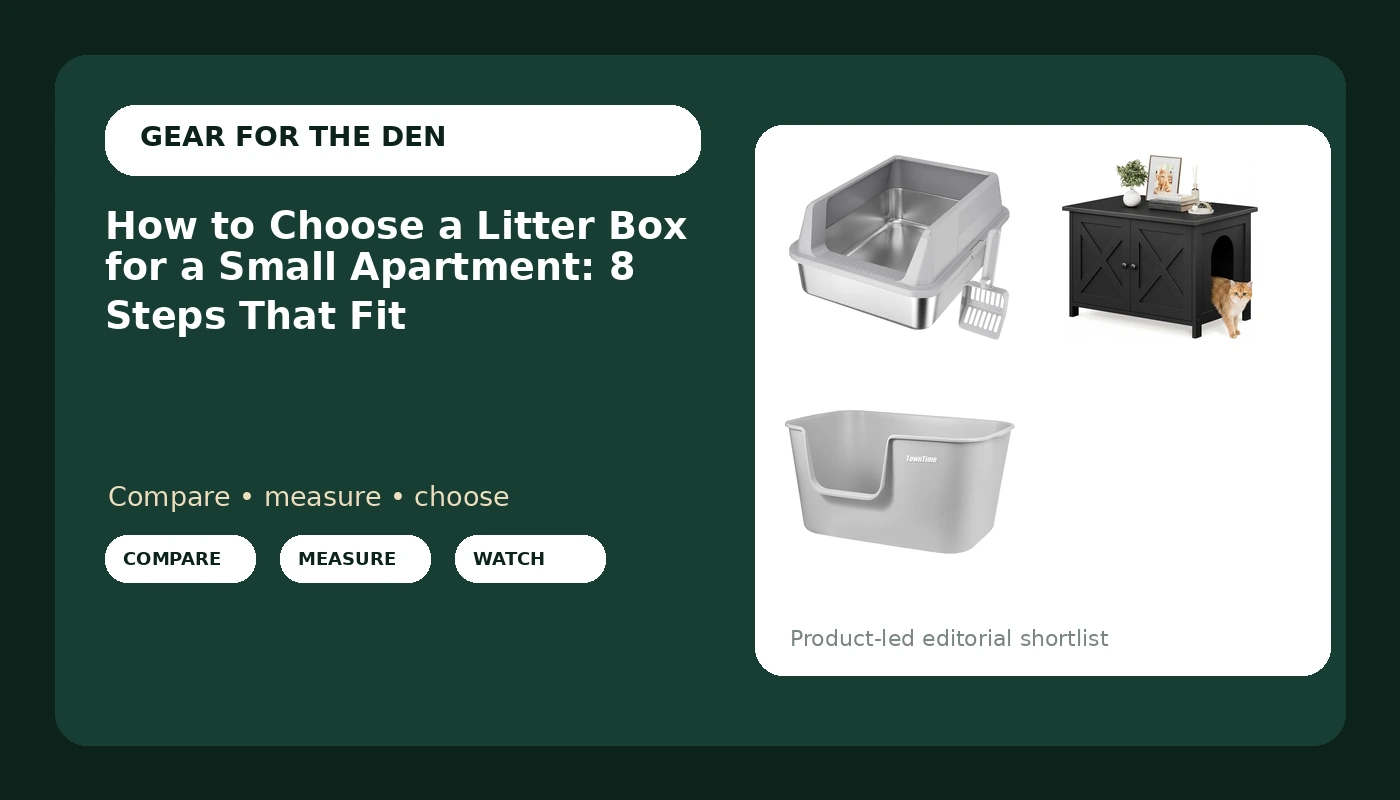
Most apartment litter box advice starts and ends with the box itself. That skips the two questions that actually decide whether the setup works: how much floor you have, and how much room your cat has to turn around. If you are trying to work out how to choose a litter box for a small apartment, the order that works is floor space first, cat fit second, odor third, and the box dead last.
I have watched this go wrong the same way in a lot of apartments. Someone buys the biggest box on the shelf, wedges it into the hallway, and replaces it three months later with something smaller and worse because the first one ate the walkway between the kitchen and the bathroom. The box was never the problem. The plan was.
When you pick a litter box for a small apartment, you are really picking a floor plan. Do the math in that order and the box you end up with will be smaller, less expensive, and easier to live with than the one you would grab off the shelf.
Why you should trust me
I cover cat litter and odor here at Gear for the Den, and before that I spent years as the person friends text before they buy gear for a cat. A lot of those texts come from apartments: studio walk-ups, one-bedrooms with a single bathroom, and a 480-square-foot place where the only uninterrupted wall was behind the entry door.
I do not run a lab, and a litter box does not need one. What I do is boring and repeatable. I take the footprint the maker publishes, tape it out on a real floor, and then walk the room the way a person actually walks it: carrying a laundry basket, in the dark, half asleep. If the taped rectangle forces a detour, the box is too big for that spot no matter how good it looks online.
The rest is cat math. Box size, entry height, litter depth, and how fast your litter clumps decide more about daily life than the color of the pan or the lid on top.
How I picked and how I tested
If you are asking how to pick a litter box for a small apartment, start with a tape measure and a cat. Not a breed chart, not a forum thread, just those two things.
Here is the method behind the three boxes below. First, does the published footprint leave a walking path? A box needs clearance in front of it, not just under it, so the real number is the box length plus about 6 inches of swing room for a scoop and a pair of knees. Second, can the cat stand, turn, and dig without hitting a wall? A box shorter than the cat is a box the cat will hang over. Third, does the material hold odor? Scratched plastic keeps smell in a way stainless steel does not. Fourth, how much work is cleaning? A box you dread scooping is a box that gets scooped less often.
Litter and box are one system, so I work from the same list I use in my guide to the best cat litter for odor control. Fast-clumping litter at a 2 to 3 inch depth behaves very differently from the same litter poured thin into a shallow tray.
What I did not do is rank these by how they look in a product photo. The three below are the ones that survive the apartment math: one small enough for a bathroom corner, one that hides the whole job inside furniture, and one that fits a big cat or a two-cat household that has floor to spare.
The three boxes worth putting on a small floor
If you want to choose a litter box for a small apartment without guessing, work from the floor plan outward. You do not need a machine with a waste drawer and a motion sensor. You need a box that fits, a cat who agrees to use it, and a cleaning routine you will actually keep.
Budget pick: Lifewit Stainless Steel Cat Litter Box for Kitty, 17.7"× 13.8"× 8.3", Gray
Budget pick
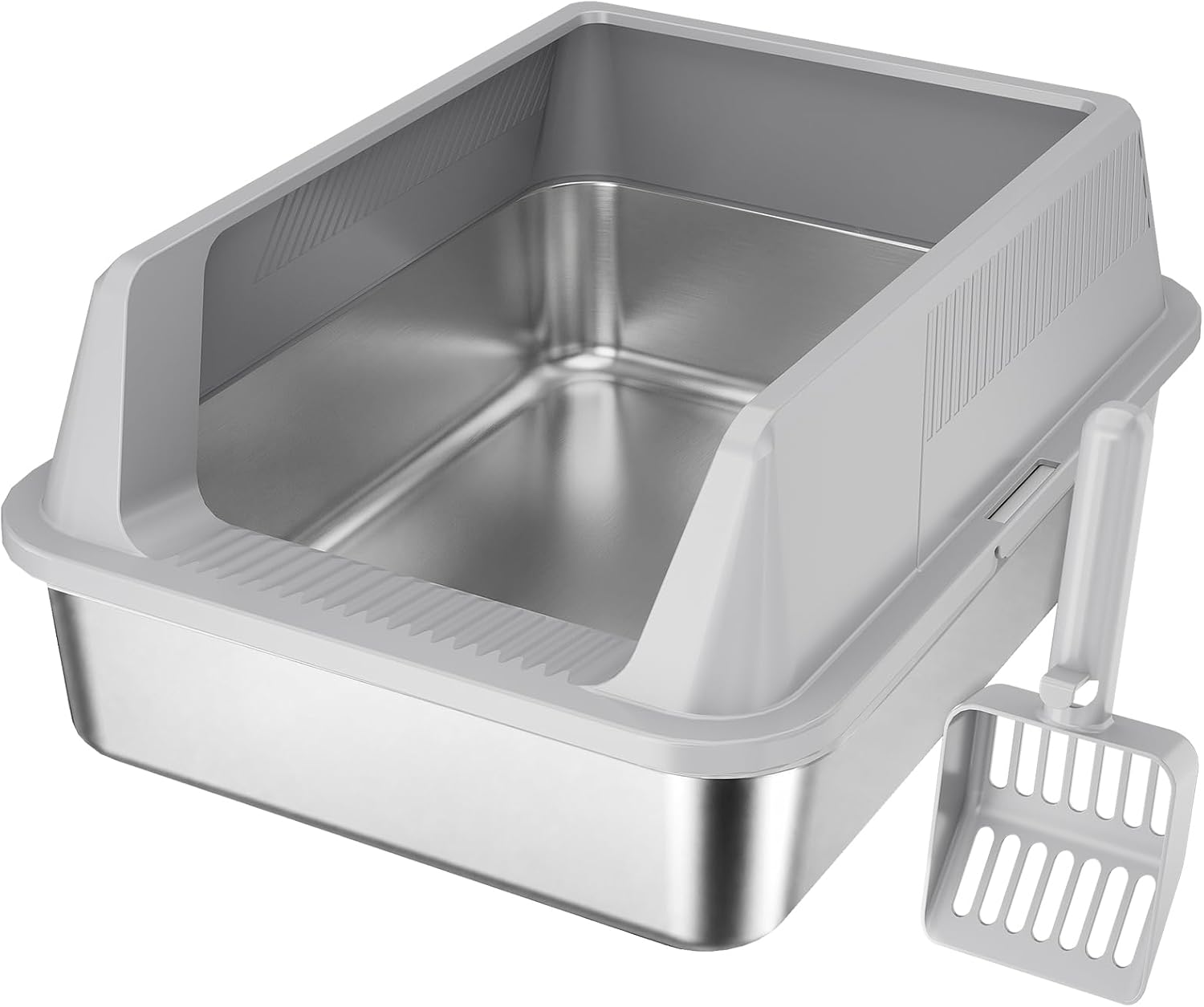
Lifewit Stainless Steel Cat Litter Box for Kitty, 17.7"× 13.8"× 8.3", Gray
This is the pan I would put in a bathroom corner or at the end of a short hallway. The pan is roughly 17.7 by 13.8 inches with 8.3 inch walls, which makes box size easy to live with and a little tight for a large cat. Stainless steel is the reason it is here. It does not absorb odor the way scratched plastic does, it scrubs clean, and it does not develop the ammonia smell that builds up in a plastic pan you have owned for a year.
The tradeoff runs in the other direction. At about 8 inches tall, the entry height suits a kitten, a senior cat, or any cat that needs a low step in. It is not a pan for a determined digger, because litter goes over the top. Litter depth also tops out around 2 to 3 inches before a cat starts flinging it onto the floor.
Flaws but not dealbreakers: It is small. If your cat is over roughly 12 pounds or likes to stretch out, size up. Steel also shows water spots, which bothers people and not cats.
Check current Amazon price. One cat, one small bathroom, and a scoop you do not mind using daily.
Our pick: Shintenchi Cat Litter Box Enclosure, Litter Box Furniture Cabinet Hidden with Removable Divider, Wooden Cat House with End Table, Black, 31.5 inch
Our pick
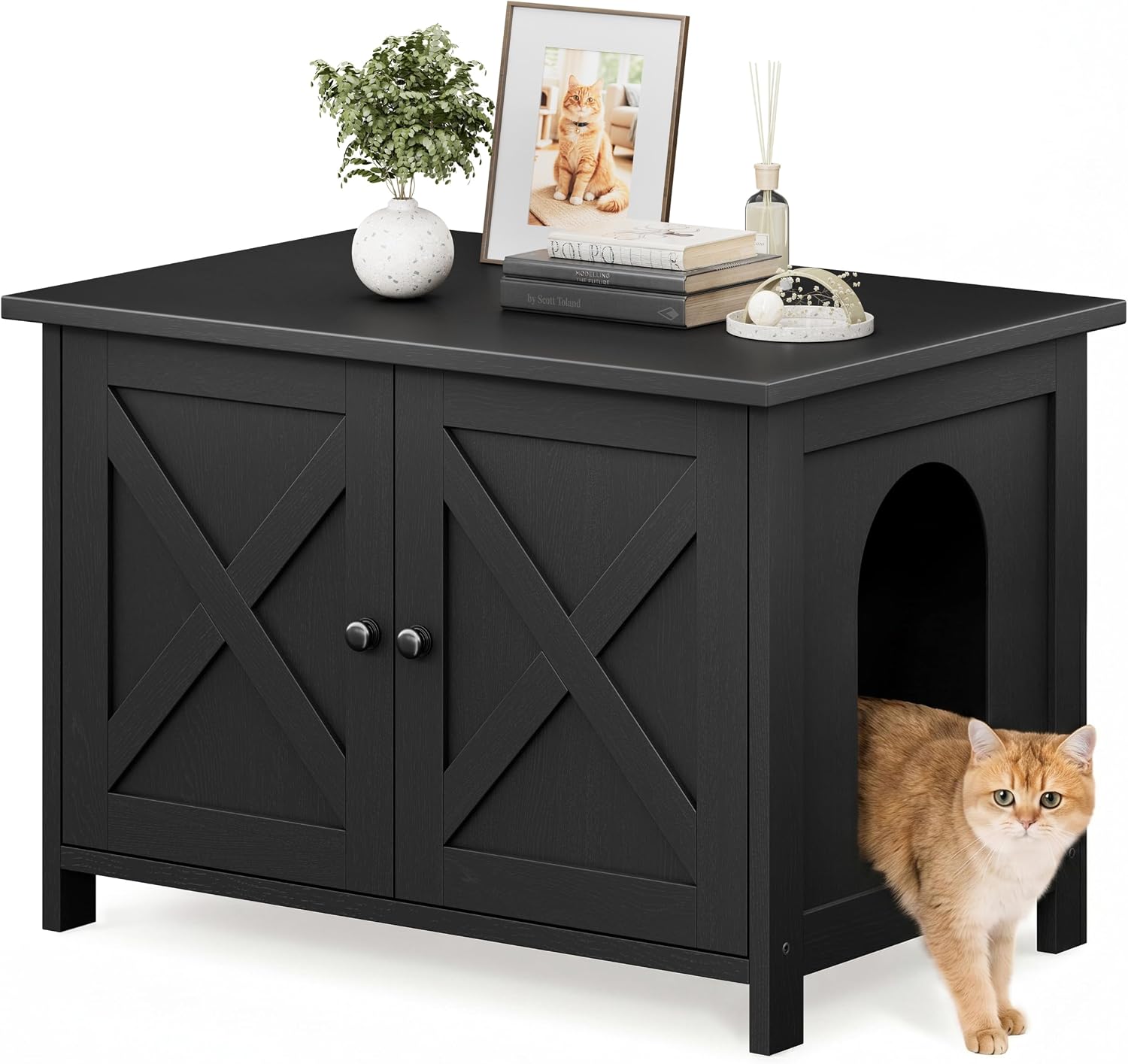
Shintenchi Cat Litter Box Enclosure, Litter Box Furniture Cabinet Hidden with Removable Divider, Wooden Cat House with End Table, Black, 31.5 inch
This is the pick for the apartment where the problem is not the box but the floor space. It is a wooden cabinet 31.5 inches wide with an end table top, so the footprint it takes up is floor you were going to use anyway: a lamp, a stack of books, a spot for keys by the door. The box lives inside it.
The removable divider is the part that matters most. Pull it out and the cabinet takes a longer pan; leave it in and a small stainless pan disappears inside. That flexibility means you are not locked into one box, and the jumbo unit below fits with the divider out.
Enclosed boxes concentrate odor, so this only works if you scoop daily and let the inside breathe between cleanings. Ventilation and litter depth do more for odor control here than any filter. Measure before you buy: 31.5 inches is real furniture, and you need room for the door to swing plus room to reach in with a scoop. A cat who hates enclosed spaces will tell you fast, though most adjust within a few days if you leave the door open at first and keep their old litter inside.
Flaws but not dealbreakers: It is the most assembly of the three, and the wood will not survive a cat that sprays. It also hides problems, because you cannot see the box from across the room, so be honest about your scooping schedule.
Check current Amazon price. This is for the apartment where the battle is walkway space, not the box itself.
Runner-up: TownTime Extra Large Kitty Litter Box with High Sides, Anti-Splashing, Tool-Free Assembly, Multi Cat, Jumbo (Grey) 24.60" L x 16.92" W x 12.99" H
Runner-up
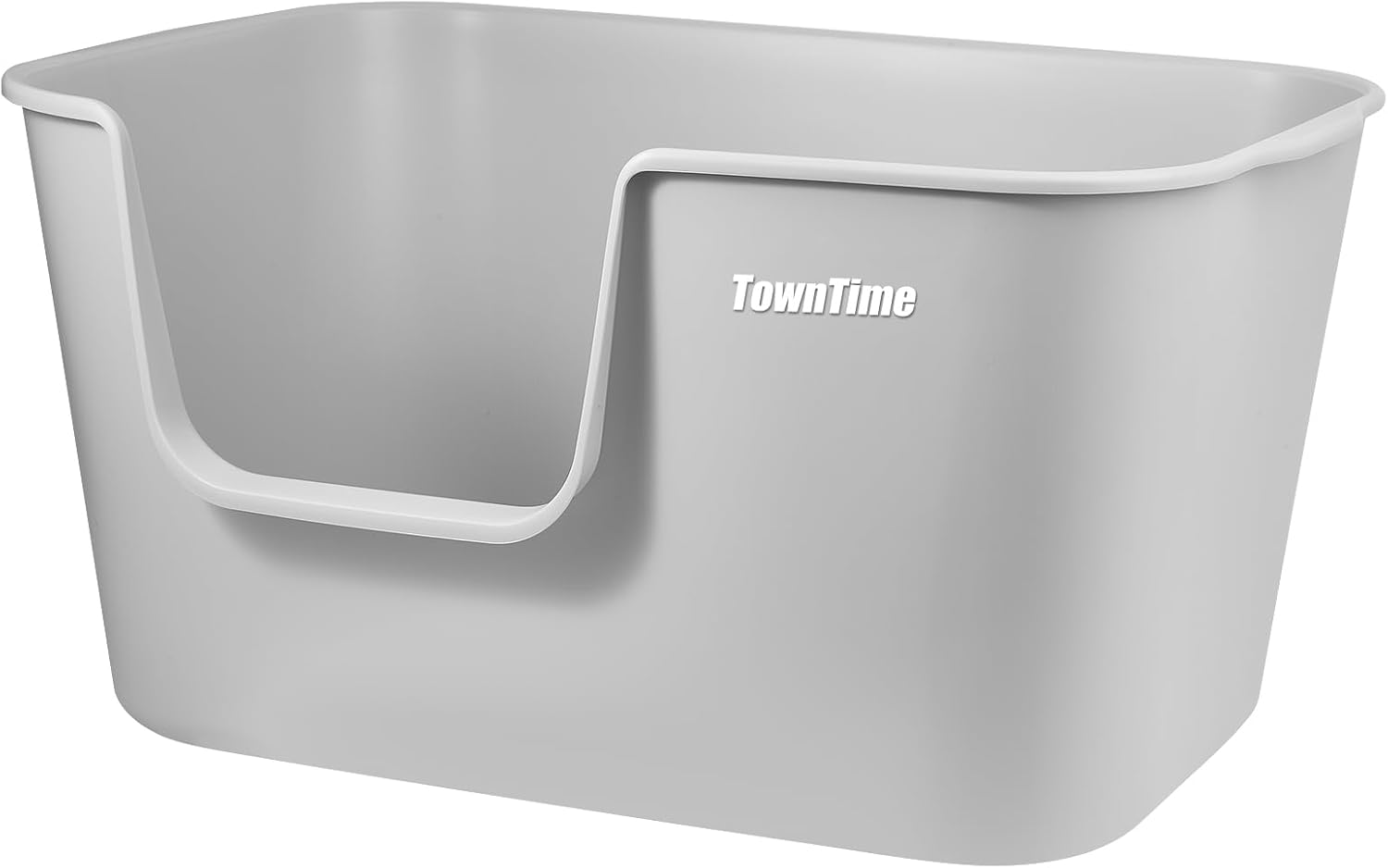
TownTime Extra Large Kitty Litter Box with High Sides, Anti-Splashing, Tool-Free Assembly, Multi Cat, Jumbo (Grey) 24.60" L x 16.92" W x 12.99" H
If your cat is big, or you have two cats and one box, this is the one that ends the argument. It is the largest of the three at about 24.6 by 16.9 inches with walls just under 13 inches high, so a full-grown cat can stand, turn, and dig without hanging over the edge. High sides are also the simplest anti-splashing fix there is: litter hits the wall and falls back in instead of landing on the floor.
The extra length is the cost. You need roughly two feet of uninterrupted floor plus clearance in front, which in a small apartment usually means the end of a hallway or the wall behind the door. It will not tuck into the corner next to the toilet the way the stainless pan does. For a two-cat household, though, one big box usually beats two small ones, because you keep the walkway and lose a cleaning station.
Tool-free assembly matters more than it sounds. A box that comes apart without tools is a box you can move, hose down outside, or store flat the next time you change apartments. A 3 inch litter depth is easy in a pan this deep.
Flaws but not dealbreakers: High sides work against a kitten or an arthritic cat. If entry height is the problem, add a step outside the box or drop to the low pan. Jumbo also means more litter per change.
Check current Amazon price.
How to choose a litter box for a small apartment: the eight-step walkthrough
Run these eight steps before you buy anything. The whole sequence takes about 20 minutes and saves you a return label.
Step one: Measure the floor, not the box. Take the published footprint, add about 6 inches to the front, and tape that rectangle on the floor. Then walk your normal path through the room in the dark. If you have to sidestep the tape, you will hate the box within two weeks. Check door swings, cabinet doors, and whether you are blocking a vent or a radiator.
Step two: Size the box to the cat. A useful rule: the pan should be about as long as your cat from nose to the base of the tail, plus a few inches, and wide enough for a full turn. Too small and the cat hangs over the side or stops using the box. Too big for the spot is a different failure, and that is a Step one problem.
Step three: Set the entry height. Kittens, seniors, and cats with arthritis need a low wall and a clear path in. If you need high sides to stop a digger, add a small step outside the box or press the low side against a wall so the cat enters from the open end.
Step four: Choose covered or open on odor logic, not looks. A lid hides the box from you and concentrates smell inside for the cat. An enclosure solves the space problem, not the odor problem. Whichever you pick, plan on daily scooping and enough airflow that the interior dries out between cleanings.
Step five: Match litter depth to the pan, and watch clumping speed. Two to three inches is the working range for clumping litter in a deep pan. Shallow pans make that hard. Slow clumping litter in a thin layer crumbles into dust, and dust is what you smell. Fast clumping litter forms a clump you can lift whole.
Step six: Think about material and replacement. Stainless steel resists odor; plastic scratches, and scratched plastic holds smell no matter how you wash it. A wood enclosure needs a tray or liner to keep urine out of the seams. Whatever you buy, plan to replace plastic pans once they are scratched.
Step seven: Pick the mat texture and decide where the waste goes. A mat with a lattice or honeycomb top traps tracked litter and lets you pour it back into the box. A flat mat just spreads it around. For waste, keep a small lidded bin and a scoop caddy within arm's reach of the box. Small and close beats large and across the apartment.
Step eight: Set the rhythm and smell test from the couch. Scoop daily, do a full litter change on a schedule that matches your depth and cat count, and wash a steel pan weekly. Then sit where you watch TV and take a breath. If you can smell the box from the couch, the fix is litter depth or scooping frequency, not a new box.
The competition and why it lost
The boxes that did not make the list fell into a few groups, and each one loses for a reason that matters more in a small apartment than in a house.
Hooded dome boxes are the classic. The lid hides the pan, but it also traps odor right at cat nose height, and the hinge and latch are the first things to break. Cleaning one means unclipping a shell with one hand while holding a scoop in the other.
Top-entry boxes ask the cat to jump in and out. That is fine for a young, healthy cat and wrong for a kitten, a senior, or a cat with sore joints.
Self-cleaning boxes with a waste drawer and a motion sensor have real appeal in an apartment, since the drawer holds a few days of clumps. They lose here on three counts: they need a power outlet near the box, they need clearance behind and above for the rake to cycle, and sensor range is the weak point. A cat that walks past, a heavy cat, or a box that shifts on a rug can trigger a cycle at the wrong time or stop the rake mid-travel. When a self-cleaning box jams, you are cleaning a machine and a litter box.
The last group is the do-it-yourself tote. People cut a hole in a plastic storage bin because it is cheap and deep. It works until the cut edges are sharp, the plastic holds odor, and there is no lid a cat will accept. Save the tote for moving day.
Corner boxes and space-saving designs get an honorable mention. A triangular pan does save a corner, and it also takes away the width a cat needs to turn around, which is the one measurement you should not trade away.
What this all costs
None of the three boxes here is an appliance, so the money question is simple. The stainless pan is the least expensive of the three. The enclosure and the jumbo box land in the same bracket as each other, and both are still in the range of a decent piece of apartment furniture, which is the point: the enclosure doubles as an end table. Check current Amazon price on each before you commit, because these prices move with the season.
Then there is the recurring cost, and this is where people underestimate apartments. Litter is the real bill. A 3 inch depth in a jumbo pan uses noticeably more litter per change than a 2 inch depth in a small steel pan, so the bigger box costs more every month, not just once. Add a mat, a scoop, a waste bin, and an enzyme cleaner, and the setup is done.
Spread over the life of the box, the one-time cost is small. A pan that lasts five years costs pennies a day. A wood enclosure that survives three moves and two apartments is cheaper per year than the three plastic pans you would otherwise scratch up and throw away.
The eight steps above take about 20 minutes, and that is the whole job of learning to choose a litter box for a small apartment. Do them once, save the footprint measurement in your phone, and every future apartment gets easier. Your cat was going to use something. Make sure the something fits.