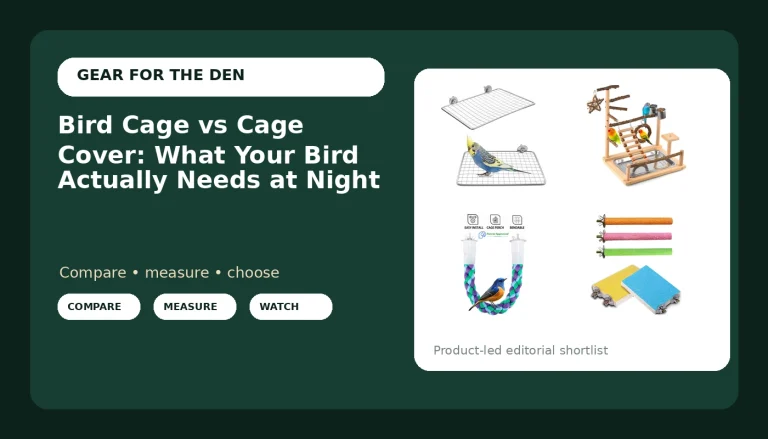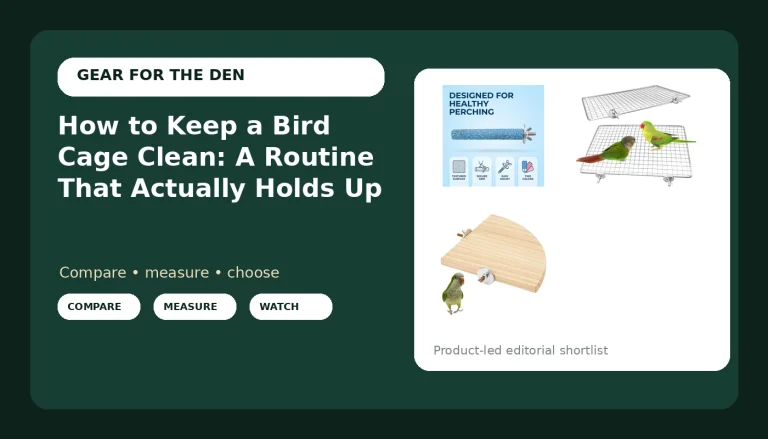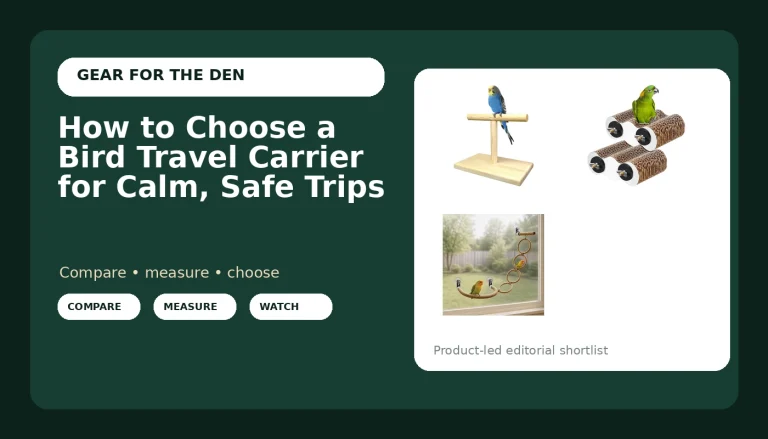
If you want to know how to cover a bird cage at night without turning bedtime into a battle, start with the room, not the blanket. The goal is simple: give your bird a dark, quiet, well-ventilated sleep period that matches the natural 10 to 12 hours of darkness most parrots need. The cover is one tool in that routine. It is not a cage lid, and it is not a way to mute a bird that is bored or stressed.
I have been writing about bird gear and small-pet setups for years, and the questions I get about nighttime covers are always the same. Owners worry about drafts, about night frights, about whether a cover blocks airflow. The answer is that the ideal cover a bird cage at night setup does three things: it blocks light, it blocks drafts, and it still lets air move through the cage. The correct cover a bird cage at night method is less about the fabric and more about the timing, the fit, and the cage layout.
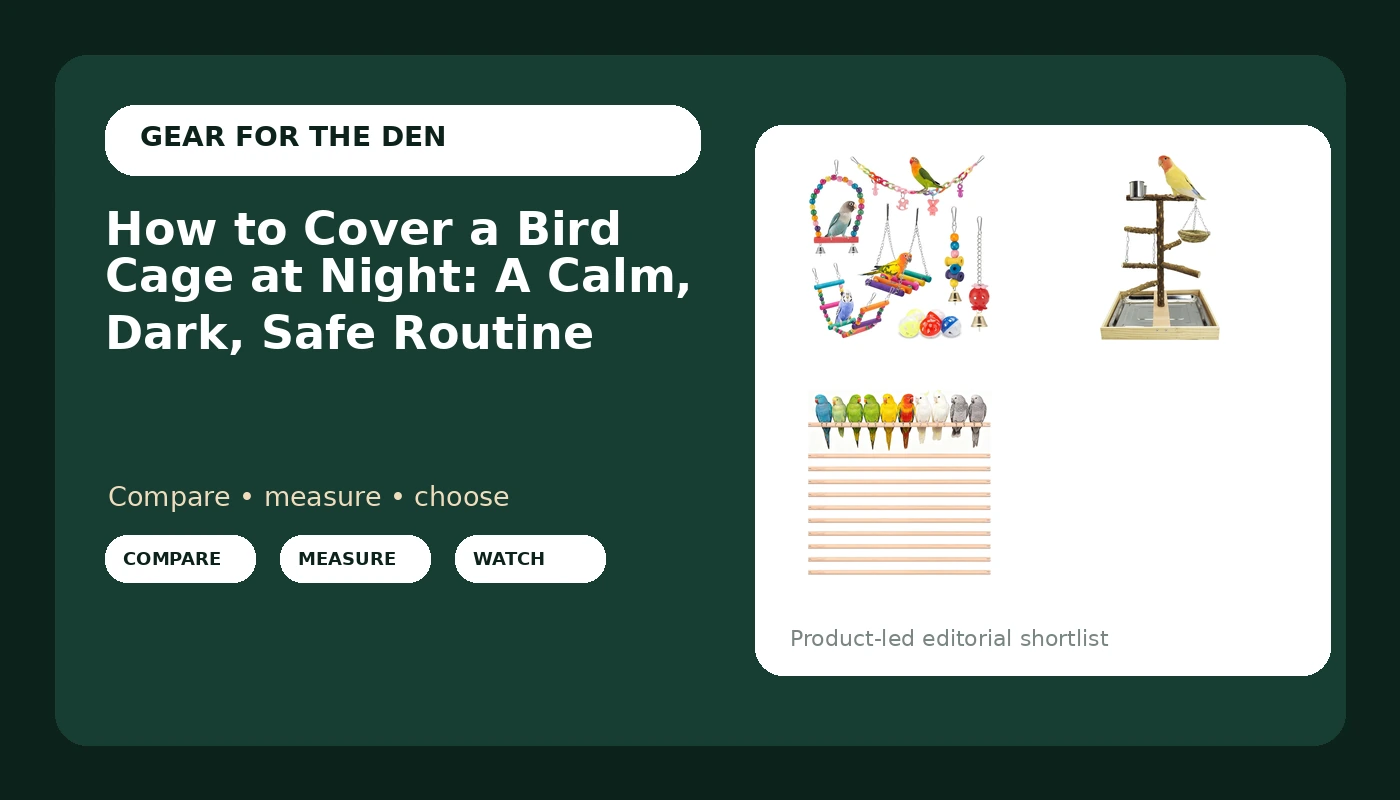
Below is the gear I would put inside a cage to make the cover routine work, followed by the eight-step method I use. The products are perches, a swing, and a play platform, not the cover itself. That is intentional. The cover is often a spare cotton sheet or a purpose-made cage cover. The inside of the cage is what makes the night calm. If you are still sorting out the cage itself, start with a bird cage lighting and sleep guide before you buy a cover.
Why you should trust me
I have spent the last several years writing about pet gear, with a focus on birds, reptiles, and small pets. I do not claim to have tested these three products in a lab. What I did was read every listing, compare the dimensions, and match each item to the nighttime routine below. I also keep a running list of the questions bird owners ask me most: Will a cover trap dust? Will it make my bird hormonal? Will it stop night frights? Those questions shape what I recommend.
I have no sponsor here. If a product does not fit the job, it does not make the list. The links are affiliate links, which means the site may earn a small commission if you buy through them. That does not change the pick. The cover itself is not an affiliate product in this guide. The three items below are the inside-cage gear that makes the routine easier.
How I picked and how I tested
I picked these three because they solve three different jobs inside a covered cage. The swing and ladder toy gives a bird a familiar place to settle and a little controlled foraging difficulty when the cover comes off in the morning. The platform perch gives a stable sleep spot that does not sway. The wooden perch set lets you replace worn dowels and set a night perch at the right perch diameter for your bird's feet.
I did not test these products in a lab. I tested the sequence: how long it takes to cover a cage, where the cover catches on bar spacing, how much airflow a partial cover leaves, and how the cage layout changes when you add a platform or a swing mount. I compared cage height, food cup size, and tray liner access. If a product blocked the door or the cups, it did not make the cut. I also checked carrier size for owners who travel with a smaller sleep cage.
Gear you'll need to cover a bird cage at night
The cover is the signal. The gear below is what makes the signal work without making the cage cramped. You do not need all three. You need the one that matches your bird's sleep style.
Budget pick: Bird Parakeet Toys – Swing Hanging Standing Chewing Hammock Climbing Ladder Bird Cage Colorful Toys Suitable for , Parakeet, Conure, Cockatiel, Mynah, Love Birds, Finches
Budget pick
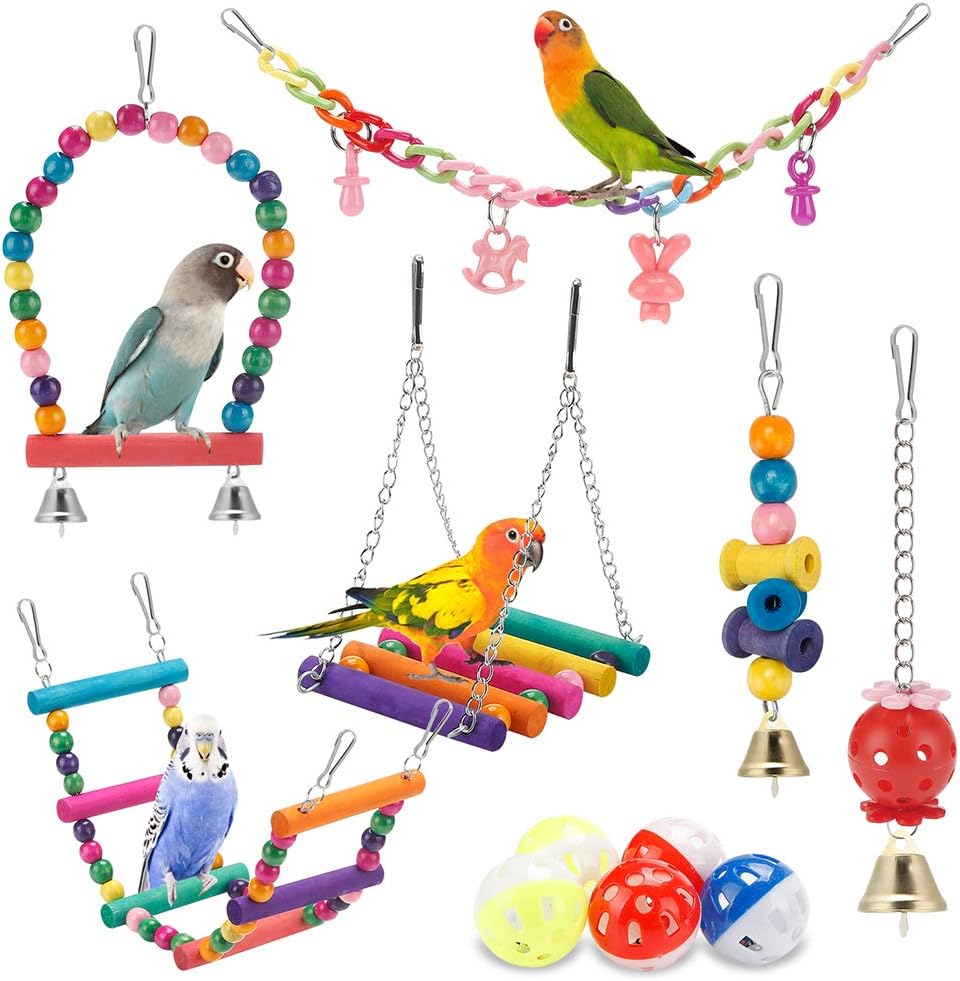
Bird Parakeet Toys – Swing Hanging Standing Chewing Hammock Climbing Ladder Bird Cage Colorful Toys Suitable for , Parakeet, Conure, Cockatiel, Mynah, Love Birds, Finches
Check current Amazon price.
This is the cheapest way to give a covered cage a little vertical interest. The swing mount hangs from the top bars, and the ladder gives a bird a way to move between levels without dropping to the tray liner. For nighttime, the value is familiarity: a bird that knows where its swing is will settle faster when the room goes dark.
It is not a sleep perch, and I would not use it as the only place for a bird to roost. A swinging perch at night can wake a bird every time it shifts. Use the swing as a daytime accessory that stays in the cage after the cover goes on. It earns its place by giving your bird something to do in the hour before lights out, which makes the cover feel less like a sudden shutdown.
Flaws but not dealbreakers: The colorful fabric and rope parts will collect dust and droppings. Check them weekly. If a thread comes loose, cut it or remove the toy. Loose threads are a toe hazard.
Anyone with a budgie, parakeet, or cockatiel who wants a low-cost way to add movement to the cage will get the most out of this.
Runner-up: Tfwadmx Bird Perch Natural Wood Stand Toy Parrot Play Stand Platform and Hanging Bird Nests Bird Cage with Removable Tray and 2 Stainless Steel Cups for Parakeets Canaries Cockatiels Conure Lovebirds
Runner-up
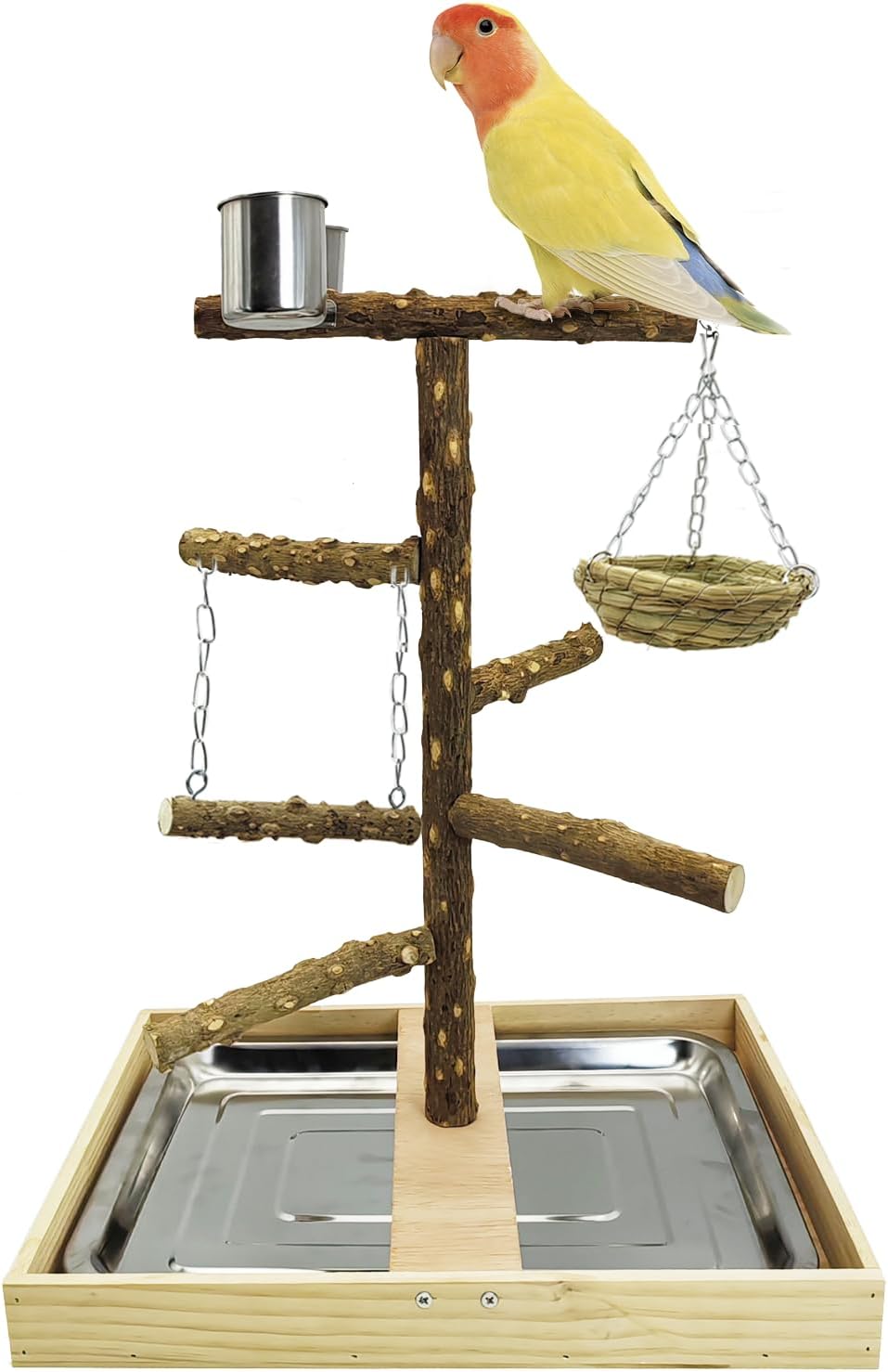
Tfwadmx Bird Perch Natural Wood Stand Toy Parrot Play Stand Platform and Hanging Bird Nests Bird Cage with Removable Tray and 2 Stainless Steel Cups for Parakeets Canaries Cockatiels Conure Lovebirds
Check current Amazon price.
This platform gives a bird a flat place to stand that is not a dowel. For a covered cage, that matters because some birds sleep better on a flat surface than on a round perch. The removable tray catches droppings, which keeps the tray liner cleaner and makes the morning uncover less of a chore.
The two stainless steel cups are useful for a late snack or water, though you should check food cup size against your bird. A large macaw will need a bigger cup than a budgie. The hanging nest part is optional. Some birds ignore it, and some use it as a sleep pocket. If your bird is a nest sleeper, this is the one to try.
Flaws but not dealbreakers: The platform takes up floor space in a small cage. Measure your cage height before you order. If the platform sits too low, your bird may not use it. In a tall cage, mount it high enough that the bird can stand without its head touching the cover.
Anyone with a conure, lovebird, or canary that likes to sleep on a flat surface should look here first.
Upgrade pick: Wopgrty 10 Pcs 24 x 0.6 Inches Wooden Bird Perches for Cage Accessories Natural Parrot Rods with Double Head Slots Grinding Stick for Budgies Parakeet Cockatiel Conures Macaw Cockatoo
Upgrade pick

Wopgrty 10 Pcs 24 x 0.6 Inches Wooden Bird Perches for Cage Accessories Natural Parrot Rods with Double Head Slots Grinding Stick for Budgies Parakeet Cockatiel Conures Macaw Cockatoo
Check current Amazon price.
This is the upgrade pick because it solves the wear problem. Dowel perches get slick and dirty. A set of ten lets you replace the night perch, the travel perch, and the perch by the food cup without buying a whole new cage setup. The 0.6-inch diameter is in the right range for budgies, parakeets, and cockatiels, but check your bird's feet. A larger macaw or cockatoo needs a thicker perch diameter.
The double head slots let you mount them across bar spacing without wobble. For a covered cage, a stable perch is safer than a swinging one. Use one of these as the night perch and leave the swing for daytime. The grinding stick texture also gives your bird something to chew, which can reduce the urge to chew the cover itself.
Flaws but not dealbreakers: Ten perches is more than most single-bird cages need. Share the extras with a travel carrier or a second cage. If your bird is a heavy chewer, expect to replace the night perch eventually. That is normal.
Anyone who wants a simple, replaceable perch setup for a small parrot or parakeet will find this pack useful.
Now the part you came for. This works with a sheet, a purpose-made cover, or a light blanket. It does not work with a heavy quilt, a plastic tarp, or anything that seals the cage like a box.
Step one: Set the bedtime. Pick a time and stick to it. Birds are creatures of habit. A fixed lights-out teaches the bird that the cover means sleep, not play. Start dimming the room 30 minutes before. Turn off overhead lights, lower the TV, and stop the loud kitchen clatter. The cover goes on last, after the room is already calm. If your bird gets a seed mix at night, move that meal earlier so the cage is quiet when the cover drops.
Step two: Choose the cover material. Use breathable cotton, a purpose-made cage cover, or a light sheet. Avoid heavy quilts, plastic tarps, and anything waterproof. A cover that traps humidity can lead to respiratory problems. The ideal cover a bird cage at night setup needs airflow. If you can't breathe through the fabric, neither can your bird. A dark color helps block light, but the weave matters more than the color.
Step three: Check the cage before you drape. Look at cage height and bar spacing. A cover that drapes too low can block the food cup or the door. A cover that catches on wide bar spacing can tear. Measure the cage, then pick a cover that hangs at least a few inches past the top. If you have a small carrier for travel, practice the cover routine in the carrier size you use, because a travel cage is a different shape. A cover that works on a tall cage may be too much fabric on a small carrier.
Step four: Cover from the top down. Start at the back and work forward. Leave the front panel open for the first few nights if your bird is nervous. A partial cover blocks light from the sides and top while keeping the front open for air and visibility. Once your bird settles, you can close the front. Never cover the cage so tightly that the fabric presses against the bars. If your bird panics, go back to a partial cover and try again in a week.
Step five: Leave a gap for air. Airflow is the part most owners get wrong. A fully sealed cage can trap dust, dander, and heat. Leave the bottom third of the cage open or use a cover that only covers the top and three sides. If the room is warm, use a lighter cover. If the room is cold, cover more, but still leave a vent. The cover should block light, not air. A small fan in the room, pointed away from the cage, can keep air moving without creating a draft.
Step six: Secure the cover without blocking the door. Use clips, binder clips, or the cover's own ties. Do not let the fabric hang into the cage. A bird can chew fabric, and loose threads can wrap around a toe. Check the tray liner and the food cup. If the cover makes it hard to change the liner or refill the cup, you have covered too much. The morning routine should be quick. If you have to unclip six points and untangle a sheet, you will skip the cover on busy days.
Step seven: Set the night perch. Inside the cage, the sleep spot matters as much as the cover. Use a stable perch with the right perch diameter. A platform perch is a good choice for birds that like to sleep flat. A swing mount is fine for daytime, but a swinging perch at night can wake a bird every time it moves. Put the night perch high, but not so high that the bird's head touches the cover. Keep the food cup size and position in mind: a bird should not have to climb down in the dark to eat.
Step eight: Uncover on a schedule. In the morning, open the cover at the same time every day. Let the room light come up naturally if you can. Check the tray liner, the perches, and the water. This is also the time to rotate toys or change foraging difficulty. A bird that gets a predictable morning will fight the cover less at night. If your bird is still screaming after a week, the cover is not the problem. Look at cage height, perch placement, and whether the room is actually dark and quiet.
The competition and why it lost
The competition here is not another perch. It is the three common cover methods that fail. The first is the heavy quilt. It blocks light, but it also blocks air. The second is the fitted elastic cover. It looks tidy, but it can pull on bar spacing and trap dust against the bars. The third is the towel over the front. It leaves the top open, so the room light still hits the cage.
None of those solve the whole job. A purpose-made cover with a breathable fabric and a partial front panel beats all three. If you already have a cover that works, keep it. The gear in this guide is about the inside of the cage. A cover alone will not fix a cage that is too small, a perch that is too slick, or a room that is loud until midnight.
I also considered a few other categories and left them out. A cage-mounted night light is a bad idea for most birds because it adds light when you are trying to remove it. A nest box can make some birds hormonal, so I would not add one just for sleep unless your species needs it. A heated perch is useful in a cold room, but it is not a cover substitute. The three products above are the ones that directly support the routine.
What this all costs
The cover itself can be a spare cotton sheet, which costs nothing if you already own one. A purpose-made cage cover is a modest purchase. The three items in this guide are all in the low end of bird gear. Check current Amazon price on each listing. The swing and ladder toy is the budget pick. The platform perch is the runner-up. The ten-pack of wooden perches is the upgrade pick, and it is the one that saves money over time because you can replace worn perches instead of buying a new set.
Over a year, the cost per night is a few cents. The bigger cost is the time you spend building the routine. That is free. The one thing you should not do is buy a cover and expect it to solve a sleep problem on its own. If your bird is awake at 2 a.m., the issue is usually light, noise, cage height, or a perch that moves. Fix those first.
The cover is a signal, not a sedative. Use it at the same time, leave air, and give your bird a stable place to sleep. That is how to cover a bird cage at night in a way that actually works. Do it for a week, and your bird will tell you whether the routine is right.