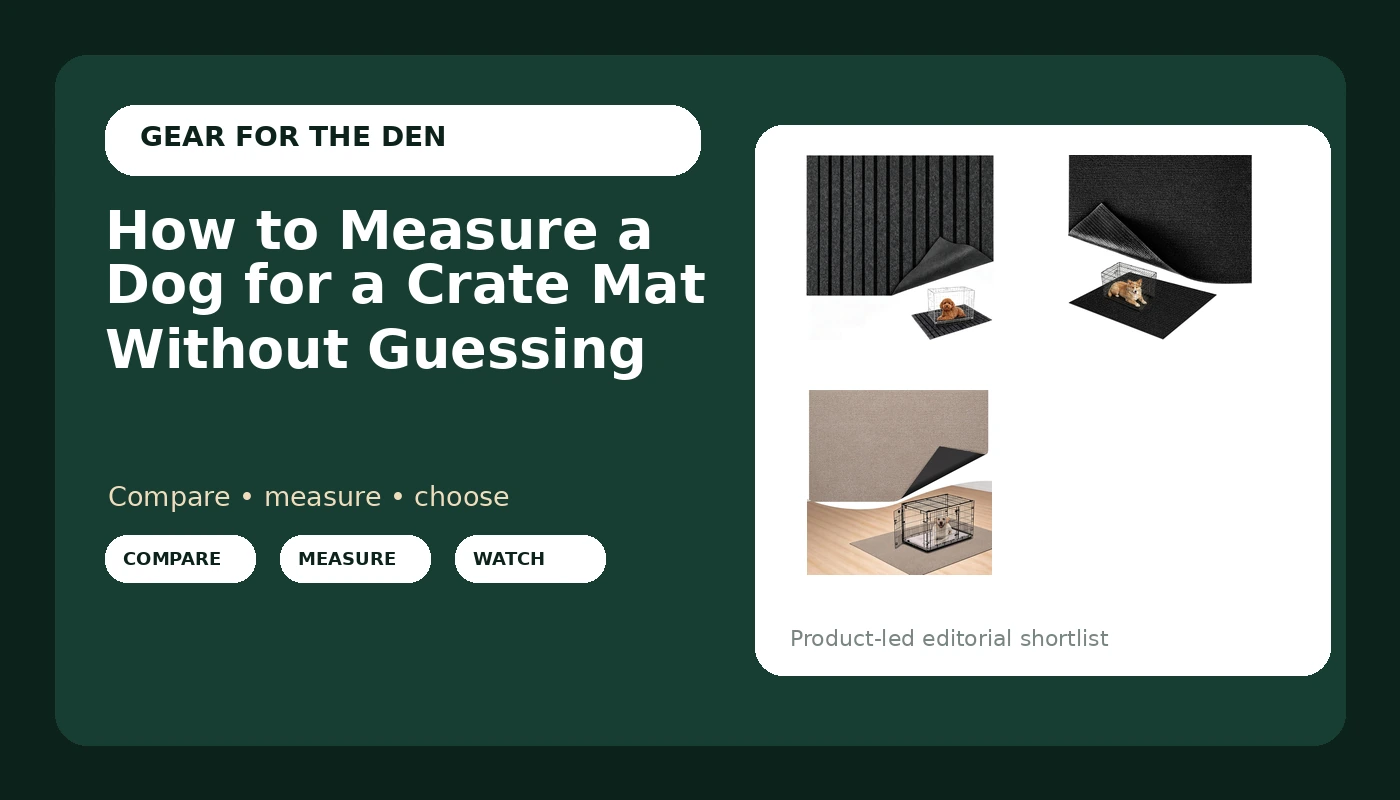
The fastest way to waste money on dog gear is to guess at sizing. When you measure a dog for a crate mat, you are not really measuring the dog. You are measuring the crate floor, the door opening, and the space your dog needs to lie down without curling into a comma.
That is the whole job. This guide walks through how to measure a dog for a crate mat in eight steps, then shows three mats that cover the common crate footprints so you can see how the numbers translate to real products.
Why you should trust me
I write about dog gear for Gear for the Den, and I have sized enough crates to know that a tape measure settles more arguments than any product listing. I am not going to pretend a crate mat is complicated. The reason this guide is worth your time is that most sizing mistakes come from three avoidable assumptions: that the crate size on the box matches the inside floor, that a mat should fill every inch, and that thicker is always better. None of those hold up when the mat is in the crate and your dog is standing on it.
The method below is the one I recommend when someone asks for help setting up a new crate. It takes five minutes and a tape measure. If you are still working on the routine side of crate training, my guide to how to crate train a puppy covers that separately.
How I picked and how I tested
I picked these three mats because they cover the three common crate footprints: 24 by 36, 36 by 24, and 47 by 32. That range covers small playpens, standard 36-inch crates, and large crates. I did not run a lab test on them. My test for a crate mat is fit, mat thickness, and whether the cover can go in a washing machine.
For each mat, I checked the listed dimensions against standard crate sizes. I looked for a waterproof layer and a non-slip base. I also checked how the size would work in a playpen with a specific panel count. The numbers that matter are crate size, bar spacing, and the clearance between the mat edge and the crate wall. If a mat is too thick, it can raise the floor enough to change gate height. If it is too thin, it slides. The sweet spot is a mat that lies flat, stays put, and leaves enough room for the door to close.
The mats that make it easy to measure a dog for a crate mat
This is the part where the measuring pays off. Each mat below matches a common crate footprint. Use the eight steps after this section to confirm your size before you order.
Best for large crates: Mluyeri Dog Crate Mat 47"x32" Extra Thick Waterproof Non-Slip Kennel Pad
Best for large crates
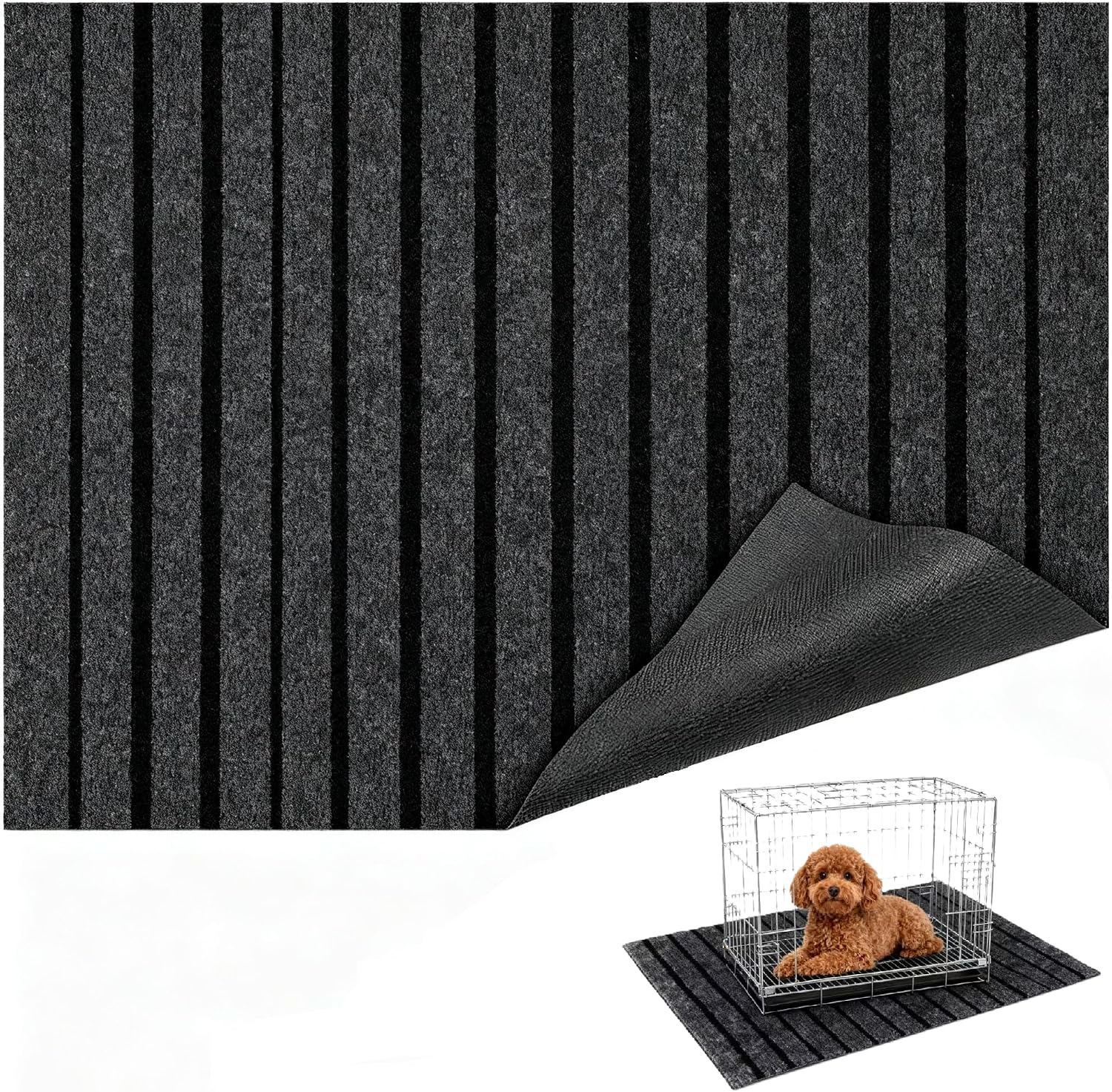
Mluyeri Dog Crate Mat 47"x32" Extra Thick Waterproof Non-Slip Kennel Pad
Check current Amazon price.
The 47 by 32 footprint is the one to look at when your crate floor measures close to that size. This is the extra thick option, so it is best for a dog that likes padding but still needs the door to clear. The waterproof layer and non-slip base are the two features that matter most in a large crate. A large mat that slides is worse than no mat because it bunches under the dog.
Measure your crate floor first, then compare that number to this 47 by 32 size. If your crate is smaller, do not force it. A mat that is too big will fold at the corners and never lie flat. This is the pick for a large crate where the floor is genuinely 47 by 32 and the dog is a sprawler. Check current Amazon price before you buy, because sizes on listings can change.
Best for standard 36-inch crates: Dog Crate Mat, 36" x 24" Extra Large Dog Playpen Mat, Non-Slip Kennel Mat
Best for standard 36-inch crates
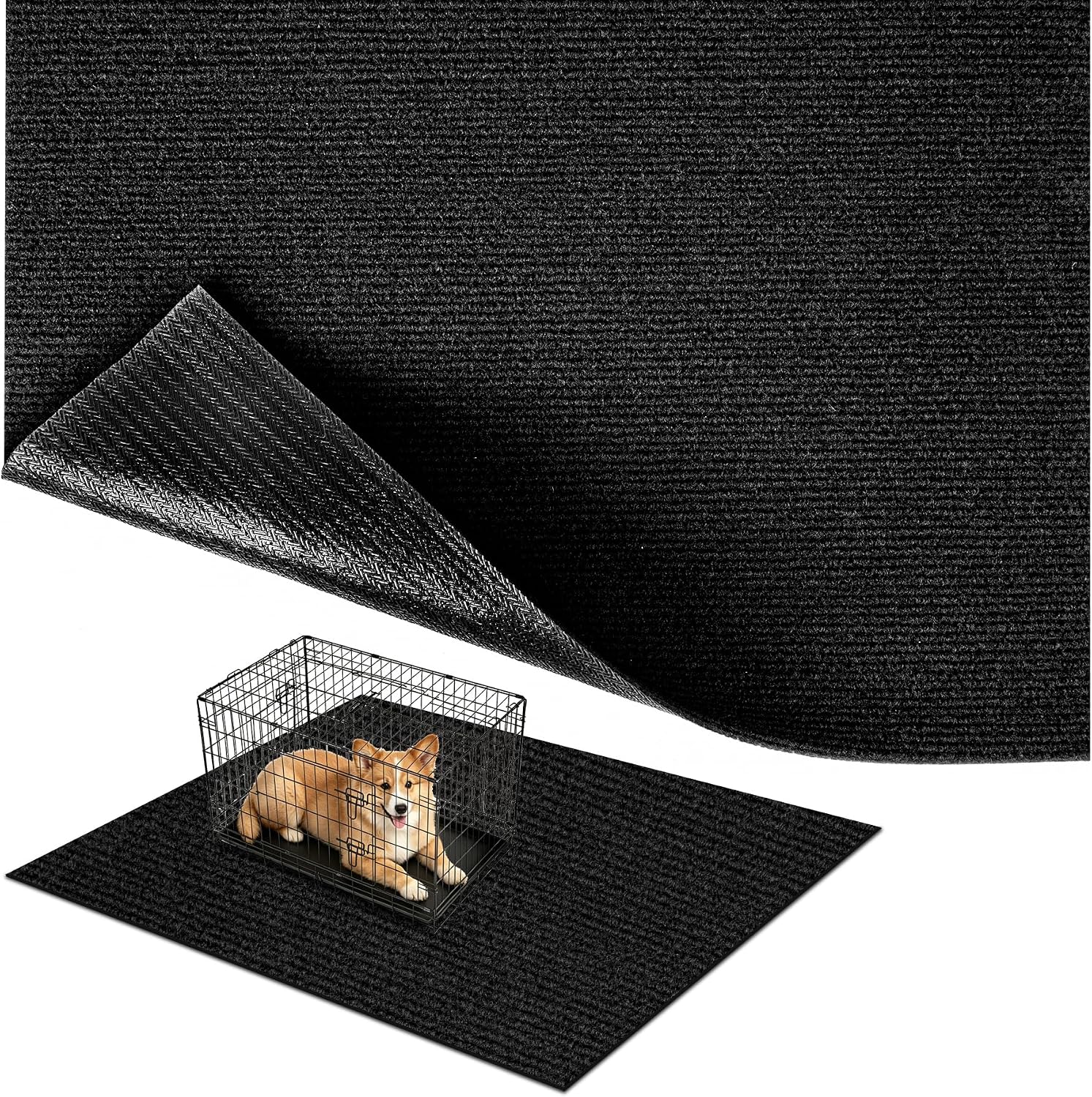
Dog Crate Mat, 36" x 24" Extra Large Dog Playpen Mat, Non-Slip Kennel Mat
Check current Amazon price.
The 36 by 24 size is the default for a standard crate and it also fits many playpen floor panels. The non-slip kennel mat base is the reason this one works on a smooth crate tray. If you run a playpen, check the panel count and the bar spacing. A 36 by 24 mat can cover the floor area of a four-panel playpen, but a six-panel setup will leave gaps.
The mat thickness here is moderate, which means it will not change gate height much. That matters if you have a dog that likes to nose the door open. Use the 36 by 24 size as your baseline. If your crate floor measures 36 by 24, this is the mat that matches. If your crate is 36 by 23 or 37 by 25, go with the closest size and leave the extra inch at the door side, not the back. The back is where the mat can bunch without blocking anything.
Best for playpens and travel: Heliospark Dog Crate Mat, 24 in X 36 in Dog Playpen Mat Kennel Mat
Best for playpens and travel
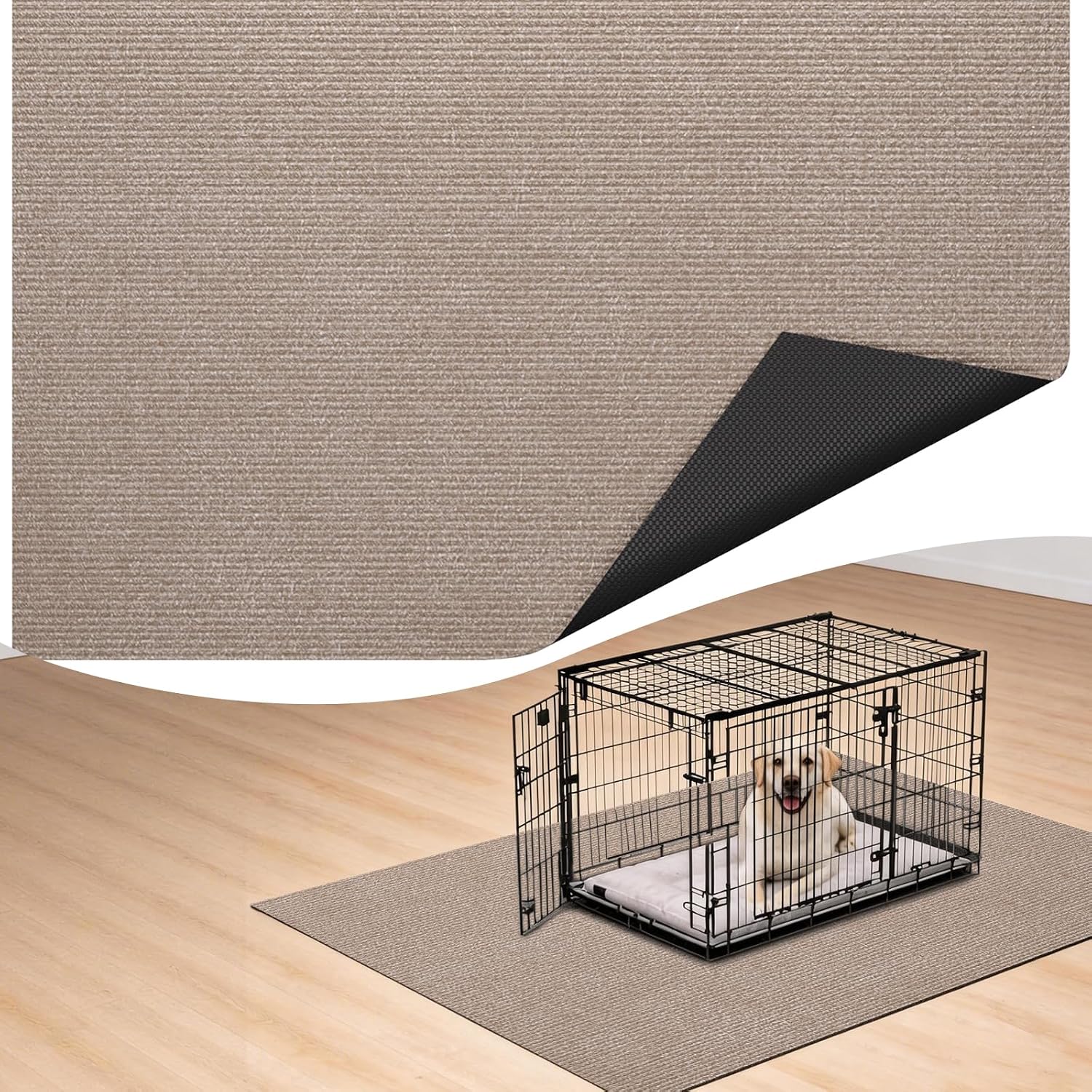
Heliospark Dog Crate Mat, 24 in X 36 in Dog Playpen Mat Kennel Mat
Check current Amazon price.
The 24 by 36 size is the one to grab for a playpen, a travel crate, or a smaller dog that still likes to stretch out. It is the same footprint as many standard crates but listed in the opposite order, so check your crate floor before you assume it will fit. This mat is the easier one to move from room to room because it is not as bulky as the 47 by 32 option.
The washable fabric matters here because playpen mats get dirty faster than crate mats. A desk mat is not a crate mat, but the measuring method overlaps: you still need the inside dimensions, not the outside. If you searched for measure a dog for a crate desk mat, this is the size class you are probably looking at. Same tape measure, same clearance rule. The cover ventilation on a playpen can be blocked if you add a thick mat, so keep the mat thickness reasonable and leave the top open.
The actual measuring workflow
Step one: Measure the crate floor, not the dog. Use a tape measure inside the crate, from the back wall to the inside of the front door, and from side wall to side wall. Write both numbers down. Do not trust the crate size on the box, because a 36-inch crate often has a floor that is slightly smaller. When you measure a dog for a crate floor mat, start with the inside floor.
Step two: Measure the dog lying down. This is the part people skip. Put the dog on the floor and measure from the front of the chest to the back of the rear. Then measure the widest point across the shoulders. A dog that curls into a ball needs less length than a dog that sprawls. The goal is a mat that covers the floor area the dog actually uses.
Step three: Check the door opening and gate height. A thick mat raises the floor. If the gate height is tight, a thick mat can make the door drag or leave a gap. Measure from the crate floor to the bottom of the door. If that number is small, choose a thinner mat or plan to trim the mat. This is also where bar spacing matters: a mat that is too thick can push against the bars.
Step four: Check bar spacing and panel count for playpens. If you are using a playpen instead of a crate, count the panels and measure the floor area. Then check bar spacing. A mat that is too small can slip through the bars or leave a gap where a puppy can poop on the floor. A mat that is too large will bow up the panels. The panel count tells you the total floor shape, so measure the inside area, not the outside.
Step five: Subtract clearance. A crate mat should not fill every inch. Leave about one inch of total slack, half an inch on each side, so the mat lies flat. If the mat is extra thick, leave a little more. The mat thickness you choose should match the clearance you have. A mat that is jammed in will wrinkle and create a ridge under the dog. A mat that is too small will slide to one corner.
Step six: Check cover ventilation. If your crate has a cover or a playpen has a top, a thick mat can reduce airflow around the floor. Cover ventilation matters more in warm rooms. A waterproof layer is good for accidents, but it also traps heat. If your dog runs hot, look for a mat with a washable fabric top and a waterproof layer underneath, not a full waterproof shell.
Step seven: Confirm washable fabric and waterproof layer. A crate mat lives on the floor, so it will collect hair, dirt, and accidents. Washable fabric is the feature that keeps the mat in use instead of in the trash. A waterproof layer protects the crate tray and the floor. Check the care instructions before you buy. If the mat cannot go in a washing machine, you will be scrubbing it by hand.
Step eight: Test the fit and the wash. Put the mat in the crate with the dog watching. Check that the door closes, the mat does not slide, and the dog can lie down without touching the bars. Then run the mat through one wash cycle before you trust it. If it shrinks or the non-slip base peels, return it. A mat that survives the wash is the one that stays.
The competition and why it lost
Not every mat is a crate mat, and some of the most common substitutes are worse than buying the right size. A folded towel is free and washable, but it bunches and slides. A human bath mat has the wrong dimensions and usually a rubber backing that traps odor. A desk mat is too small and too thin for a dog that sprawls. A generic orthopedic bed is too thick for most crate doors and does not fit the floor pan. A pee pad is for accidents, not for comfort, and a dog that shreds it will eat the plastic.
The other category that loses is the oversized mat. People buy a 47 by 32 mat for a 36 by 24 crate because they think more coverage is better. It is not. An oversized mat folds at the corners, creates a ridge, and can block the door. The right size is the one that matches the inside floor with a little clearance.
If you need a mat for a playpen, the panel count and bar spacing matter more than the color. If you need a mat for a standard crate, the 36 by 24 size is the safe default. If you need a mat for a large crate, go with the 47 by 32 size only after you measure. The three mats above cover those cases. Anything else is a guess.
What this all costs
The three mats in this guide all sit in the same budget tier, so the cost difference is not the deciding factor. The real cost is the wrong size. A mat that does not fit gets returned, or worse, it gets shoved in a closet while your dog sleeps on a bare tray. A mat that fits gets used every day.
If you want to keep costs down, start with the size that matches your crate floor and Check current Amazon price before you order. A washable fabric mat with a waterproof layer will last longer than a cheap pad that falls apart after two washes. Over a year, the cost per day is small. Over five years, the right mat is cheaper than replacing a torn one every few months.
The measuring method is free. The tape measure you already own is the only tool you need. Do the eight steps once, write the numbers on the inside of the crate with a marker, and you will never guess again. That is how to measure a dog for a crate mat without buying three wrong ones first.