Most cages sold as cockatiel starter kits are wrong before the bird even goes in. The bar spacing is wide enough for a budgie to slip through, the dowel perches are thinner than a pencil, and the food cups hang directly under the highest perch. Learning how to pick a cage for a cockatiel is mostly about four numbers you can check on a spec sheet in five minutes, long before you spend money.
Vets will tell you there is no one correct pick a cage for a cockatiel, only a correct set of measurements for the bird in front of you. Bar spacing, cage height, and perch diameter come before brand names, every single time.
This guide runs in two halves. The first half is gear, because the three perches below fix the most common problems in a cage you already own or one you are about to buy. The second half is the workflow: eight steps, in order, that take you from "which cage" to a bird that actually uses the whole thing.
Why you should trust me
I write the bird and small-pet guides here, and my method is deliberately boring. I read the spec sheet, I read the species guidance from avian vets and breeders, and I read what owners complain about six months in. I do not take free cages, I do not run sponsored picks, and I do not pretend a perch is a precision instrument that needs a lab bench.
What I care about is fit. A cockatiel is a medium-small parrot with a long tail, feet built for branches, and a habit of chewing anything soft. Gear that ignores those three facts fails, no matter how good the product photos look. The numbers in this article come from published species guidance and manufacturer specs, not from a tape measure I waved at a bird. Where a claim is a judgment call, I say so.
How I picked and how I tested
There is nothing to bench-test about a perch. It is wood, a bolt, and a wing nut. So the testing here was comparison, not measurement: I lined the candidates up against the four specs that decide how to pick a cage for a cockatiel, then threw out anything that failed one of them.
The first filter was hardware. A perch that threads onto a cage bar with a plastic wing nut will wobble, and a wobbling perch is how a bird ends up with a sore foot. Metal hardware, or at least a metal bolt, stays put.
The second filter was natural variation. Dowel perches are uniform, which means the bird's foot sits in the same position all day. Branches are not uniform, and that variation is the whole point. The same thinking runs through our small pet habitat guides if you keep other species too.
The third filter was cleaning. Anything with deep bark grooves, unfinished softwood, or a fabric cover goes in the bin, because a cockatiel will chew it and you will never get it clean. Easy to scrub beats pretty.
The fourth was range. I wanted three options that cover three jobs: a flat standing platform, a cheap natural branch, and a longer perch for a wide cage. That is why the list below is short.
Perches to buy once you pick a cage for a cockatiel
The cage is the expensive decision. These are the cheap fixes that make an average cage work better, and every one of them fits standard horizontal bars.
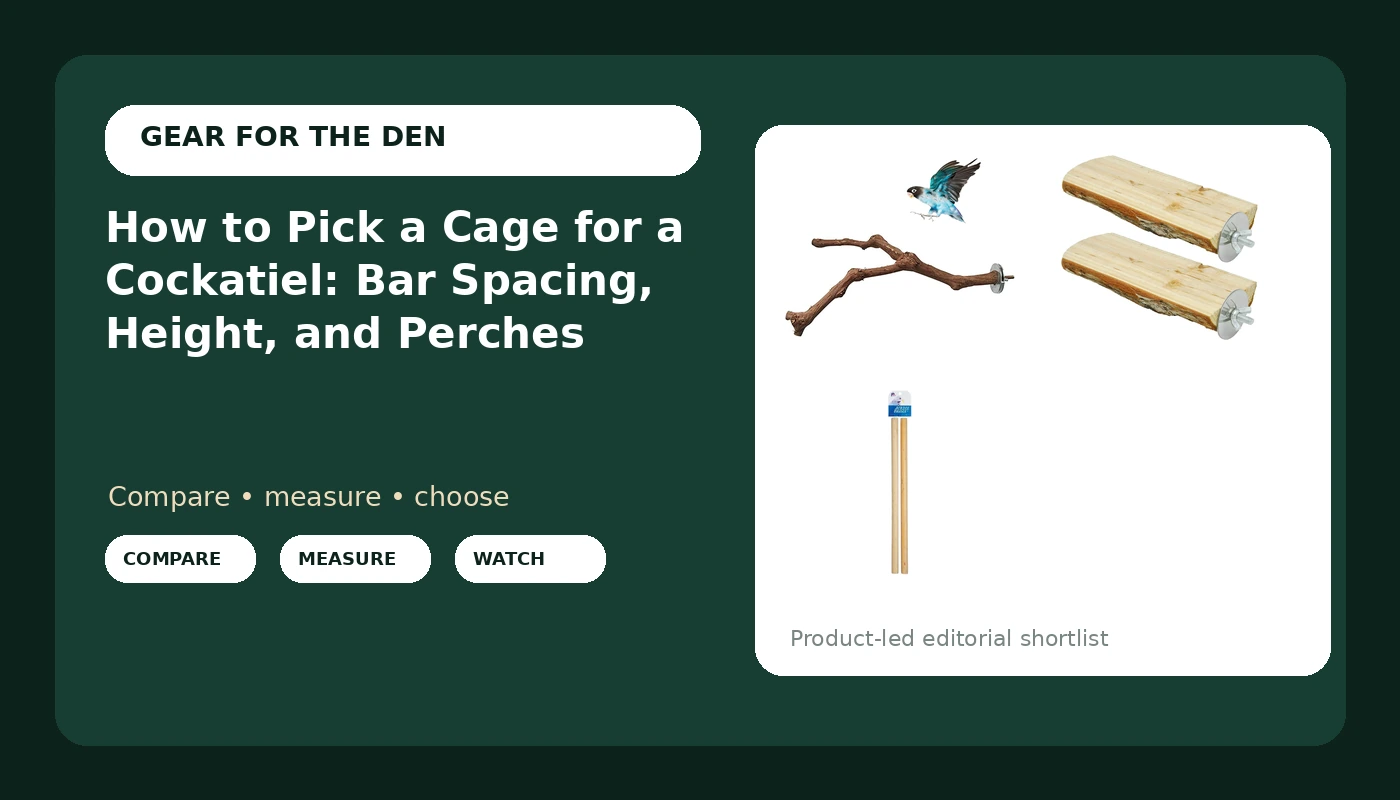
Budget pick: PINVNBY Parrot Perches Natural Birds Stand Wild Grape Stick Grinding Paw Climbing Wood Cage Accessories and Toy for Parakeet, Lovebirds,Budgies,Cockatiels and Finches
Budget pick
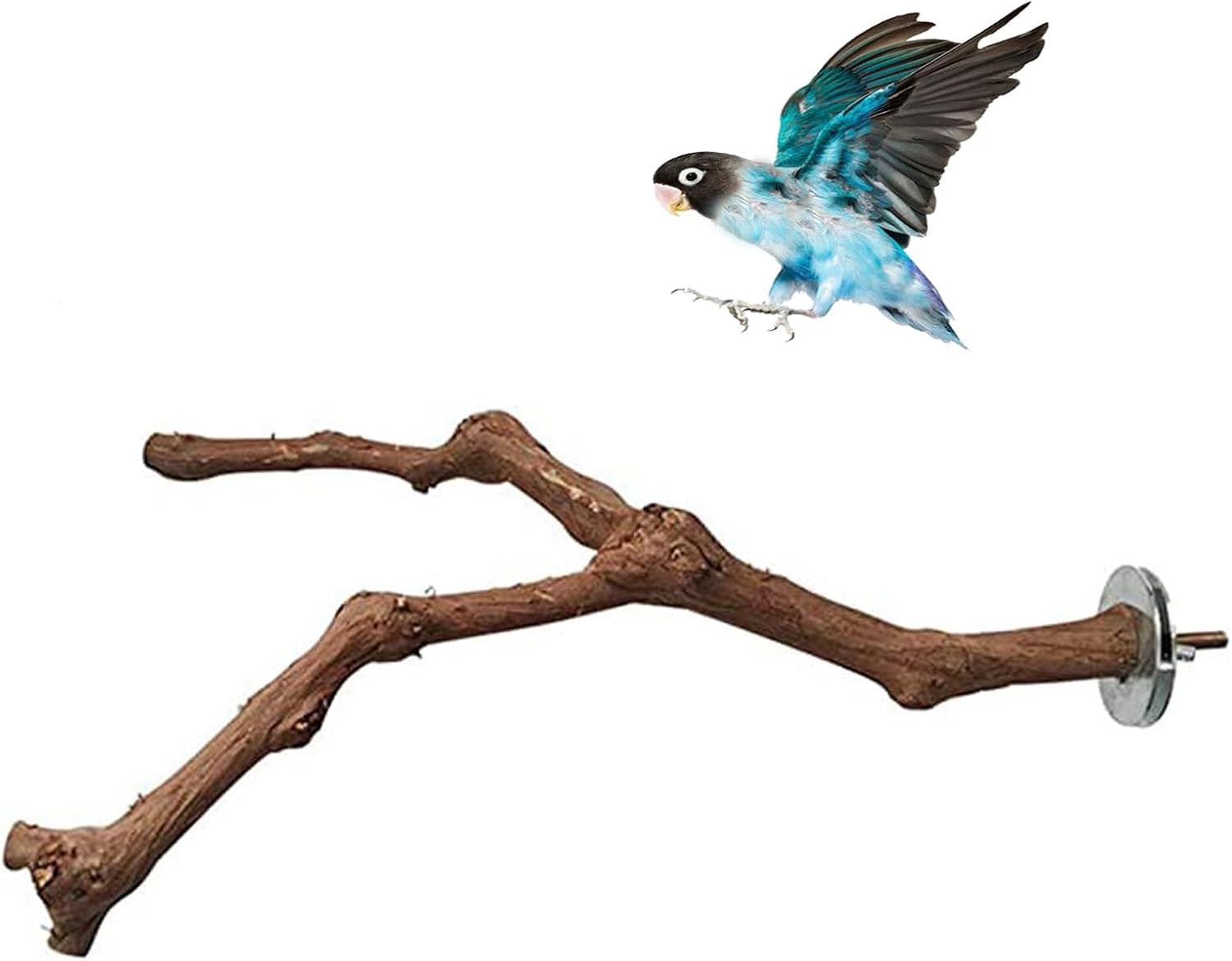
PINVNBY Parrot Perches Natural Birds Stand Wild Grape Stick Grinding Paw Climbing Wood Cage Accessories and Toy for Parakeet, Lovebirds,Budgies,Cockatiels and Finches
Check current Amazon price before you order.
Wild grape stick is the right material for a cockatiel: hard enough that it does not turn into paste in a week, rough enough that it does some work on the nails, and irregular enough that the foot changes position along its length. This is the cheapest way to replace the smooth dowel that came in the box.
It is also the least predictable product on the list, and that is the trade. Natural branches vary in diameter and shape, so what arrives may be thinner or thicker than you pictured. If your bird is a heavy chewer, expect to replace it sooner than a hardwood perch. That is fine. Chewing is the point, and a perch that gets destroyed was a perch the bird used.
Flaws but not dealbreakers: Natural wood arrives in whatever shape the branch grew. Order two if you need a specific thickness, or if you have two birds and do not want a fight over the good branch.
Best for the bird that spends all day on one dowel and needs a reason to move.
Our pick: Niteangel Parrot Cage Perch, Wooden Platform for Birds (2 Packs)
Our pick
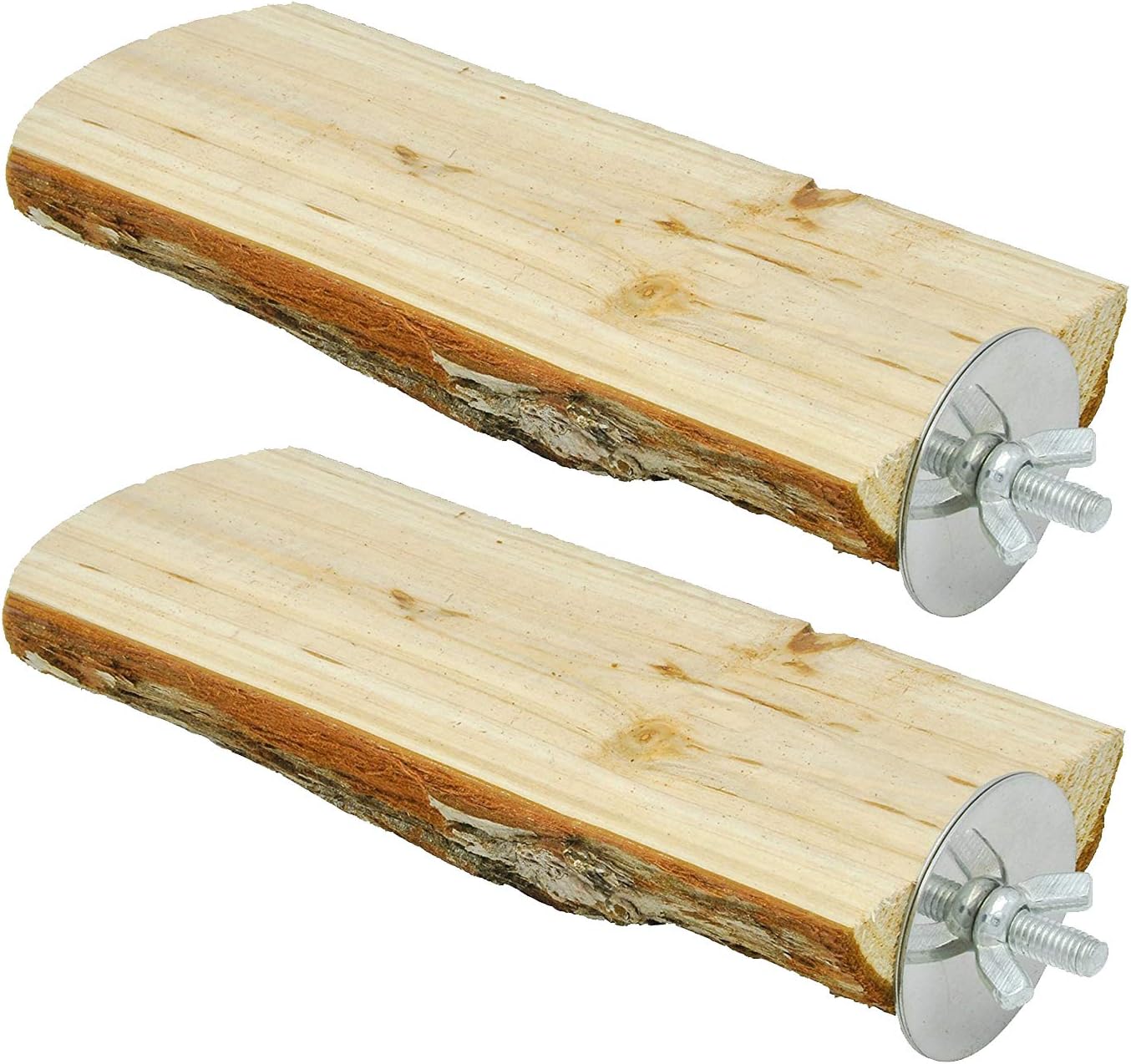
Niteangel Parrot Cage Perch, Wooden Platform for Birds (2 Packs)
Check current Amazon price before you order.
Flat platforms solve a problem that round perches cannot. A cockatiel's foot wraps a branch, but the bird also needs somewhere flat to stand while it eats, sleeps, and preens, especially if it is older or has a foot injury. Two platforms in the pack means one near the food cups and one higher up where the bird likes to roost.
The mounting hardware is the part that matters. A platform that sags when a bird lands on it teaches the bird not to trust it. Check that the bracket sits tight against the bars and that the platform does not rock front to back. Two packs also let you test placement without committing: put one high, one low, and watch which one the bird actually uses.
Flaws but not dealbreakers: Wood platforms get soiled, and a flat surface holds mess better than a branch. Line it, or plan to scrub it weekly.
Best for older birds, birds with foot problems, and any cockatiel that sleeps on the cage floor.
Upgrade pick: Prevue Pet Products Pacific Bird Cage Perch
Upgrade pick

Prevue Pet Products Pacific Bird Cage Perch
Check current Amazon price before you order.
This is the perch for a wide cage. The extra length matters because a cockatiel is a long bird, and a long tail needs room to swing when it turns around. A perch that is too short forces the bird to shuffle and scrape, and the tail drags through whatever sits below.
The other reason to spend a little more here is consistency. You know the diameter before it arrives, which means you can match it to the bird's foot instead of hoping. That matters most for the main sleeping perch, the one the bird uses for ten hours a night. Get that one right and the rest is decoration.
Flaws but not dealbreakers: It is a single perch, not a pack, so a two-bird cage needs two orders. Measure the interior width of your cage before you commit.
Best for wide cages and for the bird that needs one reliable night perch.
The actual cage-picking workflow
Now the part you came for. There is no universal ideal pick a cage for a cockatiel, but there is a repeatable order. These eight steps work on any cage, new or used, and you can do them in one sitting with a tape measure and a notepad.
Step one: Bar spacing. For a cockatiel, the target is roughly half an inch to three quarters of an inch. Wider than that and a determined bird can push its head through and get stuck; narrower and you are paying for bars the bird cannot see past. Bar spacing is the single spec that rules out most cages sold as "small bird" cages, because those are built for budgies.
Step two: Cage height and footprint. Cockatiels climb and they like height, but a tall narrow cage with a small base is worse than a shorter, wider one. Height gives a bird a place to retreat; floor space gives it somewhere to walk. Aim for a cage tall enough that the bird can perch above your eye level and wide enough that its tail clears the bars when it turns.
Step three: Door size and food cup size. A door you have to fold your hand through is a door you will stop using. Look for a full front-opening door plus a smaller cup door. Food cup size matters too: cups that are deep and narrow trap seed hulls, and cups mounted directly under a perch collect droppings. Move them or replace them.
Step four: Perch diameter. This is where most starter cages fail. A cockatiel foot should wrap roughly two thirds of the way around the perch, which puts you around three quarters of an inch to one inch for the main perch, with variation along the length. Dowels are the same diameter everywhere, which is why the natural branch above is worth the money.
Step five: Perch placement and swing mount. Put the highest perch where the bird can see the door and the room, not jammed into a corner where it feels trapped. If you hang a swing, use a swing mount rated for the bird's weight and check that it cannot swing into the food cups or the bars. A swing that knocks against the cage all night is a swing the bird abandons.
Step six: Tray liner and cleanup access. A pull-out tray with a removable grate saves you ten minutes a day. Tray liners are the cheapest part of the whole setup and the one people skip, which is how a cage gets a smell. Plan for a liner you can change in under a minute, or you will not change it.
Step seven: Foraging difficulty and enrichment. A cage is a container; the bird still needs something to do. Rotate toys, use a foraging cup, and change the layout every few weeks. Foraging difficulty should start easy and climb: a bird that has never worked for food will ignore a puzzle feeder and let it sit. Enrichment is also the reason a slightly bigger cage pays off, because it gives you room to hang things without blocking movement.
Step eight: Carrier size and the final check. Before you buy anything, check that your carrier fits through the cage door and that the cage fits through your own door. Then run the whole list once more with the bird in mind: bar spacing, cage height, perch diameter, cup position, tray, and enrichment. If two cages tie on all of that, buy the one with the bigger door.
The competition and why it lost
Some gear that shows up in the same searches does not belong in this guide.
Cage covers, seed catchers, and nest boxes are all real cockatiel accessories, but they solve problems that come after the cage decision. A cover is for sleep, a seed catcher is for a messy eater, and a nest box is a breeding question, not a housing one. Buying them before you have the cage is how people end up with a shelf of accessories that fit nothing.
Swing mounts, mineral blocks, and cuttlebone holders are the same story. They are add-ons, and every one of them depends on bar spacing and cage height, which are the two things you settle first. If you want the cleanup side of the setup, our bird cage liner and tray guide covers it.
The one category that genuinely competes with the perches above is the full perch assortment pack, the kind with six pieces in four materials. On paper it looks like better value. In practice you get one perch you like and five that are the wrong diameter for your bird. Buy the three specific perches instead and skip the bundle.
What this all costs
Here is the honest cost structure, with no prices, because prices move and my job is to tell you where the money goes.
The cage is the only real decision in the whole setup, and it is the one people rush. Everything else is small. Perches, cups, liners, and toys together usually cost less than the difference between a mediocre cage and a good one, which is why I put the gear first in this article and the workflow second.
The perches above are the cheapest part of the list, and they are also the part that changes the bird's day the most. Check current Amazon price on each one before you order, and check the length against your cage width while you are there.
Cost per day is the wrong way to think about a cage. Think in years instead. A cage that fits the bird lasts through several perch replacements, a couple of toy cycles, and at least one move to a bigger room. A cage that is too small gets replaced in eighteen months, and the second cage costs more than doing it right the first time.
So the order is: measure the bar spacing, pick the cage, then spend a little on perches, liners, and enrichment. That is how to pick a cage for a cockatiel without buying the same cage twice.