A budgie spends nearly every hour of its life inside or on top of its cage, so the bird cage for budgies is not a background purchase. It sets the bar spacing that keeps a small head from slipping between the bars, the cage height and width that decide whether the bird can climb and make short flights between perches, and the interior layout that keeps feet and beak busy. Many first-time owners get the shell roughly right and then fill it with whatever dowel came in the box, which is where foot problems and boredom tend to start. This explainer covers what the cage itself has to get right, how perch diameter, bar spacing, cage height, and tray liner choices fit together, and four perch options that cover different parts of a budgie's day.
Quick answer
The correct bird cage for budgies starts with the shell, not the accessories. Look for horizontal bars, bar spacing of roughly half an inch or less, and enough usable width for short side-to-side flights; most budgie guidance puts a single bird at a minimum near 18 inches wide, 18 inches deep, and 18 inches tall, and extra width is worth more than extra height. Then plan the inside: perches in two or three diameters, a food cup size a small bird can reach without standing on the rim, a tray liner you will actually change daily, and one perch that can double as a travel or window spot. Perch sets cost far less than a new cage, so they are usually the first thing to change when a budgie seems restless or keeps shifting its feet.
4 useful options
| Model | Best fit | What stands out |
|---|---|---|
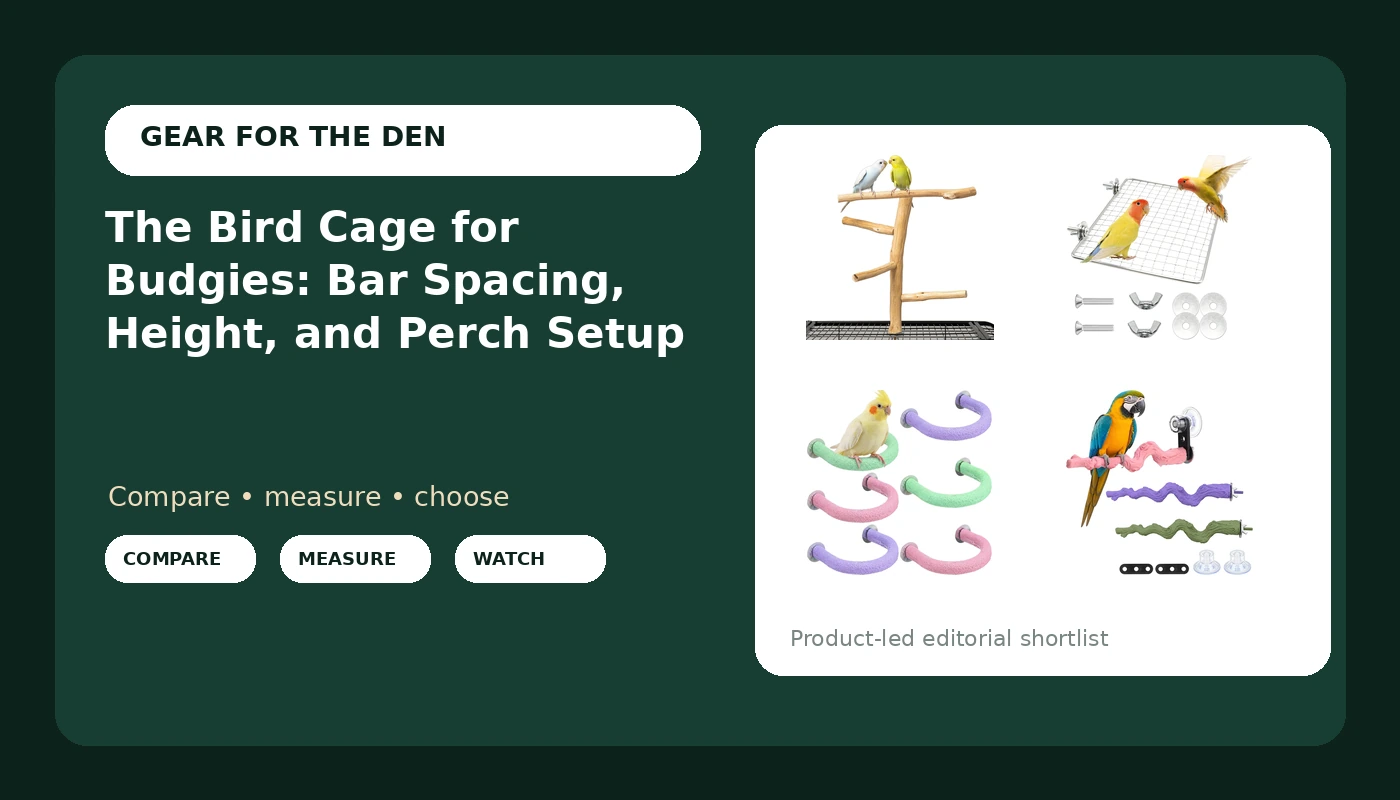
| Pecirvoli Bird Perch for Top of Cage, Natural Wood Play Stand | Out-of-cage time and landing space | Natural wood play stand built to sit on top of the cage |
| FUATY Stainless Steel Bird Perch for Cage, Open-Grid Easy Clean Parrot Perch Stand Platform | A main perch that rinses clean | Stainless steel open-grid platform with a claw-friendly grip |
| Wettarn 6 Pcs U Shape Parakeet Perch Stand Toys Bird Perches Climbing Rough Rope Paw Grinding Perch Swing Stick | Variety, climbing, and rotation | Six-piece set with rope, U-shape, and swing pieces |
| OBreezify 3 Pcs Dual-use Bird Perch with Rough Grinding Stone, Suction Cup & Screw Mount Window Perch | Travel, windows, and secondary spots | Three perches with suction cup and screw mount options |
Play stand: Pecirvoli Bird Perch for Top of Cage, Natural Wood Play Stand
A top-of-cage stand changes where the bird spends time rather than how it stands inside the cage, so it works alongside an in-cage perch plan instead of replacing it. The trade-offs are practical. The cage top has to be flat and stable enough to hold a stand, the bird is outside the bars and needs supervision, and droppings land on the cage top or the floor below instead of in the tray. Natural wood should be checked every week or so for cracks, splinters, and chewed spots, and any piece that has softened where the bird works on it is worth replacing. Used well, it adds a landing surface at a height budgies naturally prefer.
Easy-clean platform: FUATY Stainless Steel Bird Perch for Cage, Open-Grid Easy Clean Parrot Perch Stand Platform, Claw-Friendly Grip Bird Cage Accessories for Cockatiel, Conure, Budgie, Parakeet, Small Medium Birds
A flat platform is a different shape of perch rather than a better one. The level surface lets a budgie rest with the whole foot flat, which suits a bird that sits still for part of the day, but a foot that never changes angle gets no exercise, so a platform works best alongside round perches of two or three diameters. Stainless steel is the reason this one is quick to rinse: it does not soak up mess, and the grid lets water drain away instead of pooling. Check the grid for gaps that could catch a toenail, and remember that metal feels different under the foot than a branch does, which is exactly why variety matters.
Enrichment set: Wettarn 6 Pcs U Shape Parakeet Perch Stand Toys Bird Perches Climbing Rough Rope Paw Grinding Perch Swing Stick Cage Accessories for Conure Budgie Cockatiel Caique to Clean Stick Exercise
Six pieces means rotation rather than one crowded cage. Rope and swing pieces give a budgie something to climb, grip, and swing from, and the rough rope surface is meant to give nails and beak something to work against, though no perch replaces trimming or foraging. Inspect rope perches often, because frayed threads can catch a toenail and rope holds dirt that a quick rinse will not lift. A swing mount needs a solid attachment point near the top of the cage and clearance so the swing cannot knock into the bars or another perch. Because the pieces are small, this is also the easiest set to relocate, so a perch ignored in one corner may get used in another. To raise foraging difficulty, tuck a little food into a piece of the set instead of filling the main dish.
Travel and window mount: OBreezify 3 Pcs Dual-use Bird Perch with Rough Grinding Stone, Suction Cup & Screw Mount Window Perch Multi-Functional Bird Perches for Small and Medium Birds Cage, Wall, Bathroom and Car Travel
Suction cup mounting needs a clean, smooth, non-porous surface, and the cups should be pressed and checked before every use; a screw mount suits a wall or a solid surface where the bird will spend longer stretches. A grinding stone surface adds another texture for nails and beak, but it is a supplement to varied perches, not a substitute for them. The travel side is the useful part for most owners: a small perch that fits a carrier makes vet visits and car rides calmer, provided the bird cannot be thrown into the bars. Whatever the mount, press firmly and test it before the bird goes on, and keep the carrier out of direct sun.
Prices and availability may change. Product images, names, and retailer links are matched to verified listings. No current price, rating, stock status, or measured result is stated here without current evidence.
Sizing the bird cage for budgies: bar spacing, width, and cage height
There is no single ideal bird cage for budgies, and the bird cage for budgies explained below is a set of ranges rather than one model. Bar spacing is the first number to check, because it is the one thing that cannot be fixed later. Budgie guidance commonly calls for spacing of about half an inch or less, with horizontal bars so the bird can climb; a wider gap is something a small body can partly pass through, which is a serious risk. After spacing, look at usable width. Budgies fly side to side rather than straight up, so a wide, shallow cage beats a tall, narrow one, and the frequently quoted minimum for a single bird is around 18 inches in each direction, with more width for a pair. Cage height still matters, because budgies like to perch high and use the upper half of the cage far more than the floor, but height without width mostly buys climbing space. A rectangular cage with a flat top is easier to furnish, and that flat top is also what makes a play stand practical. Materials should wipe clean, with no rust or sharp edges, and any coating should be checked for chips where the bird chews. Tray liner and base design decide how much of your day goes into cleaning: a removable tray with a paper liner, changed daily, keeps droppings from building up, and a deeper base cuts down on scattered seed and hulls. Food cup size deserves a look too, since a cup that is too deep or too wide lets a budgie stand on the rim to reach the bottom. Placement is part of the setup as well: a wall on one or two sides, no drafts, no direct afternoon sun, and nothing like a nonstick pan nearby, because overheated nonstick fumes are toxic to birds.
Perch diameter, food cup size, and enrichment in practice
Perch diameter is the variable most owners never change. Budgie guidance usually lands between about three eighths and five eighths of an inch, with natural branches offering slight variation along their length, so the foot grips at a different angle through the day. Sandpaper covers are widely discouraged, because an abrasive surface does not let the foot rest. Food cup size and foraging difficulty work together: keep one shallow dish for the daily ration, and put part of it somewhere the bird has to work for, whether that is a wrapped parcel, a puzzle feeder, or food tucked among the pieces of a perch set. Carrier size is the last piece of the plan. A carrier only needs to be big enough for the bird to stand and turn, with a perch or a flat floor, and it should let the bird see out without sitting in a draft. Then run the setup in this order:
- Measure the cage and confirm bar spacing before buying anything else, because no perch or toy fixes a gap that is too wide.
- Pick two or three perch diameters and place them so the bird hops between them rather than climbing straight up one corner.
- Position food cups where nothing perches directly above them, and check that the bird can reach the bottom without standing on the rim.
- Set a tray liner routine you will keep, and choose a liner you can change in under a minute.
- Add one enrichment piece at a time and rotate it weekly instead of filling the cage on the first day.
Practical guidance for the first month
- Keep the highest perch near the top but leave head clearance, since budgies settle at height and a perch jammed against the roof gives no room to move.
- Leave the middle of the cage open. A cage packed with perches and toys has no flight path, and the bird ends up walking along the bars instead.
- Wipe food and water dishes daily and wash wood and rope perches weekly, because rope and wood hide mess that a quick rinse will not remove.
- Rotate toys and perch pieces rather than replacing everything at once, and keep one familiar perch in place so the cage still feels like home.
- Watch the feet. Constant shifting, one foot held up, or red spots on the pads are reasons to change the perch mix and to see an avian vet rather than to buy another accessory.
Which option should you choose?
Choose the Pecirvoli Bird Perch for Top of Cage, Natural Wood Play Stand when you want the bird out of the cage and on top of it, on a natural wood surface at a height budgies like. Choose the FUATY Stainless Steel Bird Perch for Cage, Open-Grid Easy Clean Parrot Perch Stand Platform, Claw-Friendly Grip Bird Cage Accessories for Cockatiel, Conure, Budgie, Parakeet, Small Medium Birds when the main perch needs to rinse clean quickly and you want a flat surface alongside round perches. Choose the Wettarn 6 Pcs U Shape Parakeet Perch Stand Toys Bird Perches Climbing Rough Rope Paw Grinding Perch Swing Stick Cage Accessories for Conure Budgie Cockatiel Caique to Clean Stick Exercise when you want several pieces to rotate for climbing, swinging, and gripping. Choose the OBreezify 3 Pcs Dual-use Bird Perch with Rough Grinding Stone, Suction Cup & Screw Mount Window Perch Multi-Functional Bird Perches for Small and Medium Birds Cage, Wall, Bathroom and Car Travel when the bird travels with you or you want extra perches on a window or wall.
None of these perches changes the numbers that matter most, which are bar spacing and usable width. A perch can make a good cage better and a cramped cage slightly less cramped, but it cannot make a cage the right size. Mount types and sizes differ between listings, so compare the listed dimensions with your cage and your bird before ordering, and treat a grinding surface as one texture among several rather than a cure for overgrown nails. Foot, beak, or breathing problems are a veterinary question, not a gear question.
The bottom line
The bird cage for budgies explained in one line: get the shell right first, then vary what the bird stands on. Bar spacing around half an inch or less, a wide rectangular cage with a flat top, a tray liner you change daily, and food cups the bird can reach without standing in them cover the parts that cannot be adjusted later. After that, perches do the daily work. A natural wood play stand for out-of-cage time, a stainless steel platform that rinses clean, a multi-piece set for climbing and swinging, and a travel or window perch for the rest of the week give a budgie a reason to move, and a bird that moves is a bird that is not parked on one spot all day.