Litter on the bathroom floor is not a cat problem. It is a box problem, and if you want to stop a cat kicking litter out at home, you change the box rather than scold the cat. The cat is doing what cats do: digging, turning, and launching over the wall with clay stuck between its toes.
The cats that throw the most litter are rarely messy by nature. They are the diggers, the big cats, and the cats who feel crowded in a box too small to turn around in. Give them depth to dig in, a wall high enough to catch the arc, and an exit they can walk out of instead of jump out of, and most of the mess is gone in a day.
Here is the order to fix it in, plus the three pieces of gear that do most of the work.
Why you should trust me
I have kept cats in apartments, in rentals with carpet I did not own, and in a house with three boxes in three rooms, and I have cleaned up more scattered litter than I want to admit. I have made every mistake in this guide before I fixed it: the tiny box, the deep fill, the hood that trapped odor, the cheap mat that spread the granules around instead of holding them.
What I care about here is not which box photographs best. It is which box keeps the litter inside it, which one a cat will use twice a day for years, and which one you can clean in under two minutes so you actually do it.
I do not sell anything and I do not accept free product for coverage. The picks below are the ones whose dimensions, materials, and entry heights line up with how cats actually behave, and the workflow is the one I would hand to anyone standing in a room with litter on the floor.
How I picked and how I tested
Every box and accessory in this guide was judged on the same short list: box size, entry height, litter depth, mat texture, clumping speed, odor control, and how easy the waste can is to empty. I read the dimensions on the listing, matched them against the body length of an average adult cat, and asked one question of each piece: does this stop litter at the door, or does it just move the mess around the room?
The test is simple and you can run it tonight. Fill a box to three inches with a fine clumping litter, put a textured mat in front of the entry, and watch where the granules land after your cat leaves. If the litter is on the mat, the setup is working. If it is three feet away, the wall is too low or the fill is too deep. If your cat is jumping out instead of walking out, the entry is too high, and that jump is the thing flinging litter across the floor.
The rest is repetition: scoop twice a day, keep the depth steady, and replace the litter before it turns to dust. If you are running more than one cat through one box, the maintenance plan in how to keep a multi-cat home from smelling like a litter box matters as much as the box itself.
One note on what I did not do. I did not put a camera on a cat and count granules, and I did not buy a lab full of boxes. The dimensions and materials below are the ones the listings give, and the guidance is built on how cats dig, turn, and exit, which does not change from house to house.
The gear that keeps the litter in the box
These three pieces cover the box, the exit, and the waste. Nothing else in a litter setup changes the mess as much as the first one does.
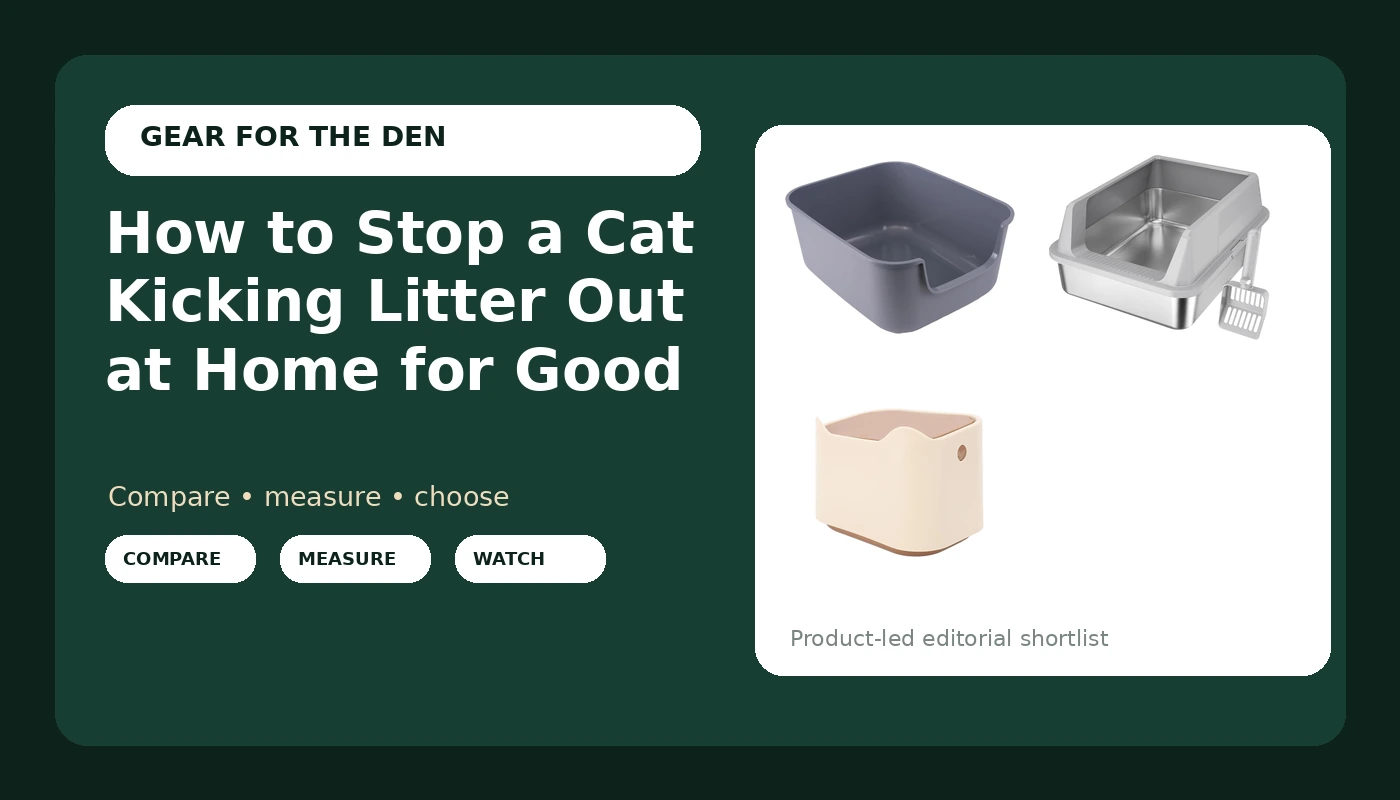
Our pick: LoopTime Large Cat Litter Box with High Sides,Cat Boxes for Indoor Cats,Cat Litter Pan for Kitty,Litter Box with Low Entry,Easy to Clean,Anti-Splashing (Grey)
Our pick
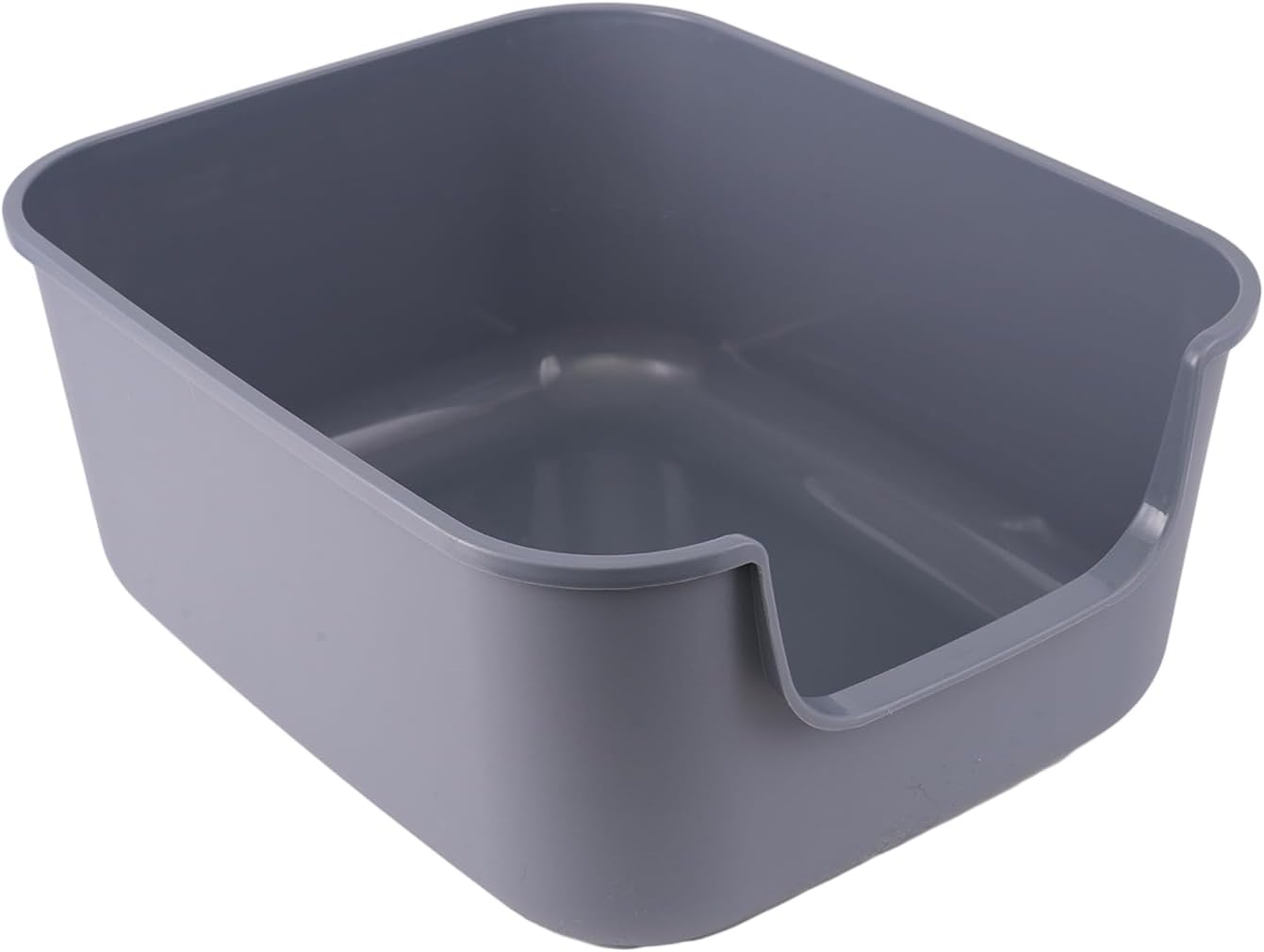
LoopTime Large Cat Litter Box with High Sides,Cat Boxes for Indoor Cats,Cat Litter Pan for Kitty,Litter Box with Low Entry,Easy to Clean,Anti-Splashing (Grey)
This is the box that solves the actual problem. The sides are high enough to catch the arc of litter a digger throws when it turns, and the entry is low enough that a cat walks out instead of hopping out. That matters more than it sounds, because the hop is what launches granules across the room.
The pan is large, which gives a full-grown cat room to turn around without its paws on the rim. Turning room is the difference between a cat that digs politely in the middle and a cat that scrapes the walls and throws litter over the top. The anti-splashing lip on the rim catches what the walls miss, and the smooth interior means a full wash takes a couple of minutes rather than a scrub.
Check current Amazon price.
Flaws but not dealbreakers: It is plastic, and plastic holds odor once the surface gets scratched, so plan on washing it with mild soap and replacing it when it goes rough. It also takes up more floor space than the box you have now, which is the trade you make for containment.
Anyone with a digger, a large cat, or carpet they care about should start here.
Best stainless option: Lifewit Stainless Steel Cat Litter Box for Kitty, 17.7"× 13.8"× 8.3", Gray
Best stainless option
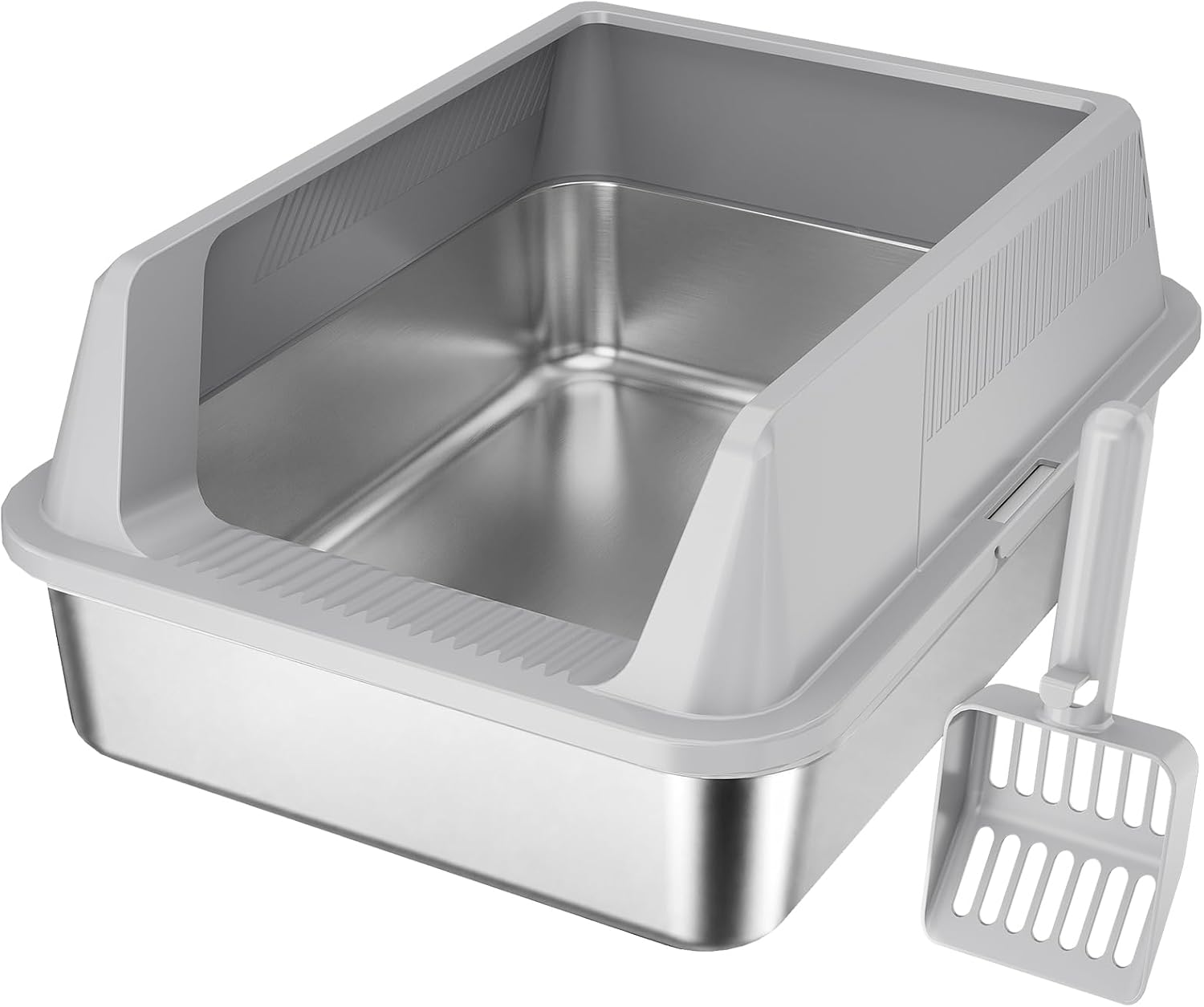
Lifewit Stainless Steel Cat Litter Box for Kitty, 17.7"× 13.8"× 8.3", Gray
The Lifewit pan is stainless steel, and that is the entire argument for it. Stainless does not absorb odor the way scratched plastic does, it does not hold the ammonia smell that builds in a plastic pan after a year of use, and it wipes clean instead of needing a scrub. If you have ever thrown out a box because it still smelled after washing, this is the fix.
At 17.7 by 13.8 by 8.3 inches it is a box for kittens, smaller cats, and gentle diggers. The 8.3-inch wall is lower than the LoopTime, so a determined kicker will still send some litter over the side, and the tighter footprint leaves a large cat with less turning room.
Check current Amazon price.
Flaws but not dealbreakers: The lower wall means more arc over the top, and the smaller floor area means it is not the box for a cat that is still growing. Pair it with a textured mat, keep the litter depth at two inches rather than three, and it stays tidy.
Best for a small cat, a senior who needs a low step, or anyone who is done with plastic odor.
The scooping-station upgrade: Saluaqui OdorResistant Cat Litter Trash Can with Press Lid Enclosed Design | Compact Multipurpose Cat Waste Garbage Can | Sturdy PP Material Ideal for Home Use
The scooping-station upgrade
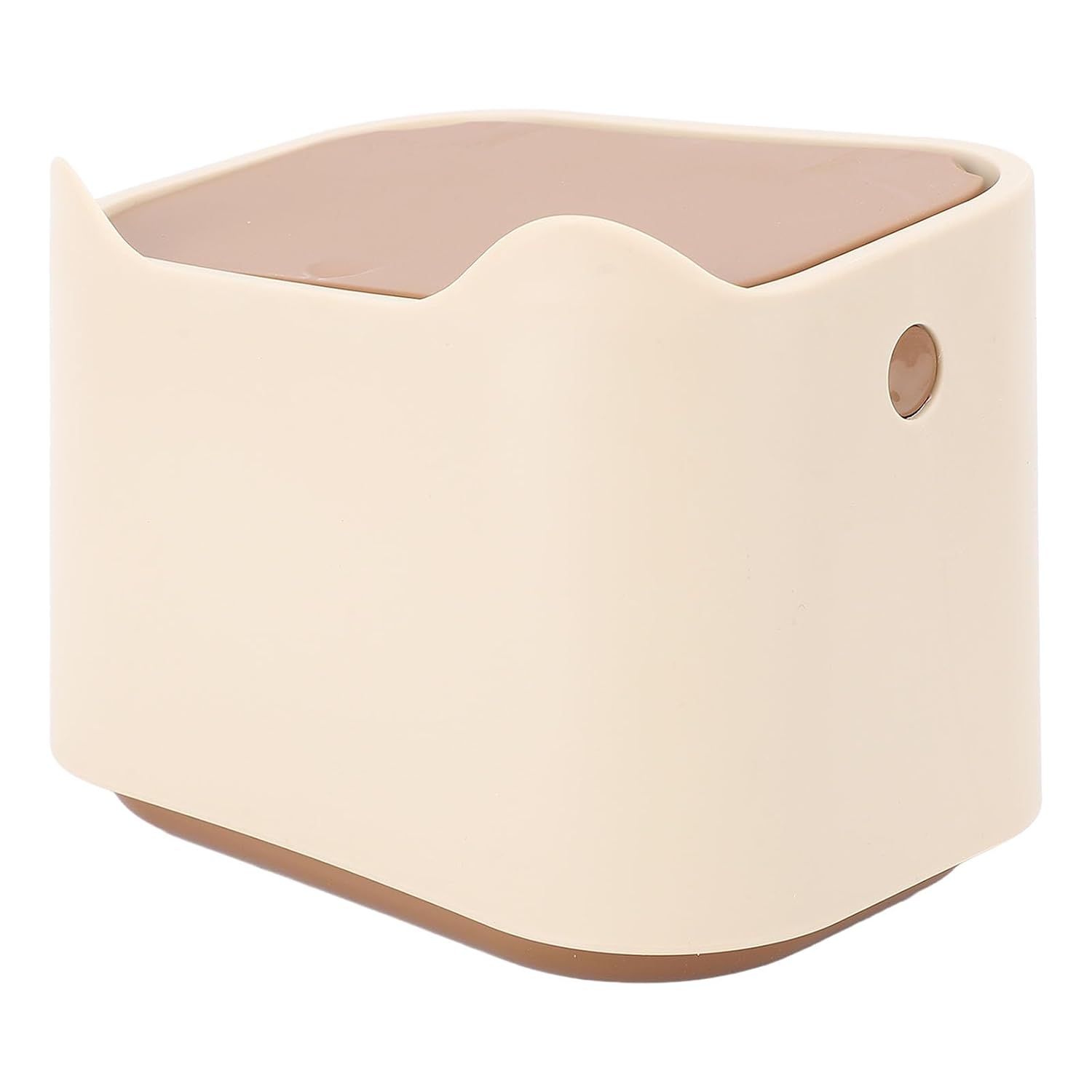
Saluaqui OdorResistant Cat Litter Trash Can with Press Lid Enclosed Design | Compact Multipurpose Cat Waste Garbage Can | Sturdy PP Material Ideal for Home Use
Scooping is where the mess actually gets made. If the waste can lives in another room, you carry a scoop of used litter across the floor, and some of it lands on the way. This can sits beside the box with a press lid, so the job is scoop, drop, press, done. The enclosed body keeps the smell inside the can instead of in the room, and the PP shell wipes clean.
It is compact, which is the point in a bathroom or a laundry corner, and compact also means you empty it more often than a full-size bin. With three cats, that is a daily job, so buy it knowing you are trading capacity for a small footprint.
Check current Amazon price.
Flaws but not dealbreakers: The capacity is small for a multi-cat house, and the press lid holds odor back rather than sealing it. Line it with a small bag and it stays manageable.
Best for a single-cat home, a small bathroom, or anyone who wants the scooping station to be self-contained.
The actual workflow: how to stop a cat kicking litter out at home
This is the order that works. Run the steps in sequence, because each one changes what the next one needs. Everything below is the practical answer to how to prevent a cat kicking litter out at home, and it starts with geometry rather than gadgets: a box long enough to turn in, litter deep enough to dig in, and a wall high enough to catch what a digger throws. That is how you stop a cat kicking litter out at home in a single weekend.
Step one: Measure the cat, not the shelf. Box size comes first. An adult cat should be able to stand in the box, turn around, and lie down without its head or tail hanging over the rim. A rough rule is a box about one and a half times the length of your cat from nose to the base of the tail, and at least as wide as the cat is long. If your box is smaller than that, no amount of litter management will fix the mess, because the cat is scraping the walls to find room. Sizing is the part people get wrong most often, so if you are choosing between two boxes, take the longer one.
Step two: Set the litter depth. Two to three inches is the working range. Three inches gives a digger enough material to dig in without hitting the bottom of the pan, which is when cats start flinging. Two inches suits a shallow pan or a cat that wants to see the floor. More than three inches in a low-sided box is an invitation, because the cat pushes the extra litter straight over the wall. Depth is the cheapest way to prevent a cat kicking litter out at home, and it is the step most people skip.
Step three: Choose a litter with a fast clumping speed. A fine-grain clumping clay grabs moisture in seconds and forms a firm clump you can lift without it crumbling. Coarse litters and crystals scatter farther when they are kicked, and a slow clump breaks apart on the scoop, leaving fragments in the box that a cat will dig at. Fast clumping also means less tracking, because the litter that sticks to a paw is the litter that has not clumped yet.
Step four: Get the entry height right. A low entry is the most underrated feature on a litter box. When the entry is high, the cat has to jump out, and the jump is what launches litter across the room. When the entry is low, the cat walks out and the granules fall off in the doorway where a mat can catch them. If your current box has a high entry, put a sturdy cardboard step in front of it while you shop for a replacement.
Step five: Raise the wall on the exit side. High sides catch the arc. The LoopTime box above is built around that idea: tall walls on three sides, a low entry on the fourth, and an anti-splashing lip on the rim. If you want to keep the box you have, a plastic storage bin with a door cut into one end does the same job, though it takes an hour and a steady hand with a utility knife.
Step six: Put texture at the door. Mat texture matters more than mat size. A woven or honeycomb mat traps granules in the gaps and holds them until you shake it out. A smooth rubber mat spreads the litter around and gives it somewhere to sit. Set the mat so the cat has to step on it on the way out, and shake it back into the box once a day. This is the step that decides whether you sweep or not.
Step seven: Move the box, and the exit path. A box wedged in a corner gives the cat one way out, and that way is usually straight into open floor. Pull the box away from the wall so the entry is not aimed at the doorway you walk through, and give the cat a clear sight line from inside the box. A cat that is not watching its back leaves the box at a walk instead of a sprint, and a walking cat tracks less.
Step eight: Empty the waste every single day. Scoop twice a day, morning and night, and take the clumps out of the room instead of leaving a bag beside the box. A press-lid can keeps the odor contained and keeps you from carrying used litter across the floor. If your box has a waste drawer, empty it on the same schedule as the scoop. Once a week, dump the whole box, wash it, and refill with fresh litter. Odor control is not only about the smell in the room: a box that smells is a box a cat rushes, and a rushed cat kicks.
The competition and why it lost
None of these solve the problem as cleanly as a bigger box with higher walls, and that is the honest way to stop a cat kicking litter out at home. Still, every one of them comes up when people ask, so here is why each one lost.
The hooded box lost first. A cover looks like it contains litter, and it does catch some of the arc, but it traps odor inside a small space, and plenty of cats will not use a box they cannot see out of. If your cat is a kicker and the hood is on, take it off for a week and see what changes before you buy anything.
Top-entry boxes are genuinely good at stopping litter, because the cat has to climb out through the top and the granules fall back in. They lose on the other side: a senior cat, a cat with a sore joint, or a small kitten will not use one, and a box that does not get used is not a solution. If you have a young, healthy digger and no seniors in the house, a top-entry box is a fair choice. If your house has a mix of ages, it is not.
Self-cleaning boxes with a weight sensor and a sensor range have the same problem in a different shape. They cost more than the rest of the setup combined, they jam, and the sensor range that decides when the rake runs is often set for a cat larger than yours, so a small cat gets interrupted mid-visit. They also hide the problem: you stop seeing how much your cat is urinating, which is one of the first signs of a urinary issue.
Crystal litter and pine pellets both track less than clay in theory, and both lose here for the same reason. They do not clump the way a fine clay does, so the box stays wetter and smells sooner, and a wet box is a box a cat digs at harder. A smooth mat loses to a textured one for the same simple reason: it has nowhere to hold the granules.
What this all costs
Three pieces of gear and one recurring cost. The box is a one-time purchase that should last years if you keep it clean, and the same goes for the waste can and the mat. Litter is the only line you pay for again and again, and a proper three-inch fill of a fast-clumping litter costs more per box than a thin layer of a cheap one. That is the trade you are making, and it is worth making, because a thin fill is what sends litter over the wall.
The math that matters is not the sticker on the box. It is the litter you throw away because the depth was wrong, the carpet cleaning you pay for because the wall was too low, and the replacement box you buy in a year because the first one was too small. Buy the right size once and the rest is maintenance.
Check current Amazon price on the box and the can, add a textured mat from anywhere, and you have a setup that ends most of the mess. The rest is scooping, twice a day, forever.
That is the job. Your cat is not the problem. The box is.