If you are looking for how to stop a cat kicking litter out, start by forgiving the cat. Cats do not fling litter to annoy you. They dig, they pivot, and a hind paw catches the top layer of litter on the way out of a box that is too small, too shallow, or too low at the lip. The litter lands on the floor because nothing in the setup is built to catch it.
I have lived with cats for most of my adult life, including a big tabby who treated his box like a sand pit, and I have written about pet gear long enough to know that most scatter complaints get answered with the wrong advice. People buy a bigger mat, or a covered box, or a no-track litter, and the litter still ends up in a two-foot halo around the box. The reason is that scatter is a system problem. Change one piece and the other pieces still fail.
This guide covers the whole system: the box, the litter depth, the mat, and the placement. If you are still shopping for the box itself, my guide to litter boxes for small apartments walks through sizing before you spend anything.
Why you should trust me
I am not a veterinarian and I do not play one on the internet. What I am is a pet gear writer for Gear for the Den who has shared a home with cats for more than twenty years, including a multi-cat stretch where litter scatter was a daily argument. I have also spent years reading manufacturer specs, owner complaints, and return reasons, which is where the useful patterns show up. When people ask me how to stop a cat kicking litter out, the answer is almost never a new litter. It is almost always a box with a higher lip, a shallower bed of litter, and a mat that actually grabs what falls.
How I picked and how I tested
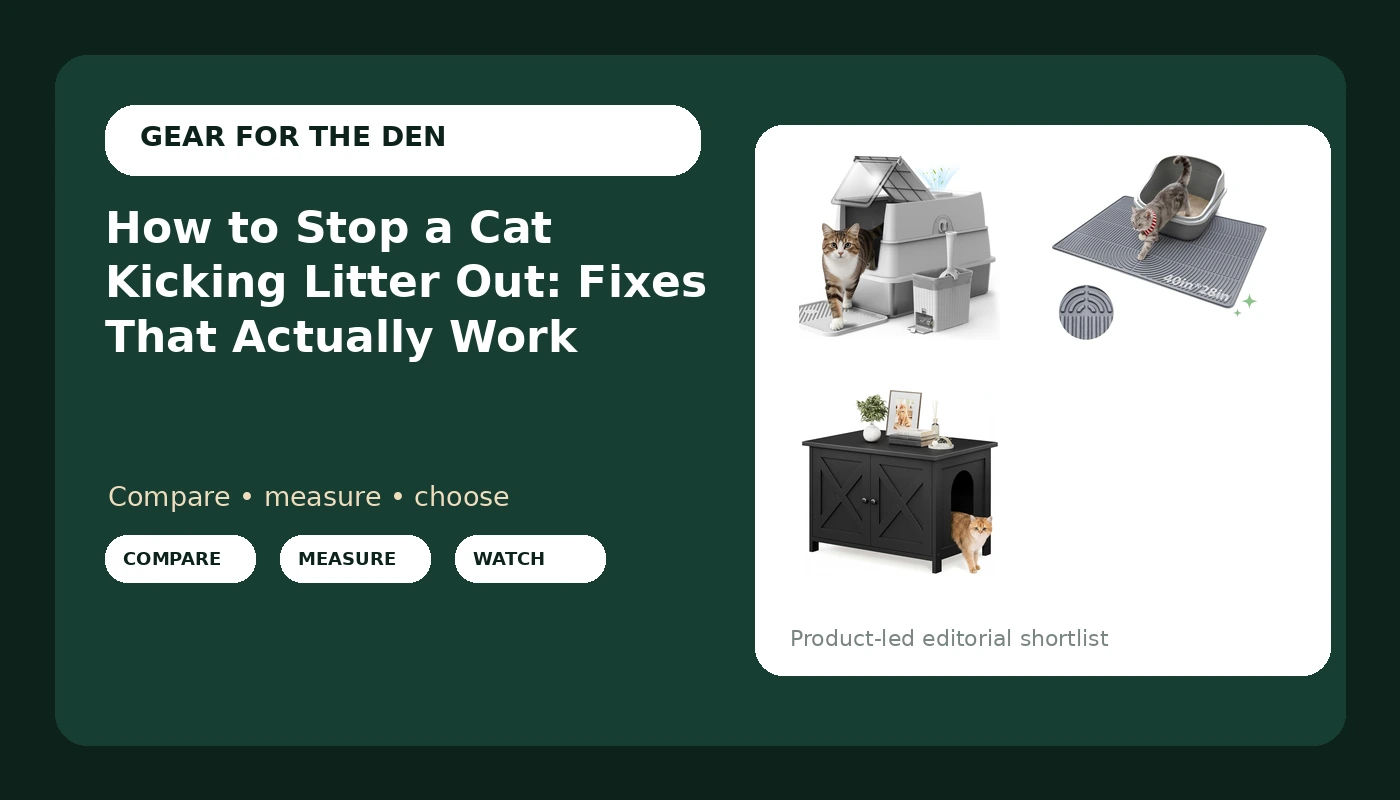
Three products are in this article: a covered stainless box, a large silicone mat, and a hidden enclosure. I did not run a laboratory test on any of them, and I am not going to pretend I measured scatter in grams. What I did was compare each one against the variables that control litter scatter, and I checked the same list every time: box size, entry height, the litter depth it can hold, clumping speed of the litter it works with, mat texture, odor control, whether there is a waste drawer or a simple pan, and sensor range on anything automated.
A box that is too small forces the cat to stand with its hind end near the door. A low entry height means litter rolls straight out. A mat with the wrong mat texture either lets the litter bounce or traps it so deep you cannot shake it clean. Odor control matters too, because a box that smells gets used fast and messy. The fastest way to stop a cat kicking litter out is to fix all of those at once instead of one at a time.
The three picks below are the pieces I would put together for a household with a chronic scatter problem. Each one solves a different part of the leak.
Gear that helps stop a cat kicking litter out
The covered box: Stainless Steel Litter Box with Lid | XL Enclosed Covered Cat Litter Box
The covered box
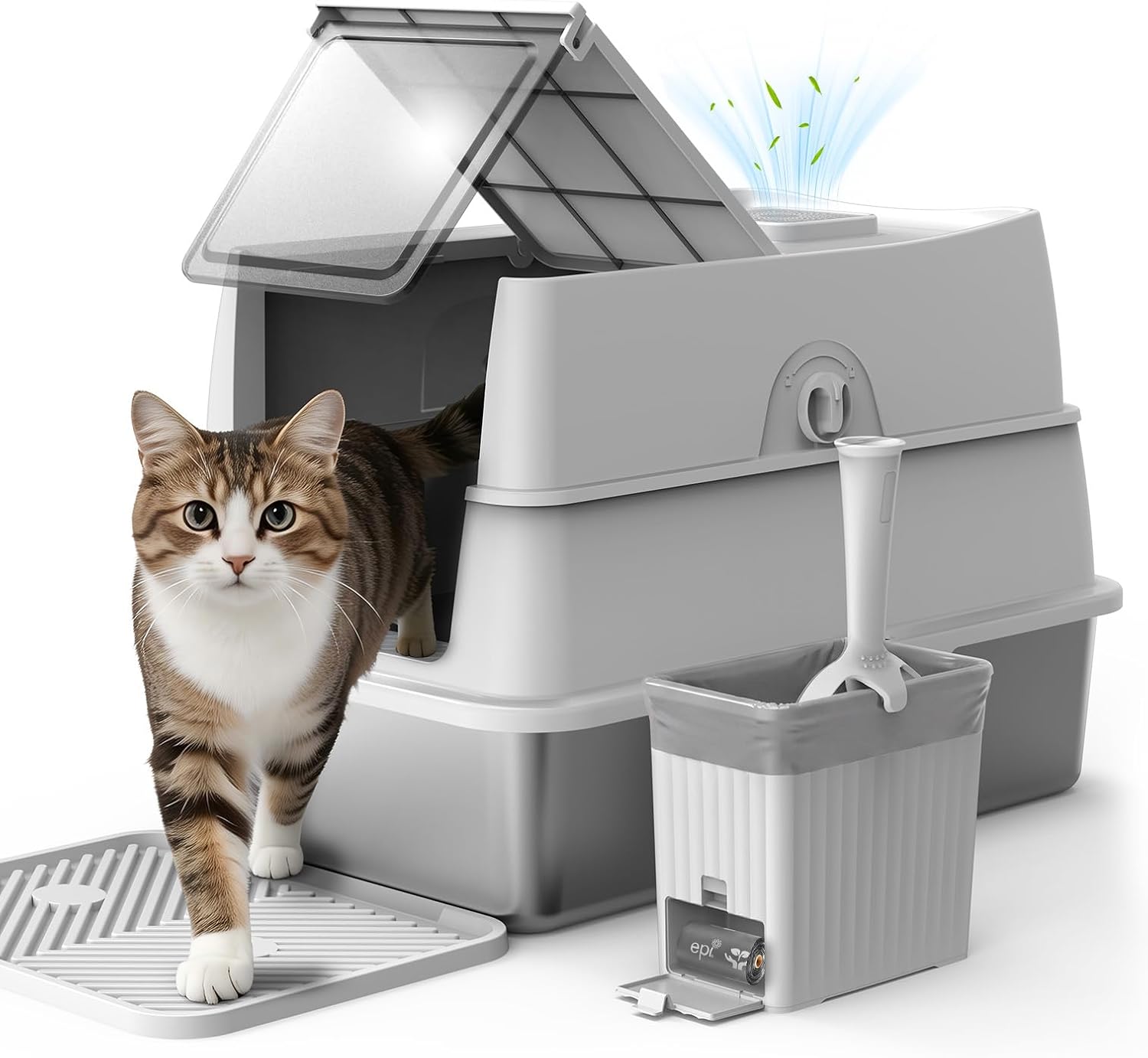
Stainless Steel Litter Box with Lid | XL Enclosed Covered Cat Litter Box
Check current Amazon price. This is the piece that fixes the source of the problem rather than the symptom. Stainless steel does not hold odor the way plastic does, so the box stays usable longer between deep cleans, and the enclosed design gives you walls tall enough to catch most of what a digging cat throws. The lid matters for the same reason a splash guard matters on a sink: it contains the arc.
The trade-off is real. Some cats refuse a covered box, especially if the entry is small or the interior is tight. If your cat is a large breed or a senior with mobility issues, watch the entry height and make sure there is room to turn around. The upside is that a covered stainless box handles odor control better than most plastic pans, and it wipes clean instead of staining.
For a cat that kicks litter backward out of an open pan, this is the single biggest change you can make. Pair it with the mat below and the scatter drops fast. If you want to know how to prevent a cat kicking litter out without buying furniture, this box plus a mat is the whole answer.
Flaws but not dealbreakers: A lid does not make a box self-cleaning. You still have to scoop daily, and you still have to wash the interior.
The trapping mat: Pawtasy Cat Litter Mat,40" x 28" Extra Large Silicone Waterproof Litter Trapping Mat for Scatter Control Soft on Kitty Paws Non-Slip Easy to Clean
The trapping mat
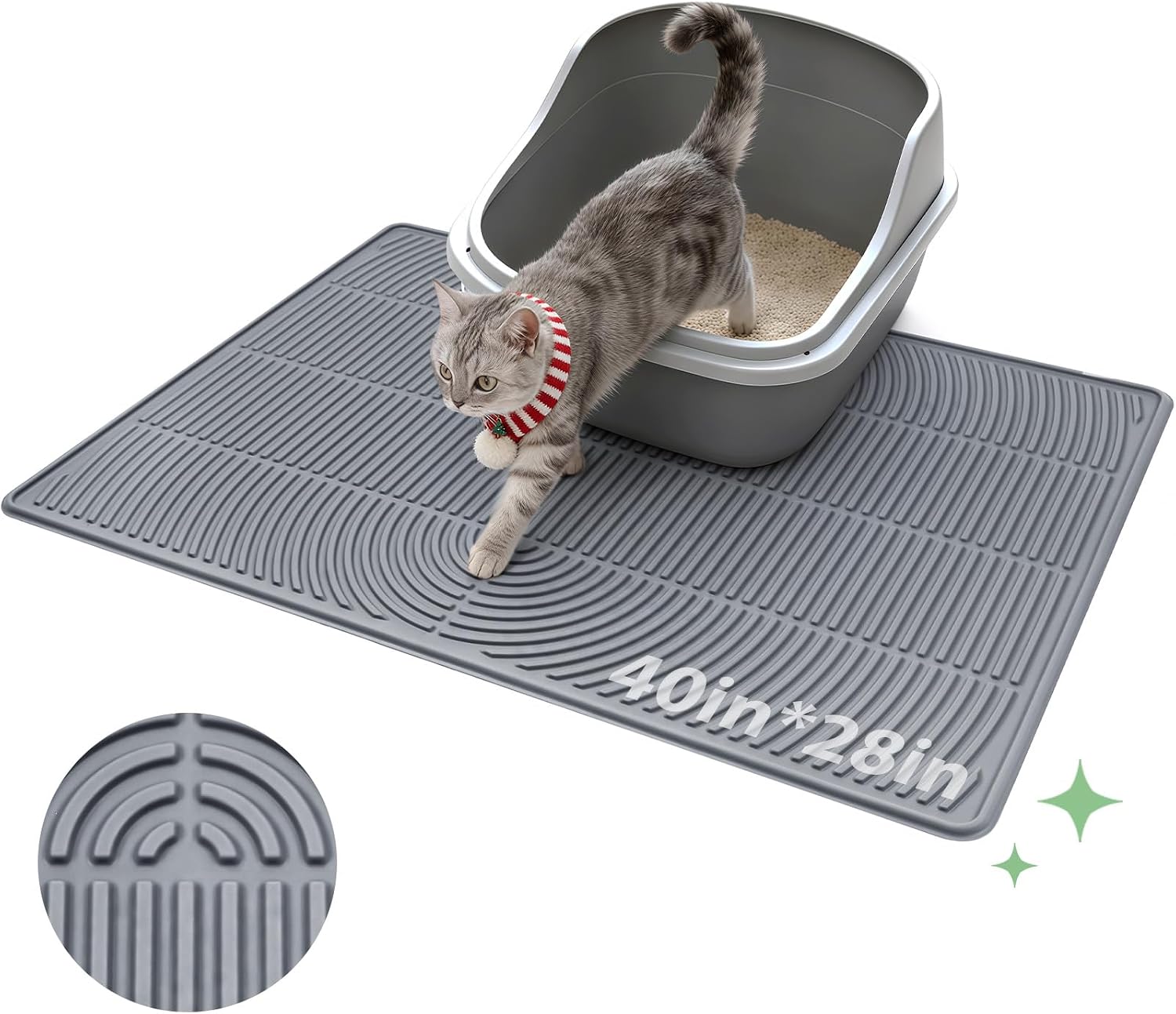
Pawtasy Cat Litter Mat,40" x 28" Extra Large Silicone Waterproof Litter Trapping Mat for Scatter Control Soft on Kitty Paws Non-Slip Easy to Clean
Check current Amazon price. A mat only works if it is big enough and if its surface grabs litter instead of letting it roll. This one is 40 by 28 inches, which is large enough to extend past the door of a covered box in every direction a cat might exit, and the silicone surface has enough texture to catch granules. Soft on paws matters more than it sounds: a cat that dislikes the mat will step over it and shake litter onto the floor anyway.
The mat texture is the part people get wrong. Deep grooves and bristle mats trap litter well but are miserable to clean. A flat silicone mat like this one is easy to shake, rinse, and wipe. The non-slip backing keeps it from sliding when a cat launches out of the box at speed.
The cheapest way to prevent a cat kicking litter out is often this mat alone, placed correctly. It will not fix a box that is too small, but it catches the litter that a good box still lets escape.
Flaws but not dealbreakers: A large mat takes up floor space, and silicone shows hair and dust between cleanings.
The enclosure: Shintenchi Cat Litter Box Enclosure, Litter Box Furniture Cabinet Hidden with Removable Divider, Wooden Cat House with End Table, Black, 31.5 inch
The enclosure
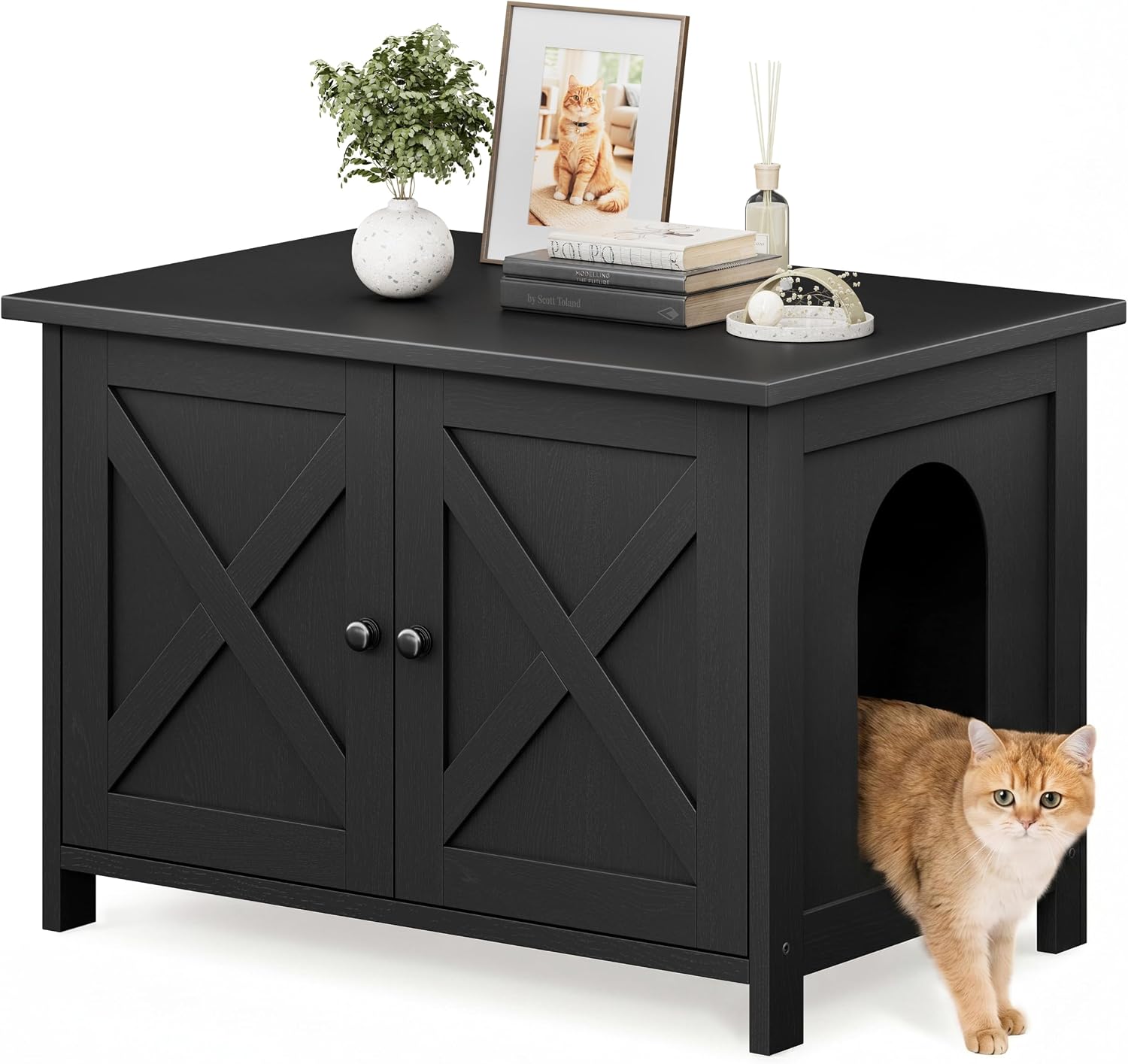
Shintenchi Cat Litter Box Enclosure, Litter Box Furniture Cabinet Hidden with Removable Divider, Wooden Cat House with End Table, Black, 31.5 inch
Check current Amazon price. An enclosure does two things at once: it hides the box so guests stop noticing it, and the walls and doorway act as a second containment layer around whatever the box itself misses. The removable divider is the useful detail here. With the divider in, you can run two boxes in one cabinet, which is the answer for a multi-cat home where one box is never enough. With it out, a single XL box fits with room to spare.
The 31.5-inch width is the number to check against your box. If your pan plus the mat footprint is wider than that, measure before you order. The end table top is a bonus for a small apartment, since it turns dead floor space into a surface you can actually use.
An enclosure is not a fix on its own. It contains scatter, but if the box inside is tiny and the litter is deep, you will still find litter in the doorway and on the floor in front of it. Think of it as the last line of defense after the box and the mat.
Flaws but not dealbreakers: Assembly is required, and a cabinet that is not cleaned regularly will hold odor because the airflow is limited.
The step-by-step fix to stop a cat kicking litter out
Step one: Size the box to the cat, not the corner. Box size is the first variable. A box should be at least one and a half times the length of your cat from nose to the base of the tail, and wide enough that the cat can turn around without its rear end hanging over the edge. A cat that cannot turn around will back up to the door and kick. If your current box is smaller than that, nothing else you do will fully fix the scatter.
Step two: Raise the entry height. Entry height is the quiet fix. A box with a five- to six-inch lip catches the litter a cat throws backward. If your cat is a senior or has joint trouble, a high lip is a problem, so use a low entry with a high back and sides instead. Covered boxes raise the effective entry height, but only if the cat will use them. Test with the lid off first, then add it.
Step three: Set litter depth at two to three inches. Litter depth is a balance. Too shallow and the cat digs to the bottom, which makes a mess and can lead to avoiding the box. Too deep and every paw stroke throws more litter over the side. Two to three inches of clumping litter is the usual sweet spot. Mark the level with a piece of tape on the outside of the box so you can refill to the same line.
Step four: Use a litter with fast clumping speed. Clumping speed decides how much loose litter is left to be kicked. A fast-clumping litter forms a firm puck quickly, so you remove urine in one piece instead of breaking it into crumbs that end up outside the box. Slow clays also track more, because the granules stay small and light. If your cat is a digger, a heavier, fast-clumping litter stays put better.
Step five: Put the right mat under the exit. Mat texture and size both matter. A mat should extend at least one cat length in front of the door and a few inches on each side. Silicone catches granules and rinses clean; bristle mats trap more but are harder to maintain. Avoid small decorative mats. They look tidy and do nothing. If you only change one thing today, make it a mat that is bigger than you think you need.
Step six: Position the box and the mat together. Placement changes behavior. Put the box in a corner so two walls help contain the scatter, and leave the mat on the open side. Do not face the box into a wall or a tight closet where the cat has to squeeze out. A cat that exits at an angle kicks at an angle, and your mat needs to cover that path, not just the doorway.
Step seven: Control odor and empty the waste drawer or pan daily. Odor control is not just about smell. A box that smells gets used quickly and carelessly, and cats that dislike a dirty box may dig harder or go elsewhere. Scoop at least once a day, twice if you have multiple cats, and wash the box weekly with a mild soap. If your box has a waste drawer, empty it before it is full. If it has a carbon filter, replace it on schedule.
Step eight: Check sensor range and waste drawer capacity on automatic boxes. If you use a self-cleaning box, sensor range determines whether it cycles at the right time. A sensor that triggers late leaves a dirty bed; one that triggers while the cat is still inside is worse. Waste drawer capacity decides how often you deal with the mess. Automatic boxes reduce scooping, not scatter, so keep the mat and the box size rules in place.
The competition and why it lost
The obvious alternatives all fail in specific ways. A hooded plastic box with a small door is the classic recommendation, but if the door flap is stiff or the interior is cramped, cats either refuse it or bolt out and scatter worse. Top-entry boxes contain litter well, but they are hard on seniors and cats with arthritis, and some cats simply will not use them.
Automatic self-cleaning boxes solve scooping, not scatter. They still need the right box size and the right mat, and the raking mechanism can drag litter toward the opening. Wood pellet litter reduces tracking for some cats, but pellets are light and roll, and many cats kick them just as far as clay.
Deep-groove mats trap a lot of litter and then hold it, which means scrubbing rather than shaking. Small mats are the most common mistake because they cover only the doorway, not the arc. And a litter box inside a closed cabinet with poor airflow can turn a scatter problem into an odor problem, which is why the enclosure above needs regular cleaning.
None of these are bad products in the right home. They lose here because this article is about scatter, and scatter is solved by size, height, depth, and a mat that covers the exit path.
What this all costs
The three pieces sit in three different cost tiers. The mat is the least expensive and the easiest place to start. The covered stainless box costs more than a basic plastic pan, but it lasts longer and holds less odor. The enclosure costs the most because it is furniture, and it is the one you can skip if the scatter is already under control.
Check current Amazon price on each listing before you decide, because prices move and the math changes. My advice is to buy in order of impact: box first, mat second, enclosure third. If the scatter is mild, the mat alone may be enough. If litter is landing two feet from the box every day, start with a larger box with a higher lip, then add the mat.
There is no subscription here and nothing to replace monthly except litter and filters. That is the whole cost of fixing this problem: one good box, one good mat, and the discipline to keep the litter at the right depth. Your cat is not going to change. The setup can.