Most aquarium stand wobble has nothing to do with the stand. It is a floor that drops a quarter inch across four feet, a leg bolt that stretched in transit, or a shelf carrying a bucket of water and a bag of filter media instead of a tank. You can stop an aquarium stand from wobbling in an afternoon with a spirit level, a wrench, and a few dollars of shims, and this is how to stop an aquarium stand from wobbling in the order that actually matters: floor first, frame second, load last.
A stand is a load path. Everything the tank weighs has to travel through the frame, through the feet, and into the floor without a gap anywhere along the way. The moment a gap opens, the frame starts to rack, the water surface moves on its own, and the whole setup turns into something you check twice a day instead of something you enjoy.
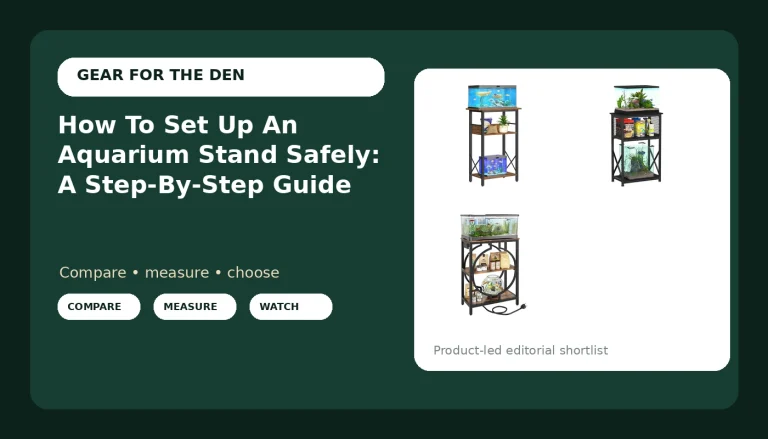
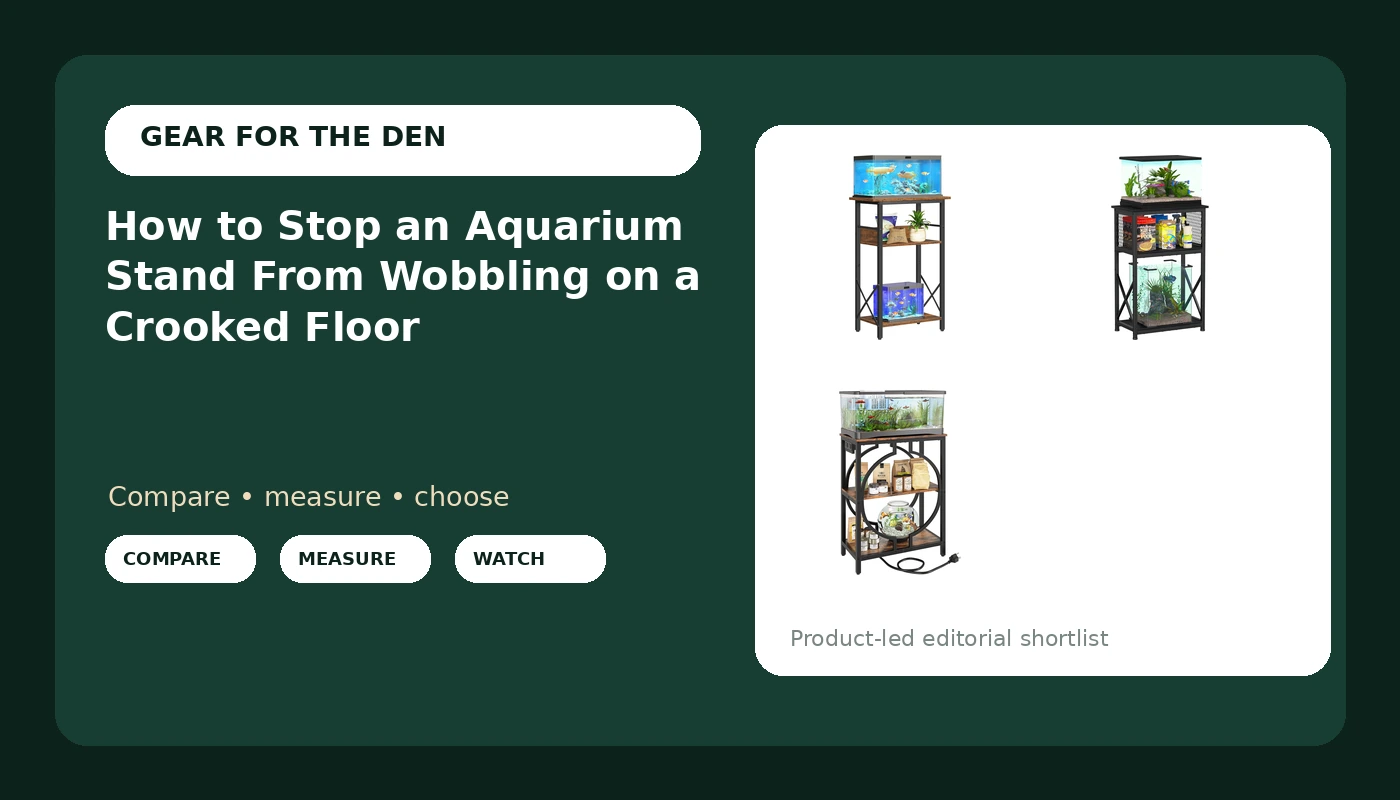
The three stands below are the 10 gallon, three-tier frames I would look at first, and the eight steps after them work on any stand you already own, including the particleboard cabinet that came in the tank kit.
Why you should trust me
I have kept freshwater tanks on a second-floor apartment floor, in a basement with a floor drain, and in a rental where the joists ran the wrong way under the exact spot the tank needed to sit. I have re-leveled the same stand after two moves, and I have watched what a slow tilt does over a month: the water line goes crooked, the filter intake starts pulling air, and the silicone seam takes the blame for a problem that started at a foot.
I am not a structural engineer, and a bubble level is not a substitute for one. What I can hand you is the sequence, the order of operations that keeps you from leveling a tank on a frame that is still loose or tightening bolts on a stand you are about to shim. Most wobble fixes fail because the owner starts in the middle.
How I picked and how I tested
I judge a stand on four things, in this order. The footprint, because a tank that overhangs the top frame puts stress on glass that was never designed to take it. The frame material and how the legs attach, because welded steel and bolted steel fail differently and you want to know which one you own. The shelf spacing, because the storage tiers are where most people quietly overload the thing. And the feet, because a stand with fixed feet needs a flat floor, and most rooms do not have one.
For the three stands below, the numbers that matter are on the listing: the top surface dimensions, the height, and what the frame is made of. The numbers that do not matter are the marketing words. I also look at whether the shelf hardware is welded or bolted, and whether the feet adjust, because both decide how much of the workflow below you can do with your hands instead of a drill.
Everything here is 10 gallon class. None of these frames is a test bench for a 75 gallon tank, and I would not ask one to be. If you are still building out the rest of the setup, start with my freshwater aquarium setup checklist so you know what the stand has to hold before you shop.
Gear that helps you stop an aquarium stand from wobbling
Each of these is a different answer to the same question: how do you get a stable frame under a small tank without building one yourself. All three are three-tier stands with storage, so the choice comes down to proportions, hardware, and one feature you either want or do not.
Budget pick: HOOBRO 10 Gallon Aquarium Stand, 3-Tier Fish Tank Stand with Storage
Budget pick
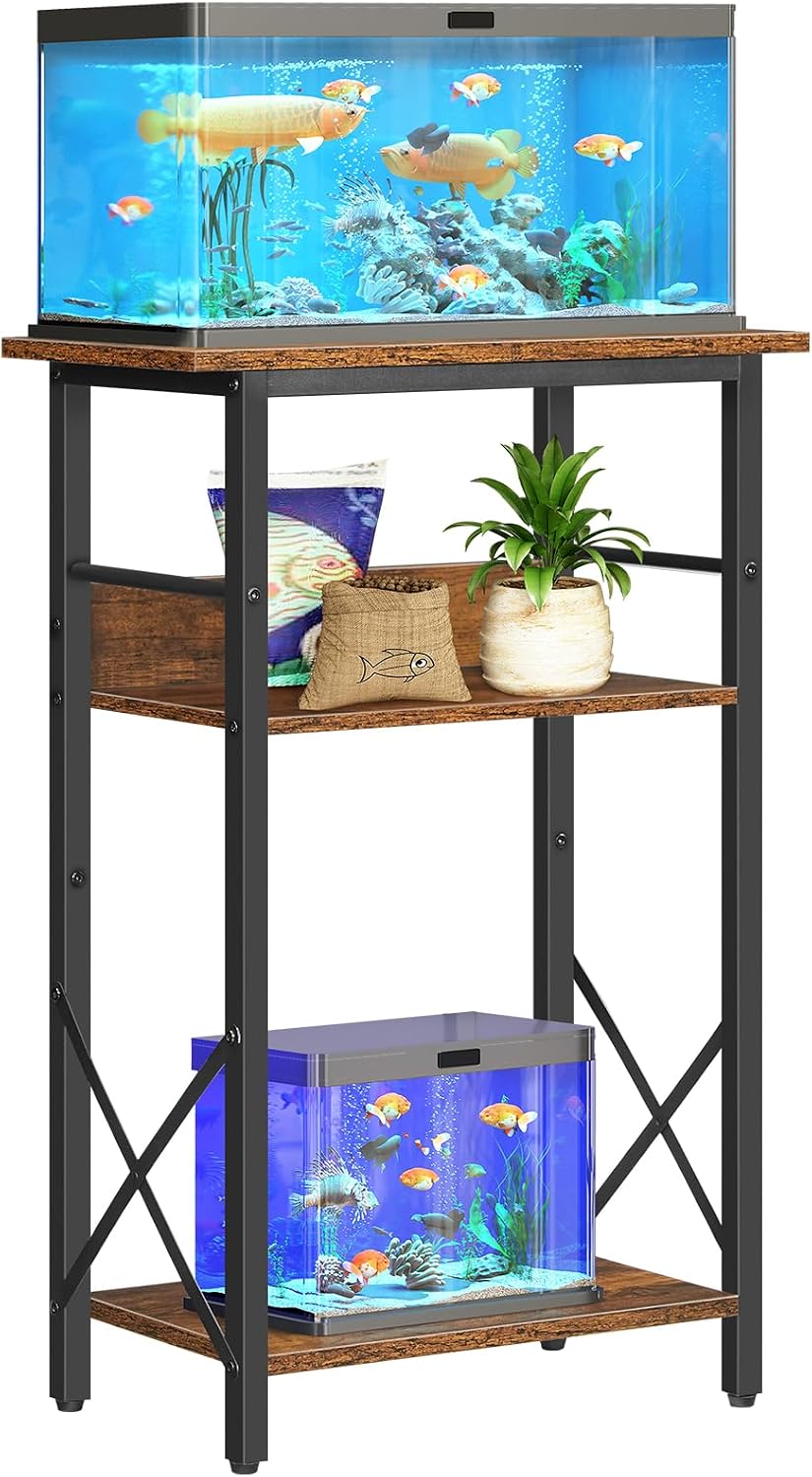
HOOBRO 10 Gallon Aquarium Stand, 3-Tier Fish Tank Stand with Storage
Check current Amazon price. This is the simplest of the three, and that is the point. An open metal frame with three tiers means you can see every joint and get a wrench on every bolt, which is exactly what the workflow below asks you to do. Closed cabinets hide the hardware, and hidden hardware is how a stand ends up wobbling for a year before anyone notices.
The top tier takes a 10 gallon tank. The lower tiers are for the equipment list: the bucket, the food, the test kit, the spare filter media. Keep the heavy items on the bottom tier and keep the top tier clear of anything that is not the tank, because every pound up high raises the center of gravity and makes the whole frame easier to move.
Flaws but not dealbreakers: open shelves put everything on display, and the frame is light enough that it will walk a little if you drag it across a floor instead of lifting it.
Anyone setting up a first 10 gallon in an apartment, where the stand has to be light enough to move on moving day, should start here.
Our pick: Snughome 10 Gallon Aquarium Stand with Storage, 3 Tier Heavy Metal Fish Tank Stand Shelf 20.47" x 11.42" x 30.91", Black
Our pick
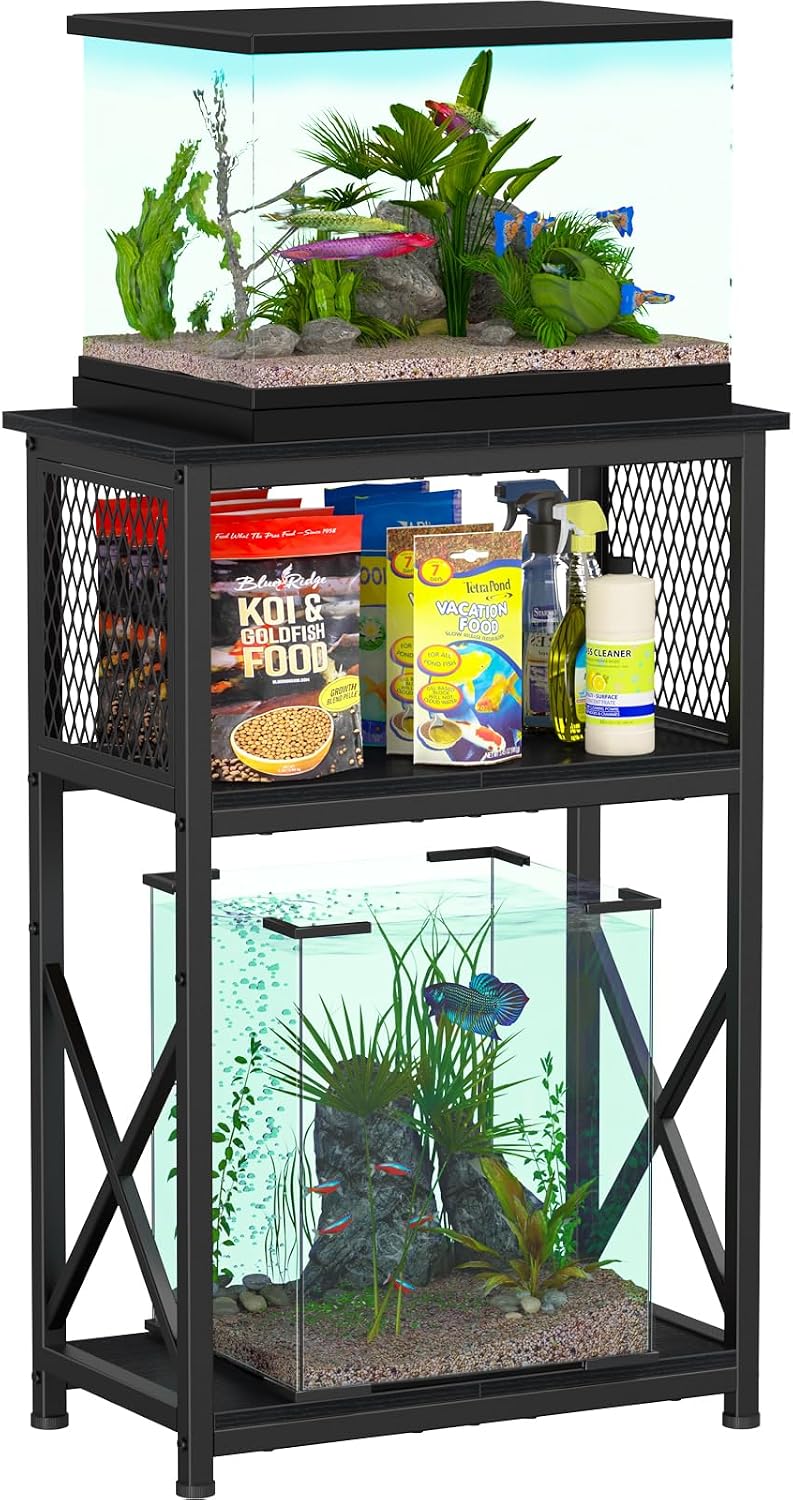
Snughome 10 Gallon Aquarium Stand with Storage, 3 Tier Heavy Metal Fish Tank Stand Shelf 20.47" x 11.42" x 30.91", Black
Check current Amazon price. The Snughome is the one I would pick for most rooms because of the proportions. Just over 20 inches wide and about 31 inches tall, it puts the tank at a comfortable viewing height and fits a narrow wall. The 11.42 inch depth is the first number to check, because it decides whether your tank base sits fully on the top frame or hangs over the front edge. Overhang is the one problem no amount of shimming fixes.
Height matters for a second reason. A stand around 31 inches tall gets top-heavy once it is loaded, so the wall anchor in step five is not optional in a house with a cat that lands on the lid or a dog that leans on the frame.
Flaws but not dealbreakers: the hardware is the weak point in this class, not the steel. Plan on a second pass with the wrench a week after you fill it.
Anyone who wants the tank at eye level on a narrow wall, with the food and the net underneath, will be happy here.
Upgrade pick: HavenlyYouth 10 Gallon Aquarium Stand with Power Outlet, 3 Tier Heavy Duty Metal Fish Tank Stand with Storage, Fish Tank Table for Home Office, 21.3" x 11.8" x 29", Rustic Brown
Upgrade pick
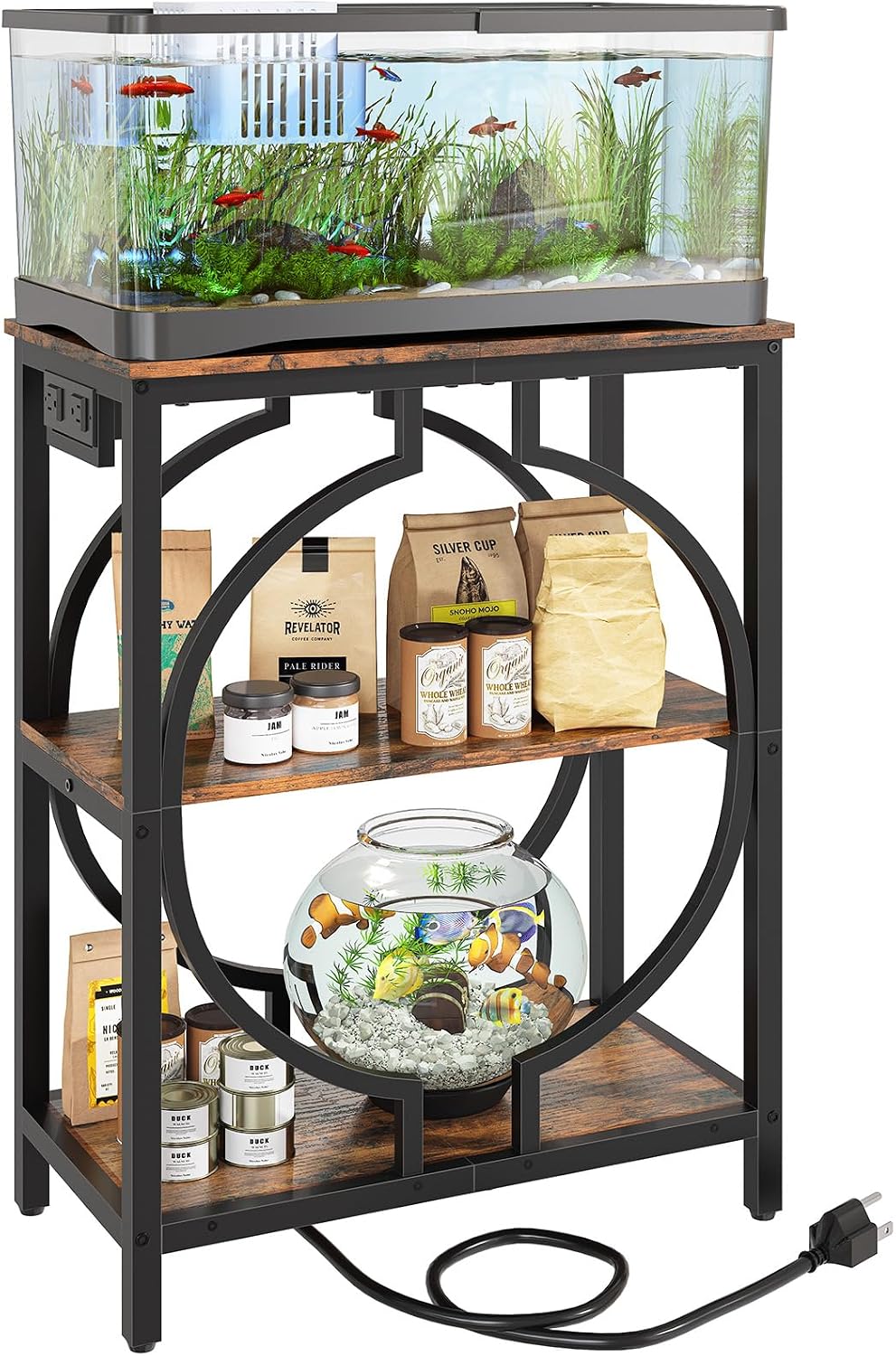
HavenlyYouth 10 Gallon Aquarium Stand with Power Outlet, 3 Tier Heavy Duty Metal Fish Tank Stand with Storage, Fish Tank Table for Home Office, 21.3" x 11.8" x 29", Rustic Brown
Check current Amazon price. The HavenlyYouth is the widest and shortest of the three at 21.3 by 11.8 by 29 inches, and it is the only one with a built-in power outlet. That outlet is what earns the upgrade label. A light, a filter, and a heater all want a socket, and a stand-mounted outlet keeps the cord run short and the drip loop where you can actually see it.
The lower height is a stability advantage, not a downgrade. A 29 inch stand with a 10 gallon tank on top carries its weight lower than a taller frame, and it is easier to level because you are not fighting a long lever arm when you reach down to the feet.
Flaws but not dealbreakers: rustic brown will not disappear against every wall, and the outlet only helps if the stand sits near an existing socket.
Anyone running a light and a heater on a 10 gallon, in an office or a bedroom where cords would otherwise dangle, should look here first.
The actual wobble fix workflow
Work in this order. Leveling a frame that is still loose will not stop an aquarium stand from wobbling, and tightening a frame that is standing on a shim you are about to pull out is wasted effort.
Step one: Clear the stand, not the tank. Take the buckets, the food, the spare filter media, and everything else off the shelves. Leave a filled tank where it is, because moving a full 10 gallon twice is how people end up with a wet floor. If the tank is not set up yet, keep it that way until step seven.
Step two: Check the floor. Put a long level on the floor where the four feet land, in both directions, and mark the high corner with tape. Most of the wobble I have chased started here, on a floor that looked flat and was not.
Step three: Shim the frame, never the tank. If the stand has adjustable feet, turn them out until the frame is level and every foot is carrying weight. If it does not, tap composite shims under the low feet, in pairs, one from each side, then snap them off flush. Cardboard and folded paper compress over time, and a compressed shim is a wobble you will be chasing again next month. The same logic is how you stop an aquarium riser from wobbling: get the base flat first, then let the frame sit on it.
Step four: Torque every fastener. Go around the frame once with the correct hex key or wrench. Check the shelf brackets, the leg bolts, and the cross bars. Then check them again once the tank is full, because a frame settles under stand load in a way it never does when it is empty.
Step five: Kill the racking. Push the top corner of the frame gently, side to side. If the whole stand moves like a parallelogram, it is racking, and the fix is a diagonal brace or a wall anchor. Attach an anti-tip strap to a stud, not to drywall alone. A wall bracket is the other route, and it is why people ask me how to stop an aquarium mount from wobbling: the anchor is the whole game, and a bracket is only as good as the stud behind it.
Step six: Match the tank to the top frame. Measure the tank base and the stand top surface. The base should sit entirely inside the frame with no overhang on any edge. This is where tank volume matters, because a 10 gallon tank full of water, substrate, and rock weighs a good deal more than the number on the box suggests, and the stand load has to cover all of it.
Step seven: Load it the way it will actually live. Add substrate first, and keep substrate depth even so the weight goes down evenly. Set the filter body beside the stand or on a lower shelf, not on a bracket hanging off the frame. Route the heater cord with a drip loop, and remember that heater wattage is not a weight problem, it is a cord problem. Check hood fit once the tank is in place, because a lid that rattles against the rim will sound like a wobble even when the frame is solid.
Step eight: Re-level with the tank full, then again after the cycle. Fill the tank, let the water settle, and put the level back on the top frame. A full tank changes the load enough to move a frame that was perfect when empty, so check the water line against the rim at both ends. Then check it again after cycle time, roughly a month in, because that is when a frame that was going to settle has settled.
If it still rocks after step eight, the frame is the problem and no shim will stop an aquarium stand from wobbling. A rocking stand is not cosmetic. Glass does not flex, and the seam pays the bill.
The competition and why it lost
The particleboard cabinet that ships with a lot of 10 gallon kits loses on the same point every time: you cannot see the joints, so you cannot torque them, and the base swells the first time water sits on it. It looks like furniture and behaves like a sponge.
Wire shelving is strong per shelf and terrible in a shear. A wire rack racks, and the wire grid is not a flat surface, so a tank base only touches at the wires. If your actual goal is to stop an aquarium holder from wobbling on a wire rack, you need a plywood deck on top of it, and once you have bought the deck and the brackets you have spent stand money on something that still looks like a garage shelf.
Cinder block and a plank is the old reliable answer. It is flat, it is heavy, and it will not wobble. It also cannot be moved by one person and it does not match anything in a living room, which is why most people who try it eventually buy a frame anyway.
A converted dresser depends entirely on the dresser. Most of them are particleboard rated for clothes, and a dresser that flexes when you open a drawer is a dresser that will flex under a tank.
Riser bases, the low platforms that lift a tank a few inches off a counter, are the one alternative that works. They are stable because they are short, and a riser is only as good as the surface under it. A flat, solid base plus four feet that all touch is the entire fix.
What this all costs
The stands sit at the value end of the 10 gallon category. Check current Amazon price on the HOOBRO, the Snughome, and the HavenlyYouth to see where each one lands today, and pick on proportions rather than on the number.
The fix itself is cheap. A pack of composite shims, a long level you probably already own, an anti-tip strap, and a foam pad for the air pump if it hums. That is the entire shopping list, and it costs less than the fish.
Run the math on the alternative. If a stand fails, you are buying a new tank, new substrate, and a new filter, and you are running the cycle time all over again with a bucket and a test kit. A shim pack is a rounding error next to that.
Level it once, torque it twice, anchor it to a stud, and check the water line after the tank is full. That is the whole job. Your stand was built to hold that tank. Let it.