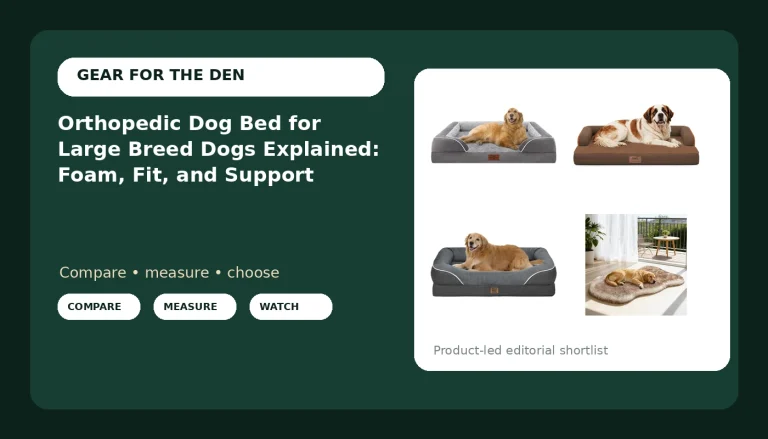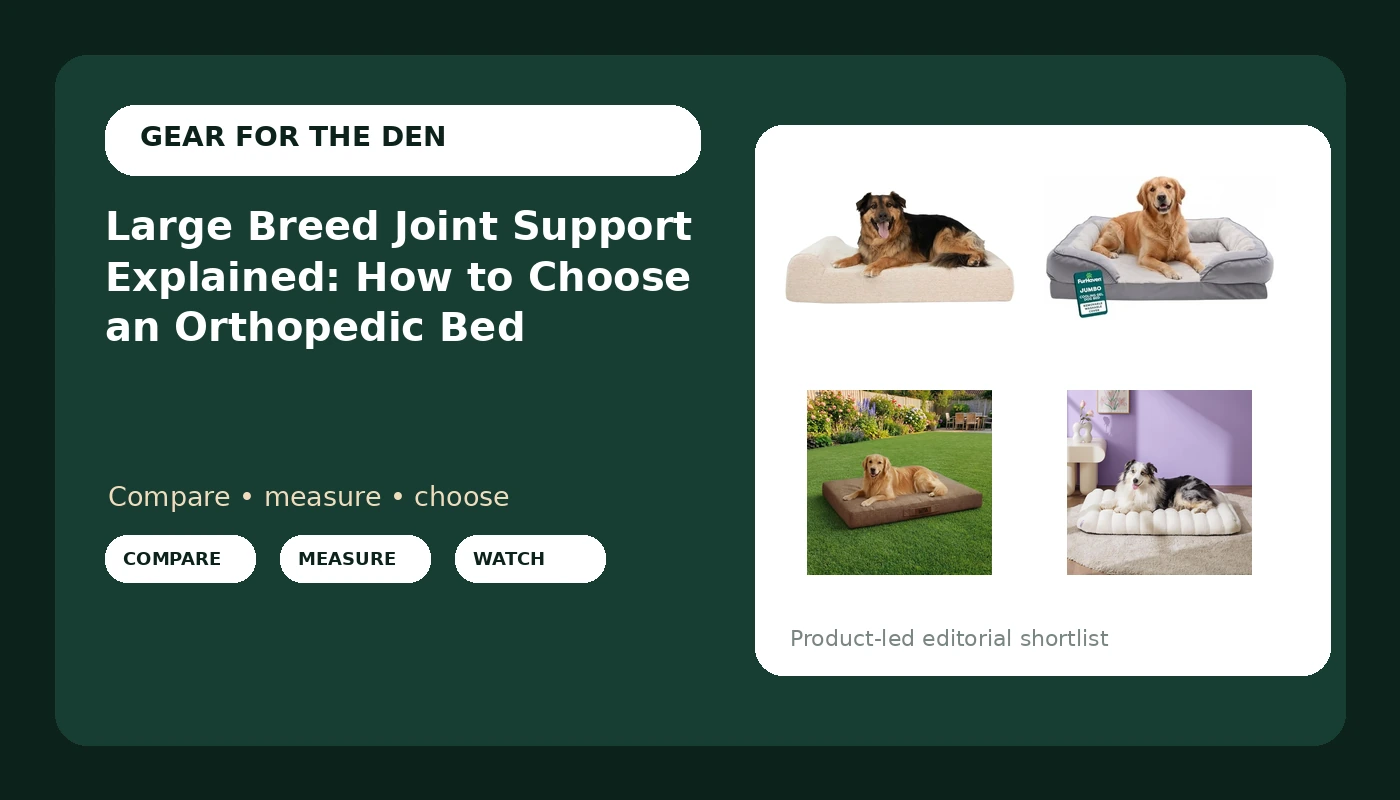
Large breed joint support explained in practical terms comes down to one question: what is the dog actually lying on? A dog at 70 pounds presses the same hips, elbows, and shoulders into the floor every time it settles, and a thin mat over hardwood changes almost nothing about that. No bed treats arthritis, and a listing that says orthopedic is not making a clinical promise. What a bed can do is spread load across a wider area, keep bony pressure points off hard surfaces, and make it easier for a stiff dog to push back up. The trouble is that orthopedic describes a category, not a measurement. The numbers that decide whether a bed helps a particular dog – foam density, weight capacity, and bed height – are usually the numbers a listing buries.
Quick answer
For a dog of 50 pounds or more, large breed joint support usually means a dense foam base that keeps the hips from reaching the floor, a surface long enough for the dog to lie flat rather than curled, and a base that grips so the bed does not slide away when the dog stands. A memory foam bed with a washable cover and a non slip backing covers the widest range of homes. Dogs that run hot do better with a gel-topped surface. Dogs that chew, dribble, or sleep in a crate need a waterproof, chew-resistant cover and a lower profile. A dog with advanced stiffness often handles a firm flat mat better than a tall pillow. None of this treats joint disease or replaces veterinary care.
Choosing large breed joint support: 4 useful options
| Model | Best fit | What stands out |
|---|---|---|
| Barker Beds Large Orthopedic Dog Bed – 7" Pillow Top with Headrest – 50-70 lbs – Memory Foam for Joint Pain & Arthritis – Washable – 48"x30"x7" – Driftwood Linen | Dogs in the 50 to 70 pound band that sprawl out flat | Memory foam pillow top with a headrest in a 48 x 30 x 7 inch footprint |
| FurHaven Cooling Gel Dog Bed for Large Dogs, Perfect Comfort Sofa Bed with Cool Gel-Top Foam with a Solid Orthopedic Foam Base for Joint Support, Washable Cover, Jumbo XL, Plush & Velvet, Granite Gray | Large dogs that sleep hot but still need a supportive base | Cool gel top over a solid orthopedic foam base, Jumbo XL, washable cover |
| Sytopia 42 Inch Indestructible Dog Bed for Extra Large Dogs, Waterproof Chew Proof Orthopedic Pet Mat for Crate with Machinne Wshable Cover, Great for Indoor Outdoor Use, Brown | Chewers, crate sleepers, and patio dogs | Waterproof and chew proof build with a machine washable cover |
| LE SURE Cute Orthopedic Dog Bed Large Sized Dog, Flat Pet Mat,36x27in Cream | Tight spaces and dogs that have stopped using a tall bed | Flat 36 x 27 inch orthopedic mat with no bolsters to climb over |
The deep-cushion pick: Barker Beds Large Orthopedic Dog Bed
The trade-off with a deep pillow top is bed height. Seven inches is roughly the height of a low step, and a dog with limited joint mobility may need a hand getting on it, or may do better with a thinner mat and a rug. The listed 50 to 70 pound band matters too. A heavier dog compresses memory foam further, so the bed that gives good hip support to a 60 pound Labrador is not automatically right for a 120 pound Dane. Memory foam is also temperature sensitive and feels firmer in a cold room until body heat softens it. On hardwood, put something grippy under a tall bed. A thick bed on a slick floor is the combination that fails.
The cooling pick: FurHaven Cooling Gel Dog Bed
The gel layer is the reason to pick this one, and it is worth being precise about what it does. A cool gel top changes how warm the surface feels. It does not add cushioning depth. The support comes from the solid orthopedic foam underneath, so the gel-topped version makes the most sense for a large dog that sleeps hot and still needs a supportive base. The Jumbo XL footprint suits dogs that sprawl, and the washable cover matters more than it sounds with an older dog, because accidents happen. The plush and velvet top is comfortable to lie on, and it also holds heat and hair, so plan on washing it more often in summer. The foam base is what carries the load.
The crate and chewer pick: Sytopia Indestructible Dog Bed
This is the practical answer for chewers and crate sleepers. A waterproof, chew proof mat with a machine washable cover survives drool, accidents, and a dog that likes to test seams, and the 42 inch size covers the floor of a large crate. The trade-off is depth. A mat style bed sits low, which makes it easy to step onto, but it offers less vertical cushioning than a pillow top, so a very heavy dog on a hard floor may still feel the ground through it. That low profile is sometimes exactly what a stiff dog needs, especially one that has started avoiding a tall bed. Indoors or out, it is the option that tolerates mess.
The low-profile pick: LE SURE Orthopedic Dog Bed
A flat mat is the least dramatic option here, and for some dogs it is the right one. There is no bolster to climb over and no deep well to sink into, so a dog that struggles to stand can walk on and off without a step, and the mat fits into corners where a full-size bed will not. The cost is cushioning depth. A flat design simply has less material between hip and floor than a thick pillow top, and it will need replacing sooner under a heavy dog. Treat it as a low, stable landing spot near a sofa or in a small room, not as a substitute for deep orthopedic bedding in a house with a very large dog.
Prices and availability may change. Product images, names, and retailer links are matched to verified listings. No current price, rating, stock status, or measured result is stated here without current evidence.
What foam density and weight capacity actually mean
Foam density is the weight of one cubic foot of foam, usually expressed in pounds per cubic foot. It is not the same thing as firmness, which is measured separately, but density is a decent predictor of how long a foam holds its shape under a heavy dog. Low-density foam feels wonderful in a showroom and flattens within months under 80 pounds of dog. Higher-density foam feels firmer out of the box and keeps its loft longer. Foam density is where correct large breed joint support actually starts.
Thickness is the other half of the story. Three inches of dense foam can outperform five inches of soft foam, because the dense layer does not compress all the way to the floor. That "does not bottom out" quality is what keeps hip support real rather than nominal. If the dog's hips touch the ground through the bed, the bed is decorative.
Weight capacity is the number most listings leave out, and it is the one that decides whether the foam still has somewhere to compress to. A 50 pound dog and a 110 pound dog put very different loads on the same slab, which is why a listing that names a 50 to 70 pound band is more useful than one that claims a universal fit. If your dog is above the listed band, expect more compression and less clearance between hip and floor. If your dog is well below it, a firm memory foam bed may feel too hard at first, and a softer top layer earns its keep.
How bed height, ramp angle, and joint mobility interact
Bed height is the number owners skip, and it decides whether the dog actually uses the bed. A thick orthopedic bed solves pressure on the hips but creates a new problem: the dog has to step up, turn, and settle on a soft surface, and that sequence is harder for a dog with reduced joint mobility. Watch how your dog gets onto furniture now. If it hesitates, circles, or needs a front paw placed for it, a tall pillow top will not get easier, and a lower, firmer mat usually will. Firmness and bed height pull in opposite directions, and the dog tells you which one wins.
The same geometry applies away from the bed, and if your dog is also avoiding stairs or the car, our guide to dog ramps for senior and large dogs covers the angles in detail. A ramp angle above roughly 20 degrees is steep for a large dog, and a steep ramp is often worse than no ramp because the dog refuses it. Lift capacity matters when you are helping a dog into a car yourself: a rear harness with a handle spreads the lift across the chest and hips rather than pulling on the neck, and it lets you support weight without lifting the whole animal. Non slip backing, or a rug under the bed, keeps the whole setup from sliding when the dog pushes up, and a bed that slides teaches a dog to avoid it.
Joint mobility is not a fixed number. It varies with time of day, weather, and how long the dog has been resting, so the best bed is the one the dog chooses on its worst morning rather than its best afternoon. That is why the steps below start with the dog, not the product page.
- Weigh your dog and measure it nose to tail while it lies flat, then add a few inches of margin.
- Compare those numbers with the listed weight band and footprint of each bed you are considering.
- Decide whether the dog can step up unaided; if not, choose a lower bed height and skip pillow tops.
- Slide a rug or grippy pad under the bed on smooth floors unless the base already has non slip backing.
- Re-check after two weeks: if the dog still sinks until its hips reach the floor, the foam is too soft for its weight capacity.
Practical checks before and after the bed arrives
- Measure the dog lying flat, not standing; a curled sleeper needs less length than a dog that sprawls.
- Put the bed where the dog already sleeps, and keep the floor under it level and free of drafts.
- Give compressed foam a day at room temperature before judging firmness, especially in cold weather.
- Wash the cover once before first use and confirm it goes back on without a fight.
- Keep a thin, firm mat near the door the dog uses most, so it has a flat option on bad mornings.
Which option should you choose?
Choose the Barker Beds Large Orthopedic Dog Bed when your dog sits inside the listed 50 to 70 pound band, sprawls out flat, and can still step onto a thick surface. Choose the FurHaven Cooling Gel Dog Bed when your dog sleeps hot and needs a supportive base rather than extra plushness. Choose the Sytopia 42 Inch Indestructible Dog Bed when the dog chews, dribbles, or sleeps in a crate, and you want a mat that survives all three. Choose the LE SURE Cute Orthopedic Dog Bed when you need a low, flat landing spot in a tight space, or when the dog has already stopped using a taller bed.
There is no single ideal large breed joint support setup that fits every dog. The details in this article come from the product listings, not from measuring or testing these beds, and no rating, price, or stock status is stated here because those change.
The bottom line
Large breed joint support is a geometry problem before it is a shopping problem. Match foam density and weight capacity to your dog's actual weight, then match bed height to what the dog can still do unaided. The Barker Beds option gives the deepest cushioning for dogs inside its listed band, the FurHaven adds a cooling gel top over a solid orthopedic base, the Sytopia handles chewing, drool, and crate floors, and the LE SURE provides a low, flat surface for tight spaces and stiff mornings. Whichever you pick, put something grippy underneath and give the dog two weeks to vote.