Most litter box complaints that get blamed on the cat trace back to the box itself. Litter box sizing is not about buying the biggest tub on the shelf, and it is not about squeezing the smallest one that fits behind a door. It is about length, width, entry height, and litter depth working together so a cat can walk in, turn around, squat, dig, and cover without scraping a wall or stepping into a wet patch. Get those numbers wrong and you get the familiar list: misses over the rim, a cat who refuses the box entirely, litter kicked across the floor, and odor control that never quite settles. This guide covers the measurements that matter, how covered and open designs change the math, and how the four options below suit different rooms and different cats.
Quick answer
Measure the cat before you shop. For most adult cats, the target is a box around one and a half times the cat's length from nose to base of tail, and at least as wide as the cat is long, with sides low enough to step over without a jump. Large cats, seniors, and multi-cat homes need more room than that minimum, and kittens need a low entry height far more than they need extra volume. Covered boxes trade airflow for privacy, so a hooded box only works when the space inside the hood is genuinely generous. The rest of this article is litter box sizing explained through numbers you can check yourself, with a tape measure or in a listing. No product below is labelled quietest, fastest, safest, or best; each is described by the job it was built to do.
4 useful options
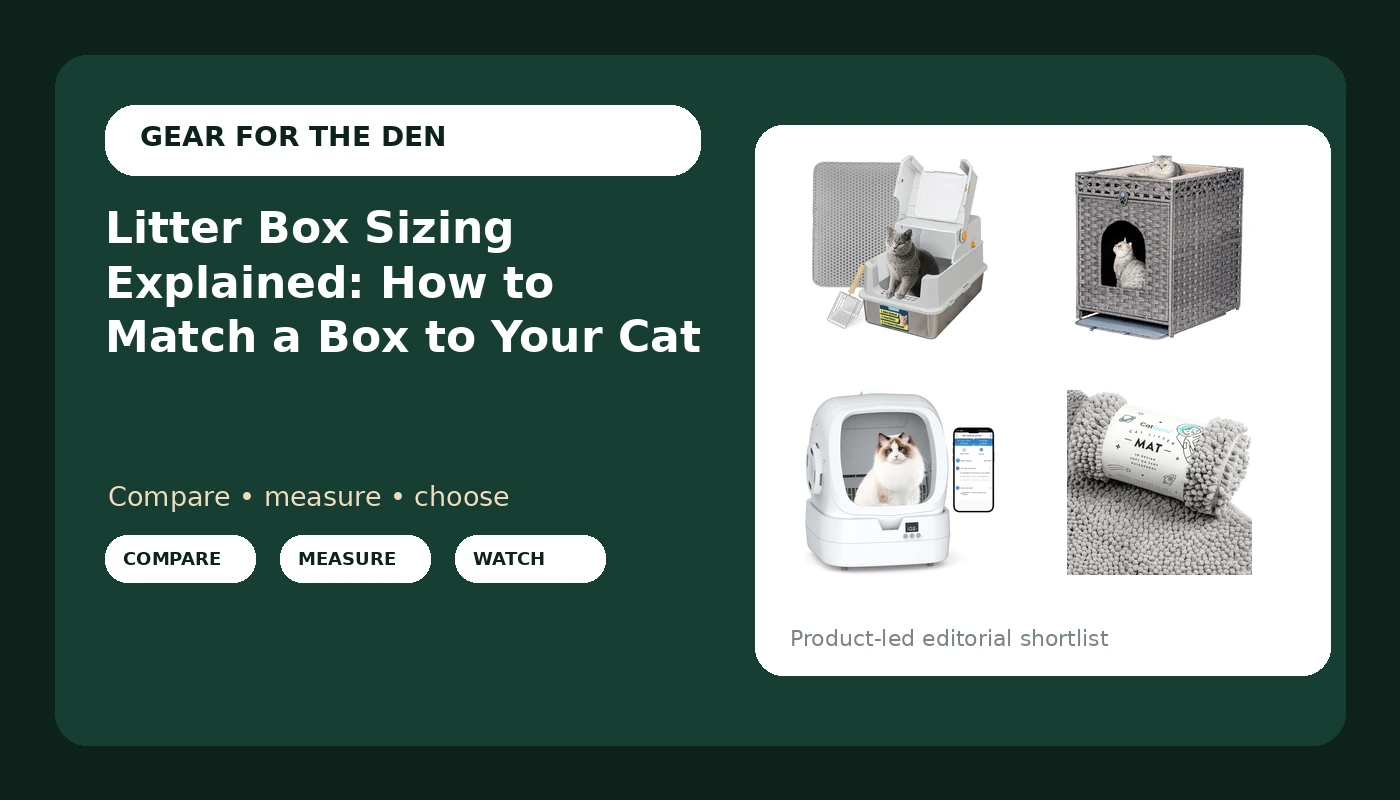
Four listings cover the common shapes: a covered stainless pan, a furniture enclosure, an automatic box, and a mat that catches what leaves the box.
| Model | Best fit | What stands out |
|---|---|---|
| TENTIZON Stainless Steel Cat Litter Box with Lid | Large cats and cats who spray high on the sides | Stainless steel pan with a hood, flip top, high sides, mat, and scoop |
| Snughome Cat Litter Box Enclosure Furniture Hidden with Cat Litter Mat | Living rooms and bedrooms where a box has to disappear | Handwoven rattan enclosure with a door and a mat, built as furniture |
| Mintakawa Automatic Cat Litter Box Self Cleaning | Homes that want scooping handled on a cycle | App control, weight monitoring, and self-cleaning, assembly required |
| CatGuru Cat Litter Mat | Any box, especially one that tracks litter | Waterproof trapping mat, non-slip, machine washable, in three sizes |
The covered stainless pan: TENTIZON Stainless Steel Cat Litter Box with Lid
The sizing question with a covered box is not the footprint on the floor, it is the usable space inside the hood. A stainless steel pan is a practical choice for odor control because the surface does not hold onto urine the way scratched plastic can, and it cleans back to a neutral finish. The trade-off is that a hood keeps smells in as well as it keeps litter in, so litter depth and scooping frequency matter more here, not less. The flip top helps on that front, since you can scoop without unclipping an entire lid. High sides cut down on spray over the rim, but they also raise the effective entry height, which is the number to check against your cat's legs rather than the box's outer height. If your cat is a senior with limited reach, or a young kitten, compare this against a low-entry open pan before committing.
The furniture enclosure: Snughome Cat Litter Box Enclosure Furniture Hidden with Cat Litter Mat
An enclosure adds a step to correct litter box sizing, because now the pan has to fit inside something else. The interior dimensions of the cabinet matter more than the cabinet's own footprint, and a pan that barely slides in leaves no room for a cat to turn, which is exactly the mistake the enclosure was supposed to solve. Ventilation is the second issue: a closed cabinet concentrates odor unless air can move through it, so a door left ajar or an open back helps. On the plus side, an enclosure raises the box off the floor in a way that suits tall cats, and the mat at the opening catches grit before it reaches a rug. If your cat is a nervous type, keep the door open at first so the box does not feel like a trap with one exit.
The automatic box: Mintakawa Automatic Cat Litter Box Self Cleaning
Automatic boxes bring two numbers that manual pans do not have: waste drawer capacity and sensor range. Drawer capacity sets how many days pass between emptying, and sensor range decides whether the unit notices a cat that approaches slowly or sits near the edge before a cycle starts. Both matter more in a multi-cat home where the box runs often. Clumping speed becomes a functional detail rather than a convenience, because a fast-clumping litter forms a firm clump the mechanism can lift, while a slow-clumping litter can smear before it sets. Weight monitoring is the feature that tells you whether a cat is using the box at all, which is useful information in a household with several cats. The listing describes the cycle as ultra-quiet and the fit as suited to medium cats and kittens, so check your cat's size against that range, and expect to assemble the unit before first use.
The tracking mat: CatGuru Cat Litter Mat
A mat does not fix bad litter box sizing, but it changes how much of the box you clean off the floor. Mat texture decides what it catches: a soft, nubbed surface traps fine grains under a cat's paws, while a stiff or porous surface can let litter bounce off and can be harder to rinse. Size matters as much as texture, since a mat that only covers half the opening catches roughly half the litter, and a long mat placed with its length running away from the door gives a cat more steps to shed grit. Placement is simple: overlap the mat's edge with the box lip so nothing falls between the two, and keep the whole setup on a hard floor. Machine washability matters over months, because a mat that has held damp litter needs a real wash, not a shake.
Prices and availability may change. Product images, names, and retailer links are matched to verified listings. No current price, rating, stock status, or measured result is stated here without current evidence.
What the ideal litter box sizing actually measures
Start with the cat. The common rule of thumb is a box about one and a half times the cat's body length from nose to tail base, measured along the inside floor, with enough width for a full turn. Width is the number people skip, and it is usually the reason a cat ends up standing with its rear over the edge. A box that is long but narrow fails the same test as one that is simply too small.
Then look at the walls. Entry height is the height a cat has to step over or through, not the box's external height. A tall-walled pan with a low front cutout can suit a cat who sprays, while a hood with a high entry stops a kitten or an arthritic senior before it starts. Litter depth is the next variable: many cats dig and cover best with roughly two to three inches of litter, and a deep fill in a shallow pan simply ends up on the floor.
Multi-cat homes change the math again. The usual guidance is one box per cat plus one more, placed in separate locations rather than lined up in a row, because one cat can guard a cluster. The ideal litter box sizing for a large breed or a long-bodied cat is bigger than the minimum, not a clever workaround with a lid.
Matching litter depth, clumping speed, and the box to the cat
The box and the litter have to agree with each other. Litter depth interacts with clumping speed: a fast-clumping litter forms a firm clump quickly, which matters in an automatic box that cycles on a schedule, while a slow-clumping litter in the same unit can smear before it sets. In a manual pan, clumping speed is mostly a scooping convenience.
Odor control is a system rather than a single product. A stainless or enamel pan does not hold onto smell the way a scratched plastic pan can, a covered box concentrates odor unless it is cleaned often, and a mat with a coarse texture collects pellets and tracked grit before they reach the carpet. Mat texture also affects cleanup, since a soft washable mat catches fine litter while a stiff porous one can be harder to rinse.
Automatic boxes add two more figures: waste drawer capacity and sensor range. Drawer capacity decides how many days pass between emptying, and sensor range decides whether the box detects a cat that approaches slowly or sits near the edge. Both matter more in a multi-cat home where the unit cycles often. Whatever the design, box size still comes first, because no sensor or liner rescues a box that is too small for the cat standing in it.
- Measure your cat from nose to base of tail, then add half that length again to find the minimum inside floor length.
- Check the usable interior rather than the outside footprint, and include the space a full turn requires.
- Measure the entry height against your cat's comfortable step, and lower the lip for kittens or seniors.
- Set litter depth at roughly two to three inches and match the litter's clumping speed to the box type.
- Place the box in a quiet spot, watch for a week, and adjust size or lid before blaming the cat.
Setting the box up so it works
- Set the box on a hard, level surface, since carpet holds odor and lets the box wobble under a jumping cat.
- Leave the hood off for the first week with a new box so the cat can see and smell the change.
- Overlap the mat with the box lip so tracked litter lands on the mat instead of beside it.
- Keep liner and litter depth consistent between cleanings, because a sudden deep fill changes how the box feels.
- Give multi-cat homes separate corners for separate boxes rather than one row along a single wall.
Which option should you choose?
Choose the TENTIZON Stainless Steel Cat Litter Box with Lid when you want a covered box with high sides for a larger cat and you will scoop often enough to manage the hood. Choose the Snughome Cat Litter Box Enclosure Furniture Hidden with Cat Litter Mat when the box has to live in a main room and you want it to read as furniture. Choose the Mintakawa Automatic Cat Litter Box Self Cleaning when scooping is the job you most want to hand off and your cat fits the medium-cat sizing the listing describes. Choose the CatGuru Cat Litter Mat when tracking is the main complaint and you want a washable surface under the entry.
There is a limit to what any listing can tell you. Interior dimensions, entry heights, and weight ranges are worth confirming on the product page, and behavior is the final measure: a cat that uses the box calmly, covers without stepping over the edge, and comes out clean is working with correct litter box sizing. Buy one option, watch for a week, and change a single variable at a time rather than replacing the whole setup at once.
The bottom line
Litter box sizing is arithmetic before it is shopping. Measure the cat, check the interior space and the entry height, keep litter depth around two to three inches, and size up rather than down for large cats and multi-cat homes. A hooded stainless pan, a furniture enclosure, an automatic box, and a washable mat each solve a different part of the problem, and none of them is the right answer in every room. Prices and availability move constantly, so check the current Amazon price on the listing you are considering and confirm the interior dimensions against your cat before the box arrives.