A microchip feeder is only as good as its aim. When the lid opens for the wrong cat, or refuses the right one, the entire point of the purchase disappears. Microchip cat feeder accuracy is the measure of how reliably a reader matches a tag to one specific cat, how quickly the lid responds once that match happens, and how well the bowl keeps food where it belongs. Many owners expect accuracy to be a single figure printed on the box. In practice it is a system: the microchip range of the antenna, the placement of the tag on the collar, the bowl width, and even the elevation angle of the unit all pull on the result. This article walks through microchip cat feeder accuracy explained in practical terms, then looks at one RFID feeder and three stainless bowl sets that owners pair with it.
Quick answer
Microchip cat feeder accuracy depends on whether the antenna detects the tag at the distance and angle your cat actually approaches from, and whether the lid opens before the cat walks away. A feeder with an adjustable microchip range and a shallow, wide bowl is easier to tune than one with a fixed antenna and a deep well. Bowl choice matters as much as electronics: a bowl that sits too deep or too narrow can push a cat's head out of the read zone, which looks like a feeder fault but is really a fit problem. The Adolug RFID feeder opens two hidden bowls from one tag, and the three stainless sets below serve as replacements or spares for automatic microchip feeders. No product here is called the quietest, fastest, safest, or best, because those labels need measurements this page does not have.
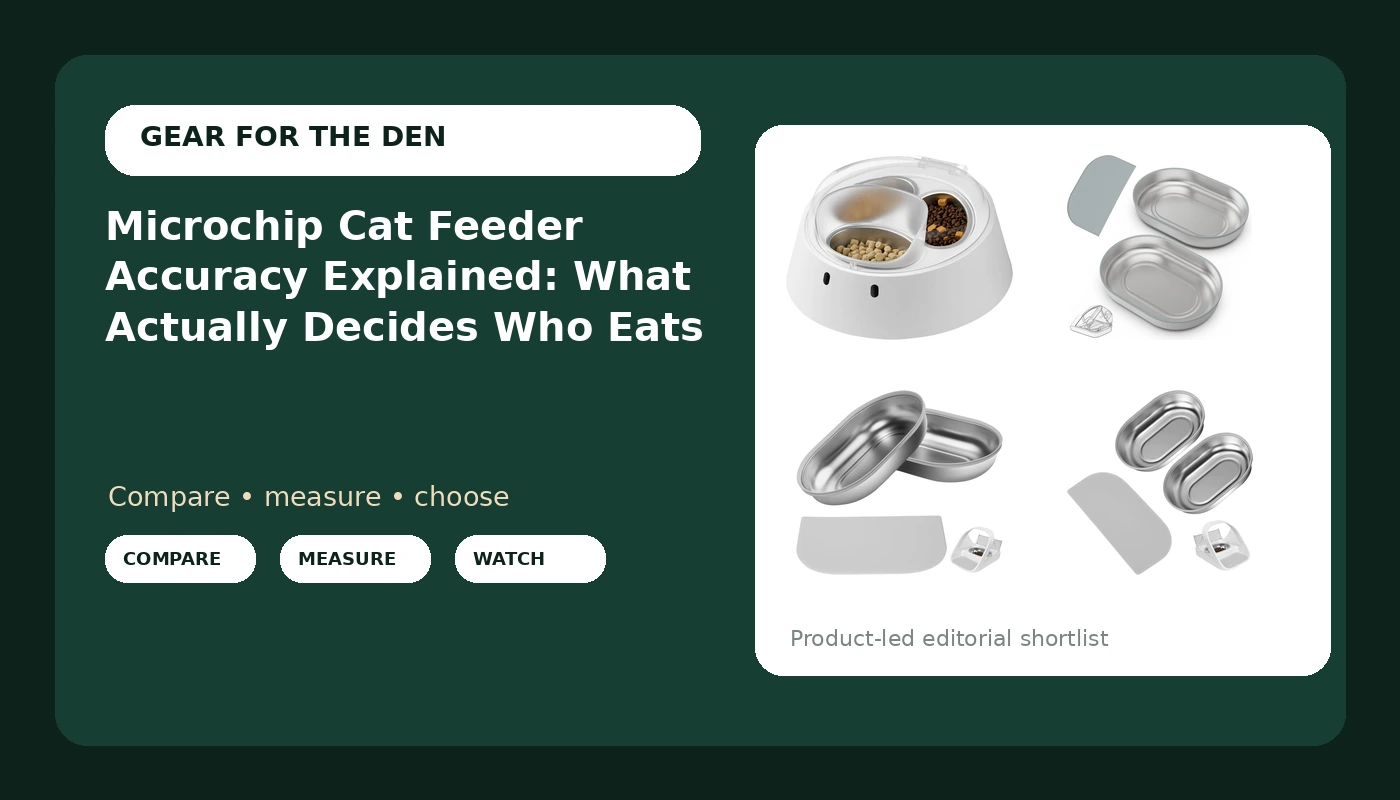
Microchip cat feeder accuracy: 4 useful options
| Model | Best fit | What stands out |
|---|---|---|
| Adolug RFID Microchip Cat Feeder, 1 Tag Opens 2 Hidden Bowls, Anti-Theft | Homes where one cat raids another cat's bowl | One tag opens two hidden bowls, with an anti-theft layout |
| Stainless Steel Bowl for Automatic Microchip Cat Pet Feeder, Sealing Ring Design for Keeping Food Fresh and Reducing Odor, SUS 304, Easy to Clean, 2 Bowl & 1 Mat Set | Owners who want a sealing ring and easy-clean SUS 304 bowls | Sealing ring design, SUS 304 stainless steel, 2 bowls plus 1 mat |
| Stainless Steel Bowl for Automatic Microchip Cat Pet Feeder, Design for Keeping Food Fresh and Reducing Odor, 2 Pcs+1 Grey Mat | Multi-cat homes where odor control is the priority | Odor-reducing design, 2 bowls plus 1 grey mat |
| Stainless Steel Bowl for Automatic Microchip Cat Pet Feeder,2 Bowls & 1 Mat Set | Straightforward replacement of worn or lost bowls | 2 bowls plus 1 mat set |
The feeder: Adolug RFID Microchip Cat Feeder, 1 Tag Opens 2 Hidden Bowls, Anti-Theft
The trade-off with any covered feeder is that the cover is also a wall. A cat that has to push into a confined space approaches differently than one eating from an open dish, and that approach is what the antenna sees. If the unit sits too high, a small cat reaches up and the tag swings away from the field. If it sits too low, a large cat crowds the housing and the tag ends up behind the read zone rather than in front of it. Because one tag opens two bowls here, both openings respond to the same cat, which is convenient for a single cat eating wet food in one bowl and dry in the other, but it does not separate two cats onto two bowls. For that you need two units, one per cat, each paired to its own tag.
The sealing-ring bowl set: Stainless Steel Bowl for Automatic Microchip Cat Pet Feeder, Sealing Ring Design
Stainless is the practical default for feeder bowls because it does not hold onto oils the way scratched plastic does, and it does not carry the scent memory that makes some cats refuse a dish after a food change. The sealing ring in this set is the detail that matters for accuracy in a roundabout way: a bowl that seats properly sits at a consistent height every time you wash it, so the distance between the collar tag and the antenna stays the same from meal to meal. A bowl that rocks or sits proud of its recess changes that distance, and a change of a centimeter or two is enough to move a marginal read from reliable to intermittent. The mat is a small thing, but it also keeps the feeder from sliding on tile when a cat pushes in hard.
The odor-control bowl pair: Stainless Steel Bowl for Automatic Microchip Cat Pet Feeder, Design for Keeping Food Fresh and Reducing Odor, 2 Pcs+1 Grey Mat
Odor control sounds like a hygiene feature, but it interacts with feeding behavior. A covered feeder already traps aroma, and a bowl that traps it further can make wet food less appealing to a cat with a sensitive nose, which shows up as a cat that approaches, hesitates, and leaves before the lid settles. That hesitation is exactly when a marginal read becomes visible, because the cat is drifting in and out of the field instead of committing. If you feed wet food, the practical move is to wash the bowl after every meal regardless of which set you buy, and to rotate between the two bowls so one is always dry and odor free.
The basic bowl and mat set: Stainless Steel Bowl for Automatic Microchip Cat Pet Feeder,2 Bowls & 1 Mat Set
This is the set to consider when the bowls are not the problem and you simply need spares. It makes sense for a two-feeder household that wants matched bowls in both units, or for an owner who has already solved the reading issue through tag placement and does not need a sealing ring. The honest limitation is that bowls are the cheapest variable in the whole accuracy equation, so changing them rarely fixes a feeder that reads poorly for structural reasons. If a cat is consistently refused, the collar tag and the unit's position deserve attention first.
Prices and availability may change. Product images, names, and retailer links are matched to verified listings. No current price, rating, stock status, or measured result is stated here without current evidence.
What decides microchip cat feeder accuracy in a real kitchen
The reader inside a microchip feeder is a short-range RFID antenna, and it does not work like a barcode scanner. It emits a weak field, and a passive tag on the collar harvests enough of that field to answer back. The microchip range is therefore a physical property of the antenna, not a software setting on most units, which is why a feeder with a fixed antenna is harder to tune than one that lets you adjust it.
Three geometry problems account for most accuracy complaints.
The first is approach angle. A tag that sits flat against the collar reads differently from one that hangs loose on a dangling charm, and a cat that walks in from the side can cross the field edge-on. Owners often rotate the feeder a few centimeters and watch the behavior change.
The second is the read zone relative to the bowl. Bowl width and depth decide where a cat's head ends up while eating. A deep, narrow bowl forces a cat to reach down and forward, which can carry the collar tag out of the field at the moment the lid is deciding whether to stay open. Whisker clearance matters here too, and not only for comfort: a cat squeezing its whiskers into a tight bowl tends to approach at an odd angle, which changes where the tag sits in the field.
The third is the elevation angle of the unit. A feeder tilted slightly forward or back points the field somewhere else. Standing a feeder on a thick mat instead of directly on the floor can shift the read zone by a noticeable margin.
None of this means the electronics are faulty. It means microchip cat feeder accuracy is a joint property of the antenna, the tag, the collar, and the bowl, and any one of them can dominate the outcome.
A five-step method for improving microchip cat feeder accuracy
Work through the variables in order of cost, not in order of how technical they sound. Most owners replace a feeder before they have tested the free fixes.
- Confirm the tag reads at all by holding the collar tag directly against the unit with the bowl removed. If that fails, the tag or the pairing is the problem, not the geometry.
- Adjust the microchip range if the unit allows it, and re-test at the distance your cat actually stands when it eats rather than at the distance you think it should.
- Change the bowl before changing the feeder. A shallower or wider bowl with better whisker clearance often moves a marginal read into reliable territory.
- Test with the cat that should be excluded, not just the cat that should be admitted. False opens are the failure owners notice last and resent most.
- Re-check after every change to the setup: a new collar, a fresh mat, a different elevation angle, or a deep clean can all shift the read zone.
Practical guidance for steady results
- Give each cat its own station rather than crowding two feeders together, because two antennas in the same corner can interact and confuse a tag that is close to both.
- Keep the unit off metal surfaces. A stainless bowl is fine, but a steel tray or a metal cabinet top underneath the feeder can distort the field.
- Wash bowls daily if you feed wet food. Odor and dried residue change how willingly a cat commits to the bowl, and hesitation is what makes a weak read visible.
- If you also run a fountain nearby, treat it as part of the same station. Water capacity, pump noise, and filter type all affect whether a cat lingers in the feeding area long enough to eat calmly, and a noisy pump can send a nervous cat away mid-meal.
- Watch portion size against the bowl. An overfilled bowl changes the head position a cat uses, and a bowl that is too full for the lid's travel can interfere with closing.
A second internal reference point is worth reading if you are feeding an older cat: senior cat feeding setup ideas covers bowl height and reach for cats that no longer crouch comfortably.
Which option should you choose?
Choose the Adolug RFID Microchip Cat Feeder, 1 Tag Opens 2 Hidden Bowls, Anti-Theft when the problem is a cat stealing food and you need the electronics, not just dishes. Choose the Stainless Steel Bowl for Automatic Microchip Cat Pet Feeder, Sealing Ring Design for Keeping Food Fresh and Reducing Odor, SUS 304, Easy to Clean, 2 Bowl & 1 Mat Set when you want a sealing ring, SUS 304 steel, and bowls you can scrub without hesitation. Choose the Stainless Steel Bowl for Automatic Microchip Cat Pet Feeder, Design for Keeping Food Fresh and Reducing Odor, 2 Pcs+1 Grey Mat when odor control in a multi-cat kitchen is the priority. Choose the Stainless Steel Bowl for Automatic Microchip Cat Pet Feeder,2 Bowls & 1 Mat Set when you only need matched spares.
The caveat is that none of these listings states a read distance, a lid speed, or a field strength. The ideal microchip cat feeder accuracy for your home is something you establish by testing, and getting correct microchip cat feeder accuracy usually means changing the cheapest variable first. If a feeder still refuses a healthy cat after tag and bowl changes, the next step is a vet check rather than another purchase, because a cat that approaches a bowl differently than it used to may be telling you something about its neck, teeth, or eyesight.
The bottom line
Microchip cat feeder accuracy is not a spec you can shop for in isolation. It is the result of an antenna field meeting a tag at a particular angle, at a particular height, with a particular bowl in the way. The feeder here supplies the electronics and the covered, anti-theft layout; the three stainless sets supply the part of the equation you can swap in an afternoon. Start with the free variables, the tag, the collar, and the position of the unit, then move to bowls, and only then consider replacing hardware. Feed on a schedule, keep bowls clean, and give each cat a station of its own, and the lid will do its job far more often than it fails.