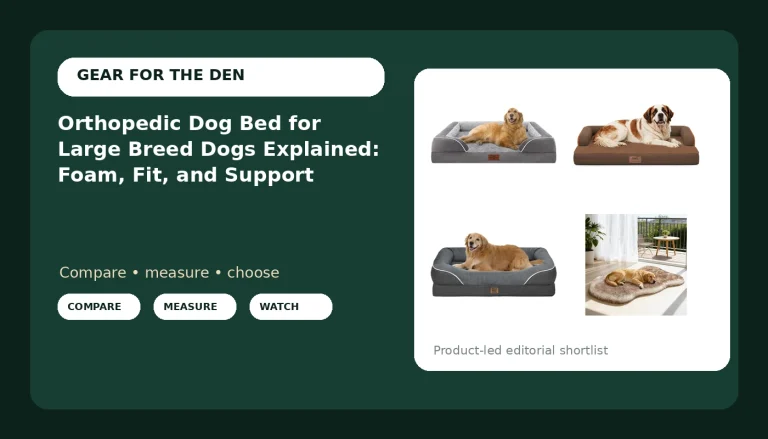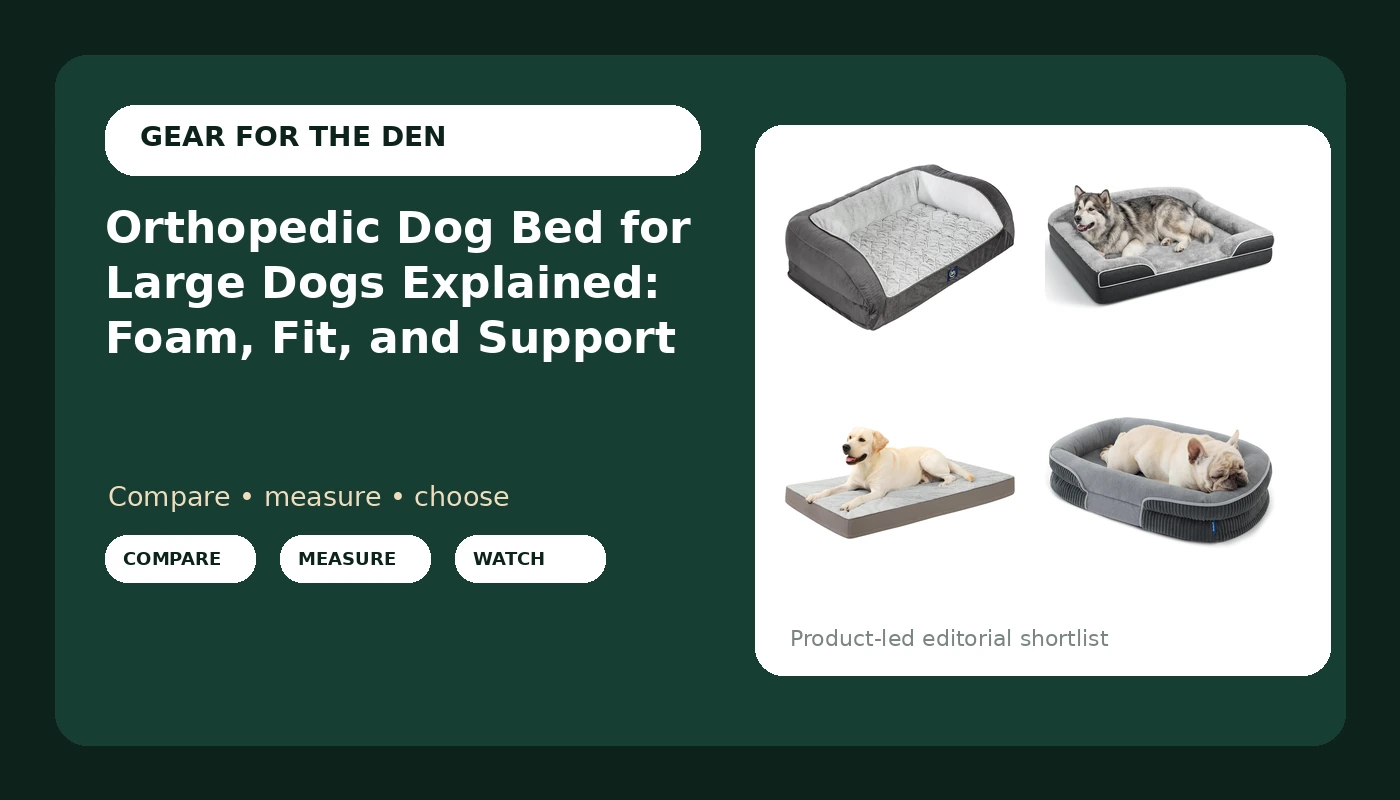
Getting an orthopedic dog bed for large dogs explained properly matters more than the label stitched to the cover. Almost every large bed sold today claims orthopedic construction, but the term describes a shape and a foam choice rather than a regulated standard, and the distance between a bed that helps a stiff senior dog rise and one that flattens by midwinter comes down to foam density, bed height, and whether the base stays put on a hard floor. A large dog puts concentrated load through the hips and elbows, so a support layer that bottoms out under that load stops providing hip support at the moment the dog needs it most. What follows covers how the category actually works, how to measure a dog rather than a room, and four current beds that solve the problem in different ways.
Quick answer
There is no single ideal orthopedic dog bed for large dogs, because the right answer depends on how your dog sleeps and how much floor space you have. A bed supports a large dog when the foam is dense enough to keep hips and elbows from pressing through to the floor, and when the bed is long enough for the dog to lie flat rather than curled around the edges. In practice that means checking three numbers before anything else: the bed's length against the dog's nose-to-tail measurement, the stated weight capacity against the dog's weight, and the foam thickness against the dog's mass. Cover fabric and color matter far less, though a washable cover and a non slip backing are worth prioritizing for a dog that leaks or a bed that sits on hardwood. The four beds below are different answers to the same problem rather than ranked versions of one another.
Four useful options
| Model | Best fit | What stands out |
|---|---|---|
| Serta Orthopedic Quilted Couch Dog Bed for Pets, Slate Gray (Large) | Dogs that lean against a raised edge | Couch profile with a quilted top |
| Extra Large Orthopedic Dog Bed, 53"x42", XXXL Washable Pet Couch Bed | Giant breeds and dogs that sprawl flat | The largest footprint in this group |
| KSIIA Orthopedic Dog Bed for Large Dogs with Waterproof Lining, Grey, 35×22 | Homes with a leak-prone or messy dog | Waterproof lining under the sleep surface |
| Bedsure 360°Oval Bolster Orthopedic Dog Bed Medium Size Dog, 30" Grey | Dogs that curl and rest their head | Full 360 degree bolster rim |
The couch profile pick: Serta Orthopedic Quilted Couch Dog Bed for Pets, Slate Gray (Large)
This is the couch-shaped option in the group, and the shape is the point. A raised back edge gives a dog a surface to brace against while pushing up onto its feet, and it keeps a heavy sleeper from drifting off the edge of a flat mat the way they can on a plain cushion. The trade-offs are bulk and drying time: couch beds carry more fabric and a more structured frame than a simple mat, so they occupy more floor space and take longer to dry after a wash. Slate gray is a forgiving choice for a bed that will live in a living room. Before ordering, measure your dog from the base of the tail to the tip of the nose while the dog is lying stretched out, then compare that to the dimensions on the current listing, because a size label alone does not guarantee a large footprint.
The giant breed pick: Extra Large Orthopedic Dog Bed, 53"x42", XXXL Washable Pet Couch Bed
This bed is here for one reason: floor area. At 53 by 42 inches it is the widest option in this group, and width matters most for a dog that sprawls flat instead of curling. A sprawler needs a bed measured along its longest dimension; a bed that is too short forces the dog into a curl or leaves the hips hanging off the edge, and hips off the edge get no support from the foam no matter how thick it is. The couch-style build and the washable cover are the other two things to weigh. Both add bulk, and both make the bed easier to live with in a house where the dog sheds or tracks in dirt. Check the listed dimensions against your dog and against the spot on the floor where the bed will sit, because a bed this size is hard to tuck into a corner once it is unpacked.
The waterproof pick: KSIIA Orthopedic Dog Bed for Large Dogs with Waterproof Lining, Grey, 35×22
Look at this one first if accidents, drool, or muddy paws are part of daily life. A waterproof lining under the sleep surface separates a bed you can wipe down from one that soaks through to the core, and foam that stays wet is foam that starts to smell and lose its shape. The 35 by 22 inch listing places it in the large range rather than the giant range, so it fits a dog at the lower end of large or a dog that sleeps curled rather than stretched. The trade-off with any waterproof layer is breathability: a dog that runs hot may do better without a barrier under the cover. A liner also only helps if the cover above it gets washed often enough that the liner is not quietly doing all the work on its own.
The bolster pick: Bedsure 360°Oval Bolster Orthopedic Dog Bed Medium Size Dog, 30" Grey
This is the smallest and most shaped bed of the four, and it needs an honest introduction. It is listed for medium size dogs at 30 inches, which sits below the large-dog range this article is about, so treat it as a reference point rather than a default pick. It fits a dog at the very bottom of the large bracket, a young dog still growing into a bigger bed, or a second resting spot beside the main bed. The 360 degree oval bolster gives a dog a rim to rest its chin on, and that head support is one reason bolster beds stay popular with dogs that sleep curled in a tight ball. The trade-off is usable floor area: the bolster occupies part of the footprint, so a curled sleeper gets more room than the outer dimensions suggest while a sprawler gets noticeably less.
Prices and availability may change. Product images, names, and retailer links are matched to verified listings. No current price, rating, stock status, or measured result is stated here without current evidence.
What orthopedic dog bed for large dogs really means
The word orthopedic in pet bedding is a description, not a certification. No standard has to be met before a manufacturer prints it on a label, so the useful question is not whether a bed is orthopedic but what it does under load. Three properties do most of the work.
Foam density comes first. Density is weight per volume, and a denser foam resists compression for longer than a light foam of the same thickness. A thick bed built from low density foam can feel plush in the store and still bottom out under a 90 pound dog within a few months, because the foam compresses until the dog is effectively lying on the floor. Thickness and density are different numbers, and a thinner dense layer usually supports better than a thick soft one.
Weight capacity comes second. Some listings publish a weight range, and that range is a more useful guide than the word orthopedic on its own. A bed rated below your dog's weight is likely to flatten, while a bed rated far above it may feel too firm for a dog that likes to sink in.
Hip support comes third, and it matters most for a senior dog. Support at the hips is a product of foam behavior and bed geometry together: a flat, firm surface lets a dog push up with the hind legs, while a soft hollow makes that push harder. That is also where bed height and joint mobility meet. A bed that is too tall for a dog with limited joint mobility becomes an obstacle to climb rather than a place to rest, and that is where a lower profile bed, a step, or a ramp earns its place. If a ramp is part of the setup, the ramp angle matters as much as the bed, because a steep ramp is no easier to use than a high bed.
Choosing the correct orthopedic dog bed for large dogs
Getting the correct orthopedic dog bed for large dogs starts as a measurement problem, not a shopping problem. Measure the dog, not the room. The decisive number is the dog's nose-to-tail length while lying stretched out, plus a few inches of margin so the dog is not pressed against an edge. Height matters too: check how tall the bed's sleeping surface sits off the floor and how much foam the dog's frame actually contacts.
Non slip backing is the quiet feature that decides whether the bed stays where you put it. A large dog stepping onto a bed on hardwood or tile will push it across the room unless the base grips, and a bed that slides is a bed a dog with weak hind legs will learn to avoid. Look for a textured or rubberized base rather than a smooth fabric bottom.
Lift capacity is a human number, not a dog number, and it matters if you move the bed for cleaning or help your dog in and out. A large orthopedic bed with a dense foam core is heavy, and a bed you cannot lift is a bed you will not wash. If you regularly lift the dog itself, that is a separate purchase with its own weight rating; the bed's job is to reduce how often you need to.
Cover care is the last piece. A removable, machine washable cover extends the life of the foam, because foam is what fails first when it stays damp or dirty.
- Measure your dog nose to tail while lying flat, then add a few inches.
- Weigh the dog and compare that number to the bed's stated weight capacity.
- Check the foam description for density or firmness claims rather than thickness alone.
- Confirm the base has a non slip backing if the bed will sit on hard flooring.
- Decide whether your dog can comfortably step into the bed's height, or whether a lower bed or a ramp is needed.
Living with a large orthopedic bed
- Wash the cover on the schedule the care label gives, and let the foam core dry fully before the cover goes back on.
- Rotate the bed or flip the cushion where the design allows, so the foam compresses evenly instead of in one spot.
- Place the bed where the dog already chooses to sleep, not where it looks best in the room.
- Keep the bed away from heating vents and direct sun, both of which break foam down faster.
- Replace the bed when the foam no longer springs back after you press it, not when the cover starts to look worn.
- If your dog is stiff in the morning, a senior dog joint mobility routine and a supportive bed work better together than either one alone.
Which option should you choose?
Choose the Serta Orthopedic Quilted Couch Dog Bed for Pets, Slate Gray (Large) when your dog likes to lean against a raised edge and you want a couch-style bed that fits a living room. Choose the Extra Large Orthopedic Dog Bed, 53"x42", XXXL Washable Pet Couch Bed when your dog is a giant breed or sprawls flat and you have the floor space for the widest bed here. Choose the KSIIA Orthopedic Dog Bed for Large Dogs with Waterproof Lining, Grey, 35×22 when accidents, drool, or muddy paws are routine and you want a waterproof barrier beneath a washable cover. Choose the Bedsure 360°Oval Bolster Orthopedic Dog Bed Medium Size Dog, 30" Grey when your dog curls tightly, rests its head on a rim, and sits at the smaller end of the large range.
The honest limitation is that no listing can tell you how a specific bed feels under a specific dog, and no single orthopedic dog bed for large dogs fits every dog in the category. Foam density figures are not published for every product, weight capacity is sometimes a range rather than a number, and a dog's preference for firm or soft is not something a product page can predict. Names, sizes, and colors above match the listings; confirm dimensions on the current product page before ordering, because listings change.
The bottom line
The right bed for a large dog is the one whose footprint fits the dog lying flat, whose foam holds up under the dog's weight, and whose cover you will actually wash. Everything else, the color, the bolster rim, the quilted top, is preference dressed up as a feature. Start with the measurement, then the weight rating, then the cover, and the choice usually narrows to one or two options without much agonizing.