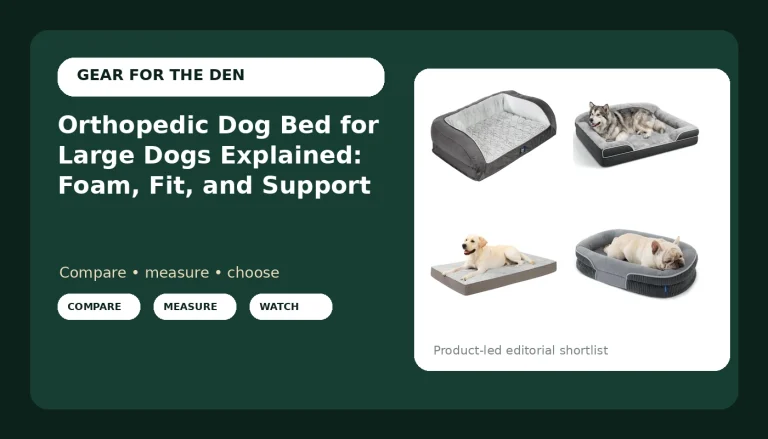
Stiffness in an older dog rarely announces itself. It shows up in small decisions: the pause before lying down, the extra circling, the way a dog who once sprawled across the whole couch now curls tight against the armrest. An orthopedic dog bed for joint stiffness does not treat arthritis or reverse hip dysplasia, and no bed replaces a veterinarian's plan. What a bed can change is the surface your dog rests on for most of the day, and that surface either helps a stiff dog rise or makes every rise a small negotiation. What follows is an orthopedic dog bed for joint stiffness explained in practical terms: what orthopedic foam actually does, what the measurements on a listing mean, and which shape suits which dog.
Quick answer
Support comes from the base, not from how plush the cover feels. A bed that helps a stiff dog has a foam base dense enough that it does not compress to the floor under the dog's hips, a sleeping surface long enough for the dog to lie flat, and an entry edge low enough to step over without a running start. Foam density, the thickness of the base, and the height of any bolster matter more than the surface texture. For most senior dogs the useful test is simple: when the dog lies down, are the hips and elbows held up rather than resting on the floor?
Four useful options
| Model | Best fit | What stands out |
|---|---|---|
| Barker Beds Large Orthopedic Dog Bed, 7" Pillow Top with Headrest | Dogs 50 to 70 lbs that need head and hip support at once | 7 inch pillow top with an integrated headrest, memory foam, washable cover, 48 x 30 x 7 inches |
| BarkBox Dog Bed Memory Foam Donut Cuddler | Dogs up to about 65 lbs that curl when they sleep | Donut shape, memory foam, removable machine washable cover, waterproof lining, includes a toy |
| FurHaven Cooling Gel Dog Bed, Perfect Comfort Sofa, Jumbo XL | Large dogs that run warm and sprawl | Cool gel top foam over a solid orthopedic foam base, washable cover, plush and velvet, granite gray |
| FurHaven Cooling Gel Dog Bed, Perfect Comfort Sofa, Jumbo Plus XXL | Extra-large dogs that need more flat surface | Same gel top and orthopedic foam base construction in the larger Jumbo Plus XXL footprint |
The tall pillow-top option: Barker Beds Large Orthopedic Dog Bed – 7" Pillow Top with Headrest – 50-70 lbs – Memory Foam for Joint Pain & Arthritis – Washable – 48"x30"x7" – Driftwood Linen
The headrest is the feature that separates this bed from a flat mat. A dog that rests its head on the floor has to lower the neck and shift weight forward, which is exactly the motion a stiff senior avoids. A raised edge lets the dog keep the head level while lying down. The trade-off is the pillow top itself: a 7 inch platform means a taller edge to clear, so a dog with limited joint mobility may need a hand steadying the collar or a low step beside the bed. The 48 inch length gives a 50 to 70 pound dog room to stretch, though a dog that sleeps fully extended may still hang over the end. The washable cover matters more than it sounds, because accidents and drooling both become more common as dogs age.
The calming donut option: BarkBox Dog Bed Memory Foam Donut Cuddler – Calming Orthopedic Joint Relief Fur Crate Lounger for Pets, Machine Washable + Removable Cover, Waterproof Lining, Includes Toy – Larger Pets – 65lbs
The donut shape does two jobs. The rim gives a dog something to press its back and hips against, which many seniors find easier to settle into than a flat surface, and the raised edge can also serve as hip support when the dog curls. The recessed center, however, is a bowl, and a dog that has to step down into a bowl and then push back out of it is doing more work than a dog stepping onto a flat mat. If your dog sleeps curled and can still rise without help, this shape fits. If your dog sprawls or struggles to get up, the same rim that feels secure while sleeping becomes an obstacle. The waterproof lining is a genuine advantage for older dogs, and the stated weight capacity of about 65 pounds is the number to check against your dog's current weight.
The cooling gel sofa, Jumbo XL: FurHaven Cooling Gel Dog Bed for Large Dogs, Perfect Comfort Sofa Bed with Cool Gel-Top Foam with a Solid Orthopedic Foam Base for Joint Support, Washable Cover, Jumbo XL, Plush & Velvet, Granite Gray
The gel layer addresses a problem that owners of senior dogs often notice before anything else: an older dog that pants through the night, moves to the tile floor, or abandons a warm bed halfway through. A cool gel top foam layer over a solid orthopedic foam base keeps the joint support while giving the dog a cooler surface. The sofa shape is the other half of the design. Bolsters on three sides let a dog lean back into the bed instead of holding itself up, and the open front keeps the entry edge low. That combination tends to work well for a large dog that sprawls sideways rather than curling. The thing to watch is bolster height: the higher the rim, the more of a step it becomes for a dog with hip pain, and a bed that is comfortable to lie in can still be awkward to enter.
The cooling gel sofa, Jumbo Plus XXL: FurHaven Cooling Gel Dog Bed for Large Dogs, Perfect Comfort Sofa Bed with Cool Gel-Top Foam & Solid Orthopedic Foam Base for Joint Support, Washable Cover, Jumbo Plus XXL, Plush & Velvet
Two FurHaven beds with almost identical names sit in this group, so the size on the listing is the detail worth checking twice before ordering. The Jumbo Plus XXL is the larger of the two, and for a dog near the top of the large range or into giant territory, extra length is not a luxury. A dog that cannot lie flat will sleep in a bunched position, and a bunched position loads the hips and spine differently than a stretched-out one. The trade-off is floor space and how the bed fits the room your dog actually sleeps in. A bed that covers most of a hallway may get pushed against a wall, which removes the open entry side. The construction itself, gel top over orthopedic base with a washable cover, is shared with the Jumbo XL, so the choice between them is mostly about footprint and your dog's sleeping posture.
Prices and availability may change. Product images, names, and retailer links are matched to verified listings. No current price, rating, stock status, or measured result is stated here without current evidence.
What an orthopedic dog bed for joint stiffness actually changes
The word orthopedic gets used loosely. In a dog bed it describes a foam base meant to hold a dog's body weight without collapsing under pressure points, and the variable that controls that is foam density. A low density foam feels soft in the hand and flattens under a 70 pound dog, which puts the hip bone, elbow, and shoulder close to the floor. A denser base keeps the dog's outline above the floor and spreads load across a wider area. That is the whole mechanism, and it is why a thick-looking bed can fail while a thinner, denser one works.
The second variable is bed height, meaning both the thickness of the base and the height of any rim or bolster. Base thickness sets how much foam there is to compress before the dog reaches the floor. Rim height sets how much of an obstacle the dog must clear to get in and out. These two pull in opposite directions: a deeper, more supportive bed is often a taller bed, and a taller bed is harder for a dog with reduced joint mobility to enter. The fix is rarely a thinner bed. It is a low entry edge on one side, a bed placed against a wall for stability, and a non slip backing so the whole thing does not slide when the dog pushes up off the front legs. Weight capacity is the third number to check, because a bed rated well below your dog's weight will compress regardless of how good the foam is.
Matching foam density, bed height, and your dog's body
- Measure your dog lying down, not standing. Nose to tail and across the shoulders, then add a few inches of slack. A bed that fits a standing dog can be too short for the same dog stretched out.
- Weigh your dog and compare that number to the bed's stated weight capacity. A dog near the top of a range is a dog that will compress the foam faster.
- Watch how your dog gets up. A dog that pushes off the front legs, rocks backward, or needs a moment before rising needs a lower entry edge more than it needs extra loft.
- Check the entry geometry. Bed height at the front edge, bolster height on the sides, and whether the foam base stays put on a hard floor. If your dog uses stairs or a ramp to reach the bed, compare the ramp angle and the lift capacity of that equipment to your dog's weight.
- Check the cover and the lining. Removable, machine washable covers with a waterproof lining are the practical choice for senior dogs, and a non slip backing keeps the bed from skating across hardwood.
Practical notes for a stiff senior dog
- Put the bed where your dog already chooses to sleep. A better bed in the wrong corner loses to a worse bed in the right one.
- Keep the bed on one level. A senior dog that has to climb stairs to reach its bed is doing the work twice.
- Watch the room temperature. A dog that runs warm will abandon a warm bed, which is the case for a cooling gel top layer.
- Press the foam with your palm every few months. Foam that no longer springs back is no longer supporting hip joints.
- Keep a second washable cover or plan for laundry day, because an uncovered bed is a bed your dog may refuse.
- If your dog needs help rising, a support harness with an appropriate lift capacity does more for joint mobility than any bed surface.
Which option should you choose?
Choose the Barker Beds Large Orthopedic Dog Bed when your dog is in the 50 to 70 pound range, tends to rest its head against something, and can step over a 7 inch pillow top without struggling. Choose the BarkBox Dog Bed Memory Foam Donut Cuddler when your dog curls into a tight ball, wants a rim to press its back against, and is under about 65 pounds. Choose the FurHaven Cooling Gel Dog Bed, Jumbo XL when your large dog runs warm, sprawls on its side, and benefits from a low open front. Choose the FurHaven Cooling Gel Dog Bed, Jumbo Plus XXL when the same dog needs a longer flat surface or sits closer to giant size.
There is no single ideal orthopedic dog bed for joint stiffness, because the shape that helps a dog rise is the shape that matches how that dog sleeps. Choosing the correct orthopedic dog bed for joint stiffness comes down to three things you can measure at home: length lying flat, current weight, and the height of the edge your dog has to clear. No listing states how much a specific dog will improve, and none of these beds treats a diagnosed condition. A veterinarian's assessment of joint mobility, weight, and pain management comes first. The bed is the comfort variable you control.
The bottom line
An orthopedic dog bed for joint stiffness works when a dense foam base keeps the dog's hips and elbows off the floor, the surface is long enough to lie flat, and the entry edge is low enough to step over. The Barker Beds pillow top adds a headrest for dogs that rest their heads while lying down. The BarkBox donut suits dogs that curl and want a rim against their back. The two FurHaven sofa beds add a cooling gel layer and three-sided bolsters, with the Jumbo XL for large dogs and the Jumbo Plus XXL for dogs that need more room. Match the shape to your dog's sleeping posture, verify the weight capacity against your dog's current weight, and confirm the size on the listing before ordering.