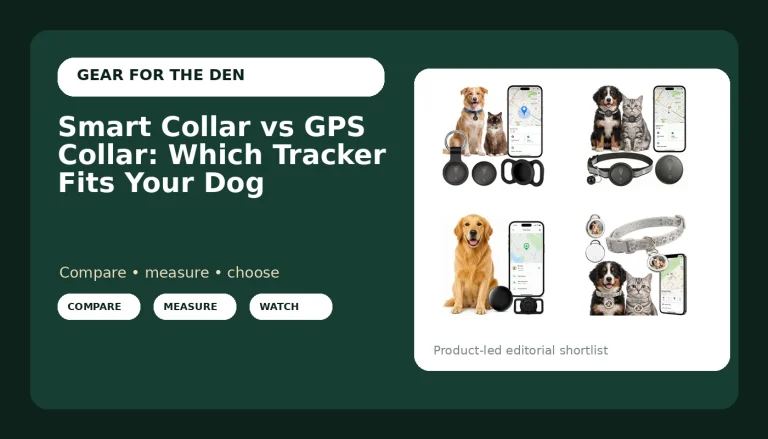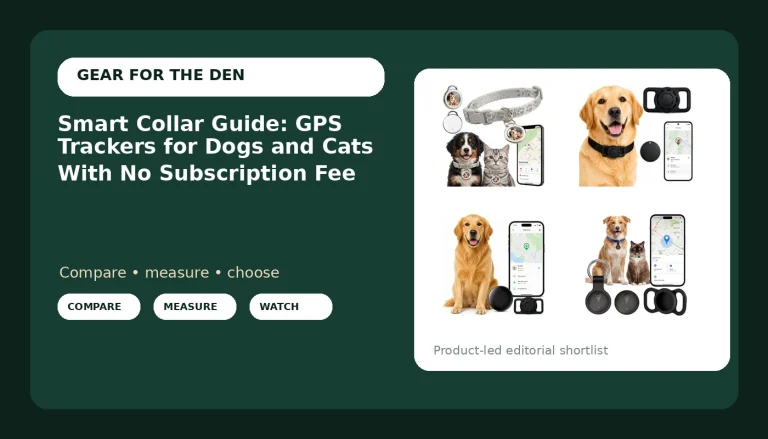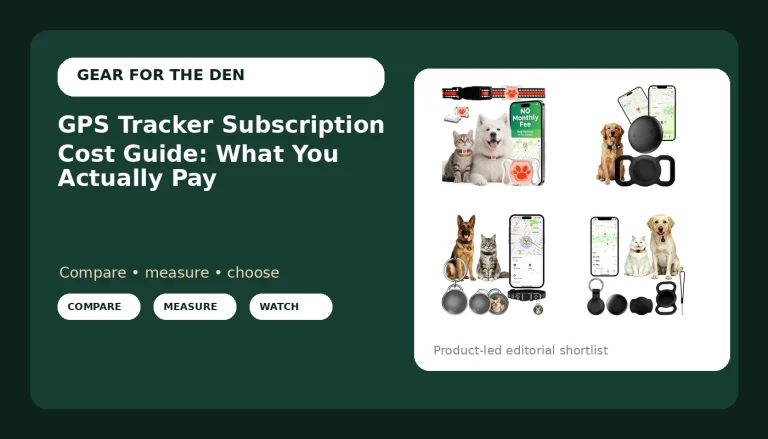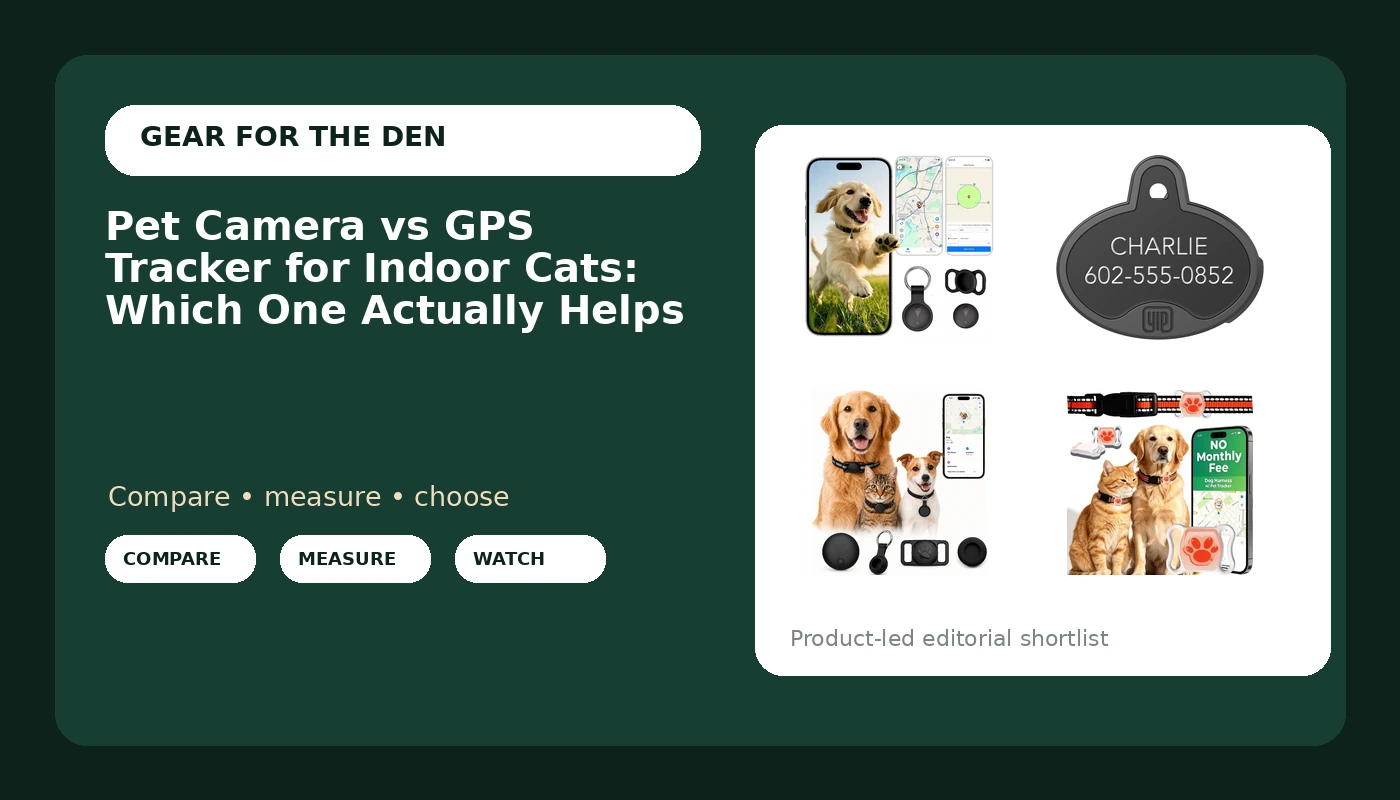
I have spent years writing about cat gear, and the pet camera vs gps tracker for indoor cats question is the one that produces the most confused answers. Most of the pages ranking for it are written by someone selling one of the two devices, so the conclusion is decided before the first sentence. This comparison does something narrower. It assumes you have already leaned toward a tracker and want to know which of four small, collar-mounted options is worth your money, and it tells you plainly when a camera would have served you better.
The short answer: the Fecisumkeji GPS Pet Tracker is the one I would start with, because it runs on Apple Find My with no monthly fee and carries the only water resistance rating in this batch. If you live in a Samsung household, the YIP Smart Tag is the equivalent pick. If your cat never goes near an open door, skip all four and buy a camera.
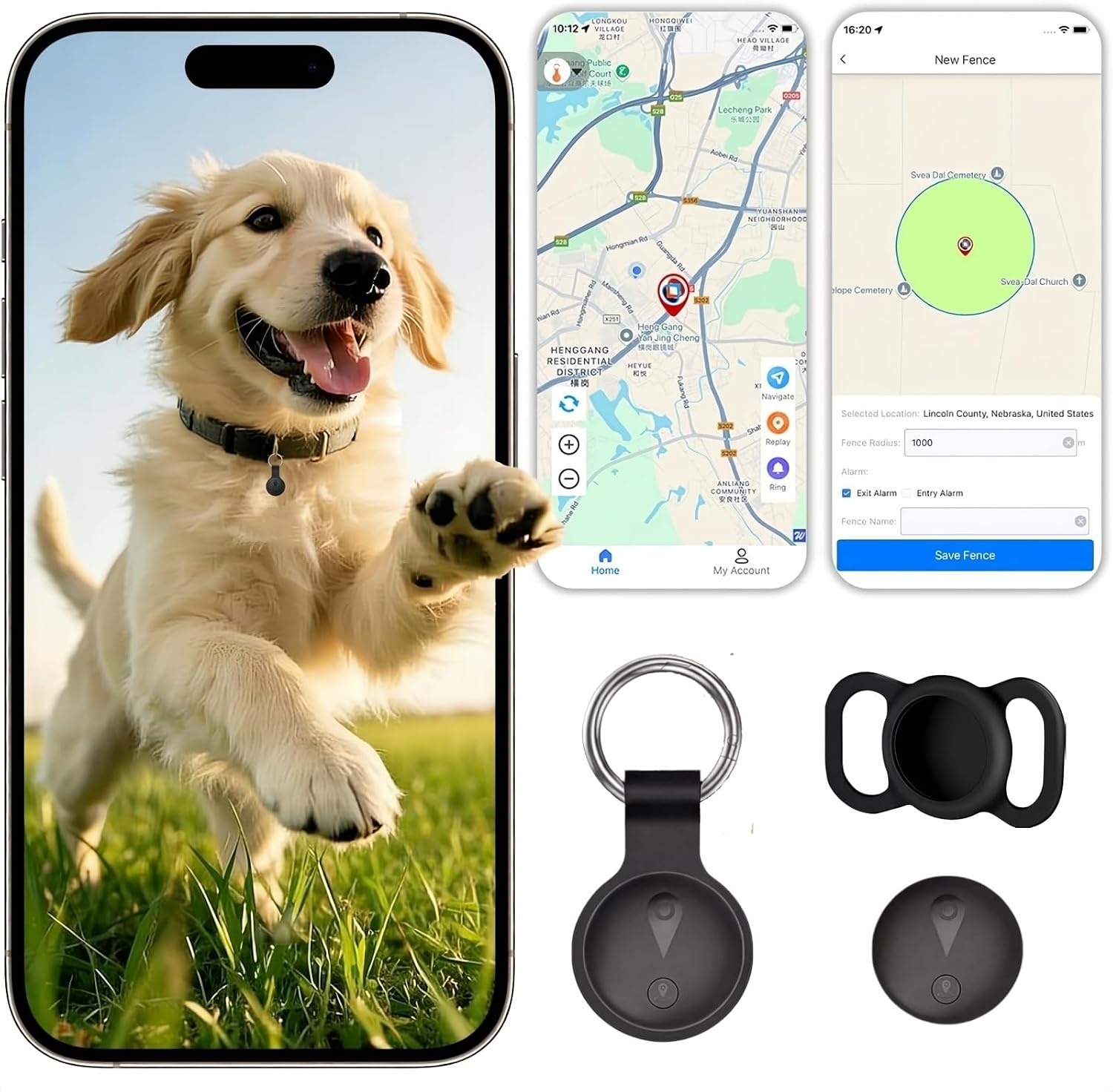
Fecisumkeji GPS Pet Tracker for Dogs & Cats
Runs on Apple Find My with no monthly fee, and it is the only tracker here with a stated IP68 water resistance rating
Network location can lag indoors, and it needs a collar to ride on
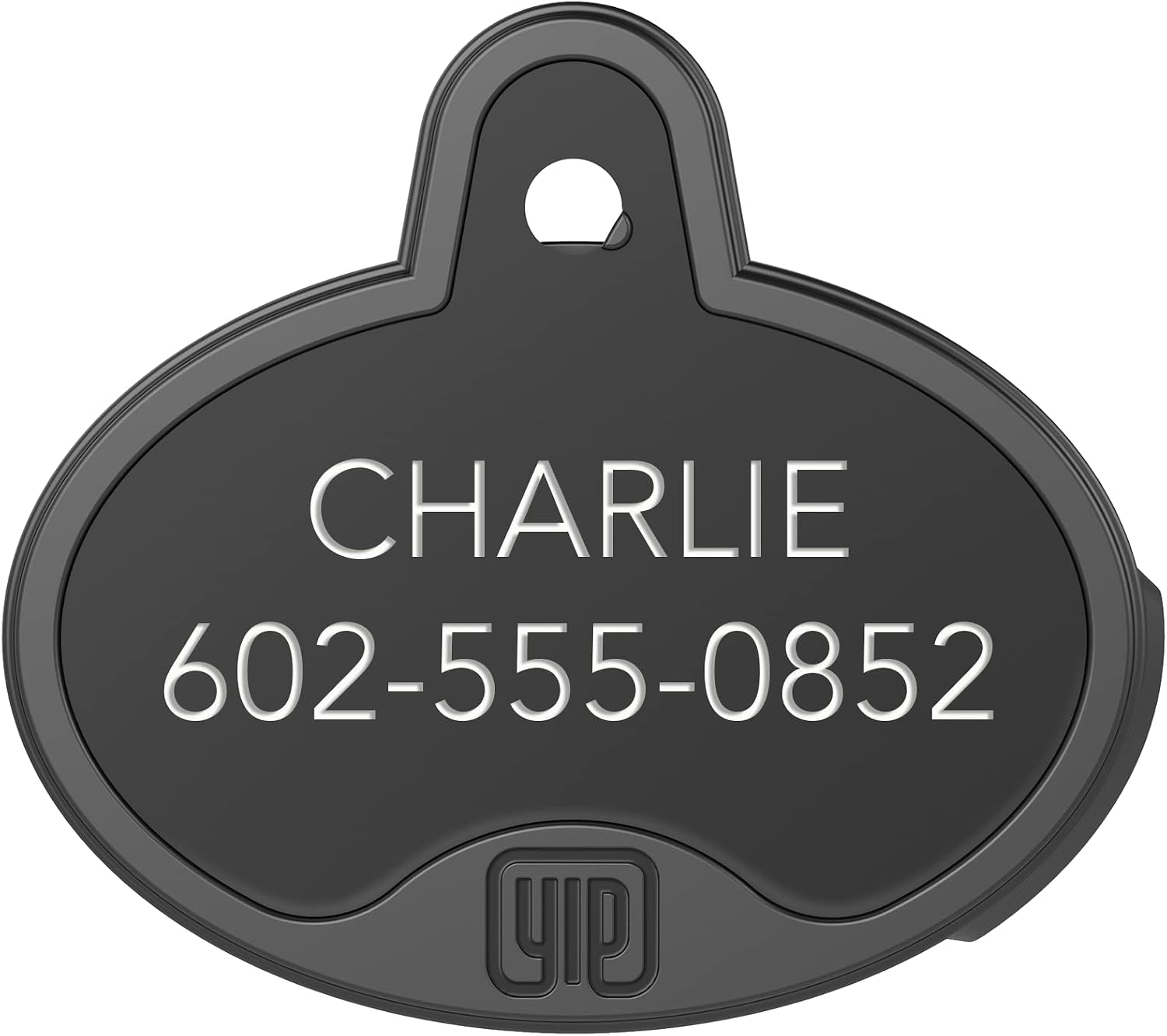
YIP Smart Tag ID & Custom Engraved Dogs Tracker
Doubles as an engraved ID tag with no subscription, and it is built for Samsung Galaxy phones
Galaxy only, so iPhone households are out, and it shares the indoor location lag of any network tag
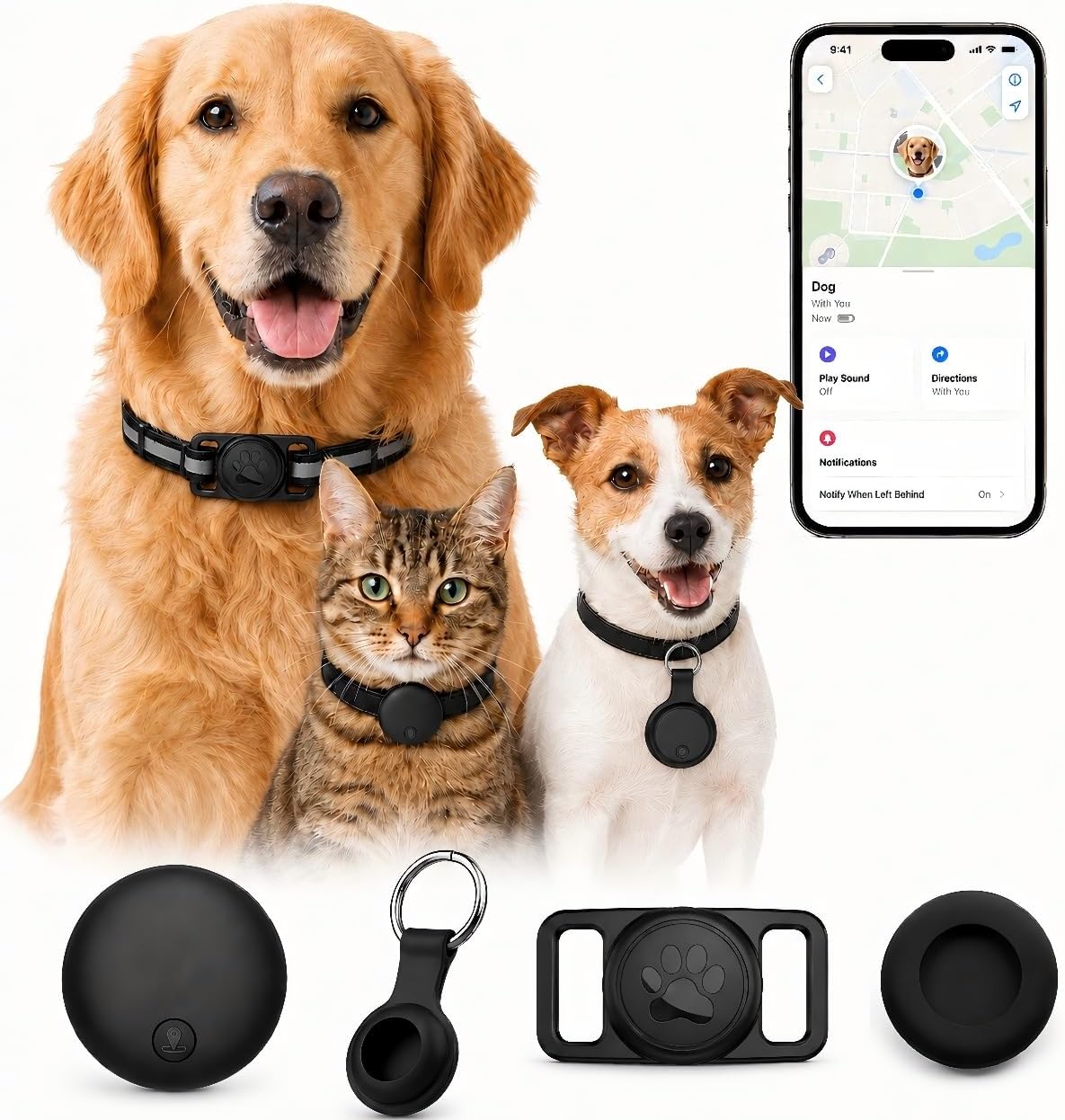
GPS Tracker for Dogs, Pet Location Tracker for Dogs & Cats, iOS Only (Black)
The lowest-commitment way to find out whether you will actually use a tracker, and it pairs with the iPhone you already carry
iOS only, and the name states neither a subscription term nor a water resistance rating
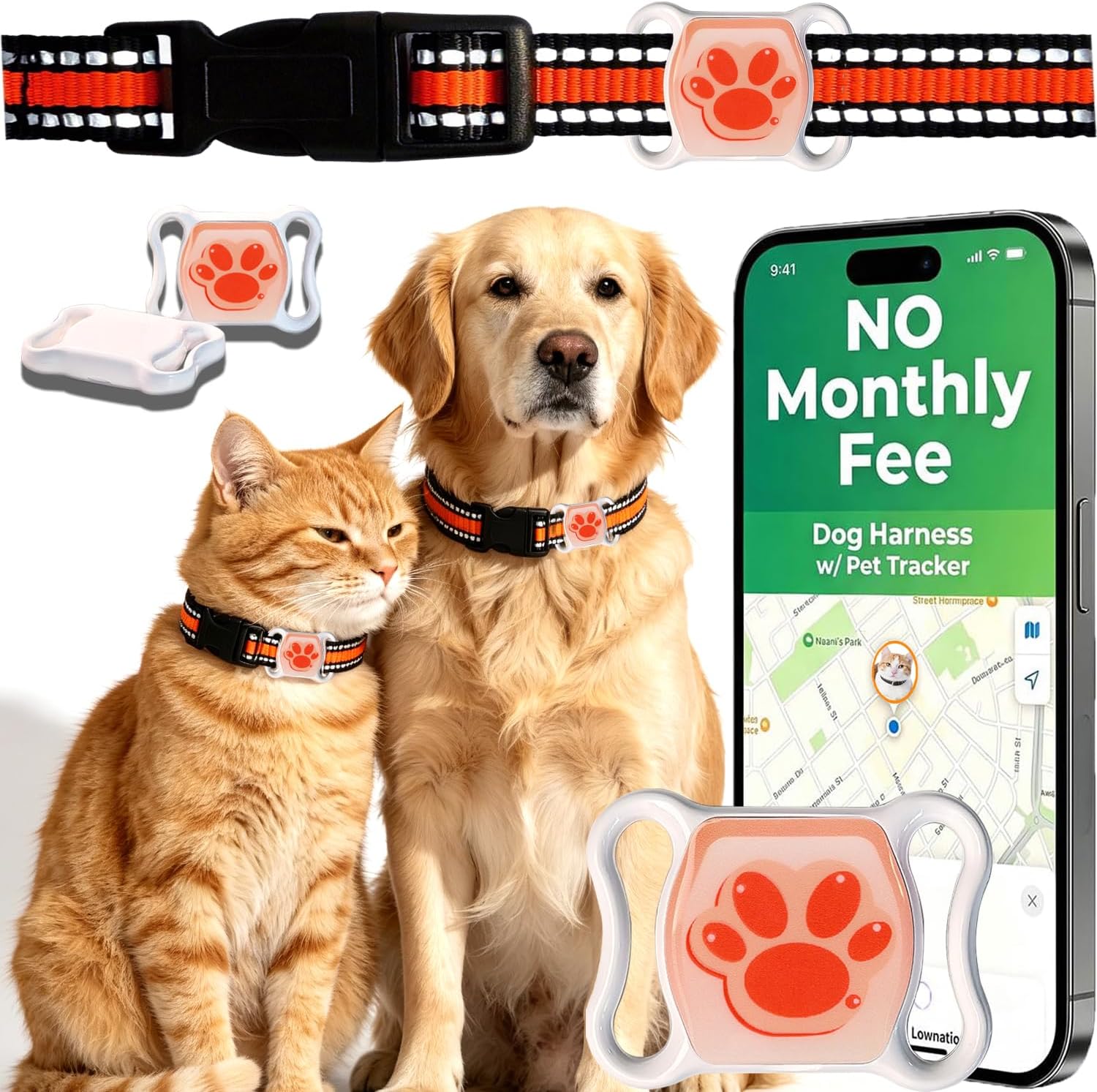
Pet GPS Tracker for Dogs & Cats, Smart GPS Collar with Real-Time Tracking
Ships as a complete collar with real-time tracking instead of a tag you have to thread onto your own collar
The priciest of the four, and a full collar raises a fit and weight question on a small cat
Prices and availability may change.
Why a pet camera and a GPS tracker answer different questions
The difference between pet camera and gps tracker for indoor cats is not a question of quality. It is a question of what data each device produces. A camera produces behavior: when your cat eats, how much she sleeps, whether she is limping, whether the other cat is bullying her away from the water bowl. A tracker produces location: a dot on a map, a last-seen time, and a direction to walk when the dot stops moving.
That is why the gps tracker for indoor cats vs pet camera argument keeps going in circles. Both devices attach to the same animal, both pair with a phone, and both promise peace of mind, but they answer different anxieties. If your fear is that the front door gets left open, a tracker is the right tool. If your fear is that something is wrong and you cannot tell what, a camera is the right tool. Buying one to solve the other problem is how people end up with a gadget that lives in a drawer.
There is also a third path worth mentioning: some owners buy both. That is defensible if you have a door-darter and you also want to know why she stopped eating, but it doubles the charging, the app pairing, and the notifications. Start with the one that matches your actual worry.
What the pet camera vs gps tracker for indoor cats choice really measures
Before you compare spec sheets, decide what you are measuring. For an indoor cat, a tracker is measuring escape risk and recovery time. Everything else on the box is secondary.
The specs that matter for that job are battery life, signal range, and how the location actually reaches your phone. Battery life decides whether the tracker is charged on the day you need it, because a dead tag reports nothing. Signal range is less about the radio inside the tag and more about the network around it. A Find My or SmartThings tag borrows nearby phones, so its useful range indoors is really the density of compatible phones near your building. A dedicated GPS collar talks to satellites, which is better outdoors and worse in a basement.
Then there is app pairing. A tracker that takes four taps and one Bluetooth handshake to set up will get used. A tracker that wants an account, a firmware update, and a permission screen three menus deep will not. I have watched people abandon perfectly good trackers because the app fought them on day one, and that is a real cost, not a minor annoyance.
The two no-subscription tags I would put on a collar first
Both of the tags in this group are built around a phone network rather than a dedicated GPS radio, and both state that no monthly fee applies.
The Fecisumkeji GPS Pet Tracker for Dogs & Cats is the one I would hand to most people. It is Apple Find My compatible, so it appears in the same app as your keys, and it carries an IP68 water resistance rating, the only explicit water rating in this batch. IP68 is the difference between a tag that survives a cat drinking from a fountain and a tag that dies in a rainstorm, so it matters more than most listing copy suggests. Fecisumkeji GPS Pet Tracker for Dogs & Cats (Check current Amazon price).
The YIP Smart Tag ID & Custom Engraved Dogs Tracker is the Samsung answer, compatible with Galaxy phones and sold as both a tracker and an engraved ID tag. For a cat that slips out, an engraved tag with a phone number on it is still the fastest way home, because a stranger can read it without an app. The trade-off is platform lock: this one is for Galaxy households, and it is not the pick for an iPhone. YIP Smart Tag ID & Custom Engraved Dogs Tracker (Check current Amazon price).
What both share is the weakness of network tracking. Indoors, a tag that relies on nearby phones can report a stale location, sometimes several minutes old, because the signal has to find a phone before it finds you. Outdoors in a populated area that is fine. In a stairwell, a crawlspace, or an empty parking garage, expect a wider circle on the map and less certainty.
The standalone collar with real-time tracking
The Pet GPS Tracker for Dogs & Cats, Smart GPS Collar with Real-Time Tracking is the only product in this batch that ships as a complete collar with the tracker built in rather than a tag you thread onto an existing collar. That matters if your cat wears a breakaway collar you like, because you may not want to replace it. It also matters if you have ever lost a tag because the silicone holder stretched.
The real-time tracking wording points at dedicated GPS rather than a crowd-sourced network, which is the better architecture when your cat gets out and keeps moving. A tag that pings nearby phones tells you where she was. A GPS collar that holds a satellite fix tells you where she is, which is the number you want when you are walking a block with a flashlight.
The trade-offs are the usual ones for a full collar. It is the priciest item in this group, and a collar has to fit. A tracker that hangs loose on a small cat's neck snags on furniture, and a collar that is too snug is worse. Check the weight and the adjustment range before you buy, and confirm the subscription terms, because this listing does not state no monthly fee in the name the way the two tags do. Pet GPS Tracker for Dogs & Cats, Smart GPS Collar with Real-Time Tracking (Check current Amazon price).
The iOS-only budget tracker
The GPS Tracker for Dogs, Pet Location Tracker for Dogs & Cats, iOS Only is the fourth option, and its limitation is right in the name. It is for iPhone households only, which is less a flaw than a sorting rule. If everyone in your home carries an iPhone, it belongs in the comparison. If anyone carries an Android, it does not.
The name states neither a subscription term nor a water resistance rating, so those are the two questions to settle before you commit. For an indoor cat in a single-platform home, this is the low-commitment entry point, and the modest outlay makes it an easy way to test whether you will actually use a tracker before spending more on a collar. GPS Tracker for Dogs, Pet Location Tracker for Dogs & Cats, iOS Only (Check current Amazon price).
Battery life, signal range, and app pairing: the specs to verify
None of the four product names in this batch state a battery figure, and that is the first thing I would confirm on the listing before buying any of them. A tracker is only as good as its charge on the day the door gets left open. Look for a stated runtime and, more importantly, a low-battery alert that reaches your phone before the tag dies rather than after.
Signal range is the second. Network tags and satellite trackers fail in different places, and no spec sheet will tell you how either behaves in your building. The practical check is the first week: put the tracker on the collar, walk your normal routes, and see where the dot starts to drift. That tells you more than a range claim on a box.
App pairing is the third, and it decides whether the tracker is still on the collar in six months. A tracker that shares an app you already use, Find My or SmartThings, has a real advantage over one that wants its own account and its own notification settings. This is the unglamorous half of the pet camera vs gps tracker for indoor cats decision, and it is the half that determines whether the device stays in service.
Subscription, water resistance, and power backup
Subscription is the cost that surprises people. Two of these four state no monthly fee in the name, the Fecisumkeji and the YIP, and the other two do not, so read the fine print on those before you buy. A tracker with a subscription is not automatically worse, because cellular service costs somebody money, but you should know the annual number before you commit.
Water resistance is where the batch separates. Only the Fecisumkeji states an IP68 rating. For the others, treat a cat water fountain, a wet food bowl, and a rainy dash to the car as risks until you confirm otherwise.
Power backup is the camera side of the pet camera vs gps tracker for indoor cats argument, and it is worth stating plainly because it is the reason a camera is not a replacement for a tracker. A camera needs a wall outlet and, if you want it to keep working when the power drops, a battery backup. A tracker tag runs on its own battery and keeps reporting through an outage, which is exactly the scenario where you need it.
Camera resolution and the specs cameras get wrong
If you do end up shopping for a camera instead, do not buy on camera resolution alone. A 2K or 4K camera resolution is marketing for a device whose real job is seeing a black cat in a dark hallway at 2 a.m., and that is about low-light sensor performance and infrared range, not pixel count. The same goes for the smart feeder specs that get mixed into these comparisons: portion accuracy and power backup matter on a feeder, and neither has anything to do with finding a cat that got out. For that side of the shopping list, see cat feeding and water gear.
The one camera spec that genuinely overlaps with a tracker is notification reliability. Both devices are useless if the alert arrives late. When you compare them, compare how fast each one tells you something is wrong.
What I would buy for an indoor cat
If your cat is a door-darter, buy the Fecisumkeji GPS Pet Tracker for Dogs & Cats. It runs on Apple Find My, states no monthly fee, and has the only water resistance rating in this batch, which makes it the least fussy option for daily wear.
If your household is Samsung, buy the YIP Smart Tag. You get the same no-fee network approach plus an engraved ID tag, and platform compatibility beats every other difference between the two.
If your cat never goes near an open door, buy neither and put the money toward a camera. On the pet camera or gps tracker for indoor cats question, that is the part most buying guides skip: a tracker that never has to find a cat is just a tag you keep charging.
And if you are still unsure, start with the iOS-only tracker or the collar, live with it for a month, and let the first real scare tell you whether you need the upgrade.