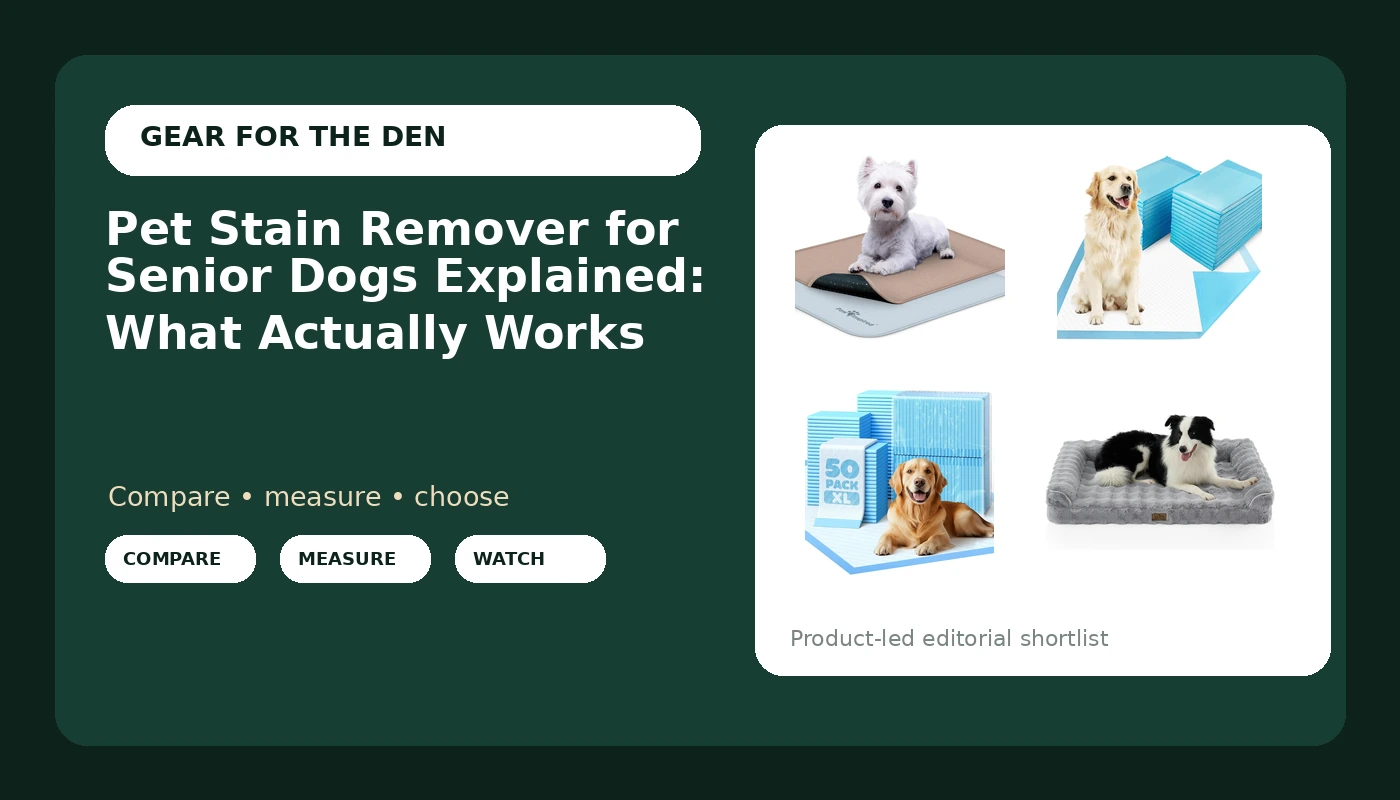
If you are shopping for a pet stain remover for senior dogs, the frustration is usually not the scrubbing. It is the repetition. An older dog tends to leak in the same two or three places, so a spray bottle ends up fighting the same battle every night. That is why the most practical answer is often not a liquid at all. It is a layered setup of liners, absorbent pads, and washable bedding that stops urine before it soaks into carpet backing, crate seams, or bed foam, and then gets laundered or thrown away on a schedule you can actually keep. This guide explains what each layer contributes, which sizes and materials matter, and how to choose between disposable and washable options for a dog who cannot always make it outside in time.
Quick answer
The pet stain remover for senior dogs explained in one line: most accidents are contained before they become stains, and the residue that does reach fabric is handled with enzymes rather than detergent alone. In practice that means a washable liner under the dog, a disposable pad in the crate or on the floor, and a bed whose cover can go into the washing machine. Four details decide whether a setup works: pad absorbency, pad size against the accident zone, liner waterproofing, and how easily each layer can be cleaned. Enzyme concentration matters for whatever still soaks through, because enzymes break down the uric acid crystals that keep a spot interesting to a dog's nose long after it looks clean. A real odor neutralizer beats a perfumed cover-up, since scent is what pulls a dog back to the same corner.
What a pet stain remover for senior dogs has to handle
Three things change as a dog ages. The volume per accident can be larger, because a senior dog may hold it longer between trips outside. The location is often fixed, because a dog with sore joints or reduced mobility will not always reach the door in time. And the timing becomes less predictable, because deep sleep and some medications dull the warning signs that used to send a dog to the door. There is no single ideal pet stain remover for senior dogs. The correct pet stain remover for senior dogs depends on where the accidents land and how much laundry your week can absorb. The four products below are arranged by the job they do in a containment setup rather than by brand, and each covers a different part of the problem.
| Model | Best fit | What stands out |
|---|---|---|
| Paw Inspired Washable Crate Liners for Dogs, 24×18 Inch, 2 Pack | Crate trays and small sleep spots | Two washable liners sized for a 24 by 18 inch footprint |
| Dogcator Dog Pee Pads Extra Large 30"x36", 30 Count Super Absorbent Pee Pads for Dogs, Disposable Urine Bed Pads for Doggie, Thicken XXL Puppy Pads, Piddle Pads X-Large for Indoor, Outdoor Use | Large floor zones around a big dog | Extra large 30 by 36 inch disposable pads in a 30 count pack |
| Powools Puppy Pads for Dogs, 34×28 in, 6-Layer Leakproof, 50-Pack | High volume households that change pads often | Six layer construction in a 50 count pack |
| COZY KISS Orthopedic XL Dog Bed for Large Dog, Washable Pet Bed | The dog's main resting spot | Orthopedic XL bed described as washable |
The base layer: Paw Inspired Washable Crate Liners for Dogs, 24×18 Inch, 2 Pack
The liner is the layer that decides whether an accident reaches the crate tray or the floor at all. Liner waterproofing is the feature to check first, because a liner that wicks simply moves the problem into the tray seam. At 24 by 18 inches this one matches a standard crate tray footprint, and the two pack matters more than it sounds: with two liners you can keep one in the crate while the other is in the wash, which is the only way a reusable layer survives a dog who leaks most nights. The trade off is coverage. This size protects a crate, not a hallway, so it belongs under a pad rather than in place of one.
The wide coverage pad: Dogcator Dog Pee Pads Extra Large 30"x36", 30 Count Super Absorbent Pee Pads for Dogs, Disposable Urine Bed Pads for Doggie, Thicken XXL Puppy Pads, Piddle Pads X-Large for Indoor, Outdoor Use
Pad size is the first decision with disposables. A 30 by 36 inch pad covers a wide zone, which suits a senior dog who circles before lying down or who shifts position overnight and leaves the pad edge behind. A disposable pad also removes the laundry question entirely, which matters in a household where washing a liner every morning is not realistic. Absorbency and thickness are described by the seller and are not measured here, so treat pack size as the practical variable: a 30 count pack sets how often you reorder. Layer this over a washable liner and most accidents never reach the carpet, and the pad is the only part that gets thrown away.
The leakproof layer: Powools Puppy Pads for Dogs, 34×28 in, 6-Layer Leakproof, 50-Pack
Six layer construction is the claim that matters here, because the number of layers is what keeps liquid from pressing back up through the surface when a dog stands on a saturated pad. A 34 by 28 inch pad sits between the extra large size above and a standard pad, which makes it a reasonable fit for a crate, a pen, or a doorway where the dog waits. The 50 count pack suits a household that changes pads several times a day rather than once. Because these are disposable, they pair well with a washable liner as a base: the liner takes the occasional miss, the pad takes the daily volume, and the carpet stays out of the conversation.
The resting spot: COZY KISS Orthopedic XL Dog Bed for Large Dog, Washable Pet Bed
The bed is the part of the setup people forget, and it is usually where the smell lives. Urine that reaches bed foam is very hard to remove, so a bed described as washable is doing stain prevention work, not just comfort work. Orthopedic construction and XL sizing matter for a large senior dog with sore joints, because a dog who is comfortable in one spot is a dog who leaks in one known spot instead of three unknown ones. Check the care instructions before the first wash, treat any residue with an enzyme cleaner before laundering, and put a pad or liner under the bed so the foam is never the first surface to absorb anything.
Prices and availability may change. Product images, names, and retailer links are matched to verified listings. No current price, rating, stock status, or measured result is stated here without current evidence.
What senior dog accidents leave behind
Urine is not a single substance. It is water, urea, salts, hormones, and uric acid, and the uric acid is the part that causes trouble. When urine dries, uric acid crystallizes and binds to fibers. Those crystals are only slightly soluble in water, which is why a detergent spray can make a carpet look clean while the crystals remain in the backing and the pad underneath, releasing odor every time humidity rises. Enzymes address this differently: a cleaner with a meaningful enzyme concentration breaks the crystals down rather than lifting the surface layer, which is why dwell time on the label matters as much as the product itself. Leave it wet long enough to work, then blot.
Two cautions are worth repeating. Ammonia based cleaners smell like urine to a dog and can pull the dog back to the same spot, and any cleaner used on a rug, a sofa, or a bed cover should be labeled carpet safe or fabric safe for that material, because enzyme cleaners can affect some dyes. A genuine odor neutralizer is doing chemical work; a perfumed spray is only covering the smell for you, not for the dog's nose.
Matching pad size, absorbency, and liners to your dog
Choosing a combination takes about ten minutes and saves months of guessing. Work through these steps in order, and write down the answers so the next reorder is automatic.
- Map the accident zone. Watch for three days and note where the dog leaks: inside the crate, beside the bed, at the back door. Measure the widest version of that area rather than the average, because a pad that is too small is the most common reason a setup fails.
- Size the pad with margin. Add roughly four to six inches beyond the wet zone on every side. That is how a 30 by 36 inch pad earns its place around a large sleeping area, and why a 34 by 28 inch pad suits a crate or a pen.
- Decide disposable versus washable by your laundry capacity. Disposable pads handle volume with no washing, while washable liners and bed covers need a machine and a drying plan. Households with a working laundry routine usually run both layers.
- Check liner waterproofing before pad absorbency. A waterproof liner under a disposable pad catches what the pad misses. If the liner wicks, the pad is working alone and the floor becomes the third layer.
- Match the cleaner to the surface. Confirm the product is carpet safe or fabric safe for what you are treating, keep an enzyme cleaner for dried spots, and remember that fresh urine needs blotting first, not scrubbing, which pushes liquid deeper.
Practical guidance for a routine that holds up
- Keep two of everything you can. Two liners, two bed covers, and a spare pack of pads mean an accident never forces a wash cycle at midnight.
- Wash on a schedule, not on demand. A weekly liner and cover wash keeps odor from building in fabric even when the surface looks clean, and it avoids laundering a waterproof layer more often than the care label allows.
- Change pads before they are saturated. A pad at its limit presses liquid back onto the dog and the floor, so replace it while dry surface is still visible.
- Treat fresh spots immediately and dried spots patiently. Blot fresh urine, apply an enzyme cleaner, and let it dwell. Dried spots often need a second application because the crystals have had time to bind.
- Keep the resting spot dry and ventilated. Lift the bed and the liner during the day and let the floor under them air out, since trapped moisture is what turns a small miss into a lasting smell.
Which option should you choose?
Choose the Paw Inspired Washable Crate Liners for Dogs, 24×18 Inch, 2 Pack when the accidents happen inside a crate and you want a reusable base layer sized for a standard tray. Choose the Dogcator Dog Pee Pads Extra Large 30"x36", 30 Count Super Absorbent Pee Pads for Dogs, Disposable Urine Bed Pads for Doggie, Thicken XXL Puppy Pads, Piddle Pads X-Large for Indoor, Outdoor Use when you need the widest coverage for a large dog who moves around and you would rather not add laundry. Choose the Powools Puppy Pads for Dogs, 34×28 in, 6-Layer Leakproof, 50-Pack when volume is high and a six layer pad in a 50 count pack fits your change schedule. Choose the COZY KISS Orthopedic XL Dog Bed for Large Dog, Washable Pet Bed when the goal is a machine washable resting spot that supports an older dog's joints.
None of these is a stain remover in the bottle sense, and none of them is measured here. Absorbency, layer count, and orthopedic claims come from the seller's descriptions. What a layered setup does is reduce how often a cleaner is needed at all, which is the part of the problem you can actually control.
The bottom line
The pet stain remover for senior dogs explained in the simplest terms is a stacking problem. Stop the urine at the surface with a pad, catch the misses with a waterproof liner, and keep the one place your dog sleeps washable. Add an enzyme cleaner with real concentration for spots that still get through, choose products labeled carpet safe or fabric safe, and treat prevention as the part of the routine you control. Senior dogs are not going to have accidents on a schedule you prefer. A layered setup at least keeps those accidents from becoming a permanent part of the floor.