A freestanding gate is one of those purchases you make in a hurry, usually the same week a puppy discovers the staircase. The plastic dog gate vs wooden dog gate question looks like a style argument, and part of it is, but material also decides how heavy the thing feels when you move it twice a day, how it reacts to a damp hallway, and how easily you wipe peanut butter off the bottom rail. I lined up four products that cover the spread of what people actually buy for containment: three folding freestanding gates and one eight-panel playpen, from a 54-inch three-panel gate up to a 144-inch run with a walk-through door. Nothing here has to be screwed into a wall.
The short answer: for a doorway you open and close all day, a folding gate with a walk-through door earns its place, and material matters less than panel count, gate height, and whether the frame folds flat when guests arrive. The long version involves how each material ages, what a stated maximum width actually means, and why the tallest product here is a playpen rather than a gate.
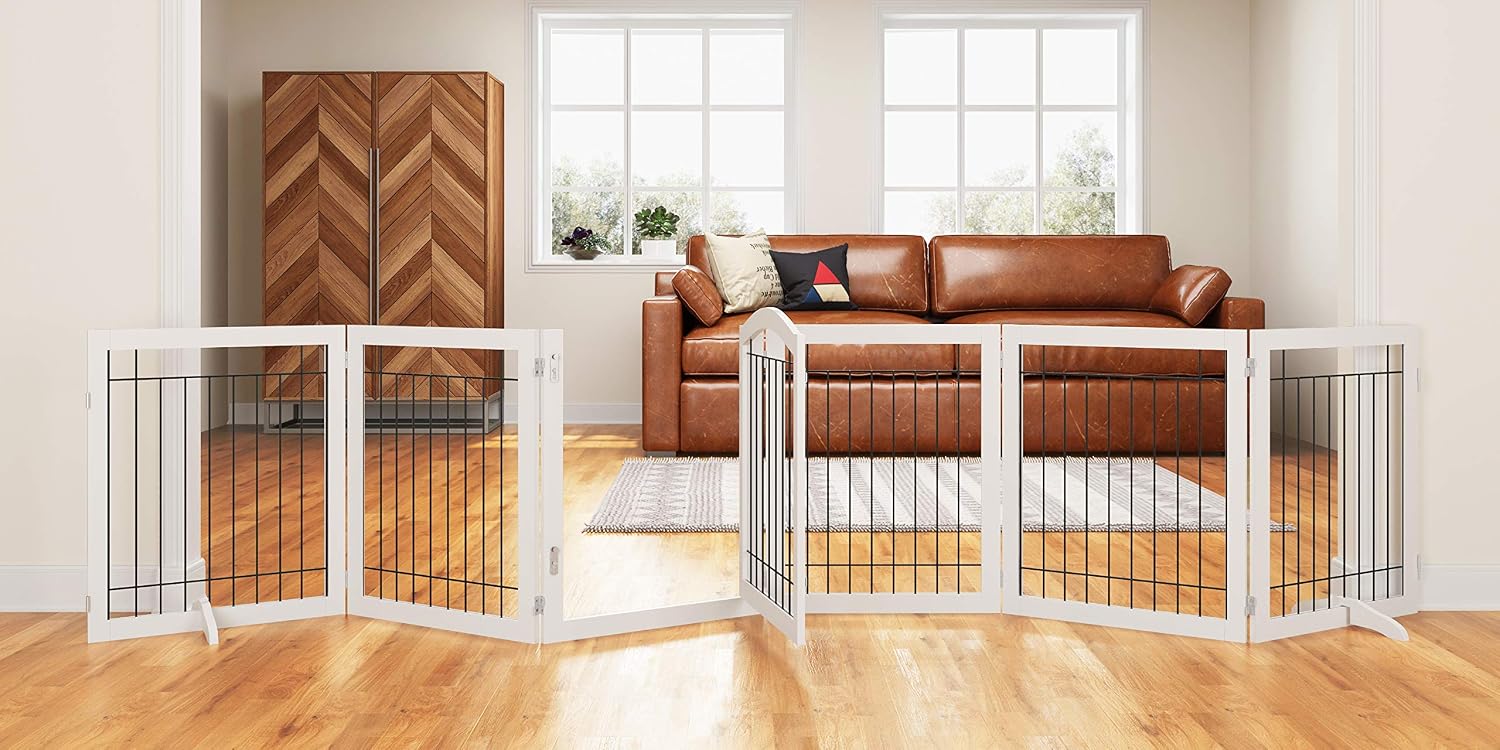
PAWLAND Dog Gate Indoor with Door, Freestanding, Foldable, 144" Wide, 30" H
Widest span of the four at 144 inches, and one of only two products here with a built-in gate you walk through
30-inch height is the lowest in this group, and the folded bundle is long to store
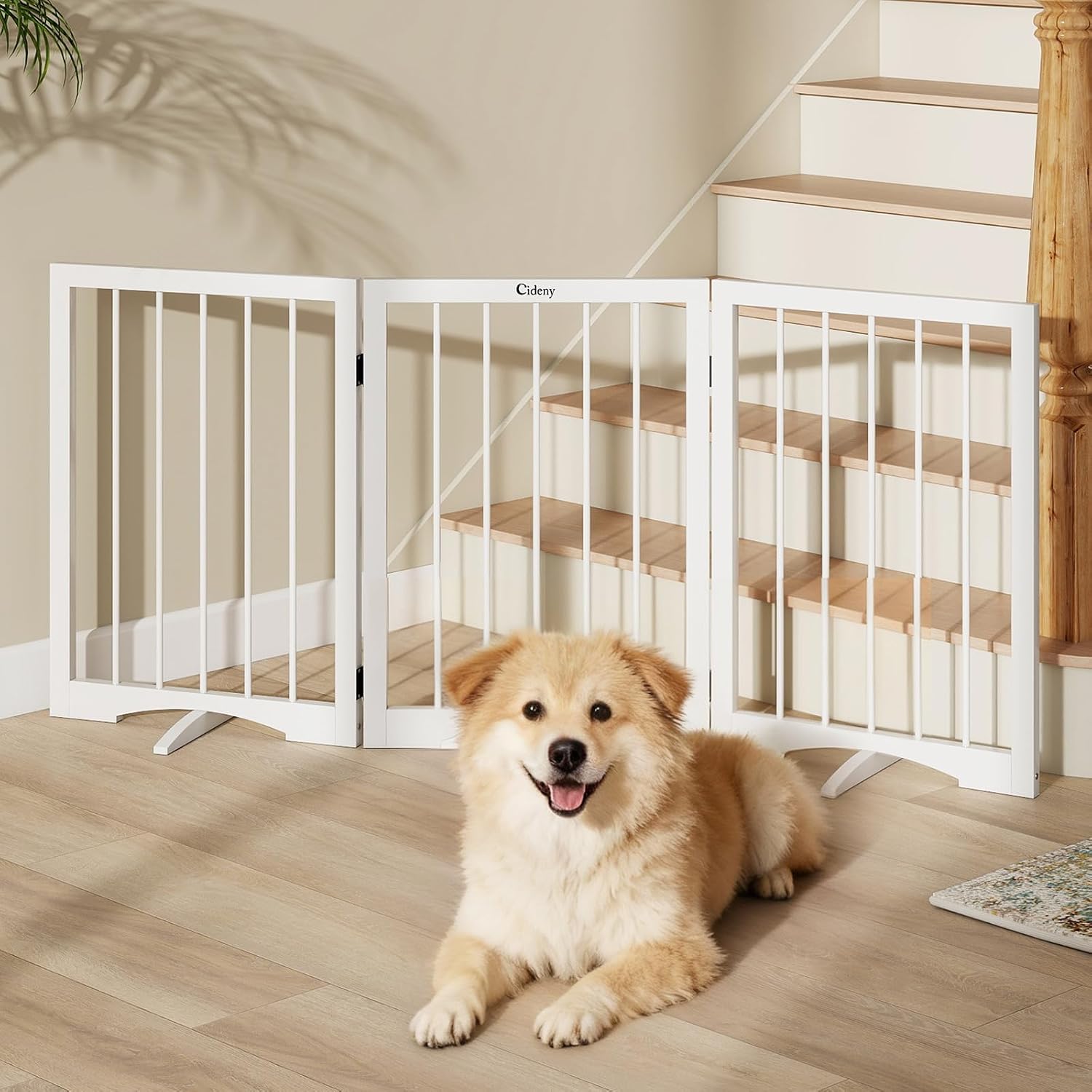
Free Standing Dog Gate Indoor, Foldable Dog Gate for Stairs Doorways
Folds flat, moves between a doorway and the bottom of the stairs, simplest setup here
Listing states no panel count and no maximum width, so a wide opening may need a second gate
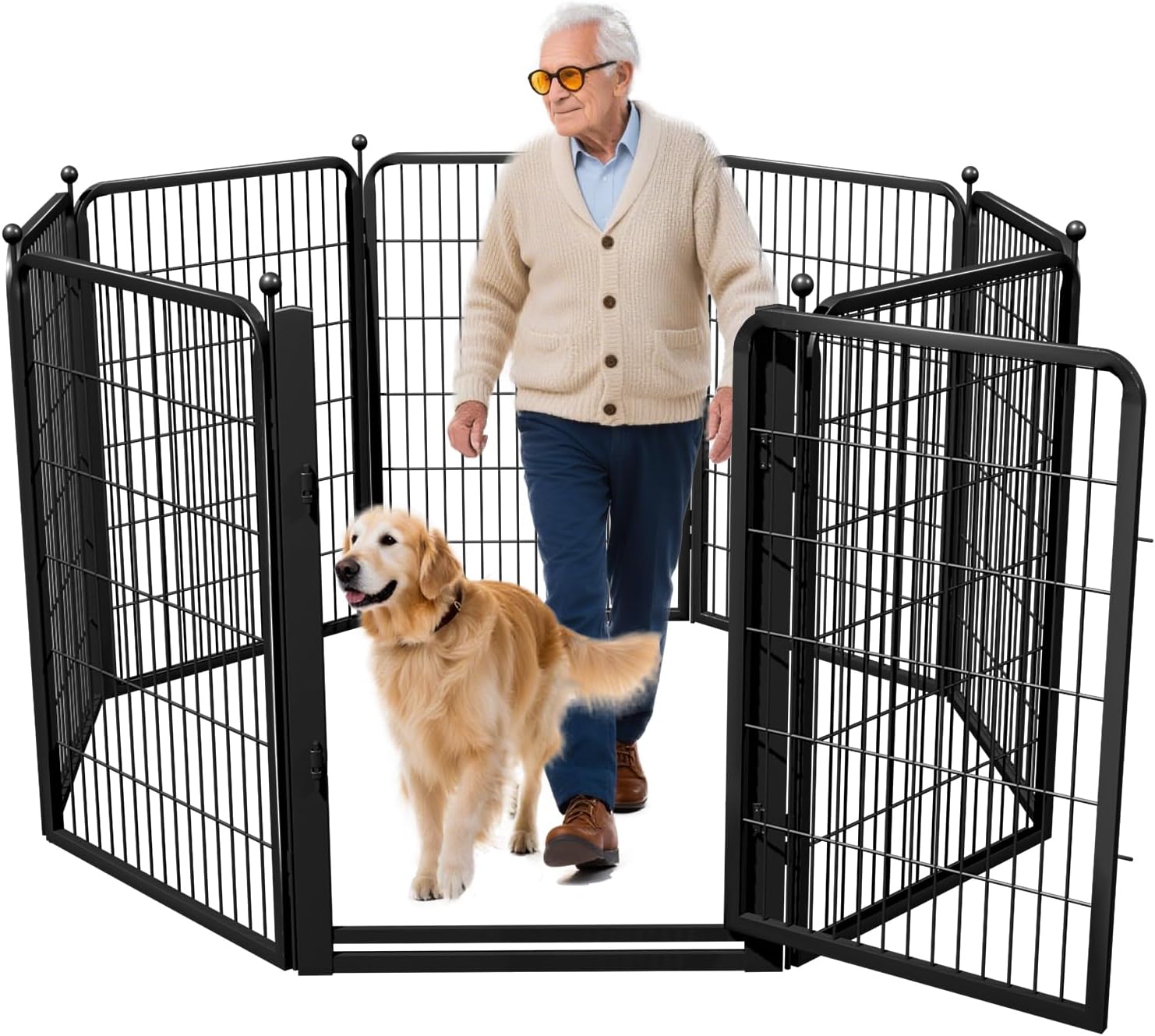
Jhsomdr Dog Playpen, 40 inch 8 Panels Dog Fence with Extra Wide Gate, No-Tripped Pet Playpen Rustproof Dog Pen Indoor Puppy Playpen for Temporary Containment, Portable Pet Fence for RV Camping
Eight panels and 40-inch height, the tallest and most configurable option, with an extra wide gate and a rustproof finish
Takes up floor space, does not fold flat, and it is more pen than doorway gate
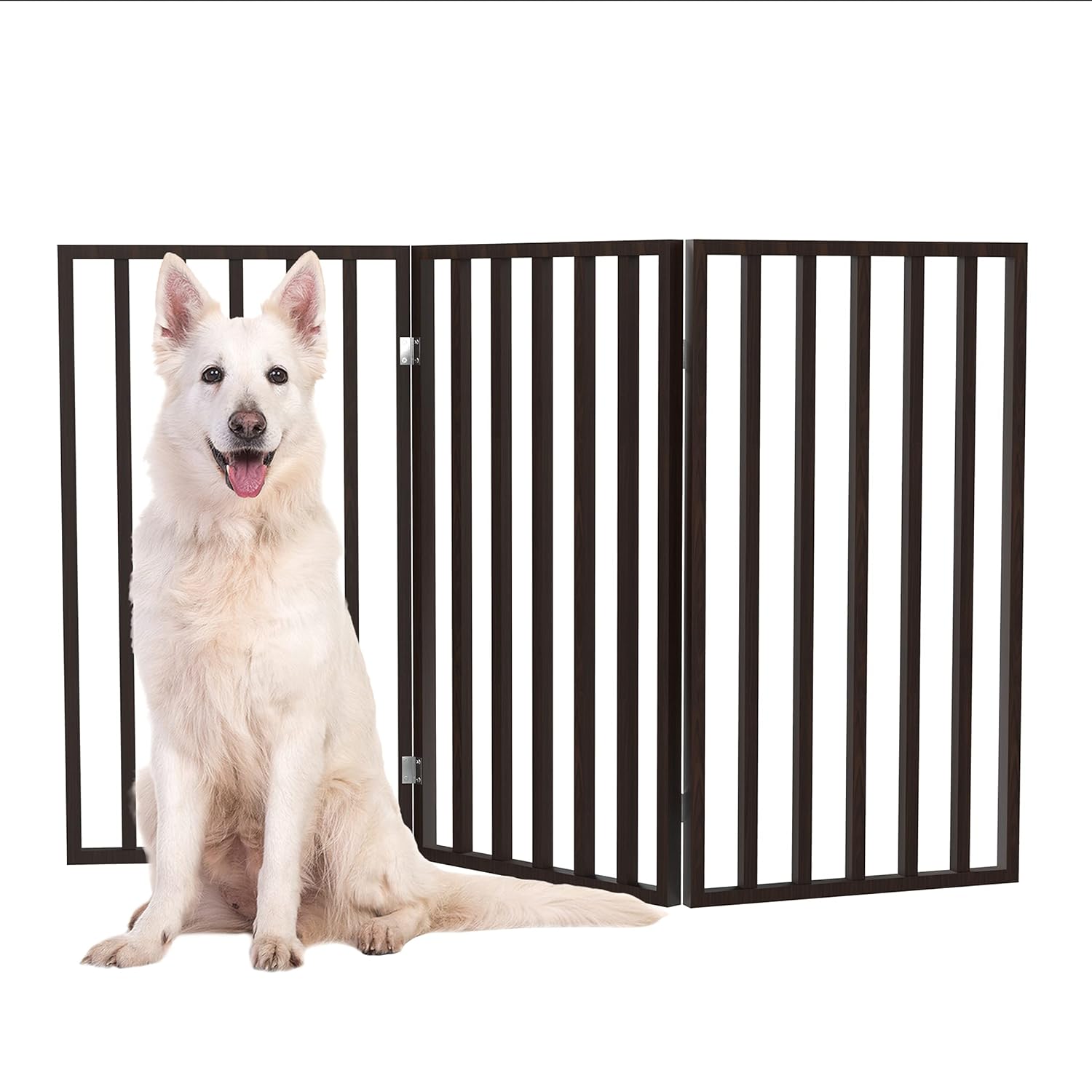
PETMAKER Pet Gate, 3 Panel Freestanding Dog Gate Indoor, Brown, 54” x 32”
54-inch span at 32 inches tall, in a brown finish that reads as furniture rather than equipment
No walk-through door, so you step over it or move the whole gate
Prices and availability may change.
How I compared these four gates
Four things separate a gate you keep from a gate you resell: the material and how it handles a mop, the panel count and the span it covers, the gate height, and whether the frame folds or stays put. Every product below is a freestanding design, which means you can move it from a doorway to a hallway to the bottom of the stairs without patching drywall. That flexibility is the reason this category exists, and it is also the reason the trade-offs matter. A gate that moves is a gate that can be pushed, tipped, or dragged by a bored dog.
Storage counts too. A three-panel gate folds into a bundle that lives behind a couch. An eight-panel pen does not fold into anything, and it becomes a piece of furniture while it is up. I also looked at the opening each product is built for, because a 54-inch gate and a 144-inch gate are not competing for the same doorway.
The one thing I did not do is rank them by price. Prices in this category swing with every sale, so check the current listing for each and compare the number yourself.
The material question: plastic dog gate vs wooden dog gate
The wooden dog gate vs plastic dog gate argument usually starts with looks and ends with weight, and weight is what you notice at 6 a.m. with a coffee in one hand.
Plastic and composite gates are lighter, and lighter matters more than it sounds. A gate you can lift with two fingers is a gate you actually move out of the way instead of stepping over. The surface is non-porous, so a damp cloth handles muddy paws, drool, and the occasional accident without staining. The trade-off is that plastic reads as utility. Thin panels flex across a long span, and the finish scratches into a dull patch where a dog leans on the top rail.
Wood is heavier, stiffer, and better at holding a straight line across a wide opening. A wooden panel resists bowing in a way a thin plastic one does not, and a stained or painted finish blends into a living room in a way white resin never will. The cost is maintenance. Wood moves with humidity, so a gate near a bathroom or a sliding door wants a wipe and a dry rather than a soak. Chewed edges splinter on wood and crack into sharp points on plastic. Neither material is chew-proof, and a determined chewer belongs in a crate, where crate size matters more than gate style.
The practical difference between plastic dog gate and wooden dog gate shows up on cleaning day and in year three. Plastic looks about the same after three years of wiping, only slightly scuffed. Wood looks better after three years if you keep it dry, and worse if you do not.
If the gate is going to be furniture, in a room where you sit and look at it, wood earns the extra weight. If the gate is a tool that gets folded, moved, and wiped, plastic wins on every count except rigidity.
Panel count, gate height, and bar spacing: sizing the gate to the dog
The plastic dog gate vs wooden dog gate debate quiets down once height and panel count are on the table, because those two numbers decide whether a gate works at all.
Start with gate height. The shortest gate here stands 30 inches and the tallest product is a 40-inch playpen. A gate between 24 and 30 inches contains most small and medium dogs that are not jumpers. A dog that clears furniture, or a large breed that leans its chest on the top rail, needs 32 inches or more. Height also has to match your stride. A gate you step over instead of through gets old fast, which is why a walk-through door is worth more than an extra inch of height.
Then panel count and span. A three-panel gate commonly covers around 54 inches when it is opened into a shallow zigzag, and the 54-inch product here is exactly that shape. An eight-panel pen wraps into a full enclosure or a long straight run. A stated width on a folding gate is the maximum it reaches, not the floor space it needs, because each panel folds back on itself. Measure the opening, then leave a few inches of slack, because a gate that exactly fills an opening has no room to sit at an angle.
Bar spacing is the number people skip. Wide gaps let a small dog squeeze through, and they let a puppy get a head through and then panic. Narrow spacing, generally under two inches, suits toy breeds and puppies. Wider spacing is fine for a large dog that cannot fit a paw through anyway. If the dog is small enough to study the gaps, a crate is the safer containment, and the gate becomes a way to keep the dog out of a room rather than in a small space.
Panel count also decides storage. Three panels fold into a bundle. Eight panels do not fold into anything.
Freestanding, folding, and where the gate has to live
The four products here split into two jobs: keeping a dog out of a space, and keeping a dog in one.
For doorways and open-plan rooms, the folding gates do the work. The PAWLAND Dog Gate Indoor with Door, Freestanding, Foldable, 144" Wide, 30" H is the long one, and the walk-through door is what separates it from the rest. A 144-inch maximum span closes off a double doorway or an open living area, and the door means you are not lifting the whole gate every time you walk through. The catch is height. Thirty inches is the low end, so it suits a dog that respects a barrier more than one that tests it. Check current Amazon price
The Free Standing Dog Gate Indoor, Foldable Dog Gate for Stairs Doorways is the flexible one. It folds, it moves, and it is aimed at the two spots where a gate gets used most: a doorway and the bottom of a staircase. Its listing does not state a panel count or a maximum width, so measure before assuming it covers a wide opening. At the top of a staircase, follow the maker's mounting guidance rather than trusting any freestanding panel. Check current Amazon price
For containment, the Jhsomdr Dog Playpen, 40 inch 8 Panels Dog Fence with Extra Wide Gate, No-Tripped Pet Playpen Rustproof Dog Pen Indoor Puppy Playpen for Temporary Containment, Portable Pet Fence for RV Camping is the one that changes the shape of a room. Eight panels build a square, a rectangle, or a straight run, and the extra wide gate gives you a way in and out without dismantling it. At 40 inches it is the tallest product here, and the rustproof finish is aimed at indoor use with the occasional trip outside or into an RV. The cost is floor space. A pen that wraps around a puppy takes up the middle of the room, and it does not fold into a closet the way a three-panel gate does. Check current Amazon price
The PETMAKER Pet Gate, 3 Panel Freestanding Dog Gate Indoor, Brown, 54” x 32” sits in the middle. Three panels, a 54-inch span, a 32-inch height, and a brown finish meant to be looked at rather than hidden. Of the four, it is the one most likely to live permanently in a living room. Check current Amazon price
Cleaning, humidity, and the finish over time
Cleaning is where the material choice turns into a weekly chore instead of a one-time decision.
Plastic and coated surfaces take a wipe. A damp cloth with a little dish soap handles food residue, and there is no finish to lift. Wood wants the same wipe followed by a dry one, and it wants it more often in a humid room. Neither material likes sitting in a puddle, which is why a waterproof layer under a pen matters more than people expect. An eight-panel pen on carpet wicks moisture into the pad underneath it, and a mat with a waterproof backing keeps that from becoming a smell you cannot find.
If a gate or pen ships with fabric, look for a washable fabric pad rather than a spot-clean-only one, and check mat thickness if the dog will lie on it. A thin mat slides under panels; a thicker one grips and stays put. If you use a cover over a pen or a crate to darken it for naps, check cover ventilation, because a covered space with no airflow gets warm quickly.
For the gates themselves the routine is short. Vacuum the gaps where fur collects, wipe the rails, and check the hinges and latch on any gate with a walk-through door. Latches are the first thing to loosen on a folding gate, and they are the part that keeps a 30-inch barrier doing its job. For dogs that will spend crate time instead, see our notes on crate sizing for large dogs.
What the specs say about these four gates
Side by side, the numbers tell you which is which. The plastic dog gate vs wooden dog gate framing gets less useful once these figures are on the table.
Height: 30 inches for the PAWLAND gate, 32 inches for the PETMAKER, 40 inches for the Jhsomdr playpen. The freestanding folding gate does not publish a height in its listing name, so check the listing before buying if your dog is a jumper.
Width: 144 inches maximum for the PAWLAND, 54 inches for the PETMAKER three-panel, and an eight-panel pen that can be arranged as a square or a long run. The folding gate states no maximum span.
Panels: three, three, eight, and unstated. More panels mean more configurations and more floor space.
Features: a walk-through door on the PAWLAND gate, an extra wide gate on the playpen, a foldable frame on three of the four, and a rustproof finish on the playpen.
None of these four is a hardware-mounted gate, so none of them is the automatic answer for the top of a staircase unless the maker says otherwise. If you need a gate fixed to the wall, that is a different shopping trip.
The specs also explain the spread you will see when you check the listings. More panels, more height, and a door cost more to build. What you are deciding is whether you need the door, the height, or the panel count, and most people need exactly one of the three.
So should you choose a plastic dog gate or wooden dog gate?
Here is the honest split. Choose wood if the gate is furniture: a permanent spot in a living room, a finish you want to look at, a span that needs to stay straight. Choose plastic or composite if the gate is a tool: something folded, moved, wiped, and leaned in a closet between uses. If you are still weighing a plastic dog gate or wooden dog gate in the abstract, measure the opening first, because the answer changes the moment you know whether the gate has to be 54 inches or 144 inches wide.
For the widest opening, the PAWLAND gate is the pick. A 144-inch span and a walk-through door solve the problem that sends most people shopping in the first place, an open plan with no door to close. Just go in knowing that 30 inches is the shortest height here, so it is a poor match for a dog that jumps. Visit on Amazon
For a normal doorway in a room you actually use, the PETMAKER three-panel gate balances the two materials. A 54-inch span and a 32-inch height cover an average hallway, and the brown finish is the closest thing here to furniture. You give up the walk-through door, so you step over it or move the whole gate.
For the smallest job and the most moving around, the Free Standing Dog Gate Indoor, Foldable Dog Gate for Stairs Doorways is the one to reach for. It folds, it stores flat, and it suits a doorway, a kitchen entry, or the bottom of the stairs. Buy it knowing its listing does not promise a panel count or a maximum width.
For a puppy, a temporary containment zone, or an RV, the Jhsomdr playpen is the only product here that builds a room inside a room. Eight panels, 40 inches of height, an extra wide gate, and a rustproof finish. You pay for it in floor space.
Every product here is freestanding, so the real question is rarely plastic versus wood in the abstract. It is whether the gate has to fold, whether it has to have a door, and how tall your dog stands when it leans on the rail. Answer those three and the material question usually answers itself.