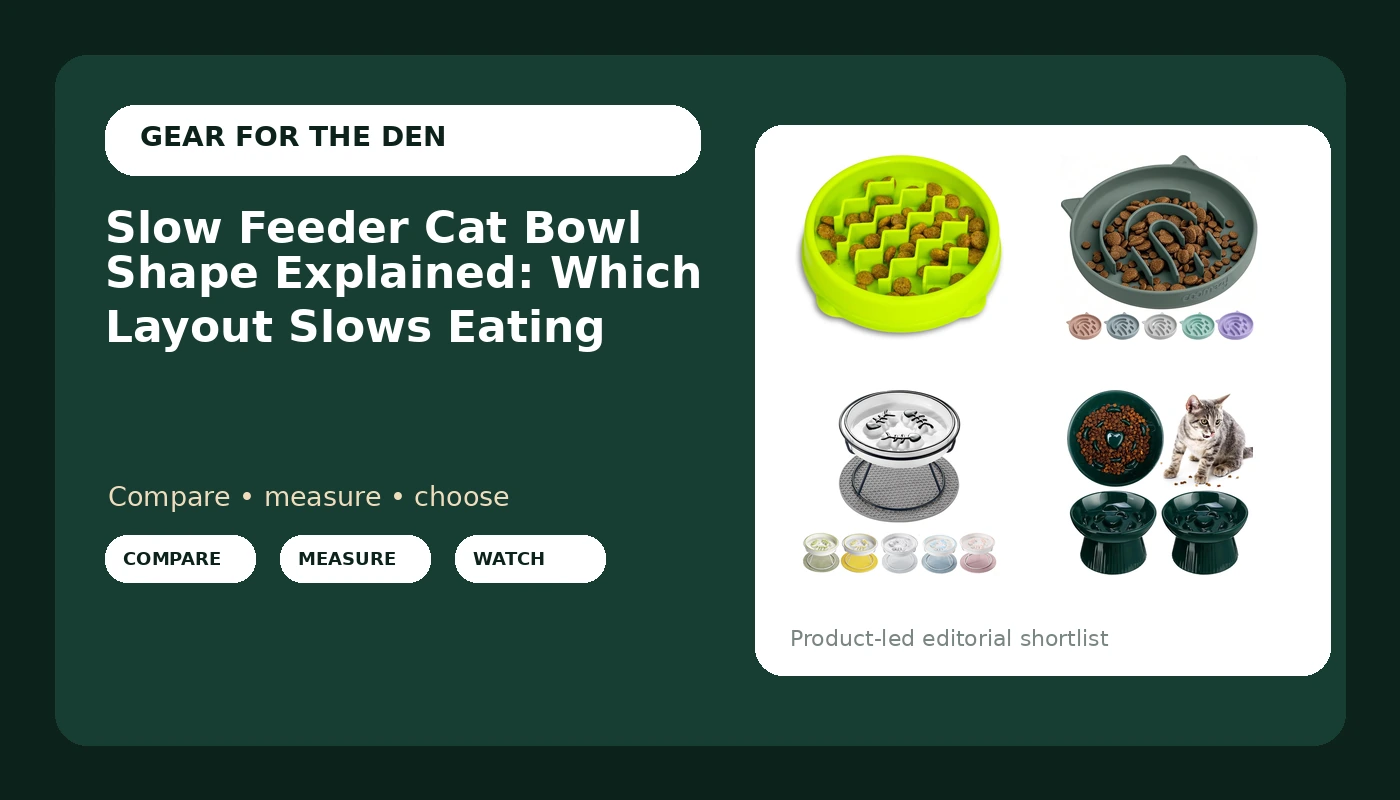
A cat that clears a bowl in ninety seconds is not necessarily greedy. It is eating at the speed the bowl permits. The slow feeder cat bowl shape sets that speed: how far the tongue travels between bites, how tightly kibble wedges into the channels, and whether the nose and whiskers can reach the bottom without pressing into a wall. Most owners arrive here after a vet visit about eating too fast, or after cleaning a second meal off the floor. This slow feeder cat bowl shape explained guide covers the geometry that actually changes eating pace, then matches four bowls to four real feeding setups.
Quick answer
Geometry matters more than material. Narrow channels with raised ridges spaced close together slow eating the most, because a cat can only gather a few pieces per pass. A wide, shallow maze slows a fast eater less but suits flat-faced cats and cats that dislike pushing their nose into a channel. Compare channel depth, bowl width, and whisker clearance before you compare finishes. Then set portion size to what your cat should eat in one sitting, because a slow feeder filled past the ridges is still a fast meal.
Four useful options
| Model | Best fit | What stands out |
|---|---|---|
| Catstages Kitty Slow Feeder Bowl for Cats & Kittens, 3/4 Cup, Green, 5" | Kittens and small cats starting out | Three-quarter cup capacity and a five-inch footprint for a short muzzle |
| Coomazy Slow Feeder Cat Bowl Silicone Pet Puzzle Feeder for Slow Eating | Cats that push bowls around the floor | Silicone body with a puzzle layout instead of rigid walls |
| Ceramic Elevated Slow Feeder Cat Bowl, Anti Vomit, Removable Dish, Black | Raised feeding and easy washing | Elevated ceramic stand with a dish that lifts out |
| Tioncy 2 Pcs Ceramic Elevated Slow Feeder Cat Bowl, Dark Green | Two-cat homes | Two matching elevated ceramic bowls in one set |
Best for kittens and small cats: Catstages Kitty Slow Feeder Bowl for Cats & Kittens, 3/4 Cup, Green, 5"
A kitten does not need the same geometry as a twelve-pound adult. The jaw is smaller, the reach is shorter, and a deep channel that slows an adult can simply block a kitten from reaching the last of the meal. That is why capacity and bowl width matter as much as the ridges themselves. A three-quarter cup bowl keeps the portion honest: fill it, watch how long the meal takes, and adjust the food rather than adding a second bowl. Because the bowl is small, it also fits on a raised tray later if you decide to add an elevation angle for a senior cat. Whisker clearance is the other thing to watch. If the sides press against the whiskers on every pass, some cats eat around the edges and leave the center full, and a wider rim avoids that.
Best for cats that dislike rigid bowls: Coomazy Slow Feeder Cat Bowl Silicone Pet Puzzle Feeder for Slow Eating
Silicone solves two problems that ceramic and rigid plastic do not. First, noise: a hard bowl skids and rings on tile, and a cat that is already tense about mealtime may eat faster when the bowl moves under its chin. Second, grip: a soft base tends to stay where it is put. The trade off is depth. Silicone walls are usually shallower than ceramic channels, so a cat that inhales food may still finish quickly, and the puzzle layout does most of the work. If your cat is a gulper, a shallow silicone maze is a starting point rather than a solution. Pair it with a measured portion size and watch the clock for a week before deciding whether you need deeper channels. Check whisker clearance too, because a soft rim can fold under a determined nose.
Best for raised feeding: Ceramic Elevated Slow Feeder Cat Bowl, Anti Vomit, Removable Dish, Black
Elevation changes the angle of the swallow, and many owners find a raised bowl suits a cat that eats fast and then brings the meal back up. The design is marketed as anti vomit, which describes the raised position rather than a promise about your cat. Two details matter more in daily use. The removable dish means you can wash the food surface without moving the whole stand, which helps with wet food that dries in the channels. The ceramic body adds weight, so a cat that paws at the bowl is less able to drag it across the kitchen. The trade off is height: a stand that is too tall for a small cat puts the food at an awkward elevation angle, and the cat may eat around the edges or knock food onto the floor. Measure your cat's shoulder height before choosing a raised design.
Best for two-cat homes: Tioncy 2 Pcs Ceramic Elevated Slow Feeder Cat Bowl, Dark Green
In a two-cat home, mismatched bowls create a race. The cat with the open bowl finishes first, then moves to the slow feeder and pushes the other cat off. A matched pair removes that advantage. Two ceramic elevated bowls also mean two washable surfaces, so you can rotate dishes through the sink instead of washing one bowl twice a day. Ceramic is heavy, which is a benefit with a cat that likes to tip a bowl and a drawback when you are carrying both to the kitchen. Check the footprint before you buy: two elevated bowls take more floor space than one, and a multi-cat feeding station needs enough separation that neither cat guards the other's food. If your cats are fed in separate rooms, a set of two still works, because you can leave one bowl in each room.
Prices and availability may change. Product images, names, and retailer links are matched to verified listings. No current price, rating, stock status, or measured result is stated here without current evidence.
What the slow feeder cat bowl shape changes
Three measurements do most of the work.
Channel depth. A deep channel forces the tongue to reach down and lift food out, which adds a pause between bites. Depth that exceeds the length of the muzzle turns into a problem: the cat cannot reach the bottom without jamming its nose into the wall, so it eats the top layer and walks away. Kittens and flat-faced cats hit that limit sooner than a long-nosed adult.
Ridge spacing. Ridges set close together let a cat collect only a few pieces per pass. Wider spacing lets the tongue sweep more food at once. This is the single biggest lever on eating speed, and it is also the hardest to judge from a product photo, because spacing looks different at an angle than it does from above.
Bowl width. A wide bowl spreads the same portion over more surface, which means more travel between bites. A narrow bowl concentrates food, which is fine for a small cat and frustrating for a large one whose whiskers touch both sides.
Whisker clearance deserves its own note. Whiskers are sensitive, and some cats will not put their face into a bowl that presses them flat. The result looks like fussiness: the cat eats the middle, then paws food onto the floor and eats it there. A wider rim, a shallower channel, or a flat plate with a few raised bumps can fix it.
Elevation angle changes the mechanics of swallowing. A raised bowl is a common choice for cats that eat quickly and then vomit, and it is also easier on an older cat with stiffness in the neck. The angle only helps if the bowl sits at a height the cat can reach without stretching.
Material comes last, but it is not irrelevant. Ceramic holds still, silicone stays quiet, and a light plastic bowl travels across the floor. If your cat pushes the bowl while eating, weight is a feature.
Finally, portion size is part of the geometry. A slow feeder works by making each bite smaller. If you fill it past the ridges, the food piles above the channels and the cat eats at normal speed again. Measure the meal, then let the shape do its job.
Matching the slow feeder cat bowl shape to your cat
There is no single ideal slow feeder cat bowl shape, because the right choice depends on the cat in front of you rather than on a category. Work through these questions in order.
- Time a normal meal. Put the usual portion in the usual bowl and time it. Under two minutes suggests a fast eater, and the number gives you something to compare against later.
- Estimate the muzzle. From the nose to the base of the whiskers is roughly the depth a cat can reach into a channel. If the channel is deeper than that, food stays at the bottom.
- Watch the whiskers. If the sides press them flat, choose a wider bowl width or a flatter layout before you choose a deeper maze.
- Decide on elevation. A raised bowl suits a cat that vomits after fast meals or a senior with neck stiffness. Keep the elevation angle low enough that the cat is not stretching.
- Test for a week with a measured portion size. Scoop the same amount each meal, note how long it takes, and change one variable at a time.
The correct slow feeder cat bowl shape for a flat-faced cat is usually wide and shallow. The ideal slow feeder cat bowl shape for a healthy adult that inhales dry food is usually a narrow maze with closely set ridges. Those two cats need opposite bowls, which is why generic advice fails.
Practical guidance for slow feeding
- Start by timing a meal in the bowl you already own, so you have a baseline before you change anything.
- Put the bowl on a non-slip mat. A bowl that slides adds noise and speed to a meal.
- Rinse the channels after every wet meal. Dried food in a narrow groove is the main reason slow feeders end up in a cupboard.
- If you also run a fountain, water capacity, pump noise, and filter type matter more to daily drinking than bowl geometry does.
- If you are shopping for an automatic feeder, microchip range decides which cat can open it, and a slow feeder underneath will not change a timed dispenser.
Which option should you choose?
Choose the Catstages Kitty Slow Feeder Bowl for Cats & Kittens, 3/4 Cup, Green, 5" when you are feeding a kitten or a small cat and want a measured portion in a bowl a short muzzle can empty. Choose the Coomazy Slow Feeder Cat Bowl Silicone Pet Puzzle Feeder for Slow Eating when your cat pushes a rigid bowl around the floor or eats on a hard surface where noise matters. Choose the Ceramic Elevated Slow Feeder Cat Bowl, Anti Vomit, Removable Dish, Black when you want a raised eating position and a dish that lifts out for washing. Choose the Tioncy 2 Pcs Ceramic Elevated Slow Feeder Cat Bowl, Dark Green when two cats share a feeding station and you want both of them on the same geometry.
No bowl fixes a medical problem. If your cat vomits repeatedly, loses weight, or eats obsessively, that is a conversation with your vet rather than a shopping decision. A slow feeder is a management tool for a healthy cat that eats too quickly.
The bottom line
The slow feeder cat bowl shape is the part you can actually measure: channel depth, ridge spacing, bowl width, and whisker clearance decide whether a meal takes two minutes or ten. Start with a measured portion size, choose the depth your cat's muzzle can reach, and treat elevation as a separate decision from the maze. For most kittens and small cats, the compact Catstages bowl is the low-risk starting point. For a cat that needs a raised position, a ceramic elevated design with a removable dish is easier to live with. For two cats, a matched pair removes the race.