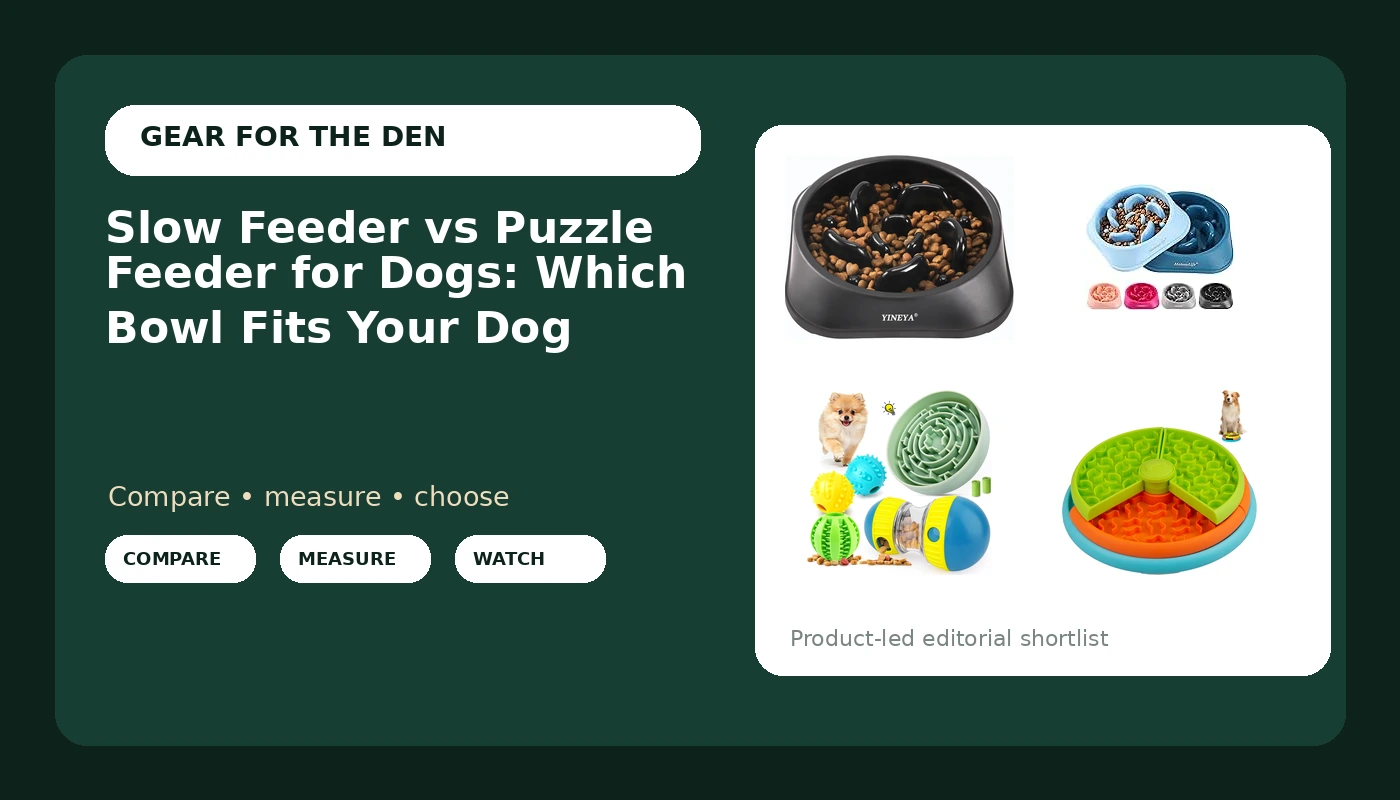
Most dogs empty a bowl of kibble in about ninety seconds, and a lot of feeding gear exists purely to stretch those ninety seconds into something closer to an actual meal. The choice between a slow feeder vs puzzle feeder for dogs looks like a coin flip on the shelf, but the two designs solve different problems. One puts obstacles between your dog and the food so the kibble goes down slower. The other adds a thinking step so the food has to be worked for. Neither is universally better, and plenty of owners buy the complicated one first and then watch it sit in the cupboard.
For most dogs, the right first purchase is a ridged slow feeder bowl, and you should only move up to a multi-level puzzle feeder once your dog clears those ridges in under three minutes. That is the short version. The long version involves bowl capacity, how many difficulty levels your dog will actually work through, and why a treat ball is sometimes a smarter second purchase than a bigger maze.
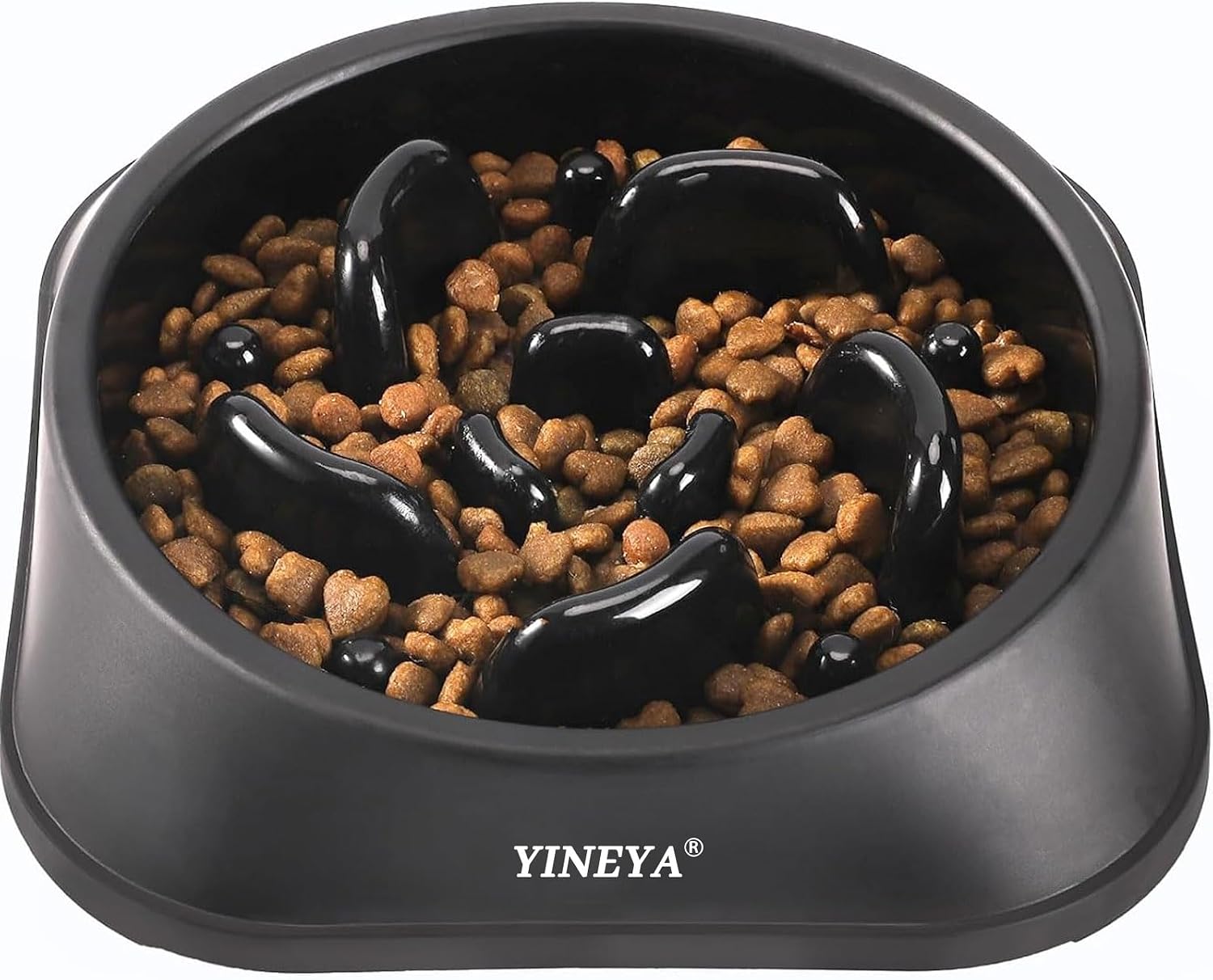
YINEYA Slow Feeder Dog Bowl for Medium Dogs, 2-Cup Puzzle Feeder Bowl
Cheapest way to find out whether your dog tolerates ridges at all
Shallow pattern that a fast eater can beat in a couple of weeks
MateeyLife 2-Pack Slow Feeder Dog Bowls, 2 Cups, Dog Puzzle Feeder Bowl
Two bowls means one is always clean and ready to go
Still a slow feeder, with no real difficulty ramp
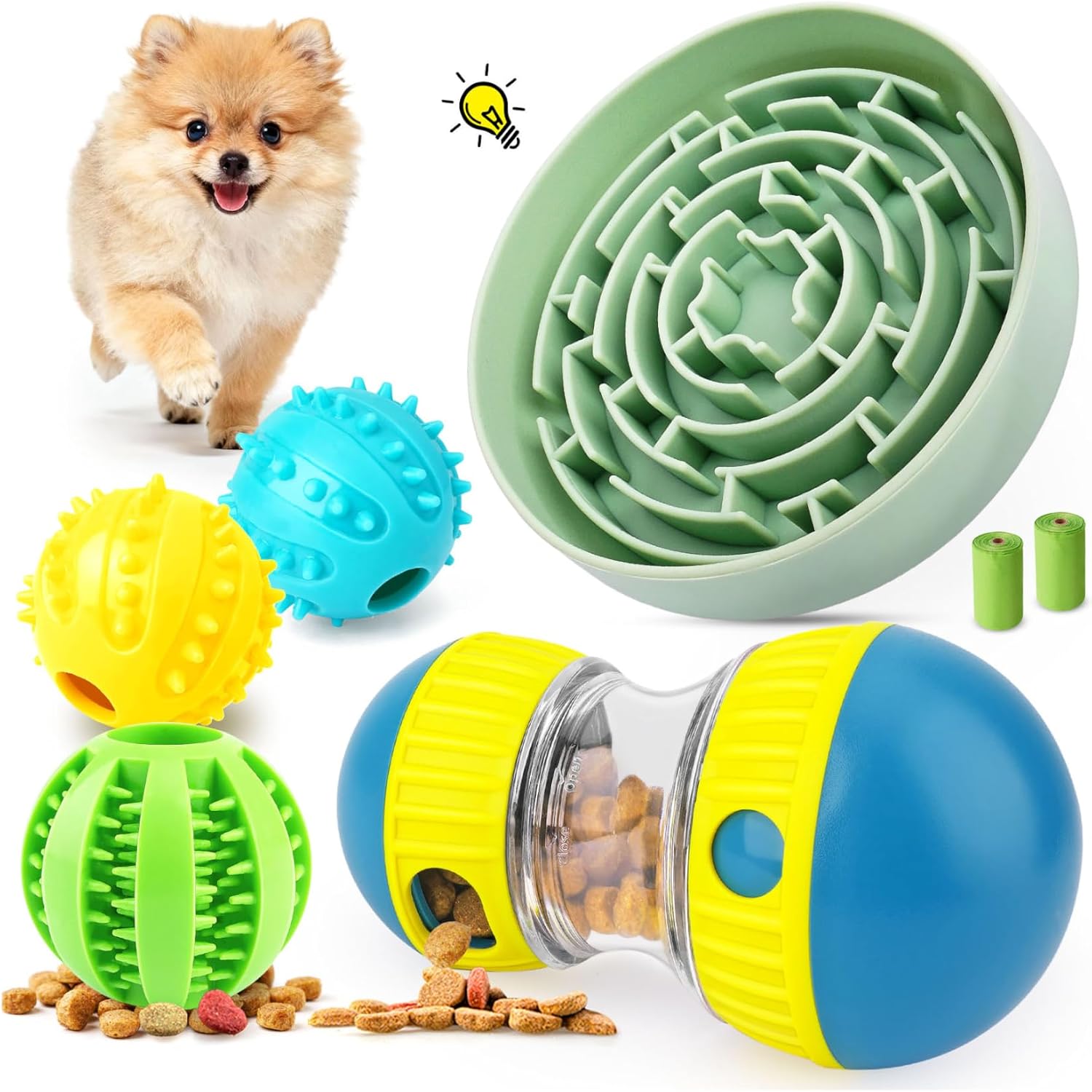
KIPRITII Dog Puzzle Feeder Set with Slow Feeder Bowl & Treat Ball
Bowl plus treat ball covers both speed and boredom in one box
Both pieces are simple designs, so a clever dog outgrows them
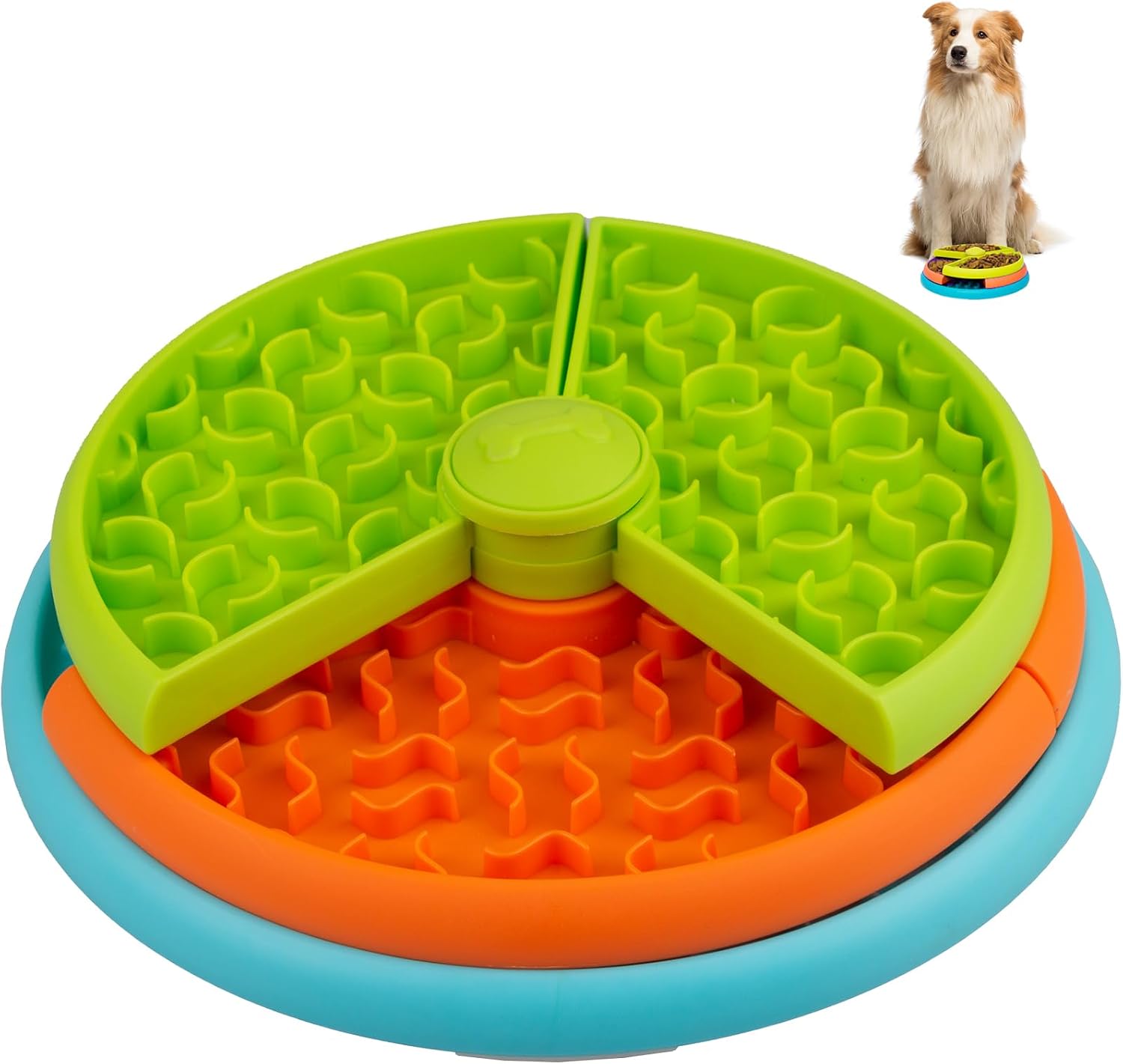
Atdoall Slow Feeder Dog Bowl, 3-Level Interactive Dog Puzzle Feeder
Three levels keep a clever dog working through a whole meal
Most expensive, most parts to clean, steepest learning curve
Prices and availability may change.
What slow feeder vs puzzle feeder for dogs actually changes
Both categories exist to fight fast eating, but they fight it with different tools.
A slow feeder is a bowl with molded ridges, valleys, or spiral walls inside. Kibble settles into the gaps, and your dog has to work its muzzle around the plastic to reach it. Nothing about that requires training, and nothing about it requires your dog to think. It is a physical obstacle, and the only skill it rewards is patience.
A puzzle feeder asks for more. Food sits behind sliders, under flip lids, inside rotating discs, or in a rolling ball that only releases kibble when it gets batted around. Your dog solves a small problem for every mouthful. That is genuinely engaging for a lot of dogs and genuinely frustrating for others.
The practical difference shows up in the first week. Slow feeders work for nearly every dog on day one. Puzzle feeders have a learning curve, and a dog that gives up on the puzzle does not eat. That risk rarely makes it onto the product page.
It helps to think about where the food actually is. In a slow feeder, the food is in front of your dog the whole time, just out of easy reach. In a puzzle feeder, the food is hidden, and your dog has to decide how to get at it. That single distinction predicts which bowl your dog will accept without a training session, and which one ends up on a shelf.
Slow feeders: ridges that buy you minutes
The slow feeder vs puzzle feeder for dogs question usually has a simple first answer, and it is the slow feeder. The design vocabulary is small. Slow feed ridges are the raised fins or spirals that break a flat surface into channels, and the deeper and more numerous they are, the more work each mouthful takes. A shallow flower pattern slows a Labrador by maybe a minute. A deep spiral maze can triple the time for the same amount of food.
Two cups of bowl capacity is the sweet spot for small and medium dogs. That covers a typical meal for a twenty to forty pound dog, and it keeps the bowl light enough to pick up and rinse at the sink. Larger dogs need two servings or a bigger bowl, and a dog that eats two cups in one sitting will clear a shallow pattern almost as fast as a flat dish.
Material matters less than people assume, but the base matters more. A non slip base is the difference between a bowl that stays put and one that slides across the kitchen floor while your dog pushes it with a nose. Silicone rings underneath do most of that work, and if a listing does not mention one, assume it does not have one.
Cleaning is the other half of the equation. Kibble leaves a film of fat and saliva behind, and a maze with deep channels traps it. Dishwasher safe construction is worth prioritizing, because hand scrubbing a spiral every night gets old by week two.
Puzzle feeders: when a meal becomes a problem to solve
Puzzle feeders split into two families. The first is the flat puzzle plate with sliding tiles, flip lids, and rotating discs. The second is the rolling treat ball that dispenses kibble as it moves. Both ask the dog to do something before eating, but they ask for different things: the plate rewards nose work and pawing, the ball rewards chasing.
Multi-level designs add a difficulty ramp. Level one is usually a set of open wells a dog can reach by sniffing. Level two hides food under sliders. Level three locks food behind a rotating piece that has to be spun the right way. A three-level bowl can keep a clever dog busy for fifteen or twenty minutes, which is the entire point.
The catch is maintenance. Sliding parts collect crumbs in their tracks, and moving pieces that cannot be removed will eventually jam on a wedged piece of kibble. Check that the components come apart and that the manufacturer lists them as dishwasher safe before you commit.
Treat balls deserve their own note. They are the easiest puzzle to introduce, because a dog only has to push the ball to get a reward, and the rolling motion is self reinforcing. The downside is noise on hard floors, and the fact that a ball can end up under the sofa within a minute. Check the size against your dog's muzzle, because a ball that is too small is a choking risk and one that is too large will not roll.
The difference between slow feeder and puzzle feeder for dogs
The difference between slow feeder and puzzle feeder for dogs comes down to what you are trying to change.
If your dog eats too fast, then gulps water or vomits shortly after a meal, the goal is mechanical: slow the swallow. That is a slow feeder job, and no amount of puzzle complexity improves on a good ridge pattern. The food has to go in slower, full stop.
If your dog eats politely but is bored, destructive, or glued to you from four in the afternoon until dinner, the goal is behavioral. That is a puzzle feeder job. Food becomes an activity, and the activity burns some of the energy that would otherwise go into a sofa cushion.
There is a middle path. A dog that eats fast and is bored does best with both, used at different meals. Slow feeder for breakfast when you are rushing out the door, puzzle feeder for dinner when you have time to supervise and your dog has the energy to work for it.
Bowl capacity, feeding height, and fit
Bowl capacity is the spec that decides whether a feeder is usable for your dog, and it is the one most buyers skim past. Two cups sounds generous until you are feeding a sixty pound dog twice a day. For small and medium dogs, two cups is one meal. For a large dog, it is a snack, and you will be refilling the maze mid-meal, which defeats the purpose.
One measurement worth taking before you buy: scoop your normal portion into a measuring cup and compare it against that two cup figure. If your dog gets one and a half cups twice a day, a two cup bowl works. If your dog gets three cups, you need a larger bowl or a feeder sized for large breeds.
Feeding height matters less with a bowl than with a raised stand, but it still matters. A bowl on the floor puts a deep maze at an awkward angle for a tall dog, and a dog that has to crane down into a spiral will sometimes just flip the bowl over instead. If your dog is tall or older, look at how feeding height changes the angle before buying a deep pattern.
Then there are the specs that simply do not apply here. These are dry food bowls, so no water capacity figure means anything, and there is no filter cartridge anywhere in this category. There is also no airtight seal on any of them. None of these are storage containers, and none of them keep kibble fresh overnight. Food goes in, food comes out, same meal.
The four bowls, one by one
Here is how the four feeders in this comparison differ, and which dog each one suits.
YINEYA Slow Feeder Dog Bowl for Medium Dogs, 2-Cup Puzzle Feeder Bowl. The name is misleading, because this is a slow feeder with a shallow ridge pattern rather than a true puzzle. It holds two cups, which is a full meal for a medium dog, and the pattern is gentle enough that almost any dog will eat from it on day one. That makes it the lowest risk first purchase here. The trade off is that a determined gulper will beat the pattern quickly. Visit on Amazon.
MateeyLife 2-Pack Slow Feeder Dog Bowls, 2 Cups, Dog Puzzle Feeder Bowl. Two bowls for a little more than the price of one is the entire argument. If you feed twice a day, having one in the wash and one on the floor takes the nightly scrub out of your routine, assuming both fit in your dishwasher. The ridge pattern is moderate, deeper than the YINEYA but not a full maze, and the pair is a sensible pick for a two dog house. Visit on Amazon.
KIPRITII Dog Puzzle Feeder Set with Slow Feeder Bowl & Treat Ball. This is the middle step: a slow feeder bowl plus a rolling treat ball in one box. The ball is the more interesting half, because it gives you a way to feed part of the meal as activity without committing to a full puzzle plate, and it is easy to rinse. The bowl alongside it is a straightforward ridge design. Buy this set if you want to find out whether your dog enjoys working for food before spending more. Visit on Amazon.
Atdoall Slow Feeder Dog Bowl, 3-Level Interactive Dog Puzzle Feeder. The most involved of the four, with three difficulty levels and moving parts. For a clever, food motivated dog, this is the one that turns dinner into twenty minutes of work. It is also the one most likely to be abandoned by a dog that does not like pawing at plastic, and the one that takes the most effort to clean because the levels trap crumbs. Visit on Amazon.
Matching the bowl to the dog
The puzzle feeder for dogs vs slow feeder question is really a question about your dog, not about the product.
Three signals point to a slow feeder. The meal disappears in under two minutes. The dog gulps water right after eating. The dog burps, paces, or lies uncomfortably after dinner.
Three signals point to a puzzle feeder. The dog is destructive when left alone. The dog is a working breed that needs a job. The dog already pushes toys around the house looking for something to do.
A few dogs need neither. A dog that grazes slowly all day will find a maze annoying, and a flat bowl is the right answer. Flat faced dogs, like pugs and bulldogs, may not be able to reach into a deep spiral at all, and they do better with a shallow, wide pattern or a plate style puzzle with sliding tiles.
Senior dogs are the other group worth thinking about. A dog with arthritis in the neck may struggle to work a deep maze, and a puzzle that demands pawing can be painful. For those dogs, a shallow pattern, a raised stand, or simply several small meals through the day usually beats any single bowl.
A decision rule you can use tonight
Choosing between a slow feeder or puzzle feeder for dogs is not a permanent identity, and it is not an either or decision you have to get right the first time. Most owners start with a cheap slow feeder, discover their dog is smarter than expected, and add a puzzle plate six months later.
There is one test worth running before you spend anything. Put a few treats in a muffin tin and cover them with tennis balls. If your dog works it out in a minute and enjoys the process, a multi-level puzzle feeder will earn its place in the rotation. If your dog stares at it and waits for you to fix the problem, save the money and put it toward a better slow feeder instead.
Should you buy both?
If you feed twice a day, one of each makes sense. Use the slow feeder for the meal when you are in a hurry, and the puzzle feeder for the meal when you are home and want the dog occupied. Two cups of kibble split between a ridged bowl at breakfast and a three level puzzle at dinner covers both problems without buying anything twice.
What I would not do is start with the most expensive option. The four feeders here cover a wide range, and the simplest one tells you almost as much about your dog's tolerance as the most complicated. Buy the cheap one, watch how your dog eats for a week, and let that decide whether you need a puzzle at all.
The gear does not fix a fast eater on its own. What a slow feeder does is buy you a few minutes, and what a puzzle feeder does is buy you a few minutes of quiet. Neither replaces a feeding schedule, and neither is a substitute for a vet visit if your dog is vomiting after meals. But as a first line of defense against a dog that inhales dinner, a ridged bowl is the cheapest gear in this entire category, and it is the one most dogs will still be using a year from now.