A thermostat is only as good as the patch of enclosure its probe occupies, and terrarium thermostat placement is the step most keepers rush. A controller can hold a steady number for years and still leave a reptile sitting in the wrong temperature, because the probe reads one pocket of air or one strip of floor rather than the whole tank. Move the probe a few inches and the same setting produces a different enclosure.
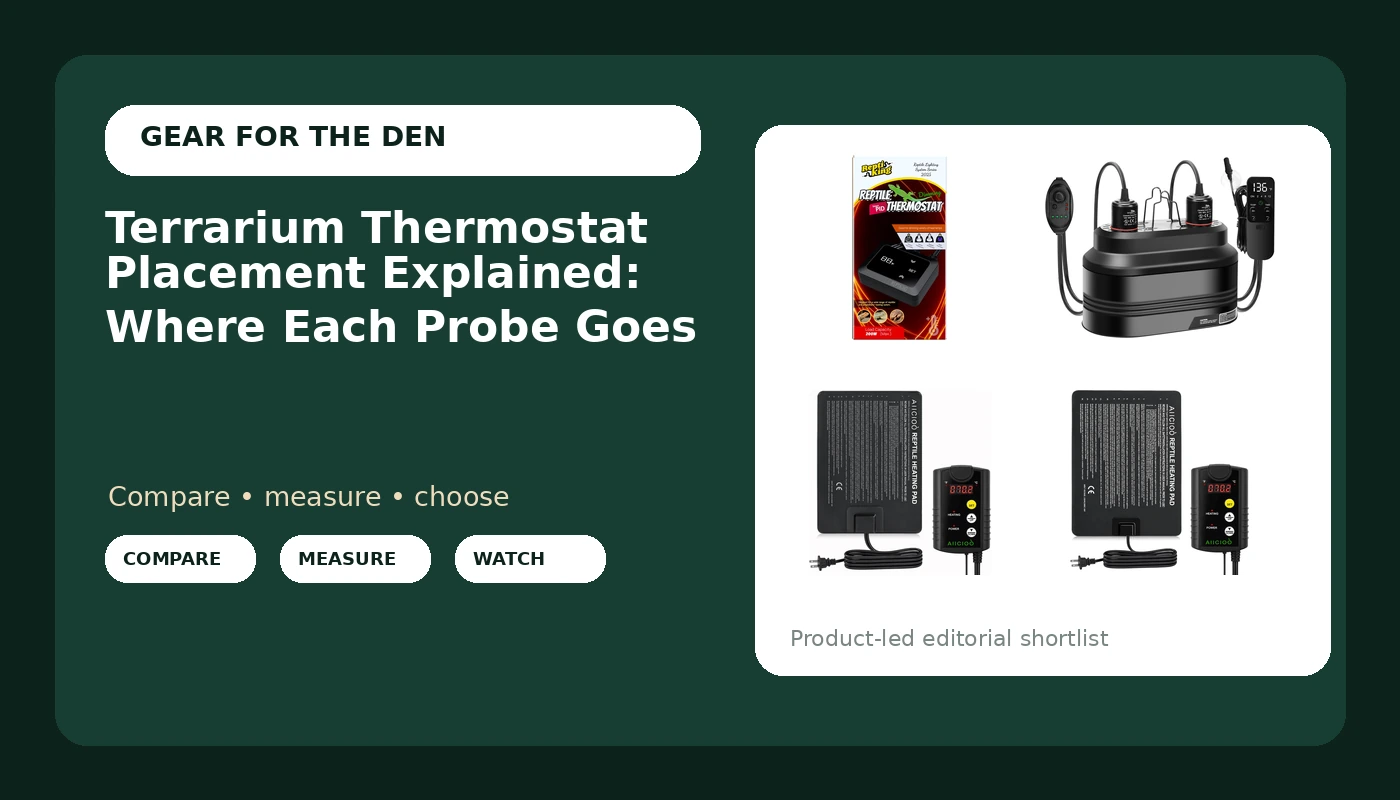
That is the problem this guide works through: terrarium thermostat placement explained by heat source, so you know whether the probe belongs on the floor above a heat mat, at basking height under a lamp, or clipped to the wall behind a hide. The four products below cover the common setups, from a dimming controller for bulbs and ceramic emitters to two under tank heat mat combos and a dual dome fixture with its own control.
Quick answer
Put the probe where the animal's body will be, not where the heater is. For an under tank heat mat, set the sensor on the warm side of the floor, directly over the mat, under only a thin layer of substrate, so it reads the surface the reptile contacts. For a basking bulb or ceramic heat emitter, suspend or clip the probe at basking height, near the spot the animal will use, away from the water bowl and out of direct radiant blast. The ideal terrarium thermostat placement also keeps the sensor out of the animal's reach, because a probe that gets dragged, buried, or slept on reports a number that has nothing to do with the enclosure. None of the controllers here is universally best; the right one follows the heat source you already run.
Four useful options
Each entry below names a role rather than a ranking.
| Model | Best fit | What stands out |
|---|---|---|
| ReptiKing Reptile Dimming Thermostat | Basking bulbs and ceramic heat emitters | Dimming PID control instead of simple on and off switching |
| MECESOR Dual Reptile Light Fixture | Two heat lamps in one enclosure | Independent thermostat control and timer dimming in a dual dome |
| Aiicioo Under Tank Heater Thermostat 8W combo | Smaller enclosures with a low wattage mat | Heat mat and thermostat supplied together as a combo set |
| Aiicioo Under Tank Heater Thermostat 16W combo | Larger enclosures that need more mat wattage | Same combo approach with a higher heat mat wattage |
Basking bulb control: ReptiKing Reptile Dimming Thermostat
A dimming controller is the natural pairing for overhead heat, but dimming only helps when the probe sits in the right place. A sensor hung near the top of a tall enclosure reads air the animal never touches, so the lamp keeps pushing while the basking surface stays cool. Clip or suspend the probe at the height of the basking spot, then set the thermostat range from a second reading taken at the surface itself.
Dual lamp control: MECESOR Dual Reptile Light Fixture
Two independently controlled sockets solve a common problem: one lamp for heat, one for light, each wanting a different setpoint and schedule. Independent control means the probe for each side can sit in its own zone, and the timer lets the fixture follow a day cycle instead of running flat out. The trade-off is more cable routing and more sensors to secure, and each probe still has to sit where the animal actually rests rather than where the fixture hangs.
Small enclosure heat mat combo: Aiicioo Under Tank Heater Thermostat 8W
A combo set removes the guesswork of matching a controller to a mat, and a low heat mat wattage fits an enclosure that does not need much floor heat. Placement is simple in principle: probe on the floor, directly over the mat, on the warm side. The trade-off with a small tank size is that the warm end and cool end sit close together, so a probe that drifts toward the middle reports a comfortable average that neither end actually holds. If you are still working out pad sizing, our reptile heat mat wattage guide walks through the math.
Larger enclosure heat mat combo: Aiicioo Under Tank Heater Thermostat 16W
The 16W version follows the same placement rule with more output, which matters as tank size grows and the mat has to warm a wider floor. More wattage also makes a badly placed probe more obvious: a sensor sitting in deep substrate reads cool, the mat stays on longer, and the floor directly above it gets hotter than the display suggests. Thin the substrate over the mat or measure at the surface the animal contacts.
Prices and availability may change. Product images, names, and retailer links are matched to verified listings. No current price, rating, stock status, or measured result is stated here without current evidence.
How terrarium thermostat placement changes with each heat source
Under tank heat mats and overhead lamps do not warm an enclosure the same way, so terrarium thermostat placement has to follow the heat source rather than a single universal rule. A mat heats the floor by contact, which means the useful reading is the surface temperature on the warm side, taken directly over the mat. Substrate depth changes that reading more than most keepers expect: a thick layer of loose bedding insulates the floor, so a probe buried under it reports a lower number than the surface the animal actually rests on. Either thin the layer over the mat or place the sensor where the reptile's belly will meet the floor.
Overhead heat is a distance problem. A basking bulb or ceramic heat emitter warms the air and the surfaces below it, and the reading climbs as the probe moves closer to the lamp. A sensor fixed to the back wall of a tall enclosure can read well below the basking spot itself, which pushes the controller to run the lamp harder than the animal needs. Suspending or clipping the probe at basking height, near the spot the animal will use, keeps the controller reacting to the temperature the reptile experiences rather than the temperature near the lid.
Two things sit outside the thermostat's job. A controller manages heat, not UVB output, and it does not manage humidity range either. A probe mounted beside a water bowl or inside a misting zone tracks evaporation and reports a number that has nothing to do with the warm end. Hide size and hide placement change readings for the same reason: a probe inside a large hide measures that hide's microclimate, not the open floor. If the animal spends its day in the hide, measure there, but understand that the open basking area will run warmer than the number on the display.
Matching placement to tank size, substrate, and the animal
Tank size decides how much room sits between the warm end and the cool end, and that distance decides how carefully the probe has to be placed. In a small enclosure the two zones are inches apart, so a probe that drifts reads an average that neither end holds. In a large enclosure the risk flips: a probe far from the heater reads cool, and the controller pushes the heat source until the area near the animal runs too warm. Work through these steps in order.
- Set the target first. Choose a basking temperature and a cool end range for your species before you touch the thermostat range, and write both numbers down.
- Match the measurement point to the heat source. Floor surface over a heat mat, basking surface under a lamp or emitter, and never the glass or the room.
- Secure the sensor so the animal cannot move it. Route the cable out of the enclosure and hold the probe with tape, a clip, or a bracket rather than leaving it loose on the floor.
- Let the system run for a few hours at the chosen setting, then confirm the reading with a second thermometer placed at the same spot.
- Re-check placement whenever substrate depth, hide size, tank size, or heat mat wattage changes, because each of those changes the number at the probe.
Practical checks that keep a probe honest
- Keep a second thermometer at the cool end. The thermostat reports only the spot its probe occupies, and one reading cannot describe a temperature gradient.
- Never let the probe sit in the water bowl, against the glass, or under a lamp shroud. Each of those positions reports something other than the basking area.
- Remember that a controller manages heat alone. If you run a UVB lamp, its UVB output is a separate decision and is not regulated by the thermostat.
- Re-check the sensor after every deep clean. Substrate gets pushed around, and a probe that ends up buried or dragged against a hide is silently wrong.
- Route cables through a grommet or over the rim so the animal cannot pull on the probe, and keep the sensor lead clear of the hot side of a lamp.
- If the controller switches constantly, the probe is probably too close to the heater. Move it to the animal's position and let the enclosure settle before changing the setting again.
Which option should you choose?
Choose the ReptiKing Reptile Dimming Thermostat when your main heat source is a basking bulb or ceramic heat emitter and you want dimming control rather than on and off switching. Choose the MECESOR Dual Reptile Light Fixture when you run two lamps and want independent thermostat control and a timer in one dome. Choose the Aiicioo Under Tank Heater Thermostat 8W combo when you heat a smaller enclosure and want a low wattage mat with its controller included. Choose the Aiicioo Under Tank Heater Thermostat 16W combo when the enclosure is larger and the mat needs more output to hold the warm side.
Getting correct terrarium thermostat placement once is not the same as keeping it. None of these listings states a measured enclosure temperature, and none of them replaces a thermometer at the basking spot. Treat the thermostat as the device that holds a target and the thermometer as the device that tells you whether the probe is in the right place.
The bottom line
Terrarium thermostat placement is a measurement decision before it is a product decision. Decide which surface the animal contacts, put the probe there, secure it so it cannot move, and confirm with a second thermometer. Then match the controller to the heat source: dimming control for bulbs and ceramic emitters, a dual dome when you run two lamps, and a mat and thermostat combo when floor heat is the plan. Placement first, controller second, and a thermometer to confirm both.