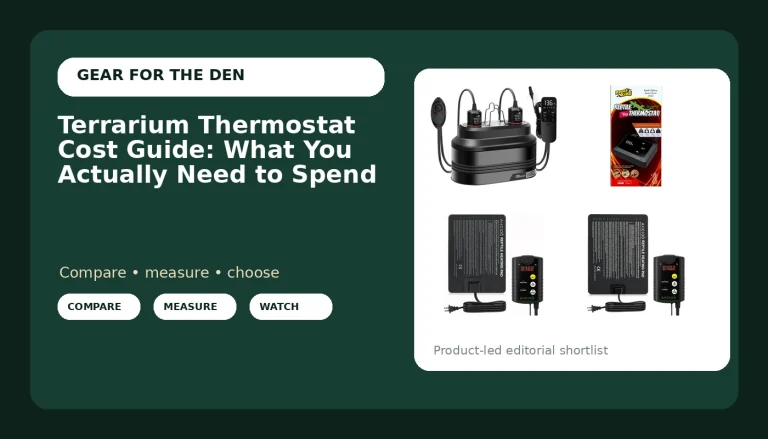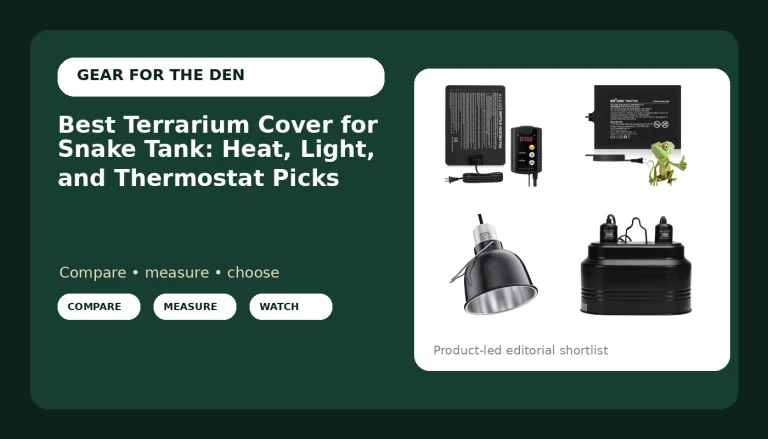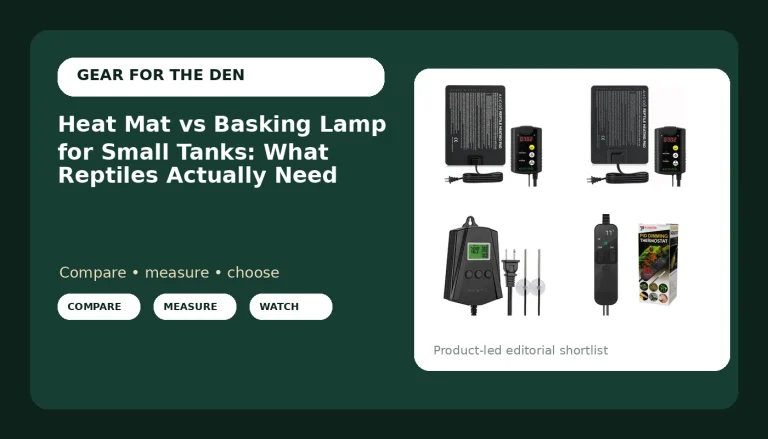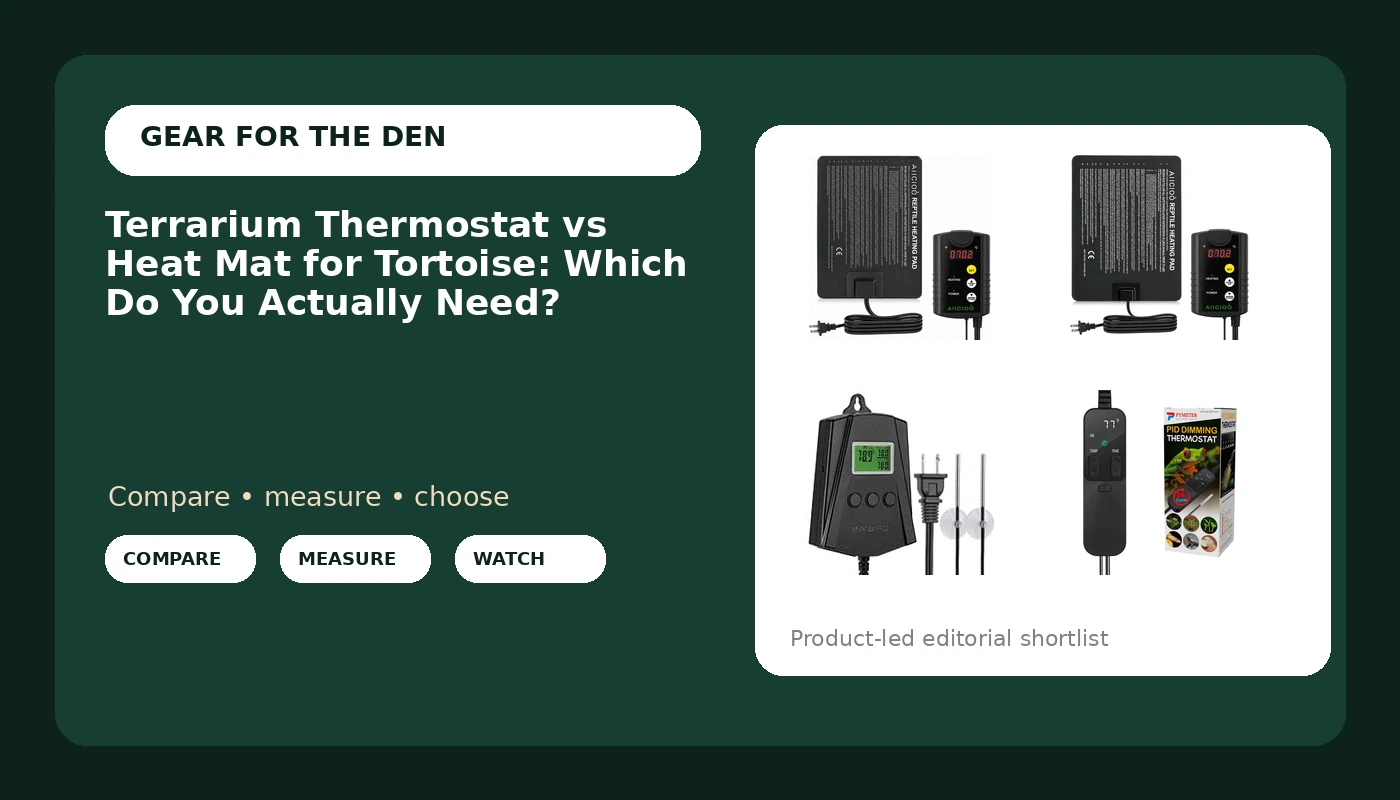
Tortoise keepers will argue about substrate and UVB strips all day, but the terrarium thermostat vs heat mat for tortoise question is the one that decides whether your animal gets a usable temperature gradient or a single hot spot it parks itself on. I keep a Hermann's tortoise in a four foot wooden enclosure, and I have wired enough reptile heating gear to know that the mat is the cheap half of the setup and the control is the half that keeps you up during a cold snap. This comparison covers four ways to solve the same problem: two Aiicioo under tank heater and thermostat combos at different wattages, an Inkbird WiFi controller with two probes and two outlets, and a Pymeter PID dimming thermostat with a 24 hour cycle timer.
The better buy for most tortoise keepers in 2026 is a standalone thermostat driving a separate heat mat, because the controller can move to a second enclosure, a basking lamp, or a nursery tub, while a combo mat stays a combo mat. That is the short version. The long version involves thermostat range, probe placement, and why heat mat wattage matters less than where you put the probe.
Read as heat mat for tortoise vs terrarium thermostat, the matchup sounds like two products competing for one slot. It is not. A heat mat is a heater. A thermostat is the brake. The only real question is whether you want those two jobs fused into one box or bought separately, so you can upgrade one half without throwing the other half away.
Here is how the four options line up.
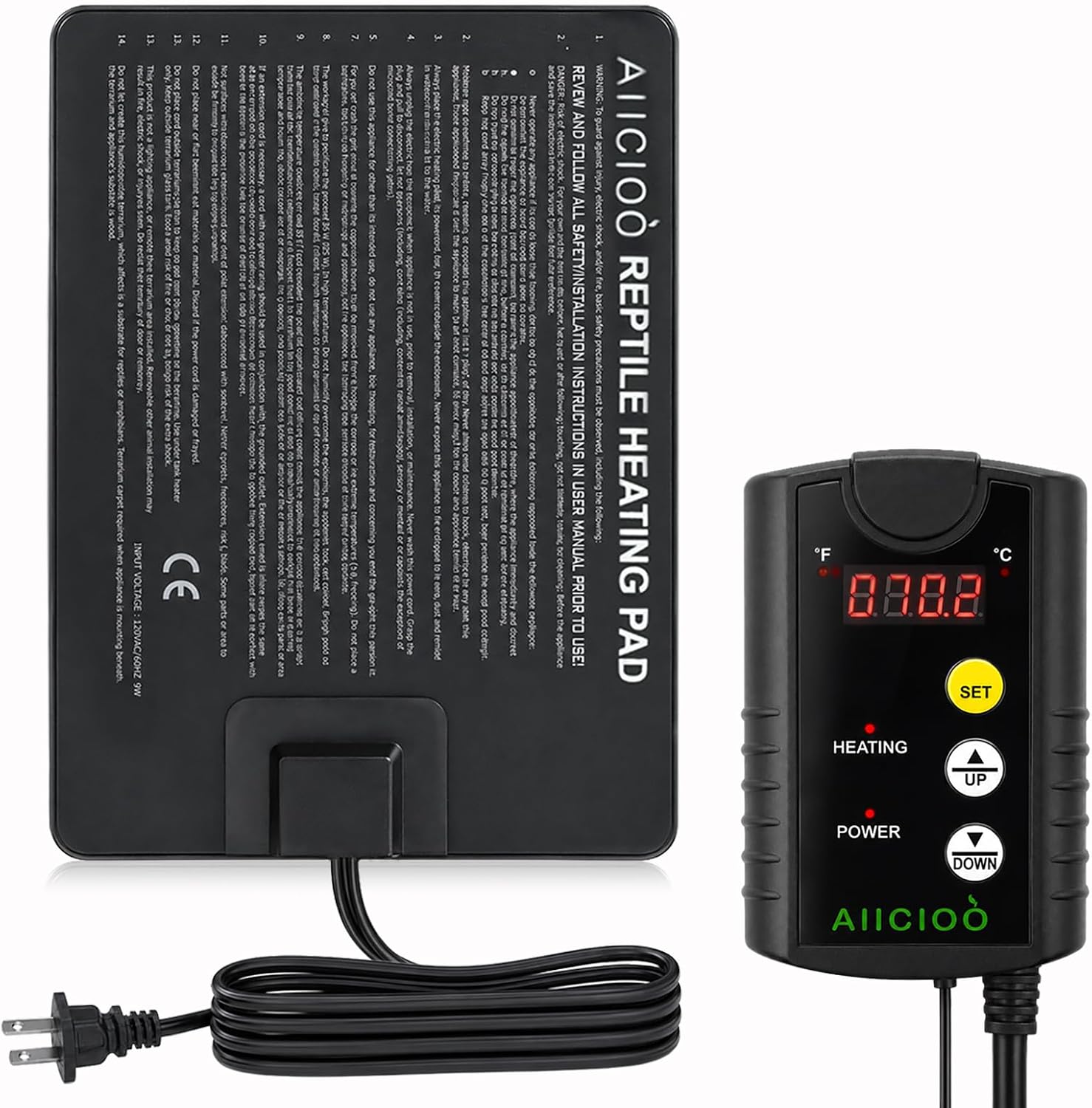
Aiicioo 8W under tank heater and thermostat combo
Mat and dial in one purchase, smallest footprint, suits a single small enclosure or a nursery tub
Single zone only, and the control cannot be reused on a lamp or a second tank
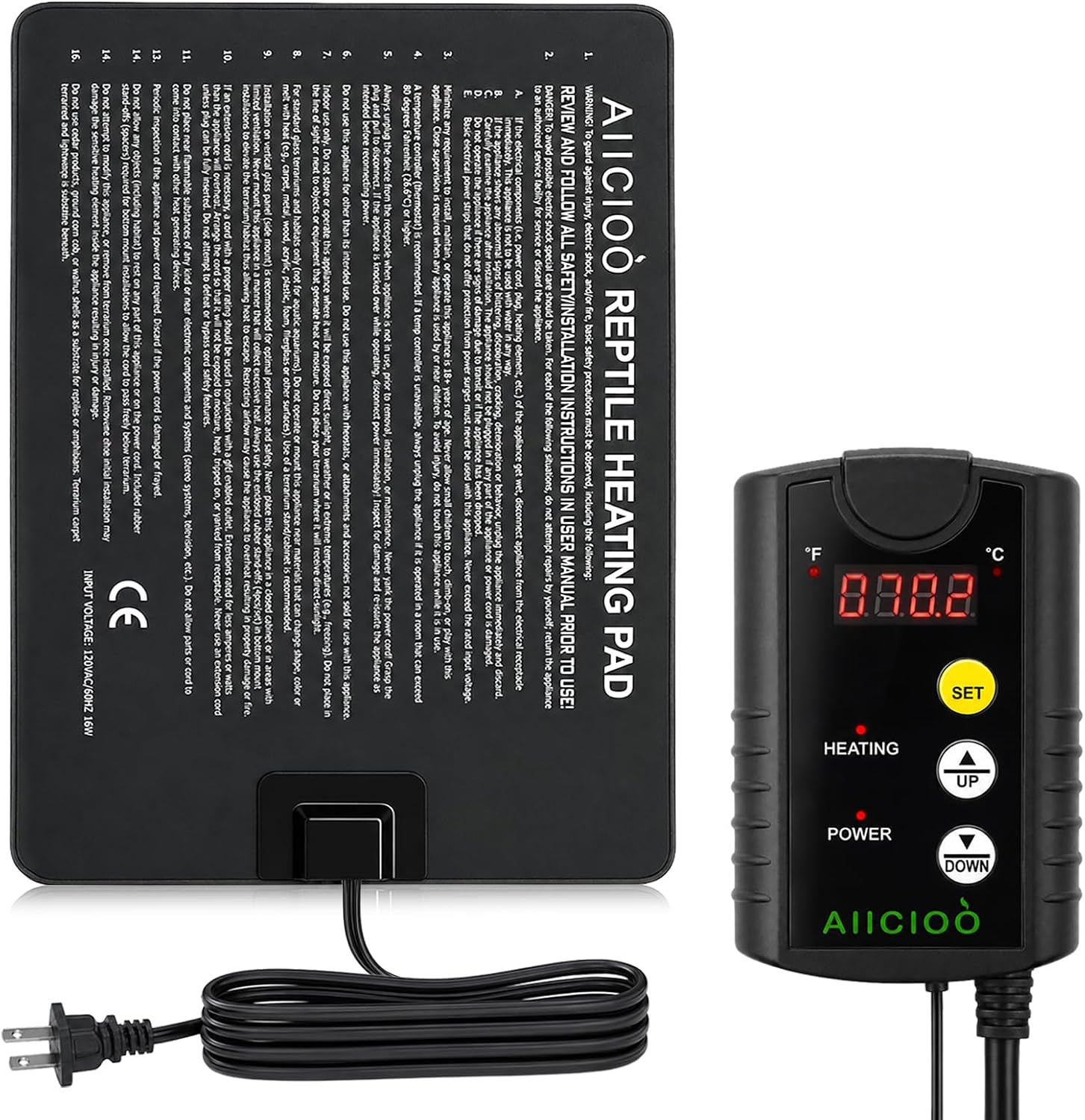
Aiicioo 16W under tank heater and thermostat combo
Same combo idea with more floor coverage, still one plug and one dial
Still a single zone unit with no remote monitoring
Inkbird WiFi heat mat thermostat controller with two probes and two outlets
Two channels, two probes, 250W per outlet, WiFi readings you can check from anywhere
No mat included, so the heater is a separate purchase
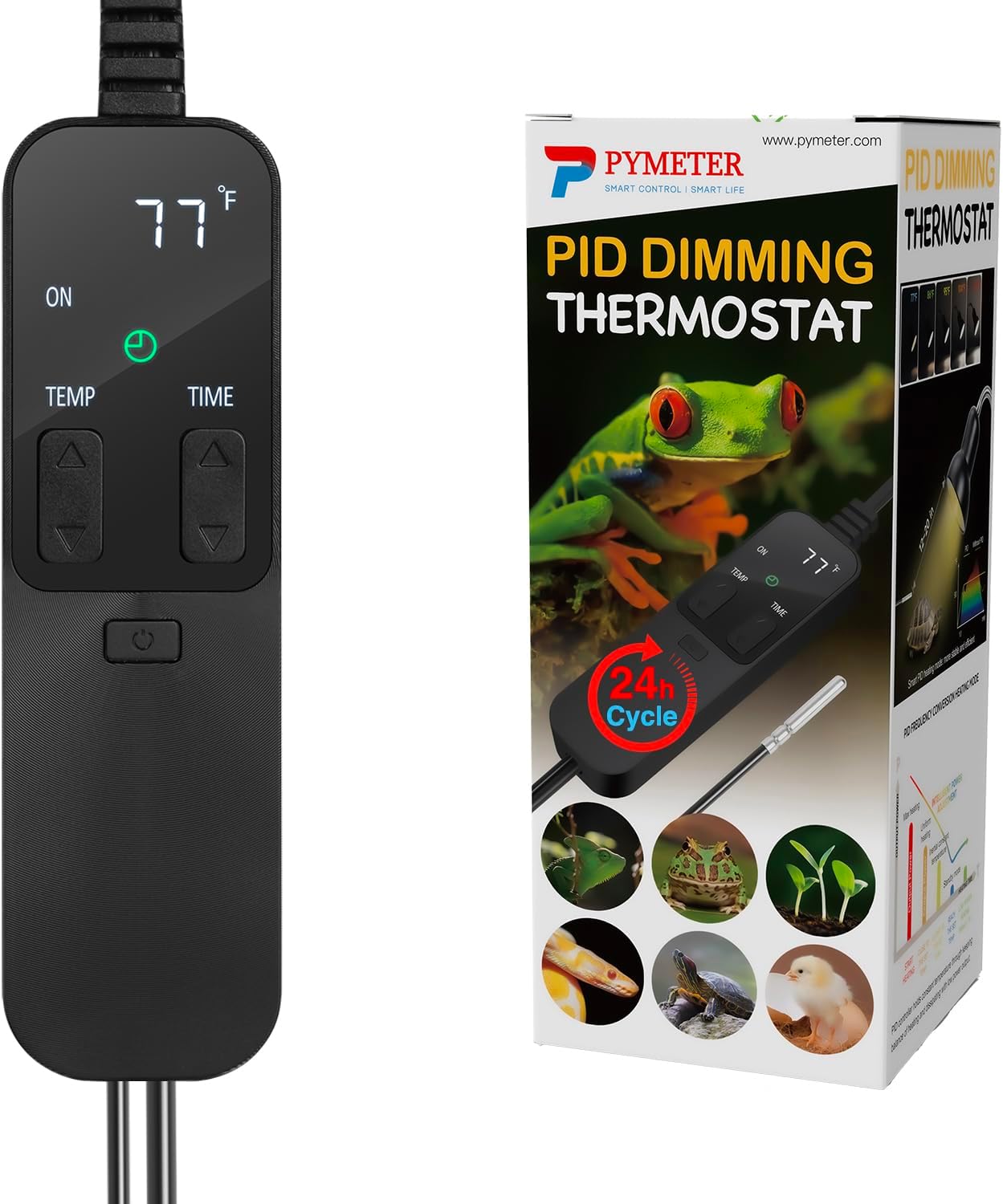
Pymeter PID dimming thermostat with 24 hour cycle timer
Dimming output plus a built in day and night schedule for lamps and mats
Dimming is wasted if you only ever run a simple on and off mat
Prices and availability may change.
What terrarium thermostat vs heat mat for tortoise really comes down to
The difference between terrarium thermostat and heat mat for tortoise is mostly about which part does the regulating, and where that regulation physically lives. A combo mat has its sensor built into the unit, which means the reading comes from wherever the manufacturer decided to place it. A standalone controller puts the probe on a cable, so you decide whether it reads the substrate surface, the air under the hide, or the glass above the mat. That single choice matters as much as the wattage printed on the box.
There is also a maintenance angle. Heat mats fail quietly. A mat that stops producing heat overnight is not dramatic, it just leaves your tortoise at room temperature until you notice. A controller with an alarm, or one that logs a graph to your phone, turns that silent failure into a notification. That is the real argument for buying the thermostat separately, and it has nothing to do with heat output.
How I judge reptile heating gear
Five things decide whether a controller earns a permanent spot on my shelf: thermostat range, probe count, outlet count and wattage headroom, alarm behavior, and whether it switches power on and off or dims it.
Thermostat range comes first. A unit that cannot hold a cool end and a basking temperature in the same week is the wrong unit, no matter how inexpensive it is. Check that the published range covers both ends of what your species needs, and check it again for the season you are buying for, because a winter basking target sits higher than a summer one.
Probe count is second. One probe means one temperature you actually know. Two probes means you can watch the warm end and the cool end at the same time, or run two separate enclosures from one box.
Outlet count and headroom come third. The Inkbird unit in this comparison is rated at 250W per outlet, which is far more than any under tank mat draws and enough for a ceramic heat emitter or a low wattage basking lamp. Headroom like that is not about running three heaters at once. It is about never being the limiting factor when you add a lamp.
Alarm behavior is fourth. An audible alarm is useful at 2 a.m. A phone notification is useful when you are away for the weekend. Both beat a silent dial.
Dimming versus on and off switching is fifth, and it matters most for lamps. A mat has enough thermal mass that simple on and off switching holds a stable surface temperature. A heat lamp does not, and that is where a PID dimming controller earns its keep.
One thing outside this list: UVB output is a lighting decision, not a heating one, and no thermostat will cover for a weak strip.
Combo heat mats: the simple path
The two Aiicioo units are the same idea at two wattages. Each one is an under tank heater with its own temperature control, sold as a combo set, and each listing covers the hermit crab, lizard, and terrarium market. Visit on Amazon for the 8W version and you get the smallest, simplest version of this whole category: one plug, one dial, one mat.
The 8W combo suits a small footprint, a hatchling tub, or a quarantine box where you want heat and control without a cable run to a separate controller. The 16W version spreads the same idea across more floor area, which matters when the tank size grows but you still want the wiring to stay simple. Both are the least complicated path to a working setup, and neither one asks you to understand a menu system.
What you give up is flexibility. The control is married to the mat. Add a second enclosure, or decide your tortoise needs a basking lamp for its basking temperature rather than floor heat, and you are buying a second combo rather than plugging a new heater into the controller you already own. For a single small enclosure with one heat source, that trade is fine. For anyone who expects to grow the setup, it is a dead end.
Standalone thermostats: the flexible path
The Inkbird WiFi controller is the two zone answer. It ships with two probes and two outlets, it is rated for 250W per outlet, and it puts the readings on your phone over WiFi. That combination covers the two jobs a tortoise enclosure actually has: holding a warm zone steady and telling you when something drifts. Visit on Amazon and the listing spells out the two channel layout, which is the part that matters. You can run a heat mat on one outlet and a ceramic emitter on the other, or split it across two enclosures and keep the probes where they belong.
The Pymeter PID dimming thermostat is the specialist. PID dimming means it does not simply cut power when the temperature is high and restore it when the temperature is low. It trims the power output to hold a line, which is exactly what a heat lamp wants and what a mat tolerates well. The 24 hour cycle timer is the second half of the pitch, because a lamp that runs on a schedule gives you something closer to a real day and night rhythm without a separate outlet timer. Visit on Amazon for the full feature list.
Neither of these ships with a heat mat, and that is the point. You buy the controller once and then size the heater to the enclosure, the substrate depth, and the hide you actually use. If you are still deciding between floor heat and overhead heat, Heat Lamp vs Heat Mat for Reptiles covers that split in more detail.
Where a combo still wins
I do not want to write off the combo units. If you have one tortoise, one small enclosure, and no interest in phone apps, the Aiicioo combo does the job with fewer cables and fewer decisions. It also travels well. A quarantine tub in a spare room does not need WiFi, it needs a mat that holds a steady temperature and a dial you can turn without reading a manual.
The honest limitation is monitoring. A combo has no remote alert, so the only way you know something changed is by looking at the enclosure. For a keeper who checks temperatures twice a day with a separate thermometer, that is acceptable. For a keeper who works long shifts, it is the gap that pushes people toward a controller with two probes.
Probe placement, substrate depth, and hide size
This is where most temperature problems actually live, and no thermostat fixes a badly placed probe. Set the probe on the substrate surface, directly over the center of the mat, and secure it so a burrowing tortoise cannot drag it into a corner. Do not bury it two inches down. Substrate depth insulates, and a probe under a deep layer reads a number your tortoise will never feel.
Hide size changes the microclimate more than most people expect. A tight hide over the warm end traps air and reads several degrees warmer than the open floor, which is fine, as long as you know which number you are controlling. The same goes for humidity range. If you are misting to hold humidity, that moisture changes how the substrate conducts heat, and your setpoint may need a small seasonal adjustment.
Then check the reading against a second thermometer once a month. A controller is only as good as the probe it trusts, and probes drift.
What the specs say
On paper, the terrarium thermostat vs heat mat for tortoise gap is narrower than the price and feature spread suggests. The two Aiicioo combos give you heat and control in one purchase at 8W and 16W. The Inkbird gives you two channels, two probes, 250W per outlet, and remote visibility. The Pymeter gives you dimming and a 24 hour timer for keepers running lamps.
The specification that decides it for most people is not wattage, it is channel count. One channel means one controlled zone. If your tortoise table has a warm end and a cool end and you want to know both, two probes is the specification that matters. If you run a basking lamp, dimming is the specification that matters. Wattage headroom is just insurance, and all four options clear the bar for the mats they are built to run.
One caution about the spec sheets: heat mat wattage is sized to floor area, not to animal size. A 16W pad in a small tank is not automatically better than an 8W pad, it just spreads heat over a larger footprint. Match the pad to the tank size, then let the thermostat do the regulating.
Should you buy the thermostat first?
Yes. Buy the controller first, then buy the heater to fit it. A thermostat outlives the mat it controls, and the difference between a single channel and two channels is the difference between a setup you outgrow in a year and one you keep. That logic is the whole terrarium thermostat vs heat mat for tortoise answer in one sentence: control first, heater second.
Whether you buy a terrarium thermostat or heat mat for tortoise first depends on what you already own. If you have a mat in a drawer, the controller is the obvious next purchase. If you are starting from nothing, buy the controller that matches the number of heat sources you expect to run, then buy the mat or lamp that fits the enclosure. In both cases the controller is the part that stays.
What I am testing next
Two things are queued for this winter. First, I want to see how the Pymeter dimming thermostat holds a basking temperature under a ceramic heat emitter in an unheated room, because dimming behavior in a cold room is where cheap controllers fall apart. Second, I want to compare the alert side of the Inkbird WiFi controller against a plain alarm unit over a two week period, since remote visibility is the feature people pay for and the one they rarely test.
Both are long term questions, and both are worth answering before anyone spends money on a third heat mat they did not need.