Every autumn the same thread shows up in reptile groups: someone has a 20-gallon long, a juvenile bearded dragon or a leopard gecko, and room in the budget for exactly one heat source. The heat mat vs basking lamp for small tanks argument gets loud because both camps are right about different animals. A heat mat warms the surface an animal presses its belly against. A basking lamp warms the air and the animal's back. A small tank makes whichever mistake you choose more expensive, because there is so little volume to buffer it. Get the heat source wrong in a 120-gallon enclosure and you have a cool corner. Get it wrong in a 10-gallon and you have a reptile that never gets the gradient it needs to thermoregulate.
For most small-tank reptiles in 2026, the right answer is both heat sources run by one controller: a low-wattage heat mat under the warm hide and a low-wattage basking lamp overhead, each on its own thermostat channel. That sounds like more gear than a 20-gallon tank deserves until you watch a leopard gecko sit on a warm patch all day and still struggle to digest, because the air above it never warmed up. Contact heat and radiant heat solve different problems, and a thermostat is the thing that keeps either of them from cooking your animal.
Here is how the four controllers and kits in this comparison line up for a small enclosure.
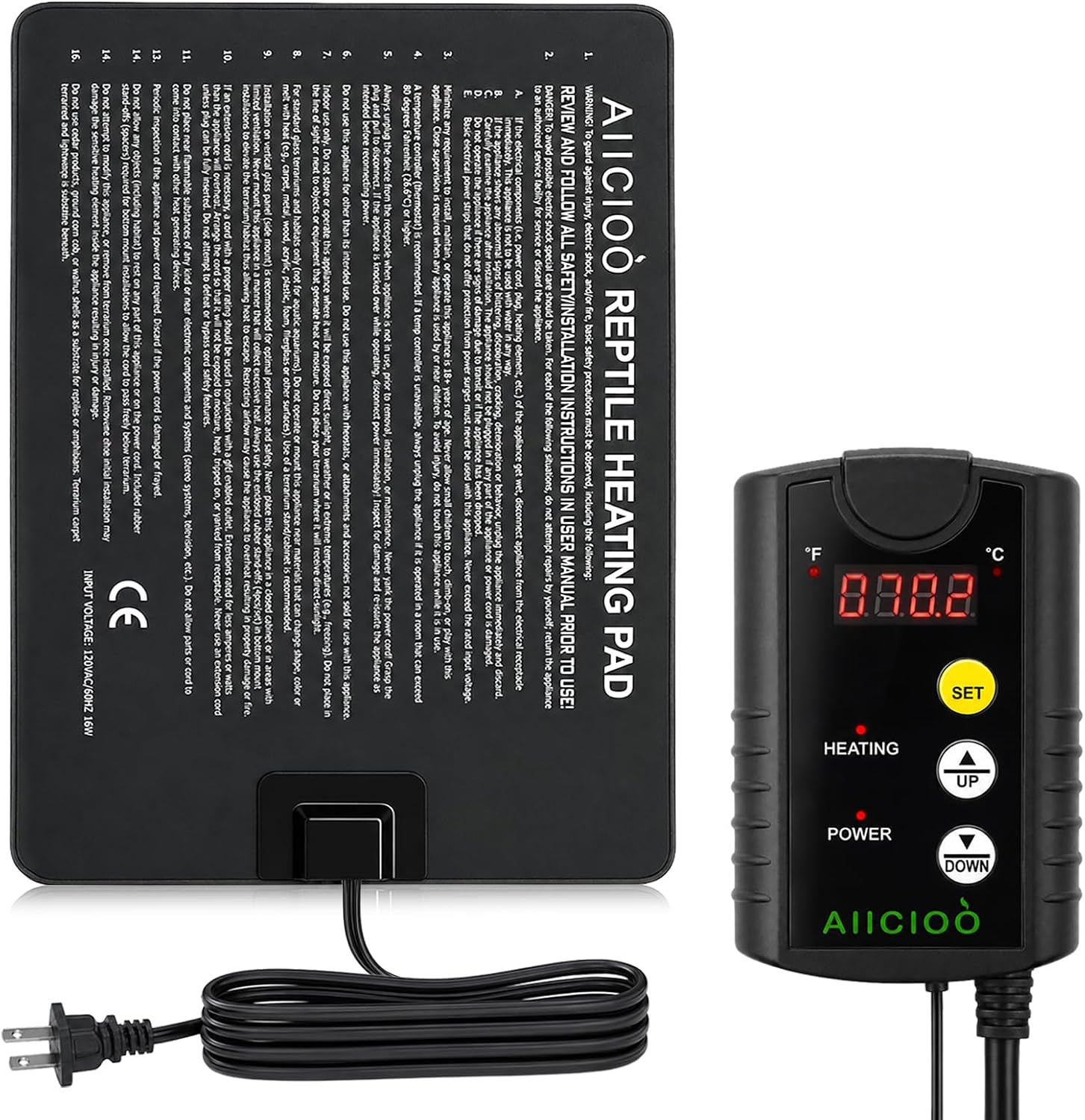
Aiicioo Under Tank Heater Thermostat 16W combo
Pad and thermostat in one box, sized for a 20 to 30 gallon floor
Single-zone kit, so it cannot also run a basking lamp
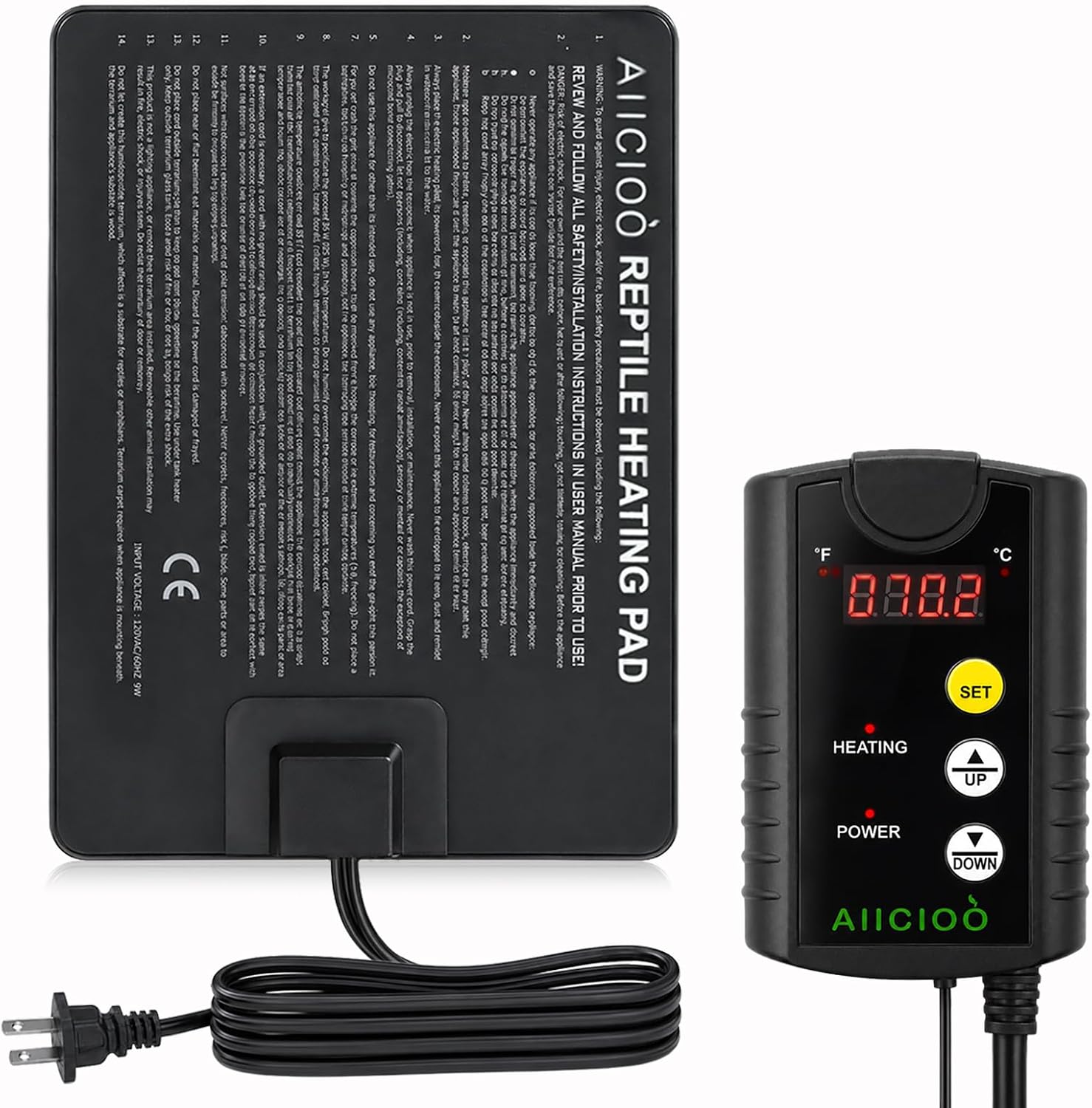
Aiicioo Under Tank Heater Thermostat 8W combo
The cheapest complete floor-heat kit for a 10-gallon tank or a hermit crab tote
8 watts is thin once the footprint grows past a 10-gallon
Inkbird WiFi Heat Mat Reptile Thermostat Controller
Two probes and two outlets, up to 250W each, so a mat and a lamp run from one unit
Controller only, no mat or lamp included, and the priciest of the four
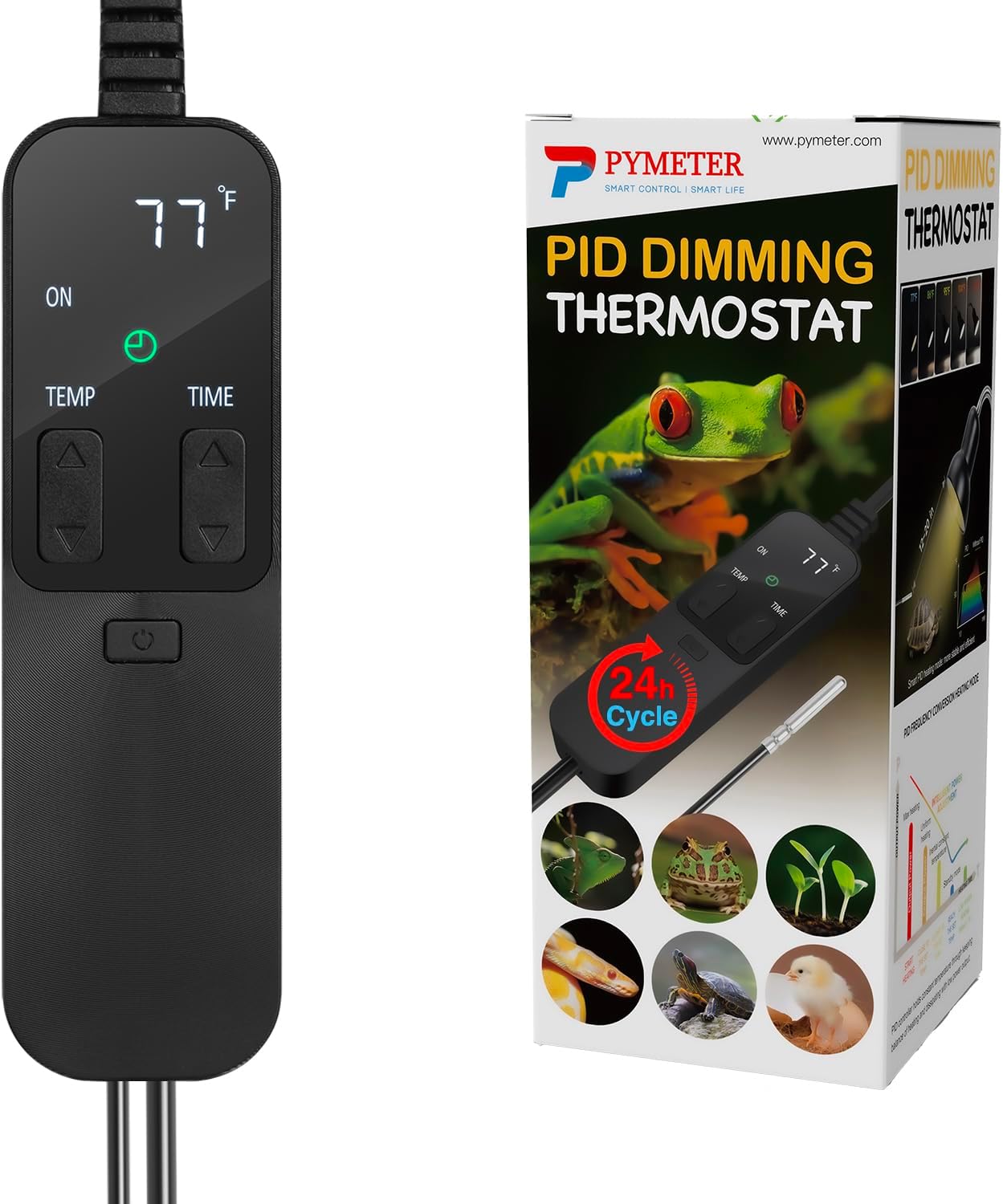
Pymeter PID Dimming Thermostat Reptile with 24 Hour Cycle Timer
Dimming control plus a 24-hour cycle timer, which suits a basking lamp
No WiFi, and more controller than a single 10-gallon tank strictly needs
Prices and availability may change.
Heat mat vs basking lamp for small tanks: the short version
The difference between heat mat and basking lamp for small tanks is the difference between contact heat and radiant heat. A heat mat is a flat, low-wattage element under the tank floor that warms one small footprint of glass or plastic. A basking lamp hangs above the screen and warms the air, the decor, and the animal's back. Contact heat is efficient at warming a body. Radiant heat is efficient at creating a gradient, and a gradient is what lets a reptile choose its own temperature instead of living at whatever the room happens to be.
That is why the argument rarely has a clean winner. A leopard gecko, a corn snake, a hermit crab, and a juvenile bearded dragon all need a warm zone, but they need it in different places. Species that press their bellies to rock do well with a mat. Species that climb onto a branch and flatten out under a light need a lamp. Nothing about the heat mat vs basking lamp for small tanks decision is complicated once you separate those two jobs.
If you keep one small tank and one animal, the useful question is not which device is better. It is which one your species actually uses, and whether you can afford to run both. For most keepers, running both costs less than it sounds, because a single two-channel controller can run a mat and a lamp at the same time.
What a heat mat actually does in a small enclosure
A heat mat is belly heat, and belly heat matters for digestion in species that spend their days on rock, sand, or hard-packed clay. In a small tank it has a second advantage that is easy to overlook: it warms the floor without warming the air, so you can hold a warm hide and a cool hide inside the same 20 gallons. A lamp that pushes ambient temperature into the high 90s makes a cool retreat impossible in a tank that size.
heat mat wattage is where most people guess wrong. An 8-watt pad suits a 10-gallon footprint, a plastic tote, or a hermit crab enclosure. A 16-watt pad covers roughly the floor of a 20 to 30 gallon tank. Putting the larger pad under a 10-gallon does not make the tank warmer in any useful way. It concentrates heat in a smaller area, which is how hot spots form, and it makes the controller work harder for no benefit.
substrate depth decides whether any of that reaches the animal. Two inches of loose sand or dry coco fiber between the pad and the reptile is insulation, not flooring. If you keep a loose substrate, either thin the layer over the warm spot or accept that the mat is heating the glass and very little else. The thermostat probe belongs on the surface the animal touches, not taped to the underside of the tank, or the controller is regulating the wrong number.
And the mat always runs on a thermostat. An unregulated heat mat in a small enclosure is a common cause of burns, because a small air volume cannot absorb a runaway element the way a large tank can.
What a basking lamp adds that a mat cannot
A basking lamp is the only one of the two devices that creates a basking temperature, meaning a hot spot the animal can move into and out of during the day. It also sets the day and night rhythm, warms the air for species that absorb heat while breathing, and, depending on the bulb, provides uvb output. If your species needs UVB, the lamp is usually where it comes from, and a heat mat can never replace it.
The catch in a small tank is that lamps are sized for rooms, not for 10 gallons. A bulb rated for a 40-gallon breeder will push the ambient temperature of a 10-gallon past the point where the animal has anywhere cool to go. Drop the wattage, raise the fixture, or put the lamp on a dimming thermostat and let it hold a target instead of running flat out. Measure the basking surface with a probe or an infrared gun rather than trusting the box.
There is a timing question too. A mat can run around the clock for species that need night heat. A lamp should not, unless you are deliberately simulating a hot climate. A 24-hour timer or a controller with a built-in cycle keeps that honest, which is one reason a controller with a timer earns its price.
Thermostats are not optional, and the four options here are not equal
Every recommendation in this article assumes a thermostat, because the difference between a heat mat that is safe and one that is not is a controller. The feature that matters most is the thermostat range: you want a unit that can hold a low target for a cool-side mat and a high target for a basking lamp without hunting around the set point.
On/off control, which most budget combos ship with, cuts power when the sensor reaches the target and restores it when the temperature drops. Dimming control reduces power instead of cutting it, which holds a steadier number. For a heat mat, on/off is fine. For a basking lamp, dimming is noticeably better, because the output does not switch on and off all afternoon.
The 16-watt Aiicioo combo is the simplest way to cover floor heat in a 20 to 30 gallon tank, because the pad and the controller arrive in one box. Check the Aiicioo 16W heat mat combo on Amazon. It does one job, floor heat, and it costs less than either of the standalone controllers below.
The 8-watt version of the same kit is the right size for a 10-gallon tank, a quarantine bin, or a hermit crab setup. Check the Aiicioo 8W heat mat combo on Amazon. If your enclosure is small enough that a lamp would overheat it, this kit is the whole heating system.
The Inkbird WiFi controller is the one to pick if you want a mat and a lamp running from a single unit. It has two probes and two outlets, up to 250 watts per outlet, and it reports to a phone, which is useful when you are at work and wondering whether the basking bulb is still on. Check the Inkbird WiFi heat mat thermostat on Amazon. You are buying control only, so a mat and a lamp go in the cart with it.
The Pymeter PID dimming thermostat is the pick for a basking lamp that needs a day and night cycle, because it dims instead of switching and it carries a 24-hour cycle timer. Check the Pymeter PID dimming thermostat on Amazon. It has no WiFi, so it is a set-and-leave unit rather than something you check from your desk.
Wattage, tank size, and the 10-gallon problem
tank size is the variable that changes every recommendation, and it changes in a direction that surprises people. A small tank needs less wattage, not more, because there is less air to heat and less distance for that heat to dissipate. A 16-watt mat under a 20-gallon long is sensible. The same mat under a 5-gallon keeper is a hot spot waiting to happen.
The same logic applies overhead. In a tank under 20 gallons, a low-wattage basking bulb at the correct distance usually gives you the basking temperature you want without cooking the cool end. In a 40-gallon or larger, you may need more wattage or a second fixture. Match the device to the footprint, then adjust distance rather than wattage when you are tuning.
A practical way to size a small tank: pick the warm-side target for your species, put one probe on the basking surface and a second probe in the cool hide, and run the setup for a full day before the animal moves in. If the cool hide climbs above the target, you have too much heat for the volume, and the fix is a smaller mat, a lower-wattage bulb, or a tighter thermostat range.
Substrate depth, hide size, and humidity range
Three details decide whether the gear you bought actually works.
substrate depth: a thick layer of loose substrate between a heat mat and the animal is insulation. Over the warm spot, keep the layer thin, or switch to tile or paper towel so the heat has a short path.
hide size: a hide that is too large does not hold heat, and one that is too small does not fit the animal. On the warm side, a hide just big enough for the reptile to touch the walls traps more warmth than a big open cave, and it gives the mat something to heat.
humidity range: a water bowl sitting directly over the warm spot raises humidity across the whole tank and can push a small enclosure past the range your species needs. Move the bowl to the cool end or use a smaller dish, then check the reading with a hygrometer before you change anything else.
Those three interact. Thinning the substrate raises the surface temperature. Shrinking the hide traps more of it. Moving the water changes the humidity. Change one at a time and give the tank a day to settle.
The trade-offs, side by side
Search for basking lamp for small tanks vs heat mat and you will find arguments on both sides, but the two devices are not really competitors.
A heat mat gives you a warm floor, low power draw, no light at night, and no effect on ambient air. It cannot create a basking temperature, it cannot provide uvb output, and it does very little under a deep substrate.
A basking lamp gives you a real basking temperature, a day and night cycle, an air temperature gradient, and, with the right bulb, UVB. It also raises ambient temperature in a tank that may not have room for a cool end, it needs a dimming or timed controller to behave, and the bulb burns out eventually.
Run together, they give you a warm hide for digestion and a hot spot for basking, which is what most small-tank species actually use. That is the setup the products above are built around, with the Aiicioo kits covering floor heat and the Inkbird or Pymeter controllers handling one device or both.
A setup order that works
If you are still weighing heat mat or basking lamp for small tanks, start with the species rather than the gear, and work in this order.
- Pick the target temperatures. Look up the basking temperature and the cool-side range for your species before you buy anything.
- Size the floor heat. Match heat mat wattage to the footprint: 8 watts for a 10-gallon, 16 watts for a 20 to 30 gallon.
- Add overhead heat only as far as the tank can take it. In a small enclosure, start lower than you think you need and raise the fixture if the probe reads short.
- Put a thermostat on every device. The Aiicioo combos include one; the Inkbird and Pymeter controllers replace it and add features.
- Run the tank empty for a day. Probe the basking surface, probe the cool hide, check the humidity range, and only then move the animal in.
The heat mat vs basking lamp for small tanks question has a boring answer that works: give the animal a warm floor and a warm spot, control both, and measure instead of guessing.