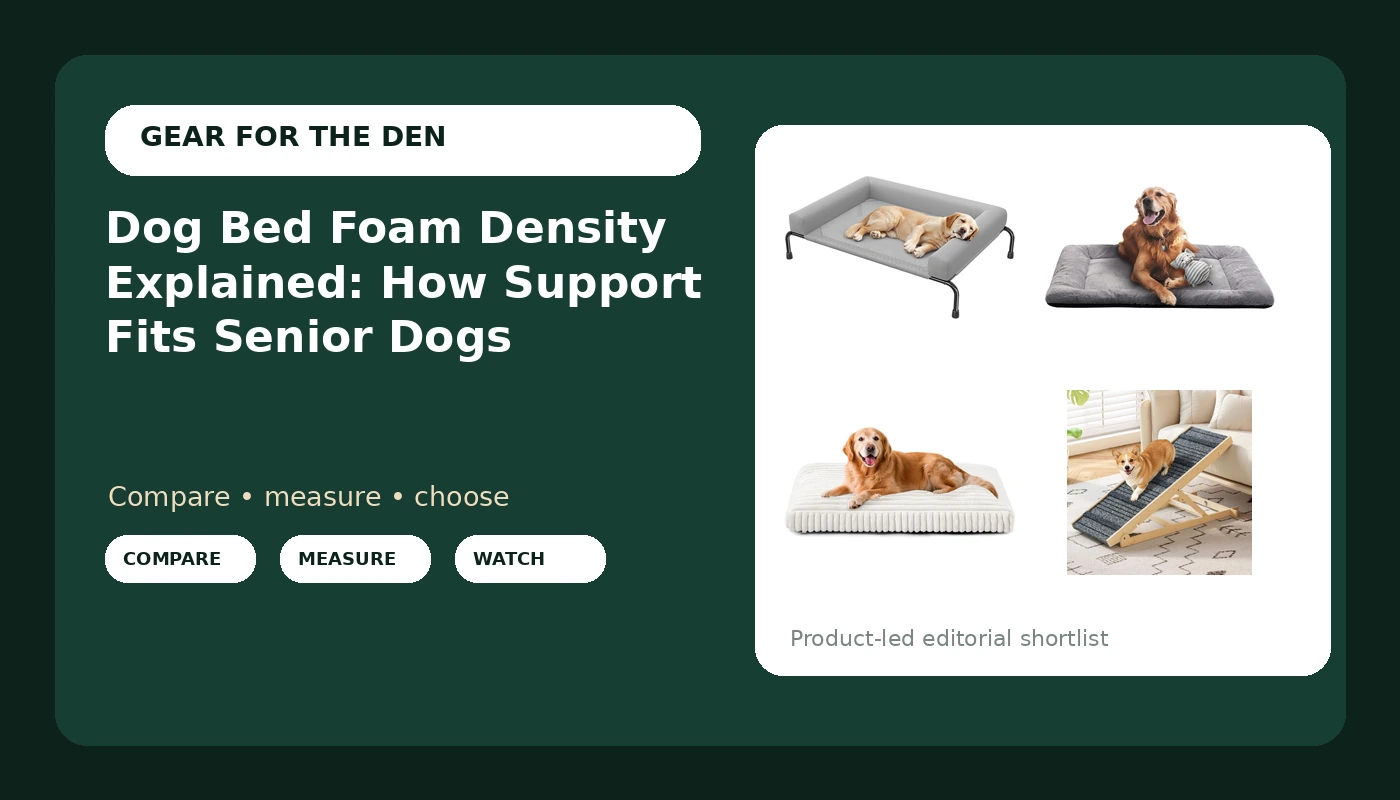
For most owners, dog bed foam density is the measurement that explains why one bed holds its shape under a 90-pound dog while another flattens in a month. Foam density describes how much material is packed into a given volume of foam. It influences compression, recovery, and the hip support a bed can offer. If your senior dog struggles to rise, slides off a slick mattress, or bottoms out on a thin crate pad, the foam underneath may be the missing piece. This dog bed foam density explained guide will help you compare an elevated bed, a crate mat, a washable crate bed, and a ramp without relying on marketing labels alone.
Quick answer
Foam density is weight per unit volume, commonly expressed as pounds per cubic foot, and it is not the same as firmness. There is no single ideal dog bed foam density for every dog. The correct dog bed foam density depends on your dog's weight, sleep position, joint mobility, and how easy it is for them to step onto or off the bed. Heavier dogs and dogs with hip support needs generally benefit from denser foam that resists bottoming out, while a lighter dog may do fine with a lower-density mat, especially in a crate. A bed that is too tall or too soft can be harder to use than a firmer, lower option. Check the listing for density, weight capacity, and dimensions; if density is not stated, treat the bed as an unknown and lean on measurements and return policy.
Four useful options
| Model | Best fit | What stands out |
|---|---|---|
| Simple Trending Elevated Dog Bed for Large Dogs with Bolsters, Grey | Dogs that need a raised sleeping surface and a bolster rail | Elevated large-dog design with bolsters, per the product name |
| Dog Crate Pad Washable Dog Bed for Crate Large Cozy Mat 42-Inch Gray | Crate users who want a large, washable mat | 42-inch crate pad described as washable and cozy |
| FURTIME Dog Beds Large Sized Dog, Washable Dog Bed for Crate, 35" | Tighter crate spaces or dogs that prefer a 35-inch bed | Washable crate bed sized at 35 inches |
| TIMHAKA Dog Ramp for Bed with 7 Adjustable Heights, Supports Up to 150lbs | Dogs that need help reaching a bed or sofa | Seven adjustable heights and a stated 150 lb support limit |
Elevated option: Simple Trending Elevated Dog Bed for Large Dogs with Bolsters, Grey
Elevated beds solve one problem and introduce another. They keep a dog off a cold or hard floor, and the raised surface can be easier to clean under. The trade off is bed height. A dog that can no longer hop or step up may need a ramp, or may do better with a low crate mat. Foam density still matters if the elevated bed uses a foam-filled platform, but the frame and fabric also affect how much give the surface has. For a large dog, check weight capacity and the distance from floor to sleeping surface. A low entry height is often more useful than a thick cushion when joint mobility is the main concern.
Crate mat option: Dog Crate Pad Washable Dog Bed for Crate Large Cozy Mat 42-Inch Gray
A crate pad is practical when space is tight or when your dog already has a favorite sleeping position. The low profile makes it easy to step onto, and a washable cover helps with accidents, drool, and shedding. The limitation is cushion depth. A thin mat may not provide enough hip support for a large dog with arthritis, especially if the foam is low density or compressed. If you use a crate pad on top of a hard tray, look for a non slip backing or add a rug pad underneath to reduce sliding. Also measure the crate interior before ordering; a 42-inch pad fits only if the crate floor is long enough.
Compact crate bed option: FURTIME Dog Beds Large Sized Dog, Washable Dog Bed for Crate, 35"
A 35-inch bed can be the right answer for a dog that curls rather than sprawls, or for a home where the crate is not the primary sleeping spot. The smaller footprint also leaves more floor space in a bedroom or vehicle. The trade off is coverage. A dog that stretches out may hang over the edge, and a bed that is too small can bunch up in a crate. If your dog is between sizes, measure from nose to tail and add a few inches for turning around. Foam density is still the hidden variable: a 35-inch bed with dense foam can support more weight than a larger bed with soft, low-density fill.
Access ramp option: TIMHAKA Dog Ramp for Bed with 7 Adjustable Heights, Supports Up to 150lbs
A ramp is often the missing accessory for a senior dog that still wants to sleep on the bed but cannot jump. The useful numbers are ramp angle, height range, and weight capacity. A ramp set too steeply can be harder to climb than a short step, so match the ramp height to the surface it reaches. The stated 150-pound support limit is a ceiling, not a target; a dog near that limit may need a wider or sturdier ramp. Non slip backing or a grip surface is also important, because a dog that slips once may refuse the ramp. If your dog already has a low bed, a ramp may be unnecessary, and a low crate pad may be the simpler solution.
Prices and availability may change. Product images, names, and retailer links are matched to verified listings. No current price, rating, stock status, or measured result is stated here without current evidence.
What dog bed foam density actually measures
Foam density is a weight measurement, not a softness rating. It describes how much foam material is in a cubic foot of foam, usually in pounds per cubic foot. A higher-density foam has more material in the same space. That usually means it resists compression longer and recovers more consistently under a heavy dog. A lower-density foam can feel soft at first, but it may flatten faster, especially under a large breed. Density is separate from firmness, which is sometimes called indentation load deflection. Two foams with the same density can feel different because of cell structure, thickness, and the cover. For dog beds, the practical question is not which density is highest, but which density keeps your dog's hips from reaching the floor while still being comfortable to lie on.
Many dog bed listings do not publish foam density at all. They may list weight capacity, thickness, or the word orthopedic. That leaves you to infer support from dimensions, cover material, and return policy. If density is missing, do not assume a thick bed is dense. A four-inch bed with low-density foam can bottom out under a 90-pound dog, while a three-inch bed with denser foam may hold up better. The reverse is also possible: a very dense bed can feel too firm for a dog that likes to sink in. That is why there is no universal ideal dog bed foam density, only a match between the foam, the dog, and how the bed is used. If you cannot find density, look for a stated weight capacity and a cover you can remove and wash.
How to choose the correct dog bed foam density for your dog
Start with the dog, not the label. Weight, body length, sleeping position, and joint mobility all change what kind of support works. A dog that sleeps curled in a tight ball puts pressure on a smaller area than a dog that sprawls. A dog with hip support needs may need a bed that does not compress under the hip and shoulder. A dog that can still jump may not need a ramp, while a dog that hesitates at the bed edge may need a lower bed height or a ramp angle that is easy to climb. The correct dog bed foam density is the one that keeps your dog supported without making the bed hard to get on or off.
- Weigh your dog and watch how they lie down. A 70-pound dog that curls needs less surface area than a 70-pound dog that stretches out.
- Measure the crate, bed, or floor space. Leave room for turning around, and check whether a 35-inch or 42-inch pad actually fits.
- Look for a stated foam density or weight capacity. If density is absent, compare thickness, cover, and return terms instead of assuming a higher number.
- Test bed height and entry. A low bed or a ramp can matter more than foam when joint mobility is limited.
- Check the base. A non slip backing or a rug under the bed prevents sliding, which can make a senior dog avoid the bed entirely.
Practical guidance for senior and large dogs
- Put a non slip backing or a rubber rug under the bed. A bed that slides when your dog steps on it can be worse than a firm bed that stays put.
- Keep bed height low if your dog has hip or shoulder trouble. A low crate mat may be easier to use than a thick bed with a tall edge.
- If you use a ramp, set the ramp angle shallow enough that your dog can walk up without scrambling. Match the ramp height to the bed or sofa it reaches.
- Wash covers regularly, but check the foam inside for compression. Foam that stays flattened after you press it is no longer doing its job.
- Do not size up blindly. A bed that is too large for the crate can bunch at the corners, and a bed that is too small can leave hips unsupported.
Which option should you choose?
Choose the Simple Trending Elevated Dog Bed for Large Dogs with Bolsters, Grey when you want a raised sleeping surface for a large dog and can manage the step up or pair it with a ramp. Choose the Dog Crate Pad Washable Dog Bed for Crate Large Cozy Mat 42-Inch Gray when your dog sleeps in a large crate and you want a low, washable mat that is easy to step onto. Choose the FURTIME Dog Beds Large Sized Dog, Washable Dog Bed for Crate, 35" when your crate or dog is better matched to a 35-inch bed. Choose the TIMHAKA Dog Ramp for Bed with 7 Adjustable Heights, Supports Up to 150lbs when the real problem is getting onto a bed or sofa, not the foam underneath.
Density is the number most likely to be missing from a listing, so no single product can be called the best fit for every senior dog. Use weight capacity, bed height, ramp angle, and your dog's joint mobility as the deciding factors, and treat any unstated foam density as an unknown.
The bottom line
Dog bed foam density is a support and durability clue, not a comfort guarantee. Higher density usually resists compression better under a heavy dog, but the right choice still depends on weight, sleep style, hip support needs, and how easily your dog can get on and off the bed. For a senior dog, a low crate pad, a washable crate bed, an elevated bed, and a ramp each solve a different part of the problem. Compare the measurements, look for a non slip backing and a washable cover, and choose the option that matches your dog's daily movement rather than the thickest label in the aisle.