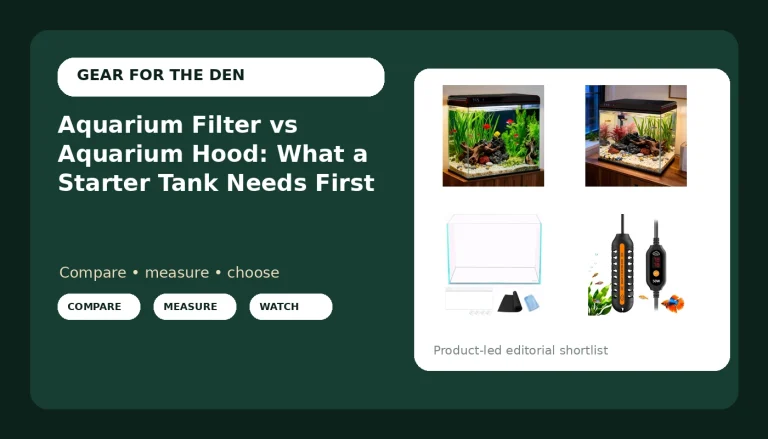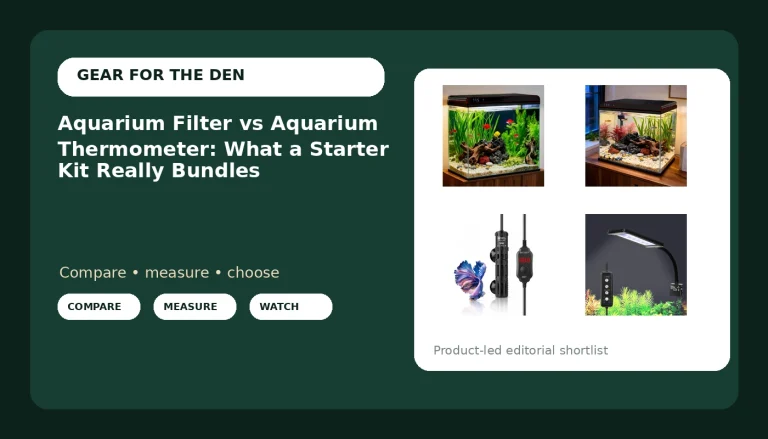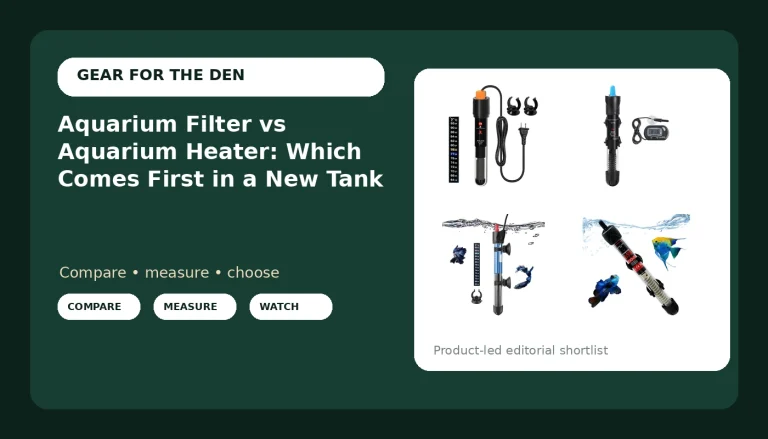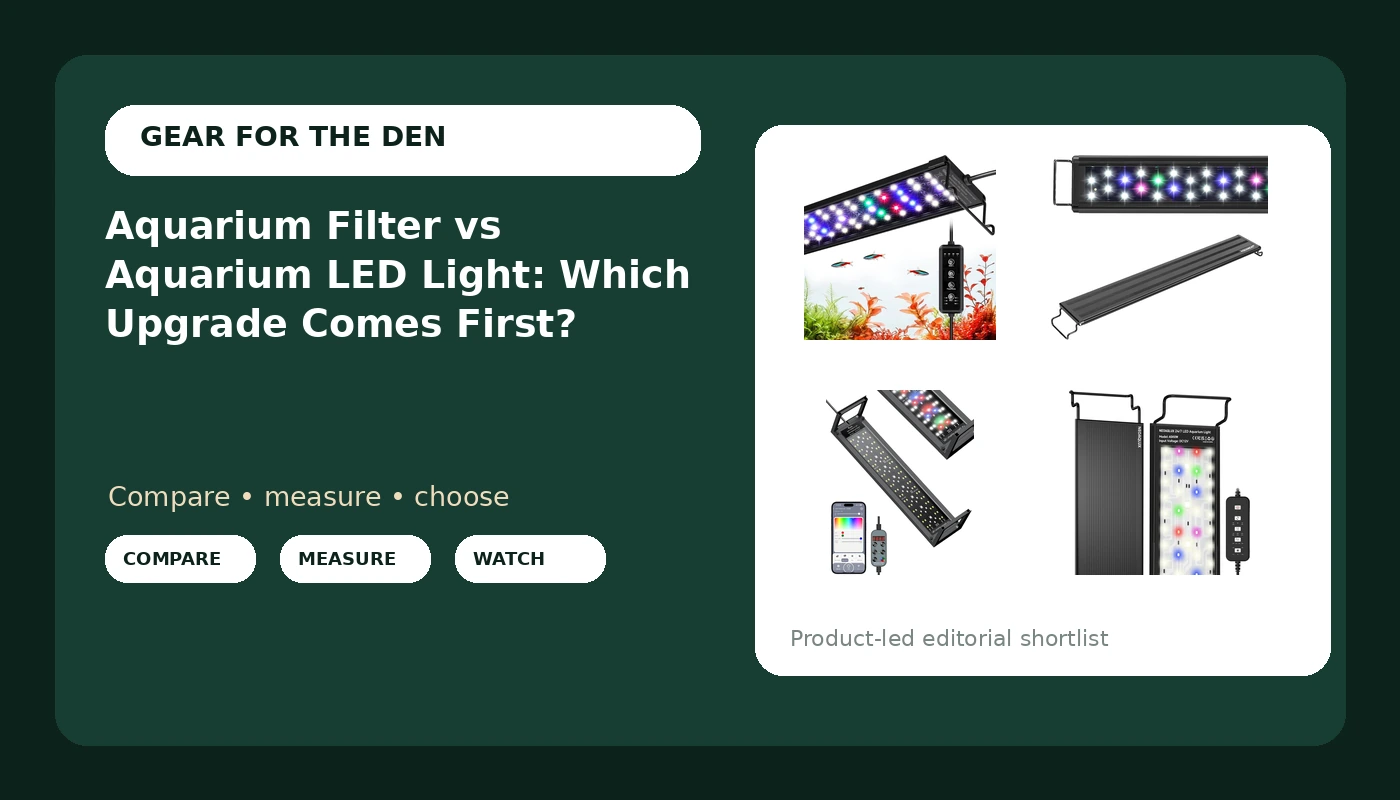
The aquarium filter vs aquarium led light question shows up in freshwater forums constantly, and it usually arrives attached to a photo of a cloudy tank and a plant that has melted back to a stem. The two products are not competitors. A filter keeps the water safe for livestock; a light decides whether plants grow and whether the tank is something you actually want to sit next to. This comparison covers four freshwater LED lights built for 12 to 24 inch tanks, then puts the filtration side of the ledger back in the frame so you can decide which one your money should buy this month.
Start with the honest version of the trade-off. A filter is not optional. Every freshwater tank runs a nitrogen cycle managed by bacteria, and those bacteria live in filter media rather than in the water column. A light is optional in the strict sense, because a fish-only tank can run for years under a plain room lamp. What a light buys you is plants, colour rendering, and a viewing experience that makes you look at the tank instead of walking past it.
So the real decision is about sequencing and about what your tank is currently failing at. Cloudy water, fish hanging at the surface, an ammonia reading you can smell: filter. Clear water, calm fish, plants stretching toward the surface with pale new growth: light.
For most freshwater keepers the correct order is filter first, light second, and if you already run a cycled tank with adequate filtration, the light is the upgrade that changes the most for the least money. Every link in the table below goes to the Amazon listing for the exact light in that row, and prices are deliberately left out because they move; use the link and check the listing yourself.
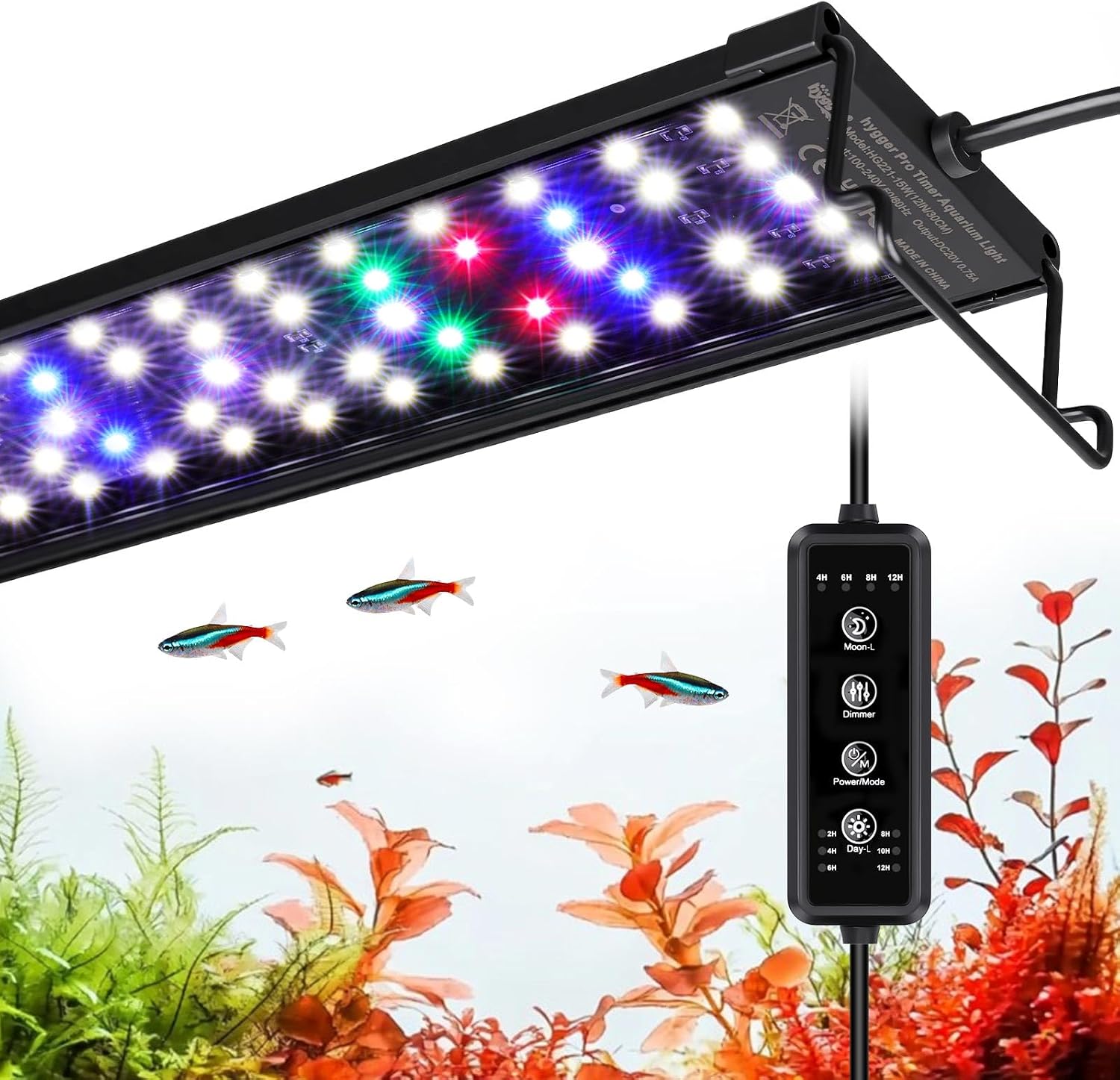
hygger LED Aquarium Light, 15W Full Spectrum Plant Lamp with Timer, 12-18"
Built-in timer plus 15 W of full spectrum in a slim 12 to 18 inch body, the simplest set-and-forget choice for a small planted tank
One size band only, no app, no dimming, no colour channels beyond the plant spectrum
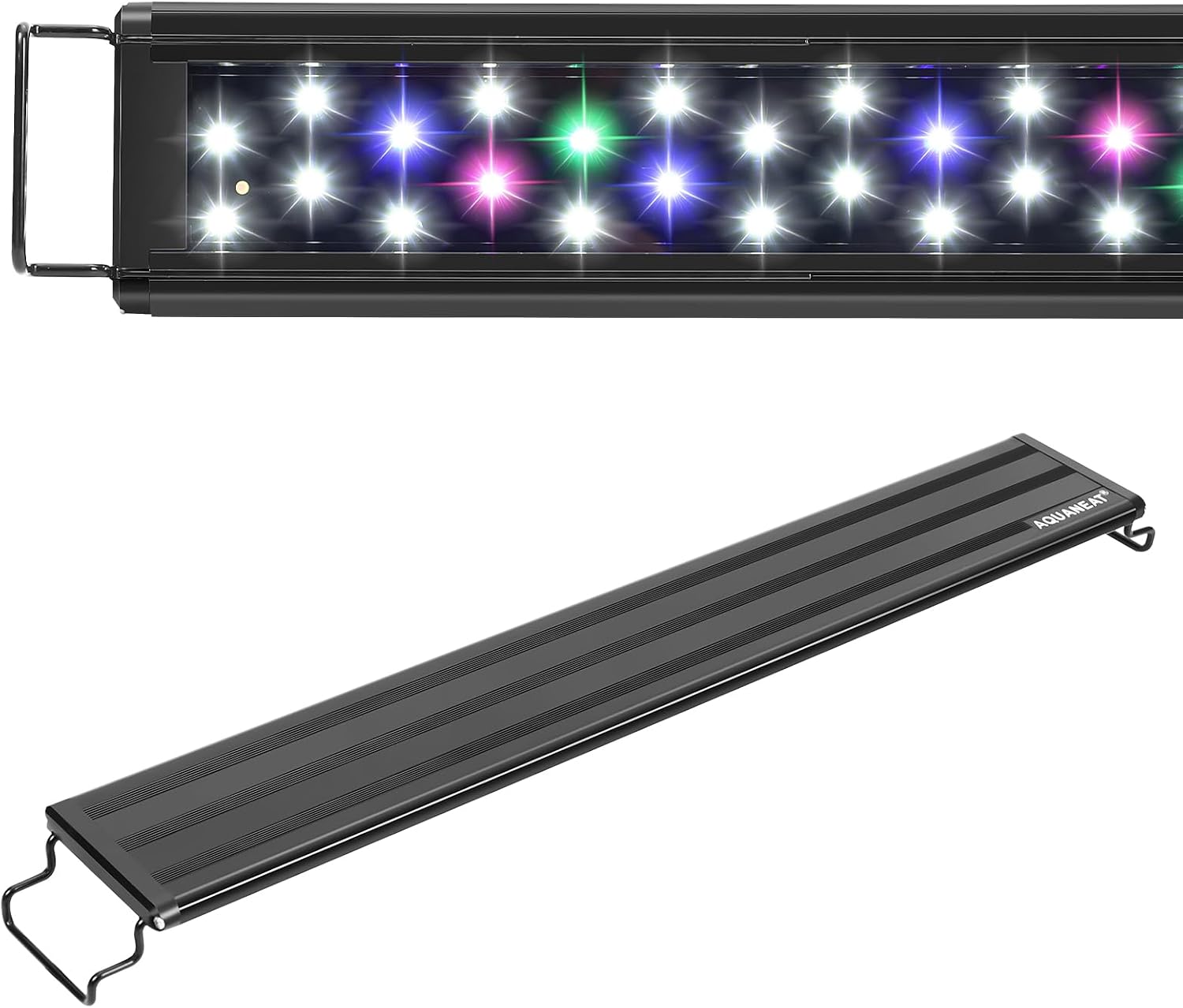
AQUANEAT LED Aquarium Light Full Spectrum 12 Inch Fish Tank Light Fresh Water
The most straightforward entry into a full spectrum LED bar over a 12 inch tank, plug in and clip on
No timer, no dimming, no extendable brackets, so it suits one tank width and one schedule
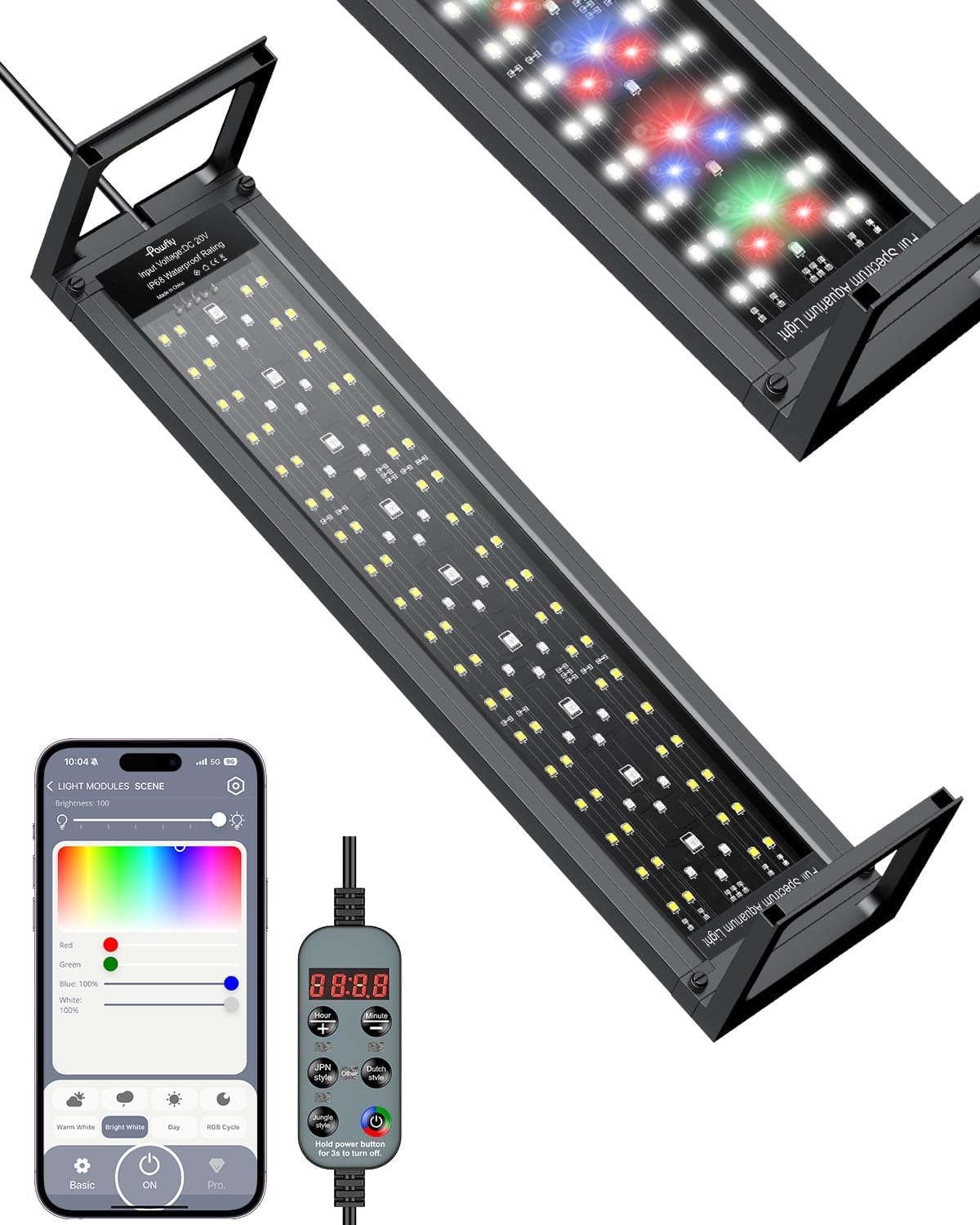
Pawfly Aquarium Light for Plants, 20 W Bluetooth Fish Tank Light, Full Spectrum Aquarium Lights for 18"-24" Fish Tanks, Extendable 24/7 LED Lights with Timer Modes & Adjustable
20 W across an 18 to 24 inch tank with Bluetooth control, extendable brackets and 24/7 timer modes
Most features live behind the app, and 20 W over a shallow tank will grow algae on a long photoperiod
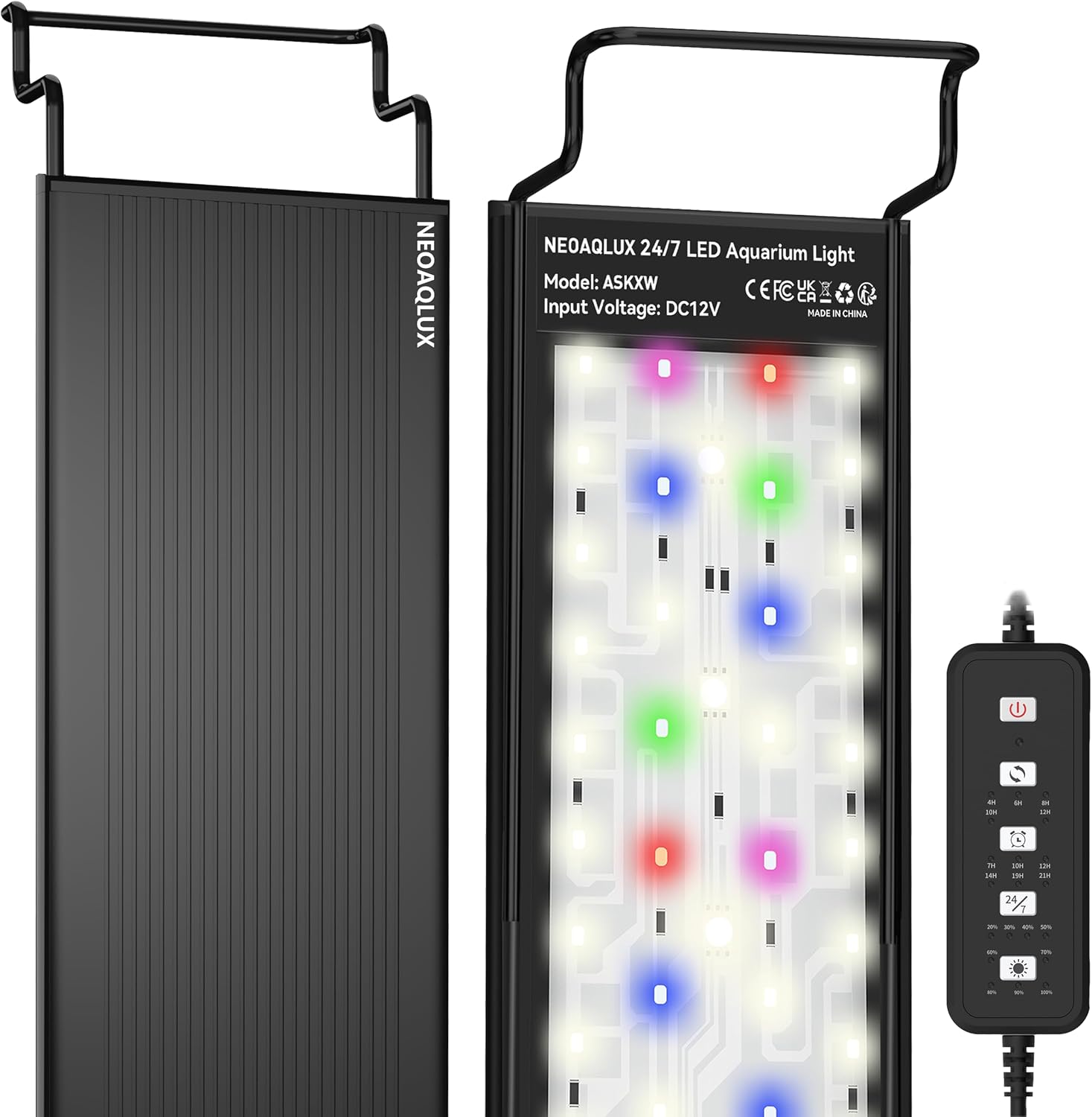
NEOAQLUX 24/7 LED Aquarium Light for 12-18 Inch Plant & Fish Tank, 12-Color & Gradient & Full Spectrum with Auto On/Off, Sunrise-Daylight-Moonlight, Extendable Brackets for Freshwater IP68
12 colour channels, gradient ramps, sunrise to moonlight auto on/off, extendable brackets and IP68 moisture protection
The longest setup curve here, and the colour channels tempt you into lighting a planted tank like a reef tank
Prices and availability may change.
How the aquarium filter vs aquarium led light split actually works
A filter and a light solve different problems, which is why the comparison comes out lopsided no matter how you frame it. Filtration is a water quality system. It moves water at a measurable flow rate, traps particles in mechanical media, houses the bacteria that convert ammonia to nitrite to nitrate, and in some designs runs chemical media for clarity. Lighting is an energy system. It delivers a wattage and a spectrum that plants use for photosynthesis, and it decides how the colours in the tank read to your eye.
The failure modes are not comparable either. An under-filtered tank goes wrong fast: ammonia climbs, gills burn, livestock dies inside a week. An under-lit tank goes wrong slowly: stems stretch, lower leaves drop, and the plants you paid for become a brown tangle over a month or two. Neither failure is fixed by the other product, and that is the whole answer to the question.
What the filter side of the ledger really costs you
Turnover is the number that matters most. Long-time keepers talk in gallons per hour and aim for a flow rate that cycles the whole tank volume several times an hour, though the multiplier depends on stocking, on whether you keep a betta that hates current, and on how much hardscape breaks the flow up. A filter rated for a 20 gallon tank will struggle on a 20 gallon tank that is heavily stocked, because ratings are quoted at the pump rather than at the outflow after your spray bar and your plants have slowed everything down.
Then there is the filtration stage count. A single sponge is one stage, mechanical and biological in the same block. A canister or a hang-on-back with separate trays gives you three, so you can rinse the mechanical pad without wrecking the bacterial colony in the biological media. Substrate grain matters here too. A coarse gravel bed traps food and waste where the filter cannot reach it, so the filter works harder; a finer sand bed keeps debris on the surface where a siphon can lift it out.
The last line on the filter side is temperature. Most freshwater fish want stability more than they want a specific number, and the thermostat range on your heater is what stops that number swinging overnight. If the heater is unreliable, no lighting schedule will save the tank.
What the light side of the ledger really costs you
Wattage is the headline number and the least useful one on its own. A 20 W bar over a 24 inch tank and a 20 W bar over a 12 inch tank are doing very different things, because the same energy spread across twice the area is half the intensity at the leaf. Coverage length, mounting height and whether the fixture sits on the rim or hangs above the water change the result more than a couple of watts either way.
Kelvin rating tells you the colour temperature of the white light, roughly how blue or how yellow it looks. Planted tanks usually sit in the middle of the freshwater range, bright and slightly cool, because that is where the red and blue peaks plants use are well represented without the tank looking like a hospital corridor. Full spectrum is the phrase every listing leans on; what it should mean is that the diode mix covers the wavelengths chlorophyll absorbs, so it is worth confirming there is some red in the mix. A pure white-blue bar grows plants slowly and looks flat.
The features that separate the four lights here are control and mounting, not raw output. A timer, an auto schedule, extendable brackets and a moisture rating decide whether you actually use the fixture the way it was designed.
The entry bar: AQUANEAT LED Aquarium Light
The AQUANEAT is a 12 inch full spectrum bar and the simplest thing in this group. There is no timer, no app, no colour channel and no extendable bracket. What it does is put full spectrum light over a small tank for someone lighting a single betta setup or a quarantine tank who does not want to think about a schedule at all.
That simplicity is also the limitation. Without a timer you are the timer, and the most common cause of algae in a small tank is a light left on for twelve hours because nobody was home to switch it off. Over a 12 inch tank with low-demand plants like anubias or java fern it is enough. Over anything with a carpeting plant or a red stem plant it is not, and you will be shopping again within a year.
Check current Amazon price if your use case is a fish-only tank, a hospital tank, or a first light while you save for something with a schedule.
The 12 to 18 inch workhorse: hygger
The hygger is a 15 W full spectrum plant lamp built for 12 to 18 inch tanks, and the timer is the reason it earns a place on this list. It is a plant-first fixture: the spectrum is tuned for freshwater plants rather than for maximum colour pop, and the body is slim enough to sit on the rim of a small tank without dominating the room.
The 15 W rating over that footprint is a sensible middle ground. It is more than the entry bar, so cryptocorynes and swords have something to work with, and it is not so much that you have to run injected CO2 to keep algae in check. The timer keeps the photoperiod consistent, which matters more for algae control than most people expect.
Where it loses points is flexibility. There is one size band, so it will not stretch to a 24 inch tank, and there is no app, no dimming and no moonlight mode. If you want the light to ramp up in the morning and fade at night, this is not that fixture.
The wide-tank pick: Pawfly 20 W
The Pawfly is the 20 W option here, built for 18 to 24 inch tanks with extendable brackets and Bluetooth control. That combination is aimed at someone running a longer tank who wants the fixture to fit the rim without a DIY bracket, and who would rather have a 24/7 timer mode than a plug-in dial.
Bluetooth is the trade-off. Everything the light can do lives in an app, so you get schedule modes and adjustability, but you also get a pairing step and a phone dependency. If you would rather set a dial and forget it, this is the wrong light for you. If you like shaping a schedule around when you are actually home in the evening, it is the most capable fixture in this group for a 24 inch tank.
At 20 W over an 18 to 24 inch span, watch the photoperiod. This is enough light to grow plants and enough light to grow algae, and the difference is how many hours a day it runs and how much of the tank is planted. Start short and lengthen.
The flexible pick: NEOAQLUX
The NEOAQLUX is the feature-dense option: 12 colour channels, gradient ramps, a sunrise to daylight to moonlight auto schedule, extendable brackets for 12 to 18 inch tanks, and an IP68 rating, which is the highest moisture protection in this group and worth having on a fixture that sits over splashing water.
Twelve colours on a freshwater tank sounds like overkill, and it can be. The genuinely useful part is the gradient and the auto on and off, because a tank that brightens over twenty minutes and dims into moonlight in the evening looks better and stresses fish less than a hard switch from dark to full brightness. The colour channels are there for a warmer evening look or for making fish colours pop.
The cost is complexity. You will spend an evening reading instructions and setting the schedule, and if you reset the fixture you get to do it again. For a keeper who enjoys tuning a setup, that is a feature. For someone who wants three settings and a plug, it is friction.
The difference between aquarium filter and aquarium led light in weekly maintenance
The difference between aquarium filter and aquarium led light shows up most clearly on water change day. Filter maintenance is non-negotiable and physical: rinse the mechanical media in tank water, check the impeller, confirm the flow rate has not dropped because a sponge is clogged. Skip it for two months and the filter tells you with a trickle instead of a stream.
Light maintenance is almost nothing. Wipe the splash guard, check that the bracket has not shifted, confirm the timer is still where you left it. The failure you are watching for is a schedule that drifted after a power cut, not a worn part. That asymmetry is worth remembering when you decide where to spend a Saturday.
Which one fails first: aquarium led light vs aquarium filter
Ask the question as aquarium led light vs aquarium filter and the answer is almost always the filter, and almost always because of neglect rather than a bad product. Impellers seize, media clogs, intake tubes end up buried behind hardscape, and a filter that has run for two years without a rinse is moving a fraction of its rated gallons per hour.
Lights fail less dramatically. Diodes dim over years, splash guards cloud, a bracket cracks, and the symptom is slow plant decline rather than a tank emergency. That is why the light is the safer thing to defer. If money is tight this month, a filter you already own and maintain will keep the tank alive longer than a new light will fix a stalled cycle.
Buying order: aquarium filter or aquarium led light
If you want a rule, buy filtration until the tank is stable, then buy light until the plants are happy. Stable means zero ammonia and nitrite on a test, a filter that cycles the tank volume several times an hour, and a heater holding a steady thermostat range through the night. Happy means new growth that is not pale, internodes that are not stretched, and algae you are winning against rather than fighting.
Only after that does the light upgrade make sense, and at that point the four fixtures above are a reasonable shortlist. Take the entry bar if the tank is small and fish-only, the hygger if you have a 12 to 18 inch planted tank and want a timer, the Pawfly if you have an 18 to 24 inch tank and want app control, and the NEOAQLUX if you want the most adjustability plus the best moisture protection.
Should you buy the light before the filter?
Only in one case: a fish-only tank with an established, well-maintained filter and no plants. There, a light is decoration and viewing comfort, and there is nothing wrong with buying it first if water quality is already solved. The aquarium filter vs aquarium led light decision genuinely flips for that kind of setup.
In every other case, filter first. A light amplifies whatever is already happening. On a healthy planted tank it amplifies growth; on a tank with an ammonia problem it amplifies algae, because algae exploits the same light plus the excess nutrients that come with weak filtration. Buying a better light for an unstable tank is the most common way people end up with a green tank and a lighter wallet.
What I'm looking at next
Two things are on the list for the next round of this comparison. First, whether app-controlled fixtures hold their schedules after a power cut, because that is the failure nobody mentions in the listing copy and everybody notices in month three. Second, how the extendable brackets on these lights handle a rimmed tank versus a rimless one, since bracket fit is the difference between a light that sits level and a light that drips condensation onto your floor. Until then, filter first, light second, and let the plants tell you when the upgrade is due.