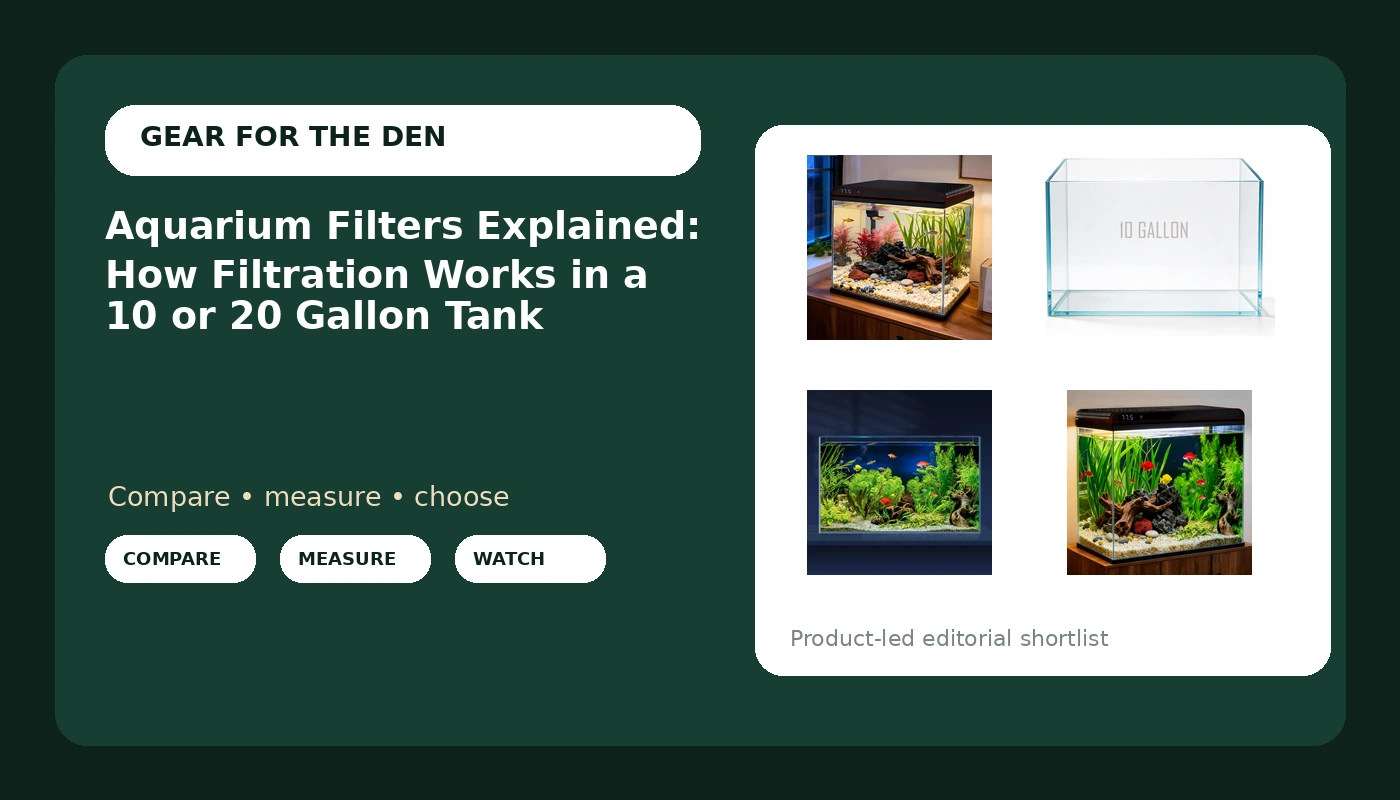
If you have ever stood in an aisle comparing boxes, you already know that most writing about aquarium filters is aimed at people who have kept a tank for years. Flow rate, gallons per hour, wattage, filtration stage: the numbers matter, but they only mean something once you connect them to tank volume and to the animals you plan to keep. This guide walks through what a filter is actually doing, how to read the specifications that decide whether a small setup works, and how the filtration that arrives inside a starter kit fits a 10 or 20 gallon tank. By the end you should be able to open a product listing and judge whether the pump and the media are proportionate to the tank, instead of trusting a badge on the box.
Quick answer
Aquarium filters do three jobs at once: they trap solid waste, they hold media that pulls dissolved compounds out of the water, and they host the bacteria that convert toxic ammonia into less harmful nitrate. Sizing one is mostly arithmetic. A pump rated for roughly four to six times the tank volume in gallons per hour is a common starting target for a lightly stocked freshwater tank, and a heavier bioload pushes that number up. The four options below are not stand-alone filters; they are tanks and starter kits whose included or intended filtration is the part worth evaluating, and each one fits a different kind of buyer. None of them is called the quietest, fastest, or best here, because those labels depend on a running setup that this page cannot verify.
4 useful options
| Model | Best fit | What stands out |
|---|---|---|
| Coospider 10 Gallon Glass Fish Tank, Aquarium Starter Kit, Simple Self-Cleaning Aquarium with 3-Color LED Lights, Quiet Filter Pump, Temperature Monitoring for Fish, Shrimp, Kids Gift Ideas | First small tank where the buyer wants filtration and lighting included | Arrives as a kit with a filter pump, three-color LED lighting, and temperature monitoring |
| AQUA DAREN 10 Gallon Rimless Aquarium Fish Tank, Ultra-Clear Nano Glass Rectangular Fish Tank L17.7"×W11"×H11.8" Thickness 6mm Glass Aquarium (M 10 Gallons) | Buyer who already owns a filter and light and cares about the glass itself | Rimless, ultra-clear rectangular glass with a listed 6 mm thickness |
| LAQUAL 10 Gallon Ultra Clear Glass Fish Tank, Rimless Low Iron Aquarium for Betta/Nano/Goldfish/Snail/Shrimp, Big Fish Tank & Cover Set & Feeding Ring & Cleaning Tools | Betta, shrimp, or snail keeper who wants accessories in the box | Ships with a cover set, a feeding ring, and cleaning tools |
| Coospider 20 Gallon Glass Fish Tank, Aquarium Starter Kit, Simple Self-Cleaning Aquarium with 3-Color LED Lights, with Quiet Filter Pump, with Temperature Monitoring for Fish, Shrimp, Kids Gift Ideas | Keepers who want more water volume with the same kit logic | Larger version of the Coospider starter kit with filter pump, LED lighting, and temperature monitoring |
Kit with filtration included: Coospider 10 Gallon Glass Fish Tank, Aquarium Starter Kit, Simple Self-Cleaning Aquarium with 3-Color LED Lights, Quiet Filter Pump, Temperature Monitoring for Fish, Shrimp, Kids Gift Ideas
The appeal of a kit is that light, pump, and temperature monitoring arrive together, so the only decisions left are media and water. What the listing does not state is the pump's rated gallons per hour or its wattage, and those two numbers decide whether the turnover suits a single betta or a small community. Before ordering, measure the footprint, and plan a way to soften the flow if you keep bettas or shrimp, because a pump that moves a 10 gallon tank briskly can push small fish around. Temperature monitoring is a readout, not a thermostat range, so pair it with a heater you can set. Treat the self-cleaning wording as a description of how debris is directed toward the intake, not a promise that water changes stop.
Glass-only option: AQUA DAREN 10 Gallon Rimless Aquarium Fish Tank, Ultra-Clear Nano Glass Rectangular Fish Tank L17.7"×W11"×H11.8" Thickness 6mm Glass Aquarium (M 10 Gallons)
Rimless ultra-clear glass is about the view, not about filtration, which is why this tank suits someone who already owns a filter and a light. There is no cover and no molded cut-outs, so you choose every component, and you also accept faster evaporation, which concentrates minerals and means more topping off. The rectangular footprint and listed glass thickness make it a desk or shelf tank rather than a floor unit, so confirm the surface underneath is flat and level. Because nitrifying bacteria colonize substrate and media, the filter you pick and the substrate grain you pour in matter more here than in a kit. Expect to buy a heater, a filter, and a light separately.
Accessories included: LAQUAL 10 Gallon Ultra Clear Glass Fish Tank, Rimless Low Iron Aquarium for Betta/Nano/Goldfish/Snail/Shrimp, Big Fish Tank & Cover Set & Feeding Ring & Cleaning Tools
The cover limits evaporation and reduces the chance of a jumper landing on the floor, and the feeding ring keeps floating food in one place so it does not drift straight into a filter intake. Cleaning tools matter more than they sound, because algae on rimless glass is visible from every angle and a designated scraper keeps you from reaching for abrasives. The listing names betta, nano, goldfish, snail, and shrimp, and it is worth treating goldfish as a size question rather than a compatibility question, since they outgrow a 10 gallon tank over time. Budget separately for a filter and a heater, and confirm the cover arrangement suits the equipment you plan to hang on the rim.
Larger kit: Coospider 20 Gallon Glass Fish Tank, Aquarium Starter Kit, Simple Self-Cleaning Aquarium with 3-Color LED Lights, with Quiet Filter Pump, with Temperature Monitoring for Fish, Shrimp, Kids Gift Ideas
The larger kit follows the same logic as the 10 gallon version, but the extra water volume changes the math. More gallons dilute waste and give the bacteria living in the media more time to keep up, which is why a 20 gallon tank is generally more forgiving for a beginner who is still learning water changes. It also weighs considerably more when filled, so it needs a stand rated for the load and a spot out of direct sun. Ask the seller for the pump's rated gallons per hour and compare that figure against 20 gallons rather than assuming the included pump scales up with the box. The same caution about the self-cleaning wording applies.
Prices and availability may change. Product images, names, and retailer links are matched to verified listings. No current price, rating, stock status, or measured result is stated here without current evidence.
Aquarium filters explained: the three filtration stages
Every filter, whether it is a sponge driven by an air pump or a canister tucked under the stand, runs the same three stages, and knowing which stage does what keeps you from overbuying.
Mechanical filtration is the part you can see working. Filter floss, sponges, and pads trap particles before they break down, which is why they clog and why they get rinsed. Rinse them in water you removed during a water change, never under the tap, because chlorine kills the bacteria living in them.
Chemical filtration uses carbon, resins, and similar media to pull dissolved compounds, odors, and discoloration out of the water. It is optional and situational. Carbon exhausts its usefulness over time, and it is not a substitute for water changes, since it does not remove nitrate in a meaningful way.
Biological filtration is the stage that actually keeps fish alive. Porous media such as ceramic rings, bio balls, and coarse sponge provide surface area for nitrifying bacteria that convert ammonia to nitrite and nitrite to nitrate. This colony takes weeks to establish, it lives on surfaces rather than in the water, and it is the reason you never replace all your media at once. If flow rate through the media is too high, contact time drops and each filtration stage does less work than its rating suggests.
Sizing aquarium filters to tank volume and flow rate
Sizing starts with tank volume and a turnover target. A common starting range for a lightly stocked freshwater tank is four to six times the volume per hour, so a 10 gallon tank points toward roughly 40 to 60 gallons per hour and a 20 gallon tank toward roughly 80 to 120. Published gallons per hour figures usually describe free flow, and real output falls with media in place, so leave headroom rather than buying exactly to the number. The goal is not the largest unit available, but correct aquarium filters for the bioload you actually keep.
Wattage is the running cost question. A small internal pump may draw only a few watts while a larger power filter draws more, and the difference matters if the tank runs year round. Check whether flow is adjustable, since a pump you can dial back is easier to live with in a nano tank.
Two more specs shape the setup. Substrate grain affects both looks and biology: finer grains pack more surface area but can compact and slow water movement, while coarser gravel keeps flow open with less area for bacteria. A thermostat range tells you what a heater can hold, usually somewhere in the mid seventies to low eighties Fahrenheit for tropical fish, while the temperature monitoring built into a kit is only a readout. If you keep plants, the kelvin rating of the light matters more than brightness alone, and a light in the 6500K range is the usual starting point.
- Measure the space and confirm the tank volume you can actually support.
- Set a turnover target of four to six times the volume per hour.
- Choose media for all three stages: mechanical sponge, biological rings or balls, chemical carbon only if needed.
- Check the pump's wattage and whether its flow can be adjusted.
- Cycle the tank and test ammonia and nitrite until both read zero before adding livestock.
Practical guidance for ideal aquarium filters
- Match gallons per hour to tank volume, not to the size of the box the filter came in.
- Rinse biological media in removed tank water, never under chlorinated tap water.
- Clean or replace media in rotation so you never strip the bacteria colony all at once.
- Pair any kit's temperature monitoring with a heater that has a settable thermostat range.
- Pick substrate grain with the livestock in mind, since it affects both flow and surface area.
Which option should you choose?
Choose the Coospider 10 Gallon Glass Fish Tank, Aquarium Starter Kit, Simple Self-Cleaning Aquarium with 3-Color LED Lights, Quiet Filter Pump, Temperature Monitoring for Fish, Shrimp, Kids Gift Ideas when you want a first small tank where the pump, the light, and a temperature readout arrive in one box. Choose the AQUA DAREN 10 Gallon Rimless Aquarium Fish Tank, Ultra-Clear Nano Glass Rectangular Fish Tank L17.7"×W11"×H11.8" Thickness 6mm Glass Aquarium (M 10 Gallons) when you already own filtration and lighting and the glass itself is the point. Choose the LAQUAL 10 Gallon Ultra Clear Glass Fish Tank, Rimless Low Iron Aquarium for Betta/Nano/Goldfish/Snail/Shrimp, Big Fish Tank & Cover Set & Feeding Ring & Cleaning Tools when you want a cover, a feeding ring, and cleaning tools included and plan to add your own filter. Choose the Coospider 20 Gallon Glass Fish Tank, Aquarium Starter Kit, Simple Self-Cleaning Aquarium with 3-Color LED Lights, with Quiet Filter Pump, with Temperature Monitoring for Fish, Shrimp, Kids Gift Ideas when you want more water volume with the same kit approach.
The caveat is the same for all four. The listings describe what is in the box, not measured flow rates, sound levels, or long term reliability, so treat an accessory list as a starting point and confirm pump specifications with the seller before you rely on them.
The bottom line
There is no single spec sheet that describes ideal aquarium filters for every tank, which is why the useful skill is reading volume, flow rate, wattage, and media together rather than shopping by badge. If there is a one line version of aquarium filters explained, it is this: match the pump to the tank volume, keep the biological media wet and undisturbed, and change part of the water every week. The 10 gallon Coospider kit covers the most ground for a first setup, the AQUA DAREN tank is the cleanest choice if you already own equipment, the LAQUAL tank adds useful accessories without a pump, and the 20 gallon Coospider kit buys margin through volume. Whichever you pick, the filter is only as good as the maintenance routine around it.