A cockatiel is a small parrot with a long tail, a crest it raises when startled, and a constant urge to climb and chew. That combination is why the bird cage for cockatiels that actually works is rarely the plain starter cage sold with one smooth dowel perch and a single plastic dish. The bird needs a shell that keeps it inside without trapping its head, and an interior that gives its feet something better than a uniform rod to grip.
This guide treats the setup as two separate purchases: the shell, where bar spacing and cage height decide whether the cage is safe and roomy enough, and the interior, where perch diameter, food cup size, and foraging difficulty decide whether the bird stays busy. It is written for owners who already have a cage and want to know what to change first, and for buyers who would rather not replace a cage in a month.
Quick answer
Here is bird cage for cockatiels explained in a single paragraph: choose a shell with narrow bar spacing and real cage height, then rebuild the inside with natural wood perches of mixed thickness, a food cup you can reach into with a whole hand, and open space left for the tail and wings. There is no single ideal bird cage for cockatiels, because the correct bird cage for cockatiels is the one whose measurements fit the bird in front of you rather than the photo on the box. Get the shell right first, and the perches and stands below become upgrades instead of workarounds.
Four useful options
| Model | Best fit | What stands out |
|---|---|---|
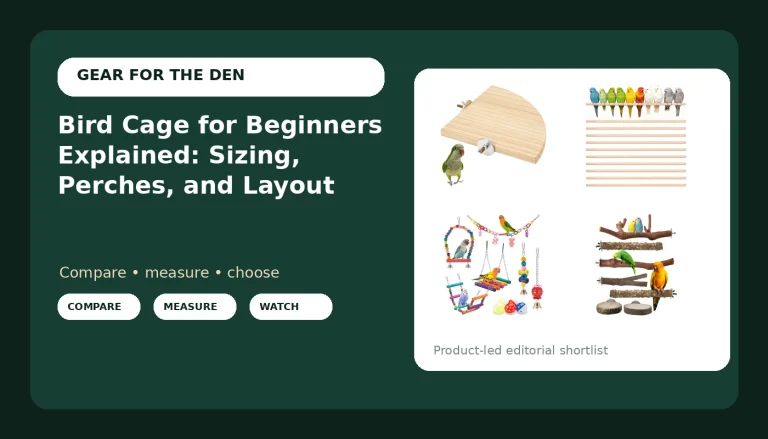
| Bissap Bird Perch Stand 7PCS | Rebuilding the inside of an existing cage | Seven natural grape wood pieces in mixed shapes, including a platform and a hammock |
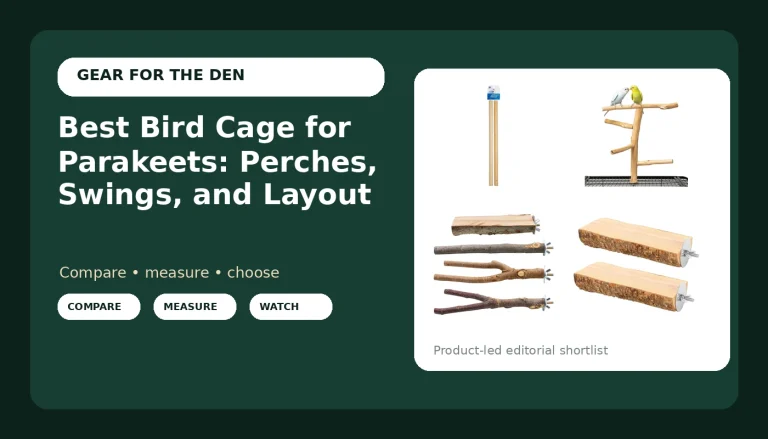
| Tfwadmx Bird Perch Natural Wood Stand | A feeding and hanging-out station outside the cage | Natural wood stand with a removable tray and two stainless steel cups |
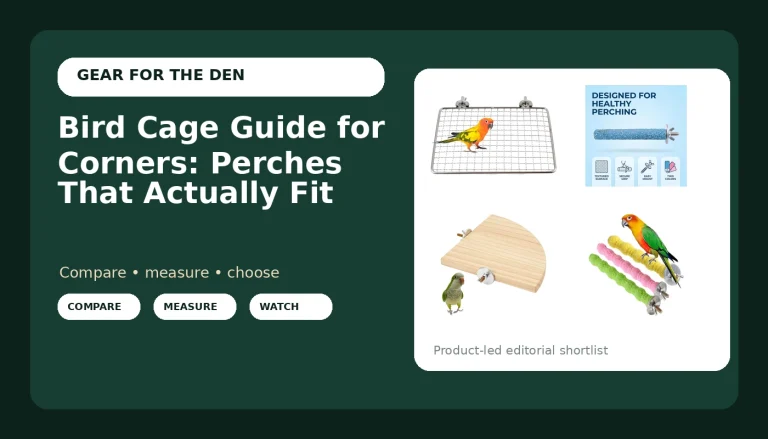
| Wood Window Bird Perch Toy with Suction Cup | Supervised window time and car travel | Suction cup mount with a climbing ramp and ladder platform |
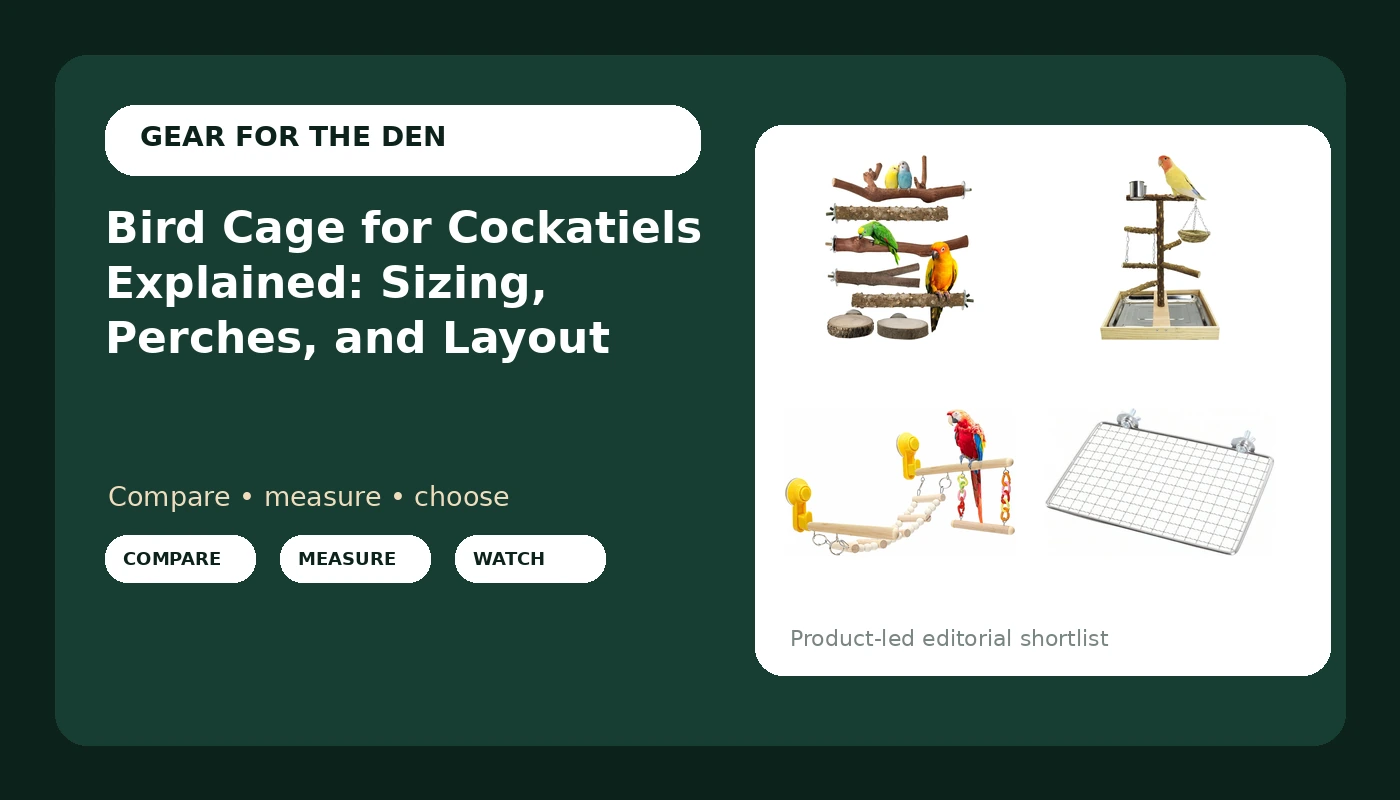
| Space-Saving Bird Cage Mesh Perch | Adding a perch to a tight cage or carrier | Mesh perch listed at a large size of 20 by 15 centimeters |
The variety set: Bissap Bird Perch Stand 7PCS
A set like this is the quickest way to vary perch diameter without buying four separate items. The trade-off is that natural wood is a consumable. Grape wood is soft, and a cockatiel will test it with its beak on the first day, so plan on replacing a chewed piece rather than treating the set as permanent furniture. Check each branch for sharp edges or loose fittings when you swap it in, and mount the heaviest piece low in the cage so a fall lands on the floor grate instead of a food cup.
The standalone stand: Tfwadmx Bird Perch Natural Wood Stand
Food cup size is the detail worth checking on any stand, because the cups are the part you handle twice a day. Stainless steel rinses clean and does not hold odor the way scratched plastic can, and the removable tray gives you a tray liner area: cut paper or a liner to fit, lift the tray out, and the cleaning job is done. The trade-off is footprint. A stand like this occupies floor or table space that a cage-mounted perch does not, so measure the corner you have in mind before you commit to it.
The window perch: Wood Window Bird Perch Toy with Suction Cup
A suction mount only holds as well as the surface under it. Glass and smooth tile work; painted drywall and textured plastic do not. Clean and dry the pane first, press the cup firmly, and test the hold with your hand before the bird steps onto it. The same perch is a reasonable travel companion, which is why carrier size matters as much as cage size when you plan a trip, since a perch that fits the carrier door but not the interior is dead weight. Sun through glass also builds heat quickly, so treat a window perch as a supervised spot rather than an all-day one.
The space saver: Space-Saving Bird Cage Mesh Perch
A perch like this earns its place in a small cage or a travel carrier where every centimeter counts. The trade-off is grip and wear. Mesh is a single texture, so it should not be the only perch in the cage, and the surface should be checked for fraying or sharp edges whenever you clean. Use it as the low perch near the food cups or as the carrier perch, and keep a wood perch up top where the bird sleeps.
Prices and availability may change. Product images, names, and retailer links are matched to verified listings. No current price, rating, stock status, or measured result is stated here without current evidence.
Sizing a bird cage for cockatiels: bar spacing and cage height
Bar spacing is the first measurement, because it decides whether the cage is safe. For a cockatiel, the gap between bars is commonly cited in the range of half an inch to three quarters of an inch. The practical test is the bird's head: if the gap looks wide enough for the head to pass through, it is too wide, and the bird should not be left alone in that cage. Vertical bars are standard on the sides of most cages, with horizontal bars on part of the front, which gives a climbing bird something to grip.
Cage height is the second measurement and the one most often traded away for a wide, low footprint. A cockatiel carries a long tail, and a cage with too little height forces the bird to sit with the tail pressed against the floor grate or bent against a perch. Height also creates the vertical levels birds use: a high perch for sleeping, a middle level for hanging out, and a low area near the food cups.
Width matters too. A cage that is tall but narrow gives the bird nowhere to turn on a perch without its tail touching the bars, and a cockatiel that cannot turn will sit in one spot. Look for clear horizontal space at the level where the main perch sits, not just an impressive overall height figure.
Measure before you buy anything else. Once the shell is right, everything else in this guide is adjustable, so a look at a small parrot cage size guide before you shop can save a return.
Perch diameter, food cup size, and the rest of the interior
Perch diameter is where most starter cages fail. A single smooth dowel of one thickness puts the feet in the same position all day, and a cockatiel's feet are built to wrap around branches of different sizes. Offering two or three diameters lets the toes open on a thick branch and close on a thinner one, which spreads pressure across the foot. Natural wood also gives the beak something to work on, and grape wood, the material in the set above, is soft enough to interest a bird that likes to shred.
Food cup size is the second interior decision. Cups that are too small need constant refilling and are awkward to wash; a cup that takes a whole hand is easier to scrub and harder for the bird to tip. Stainless steel rinses clean and does not hold odor the way scratched plastic can.
Foraging difficulty is the third. A toy the bird solves in seconds stops being enrichment, and one it never solves becomes decoration. Start easy and raise the difficulty as the bird learns.
Carrier size, tray liner choice, and swing mount position all follow from those three. A carrier needs enough room for the bird to stand without its crest touching the roof, a tray liner needs to lift out easily, and a swing should hang where it will not become the sleeping perch if the bird is a restless sleeper.
- Measure bar spacing and cage height before ordering any accessory.
- Choose at least two perch diameters, and replace a perch when it is chewed through or slick.
- Position the highest perch so the tail clears the bars and the bird can turn around.
- Set food cup size so a full hand fits inside, and keep cups below the sleep perch.
- Leave the center of the cage open and hang foraging toys at a difficulty the bird beats in minutes.
Living with the setup: cleaning, rotation, and travel
- Rotate natural wood perches and inspect for splinters, chewed ends, and loose hardware.
- Use a tray liner and replace it daily, which makes the weekly deep clean much shorter.
- Keep a travel carrier stocked with a perch, a water dish, and a cover, and check carrier size before a vet trip.
- Skip a swing mount that clips where the bird sleeps, because a swing at the highest point often becomes a night perch that moves all night.
- Watch the bird rather than the product list. If it ignores a perch for a week, move the perch instead of buying another one.
Which option should you choose?
Choose the Bissap Bird Perch Stand 7PCS when you are rebuilding the inside of an existing cage and want several shapes and thicknesses in one purchase. Choose the Tfwadmx Bird Perch Natural Wood Stand when you want a feeding and hanging-out station outside the cage, complete with its own tray and stainless steel cups. Choose the Wood Window Bird Perch Toy with Suction Cup when the bird needs a supervised spot by a window or a perch for the car. Choose the Space-Saving Bird Cage Mesh Perch when the cage or carrier is tight and you need one more perch without giving up flight space.
None of these changes the shell. If the bar spacing is wide enough for a cockatiel to push its head through, or the cage height leaves the tail dragging on the floor grate, perches are the wrong fix. Measure the cage first, then treat every accessory as one piece of a layout rather than a solution on its own.
The bottom line
The bird cage for cockatiels that works is a shell with narrow bar spacing and enough height for a long tail, filled with a few perches of different thicknesses, a cup you can clean properly, and open space the bird can actually cross. Accessories are how you tune that layout: a mixed natural wood set, a stand with its own tray and cups, a suction perch for window and car time, and a slim mesh perch for tight quarters. Start with measurements, buy the shell once, and adjust the inside as the bird settles in.