Bird perches explained in plain terms come down to four questions: what surface the bird grips, how thick that surface is (the perch diameter), where the perch sits inside the cage, and how easily it can be cleaned. A cage can have correct bar spacing and generous cage height and still leave a bird parked on one smooth dowel for most of the day, which is the pattern behind a lot of sore-foot complaints in small parrots. The practical goal is not to buy one perfect stick. It is to assemble a small set of bird perches that differ in texture, thickness, and position so the bird has to shift its grip and use its feet the way it would on real branches.
Quick answer
A perch should match your bird's foot size, vary in diameter and texture around the cage, and sit where droppings will not land on it. Natural wood branches and flat wood platforms do different jobs, and suction cup perches are best treated as out-of-cage accessories for windows, showers, and car travel rather than as the only place a bird sleeps. Start with one flat platform and one branch inside the cage, then add a suction cup perch for supervised time outside it. No single product below should be called the safest or the best for every bird, because fit depends on species, foot size, and how your bird actually uses the space.
4 useful options
| Model | Best fit | What stands out |
|---|---|---|
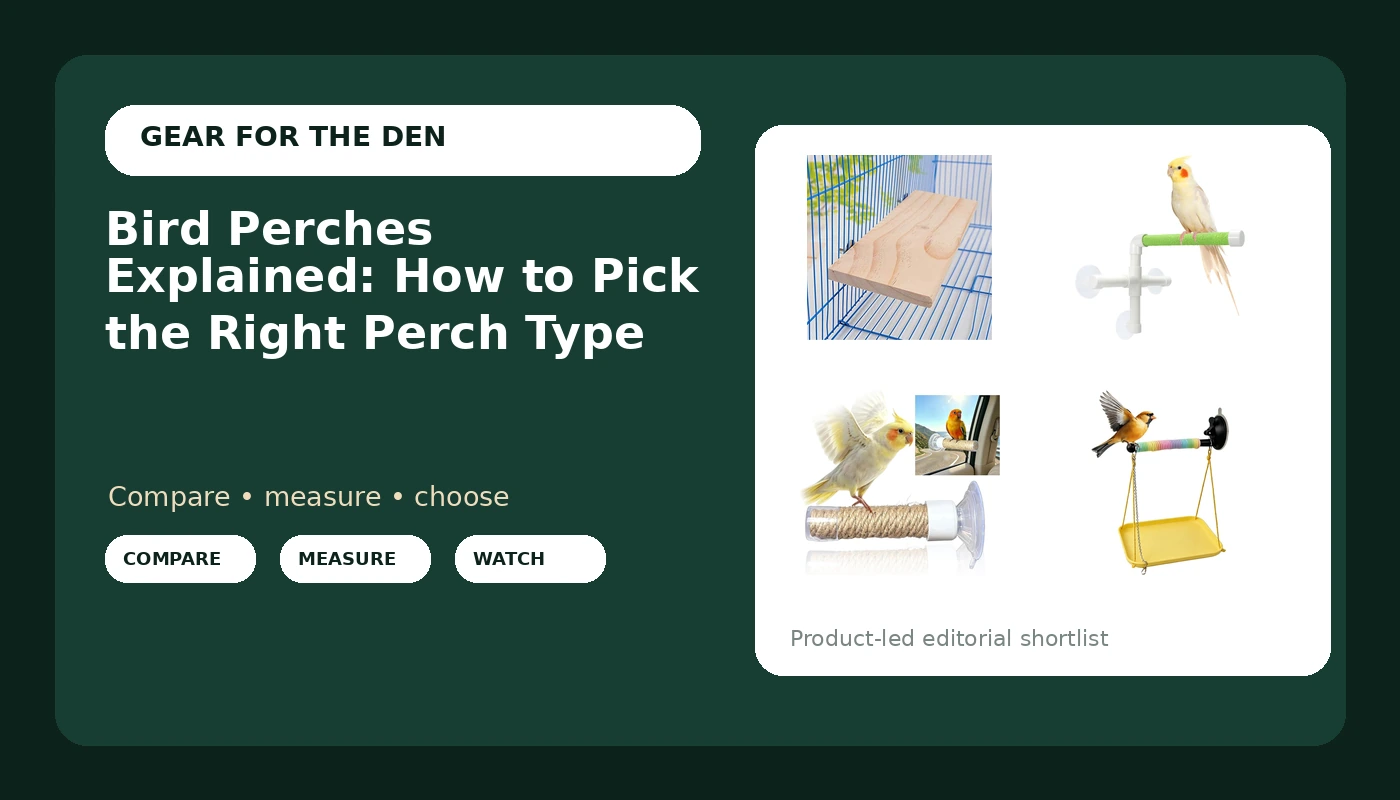
| Litewoo Parrot Bird Wood Perch Platform Large Stand Shelf for Budgie, 1PC | Main standing surface inside a small-parrot cage | Flat wood platform instead of a round dowel |
| Bird Portable Suction Cup Shower Perch Window Wall Standing Platform for Parrot Parakeet Conure Cockatiel African Grey (Random Color) | Shower and window time outside the cage | Portable platform that mounts to smooth surfaces; color is random |
| Window Perch for Birds Suction Cup Bird Perch of Car Travel for Cockatiel | Car rides and short trips | Compact suction cup perch named for cockatiels and travel |
| Suction Cup Bird Perch Stand, Parrot Perch with Anti-Fly Chain & Poop Tray | Window or wall perching where mess control matters | Listed with a poop tray and an anti-fly chain |
Main cage perch: Litewoo Parrot Bird Wood Perch Platform Large Stand Shelf for Budgie, 1PC
Inside the cage, a flat platform is the perch that gets used for eating, resting, and sleeping, and it is the one that should be easiest to clean. A platform spreads a bird's weight across the whole foot instead of along one narrow contact line, which is why keepers often pair a platform with round branches rather than using it to replace them. The trade-offs are real: wood is porous, so it needs scrubbing and thorough drying rather than a quick wipe, and a large platform takes up cage volume that a thin branch would not. Place it below the highest sleeping perch and away from the food cup so droppings land on neither the platform nor the food.
Out-of-cage platform: Bird Portable Suction Cup Shower Perch Window Wall Standing Platform for Parrot Parakeet Conure Cockatiel African Grey (Random Color)
Suction cup perches are not cage furniture. They belong on glass, tile, mirror, or another smooth, non-porous surface, and they earn their keep during shower time, window time, and supervised time in a room. Because the color is random, this one is a poor fit for anyone matching a room or a cage color scheme, and the honest trade-off is that holding power depends on the surface and on how carefully the cups are pressed on. Check the surface first, clean it, and treat the perch as a supervised accessory rather than a permanent sleeping spot.
Travel perch: Window Perch for Birds Suction Cup Bird Perch of Car Travel for Cockatiel
A suction cup perch sold for car travel raises the same question every travel perch does: where is the bird while the car is moving? A perch attached to a car window is useful when the car is parked, or when the bird is inside a carrier that is itself secured. Check carrier size before you plan around a window perch, because a perch that does not fit the carrier you already own is not travel gear. Used at a hotel window or a parked car, it does the same job as any other window perch, which is to give a cockatiel somewhere level to stand.
Mess-controlled perch: Suction Cup Bird Perch Stand, Parrot Perch with Anti-Fly Chain & Poop Tray
This is the option for anyone whose real complaint is the mess rather than the perch. A built-in tray catches droppings before they reach the sill or the wall, and a tray liner turns cleanup into swapping paper instead of scrubbing a surface. The anti-fly chain is part of the listed design and should be treated as a restraint that needs regular checking for wear, the same way you would inspect any tether. Neither feature replaces supervision. Mount the perch somewhere the tray can be reached easily, or you will stop emptying it and the cleanup advantage disappears.
Prices and availability may change. Product images, names, and retailer links are matched to verified listings. No current price, rating, stock status, or measured result is stated here without current evidence.
What bird perches actually need to do
Feet are the part of a bird's body that perch decisions affect most, and the two variables that matter are diameter and texture. A bird's toes should wrap most of the way around a perch without the tips meeting underneath. Too thin and the toes curl past a comfortable grip; too thick and the foot cannot close at all. That is why the dowel that ships with a cage rarely suits a bird long term, and why the ideal bird perches arrangement is a mix of diameters and surfaces rather than one perfect stick. Thin branches, medium branches, and one flat platform in the same cage cover far more ground than a matched pair of dowels.
Texture matters as much as size. Smooth, uniform dowels give the foot the same contact in the same place every day, and months of that can lead to pressure sores on the foot pad. Natural wood with slight variation, bark, and irregular branch thickness forces small adjustments in grip, which is the closest a cage gets to the branch-to-branch movement of a wild bird. Rope perches do something similar with a softer surface, though they fray and need inspection. The same logic applies to bird cage size and bar spacing, because a perch you cannot fit at a sensible height is not a useful perch.
Placement is the third variable and the one most often ignored. Perches sit at different heights, and cage height is what limits how much vertical choice a bird has. The bird that sleeps at the highest point needs a comfortable perch there, but the food and water stations should not sit directly beneath it. Droppings fall, and a perch above a food cup creates a hygiene fight you will not win. If the cage allows a swing mount from the ceiling, that is one more position the bird can choose on its own.
Cleanliness drives the rest. Wood is porous, so a wood perch needs periodic scrubbing and drying rather than a wipe. Suction cup perches sit outside the cage on glass or tile, where droppings land on whatever is below, which is where a tray or a tray liner earns its place. Getting correct bird perches means matching diameter, texture, and position to the bird in front of you, not to the colour of the cage.
Matching perch diameter, texture, and placement to your bird
No single number works, because bird feet come in a wide range of sizes and the right perch for a budgie is wrong for a grey. Use these steps as a checklist for any new perch, whether it is a wood platform, a natural branch, or a suction cup mount.
- Match perch diameter to the bird's grip. Small birds such as budgies and parakeets need thinner perches than a cockatiel or an African grey, and the test is whether the toes wrap most of the way around without overlapping.
- Vary texture across the cage. Pair one smooth platform with branches of two or three different thicknesses so the foot is not loaded the same way all day.
- Place the highest perch where the bird sleeps, and keep food and water out from under it. Check the cage height you actually have before adding a tall platform.
- Set the feeding station deliberately. Food cup size and position change how hard the bird has to work, and a perch set back from the cup raises foraging difficulty slightly, which helps a bored bird.
- Plan out-of-cage perching separately. Before buying, check the surface the suction cups will attach to, the carrier size if the bird travels in a carrier, and whether you need a tray or a tray liner underneath.
Practical guidance for cage, window, and travel perches
- Inspect wood perches weekly for cracks, splinters, and soft spots, and scrub and dry them properly instead of wiping the surface.
- Before mounting anything with suction cups, clean the glass or tile and press the cups on firmly. A cup that will not hold on a textured or dusty surface is a surface problem, not a perch problem.
- Treat any suction cup perch as supervised-only when it is outside the cage, and take it down before you drive rather than leaving a bird perched on a window while the car is moving.
- Watch where droppings land, not just where the perch is. Slide a tray or a tray liner under a window perch so the wall or sill is not the thing you end up cleaning.
- Reassess as the bird grows and as your routine changes. A perch that fit a young bird may become too thin, and a platform can end up in a spot with too much foot traffic.
Which option should you choose?
Choose the Litewoo Parrot Bird Wood Perch Platform Large Stand Shelf for Budgie, 1PC when your priority is a stable, flat standing surface for a budgie or similar small parrot inside the cage. Choose the Bird Portable Suction Cup Shower Perch Window Wall Standing Platform for Parrot Parakeet Conure Cockatiel African Grey (Random Color) when you want one platform that moves between the shower, a window, and a wall during supervised time out of the cage. Choose the Window Perch for Birds Suction Cup Bird Perch of Car Travel for Cockatiel when you need a compact suction cup perch for a cockatiel and short trips. Choose the Suction Cup Bird Perch Stand, Parrot Perch with Anti-Fly Chain & Poop Tray when mess control under a window or wall perch is the deciding factor.
One caveat applies to all four. These are product listings, not test results. Suction cup holding power depends on the surface, the temperature, and how well the cups are pressed on, and none of that can be verified from a product name. Compare the listing photos and dimensions against your own cage and bird before ordering, and never rely on a suction cup perch as the only resting place for a bird that cannot be supervised.
The bottom line
A good perch setup is a set, not a single purchase. Inside the cage, a flat wood platform plus a couple of branches of different thickness gives your bird options for its feet and keeps any one spot from taking all the pressure. Outside the cage, a suction cup perch turns a window, a shower wall, or a hotel room into usable space, as long as you supervise the bird and clean up after it. Match diameter and texture to the bird in front of you, keep droppings away from food and water, and replace anything cracked, unstable, or worn. That routine matters more than which of these four you start with.