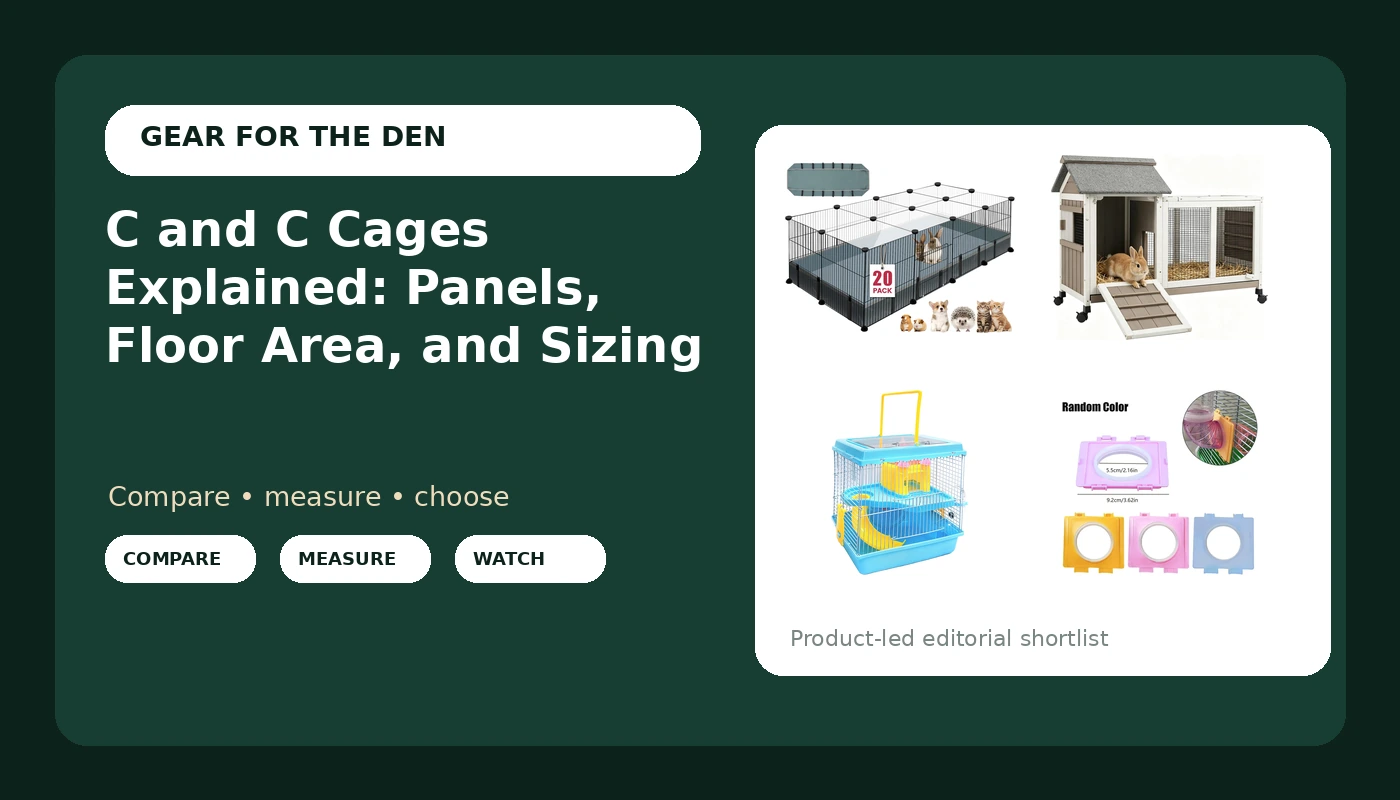
Small-pet owners run into the same problem from two directions. Buy a finished cage and it is often the wrong shape, too small once the animal is full grown, or awkward to clean around. Build the enclosure yourself and it fits the corner you actually have, but you have to source every part. A c and c cages setup sits in the second camp. The name comes from the two pieces of the original design, the wire grid panels that form the walls and the shallow base that holds the bedding, and the appeal is that you set the footprint, the height, and how many hideouts and toys fit inside. This guide explains what the term covers, which numbers to write down before you buy anything, and four available enclosures that fill the roles a small-pet setup usually needs.
Quick answer
A c and c cages enclosure is a modular pen made from wire grid panels joined at the edges, normally standing inside or on top of a solid, shallow base that keeps loose bedding contained. There is no single correct size, because floor area, bar spacing, and wall height all have to be matched to the species, the number of animals, and how much time they spend outside the pen. If you would rather buy panels than source them separately, a panel playpen is the closest off-the-shelf equivalent. A two-story hutch covers multi-level or outdoor housing, a small portable carrier covers trips and cleaning days, and a connector set supplies the joining hardware when you already own panels or tubes.
Four useful options
| Model | Best fit | What stands out |
|---|---|---|
| VISCOO 20 Panels Small Animal Playpen, 48" x 24" x 16" Rabbit Cage | Building a modular floor plan | 20 panels that connect into a freestanding pen with a stated 48 by 24 by 16 inch footprint |
| Gowoodhut Outdoor Rabbit Hutch 2-Story Indoor Bunny Cage with Run | Multi-level or outdoor housing | Two stacked stories plus an attached run |
| Tfwadmx 2-Tier Portable Dwarf Small Hamster Carrier Travel Cage,Blue | Trips, moves, and cleaning days | Two-tier layout in a portable carrier sized for dwarf hamsters |
| 2 Set Small Animals Hamster Tunnel Cage Cover with Ventilation Holes External Pipe Interface Fitting Connection Board Tube Connector Stretch Resistant Inner Diameter 2.17 inch | Connecting tunnels and panels | Two sets of covers and connectors with a stated 2.17 inch inner diameter |
The modular base: VISCOO 20 Panels Small Animal Playpen, 48" x 24" x 16" Rabbit Cage
A panel pen and a traditional grid build share the same logic: a low wall around a defined floor area, with bedding held inside a base underneath. The advantage of a panel pen is that the connectors arrive matched to the panels, so you are not hunting for clips that fit. What it does not give you is a built-in tub. If your animal kicks bedding, plan on a mat or a shallow tray under the pen, and check the listing for the spacing between the panel bars so you know whether a nose or a leg can pass through. A pen that is open on top is also a climbing invitation for some animals, so consider whether you need a roof section before you commit to the shape.
The multi-level option: Gowoodhut Outdoor Rabbit Hutch 2-Story Indoor Bunny Cage with Run
A ramp and an upper floor are only worth counting if the animal will use them. An older rabbit, or one that is not confident on a slope, may spend all of its time on the lower level, so treat the second story as a bonus rather than as part of your floor area calculation. The run is the more useful half of the design for most owners, because it adds length at ground level where the animal actually moves. Placement also does more work than any accessory: outdoor hutches need shade in summer, protection from wind and rain, and a surface underneath that drains. An indoor hutch needs the same level floor and a spot away from radiators and draughts.
The travel tier: Tfwadmx 2-Tier Portable Dwarf Small Hamster Carrier Travel Cage,Blue
Carriers get judged on the wrong things. A two-tier format looks generous, but a tiered interior creates a drop, and a small animal that falls off a ledge in a moving car is at real risk. For journeys of any length, the practical checklist is a hideout the animal can retreat into, bedding that keeps it warm without being dusty, and a water source that will not soak everything. Keep the carrier small enough that the animal feels enclosed but large enough that it can turn around and lie flat. If the trip is longer than a couple of hours, plan a stop where you can offer food and check the animal rather than assuming it is fine because it is quiet.
The connector kit: 2 Set Small Animals Hamster Tunnel Cage Cover with Ventilation Holes External Pipe Interface Fitting Connection Board Tube Connector Stretch Resistant Inner Diameter 2.17 inch
Tunnel diameter is the measurement people get wrong most often. A passage that is too narrow becomes a pinch point for a grown animal, and one that is too wide will not grip the connector, so the joint pops apart the first time the animal pushes through it. Measure the inside of the tube, not the outside, and compare that number against the stated inner diameter. Ventilation holes are the other detail worth checking, because a sealed tunnel is a stuffy tunnel, and a run of connected tubes with no airflow is not somewhere an animal should spend much time.
Prices and availability may change. Product images, names, and retailer links are matched to verified listings. No current price, rating, stock status, or measured result is stated here without current evidence.
What c and c cages actually are
The phrase describes a method, not a brand. The original build used wire storage grids for walls and a sheet of corrugated plastic cut and folded into a tray for the base, with the panels held to the tray by clips or ties. Everything about that recipe is adjustable. Panels can be stacked two high for a taller wall, a lid can be added for cats or climbing animals, and the tray can be cut to whatever rectangle fits the room. The reason the approach caught on is cost per square foot of floor area. A commercial cage with the same footprint usually costs more, and it locks you into one shape.
Species changes the answer more than the price does. Guinea pigs are the classic use case, because they are heavy-bodied, they do not climb, and they need a long uninterrupted run of floor area rather than height. Rabbits need more room again, and many will clear a single panel, so wall height goes up. Hamsters are the opposite problem: they burrow, so depth of bedding matters more than length of wall. Rats climb, so a lid stops being optional. Guides that promise c and c cages explained in a single page usually skip the two decisions that matter most, which are how much floor area you can genuinely give up and how you intend to contain the bedding.
Sizing, spacing, and accessories that matter
There is no universal template for ideal c and c cages, because the right footprint depends on species, group size, and how many hours a day the animal spends outside the pen. What does carry across species is a short list of numbers. Floor area comes first, measured as length times width of the usable interior rather than the outside of the frame. Bar spacing comes second, because gaps that a young animal can squeeze through or catch a limb in are the most common failure in DIY builds. Then come the accessories, which are only as good as their fit: a hideout should be large enough to turn around in, a bottle should hold enough that you are not refilling it twice a day, and a hay rack should keep hay off the floor where it will be soiled.
The measurements that separate correct c and c cages from an improvised pen are boring ones, and that is the point. Write them down before you buy anything, then check each product against your list rather than against the photographs.
- Measure the space you can actually commit, in inches, and subtract the clearance you need to walk past the enclosure and open it.
- Match bar spacing to the smallest animal that will live in the pen, including any young that arrive later.
- Decide how bedding will be contained, whether that is a tray, a mat, or a shallow base, and budget for it in the same purchase.
- Place the hideout, the water bottle, and the hay rack before adding toys, so the essentials get the best positions.
- Watch the finished enclosure for a week and adjust the layout once you see which corners the animal uses and which it avoids.
Setting up and living with the enclosure
- Site the pen on a hard, level floor, away from radiators, direct sun, and draughty doorways.
- Choose bedding with a low dust content, and shake a handful before you fill a tray to see how much dust it releases.
- Match bottle capacity to the animal, and check the spout twice a day in warm weather when consumption rises.
- Keep the hay rack above the bedding line so hay stays dry and within reach.
- Rinse connectors, tube sections, and tray corners during every full clean, since these are the spots where residue collects.
Which option should you choose?
Choose the VISCOO 20 Panels Small Animal Playpen, 48" x 24" x 16" Rabbit Cage when you want a modular floor plan you can reshape and you have a mat or tray to hold the bedding. Choose the Gowoodhut Outdoor Rabbit Hutch 2-Story Indoor Bunny Cage with Run when you need multi-level housing with a ground-level run and you have a patio, garage, or spare room to place it in. Choose the Tfwadmx 2-Tier Portable Dwarf Small Hamster Carrier Travel Cage,Blue when you need a small carrier for vet trips, moves, or cleaning days. Choose the 2 Set Small Animals Hamster Tunnel Cage Cover with Ventilation Holes External Pipe Interface Fitting Connection Board Tube Connector Stretch Resistant Inner Diameter 2.17 inch when you already own panels or tunnels and need the joining hardware to match a 2.17 inch tube.
What none of these listings can do is tell you whether the enclosure fits your room, your animal, or your cleaning routine. The sizes quoted above come from the product names and listing descriptors rather than from a build in a test room, and a dimension that works for a dwarf hamster will not work for a rabbit. Measure your space, note your species, and treat every product page as the second opinion rather than the first.
The bottom line
A c and c cages setup works because it separates two questions that a finished cage forces you to answer at once: how big the enclosure is, and what shape it has to be. Panels let you change the second without replacing the first, which is why the approach persists even though it takes an afternoon to assemble. Start with floor area and bar spacing, add a base that contains bedding, and only then decide between a panel pen, a multi-level hutch, a travel carrier, and a connector set. Buy the pieces that match the measurements you wrote down, keep the receipts for anything that arrives the wrong size, and expect to adjust the layout once you see how the animal actually uses the space.