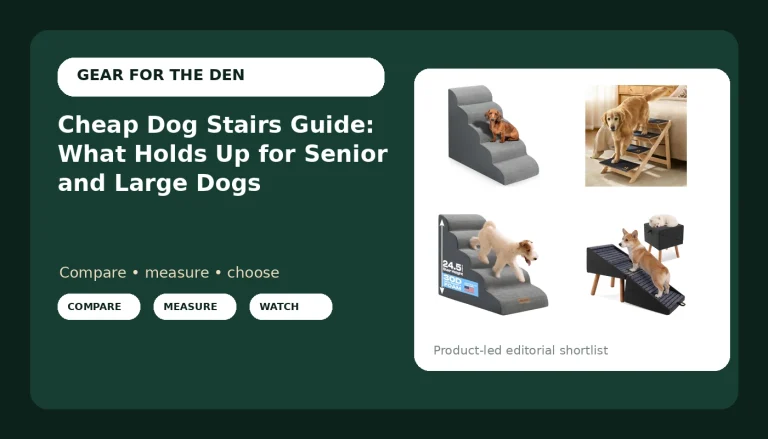
The car ramp for dogs vs dog stairs for senior dogs question rarely gets a clean answer, because both products solve the same problem in different ways. A ramp trades floor space for a shallower climb. A set of stairs trades incline for a smaller footprint. If your dog is a senior with stiff hips, or a large breed you can no longer lift onto the couch, the decision narrows to three numbers: bed height, ramp angle, and weight capacity.
For most senior dogs in this group, the Veehoo Dog Ramp for Bed Couch is the most flexible pick, because its 17 to 23 inch span covers a couch and most beds, and it folds flat when you need the floor back.
The four products below all attack the same problem: getting a dog onto furniture without a jump. Two are built around a ramp surface and two around steps, and the price column links to the live listing, since prices on Amazon move faster than any published guide can track.
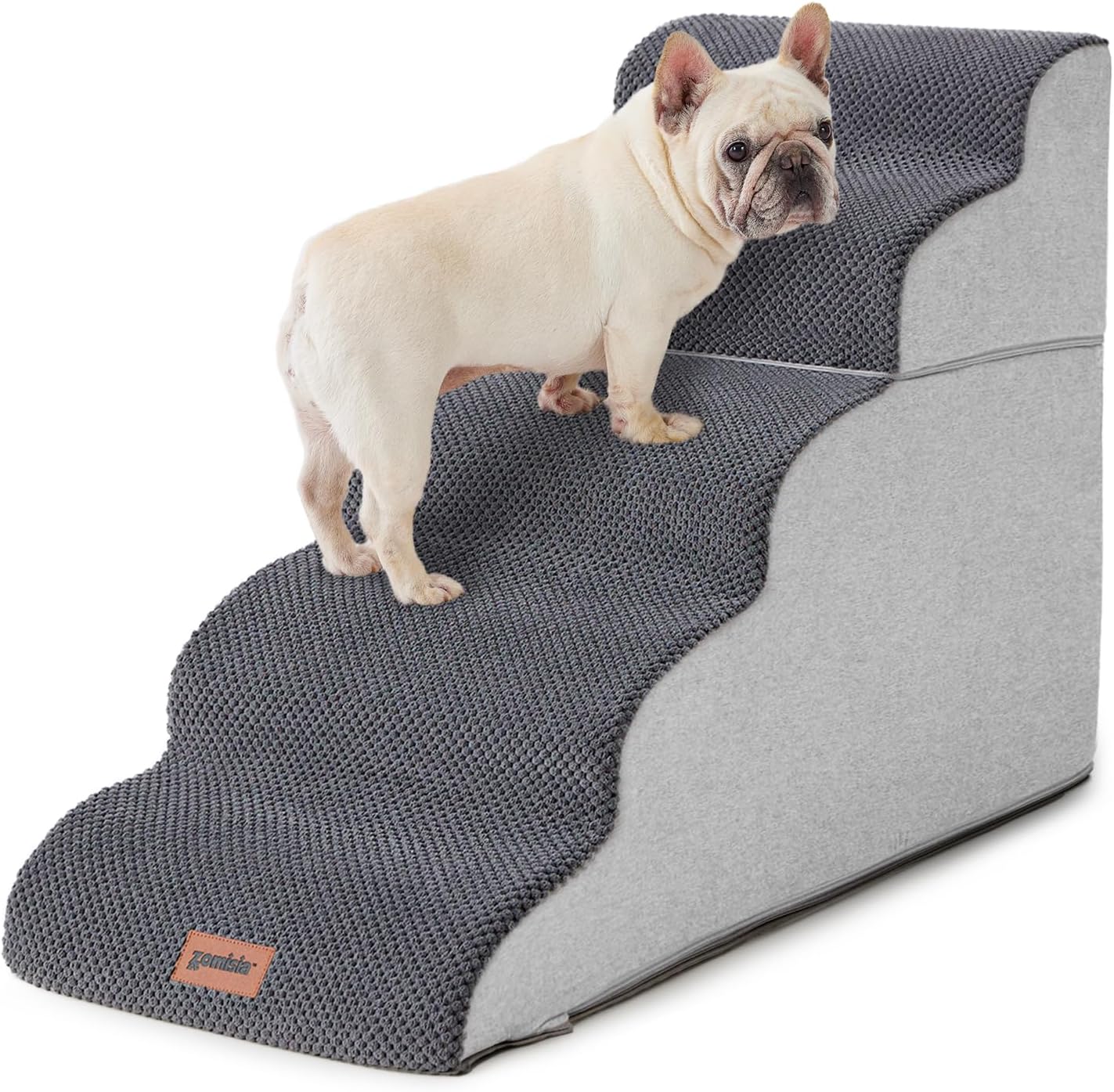
ZOMISIA Dog Stairs Ramp for High Beds Up to 25", 5 Step Pet Stairs Grey
Tallest reach here, so it fits high beds and deep couches the shorter units cannot touch
Five separate footfalls per trip, which is a lot of repetition for a stiff dog
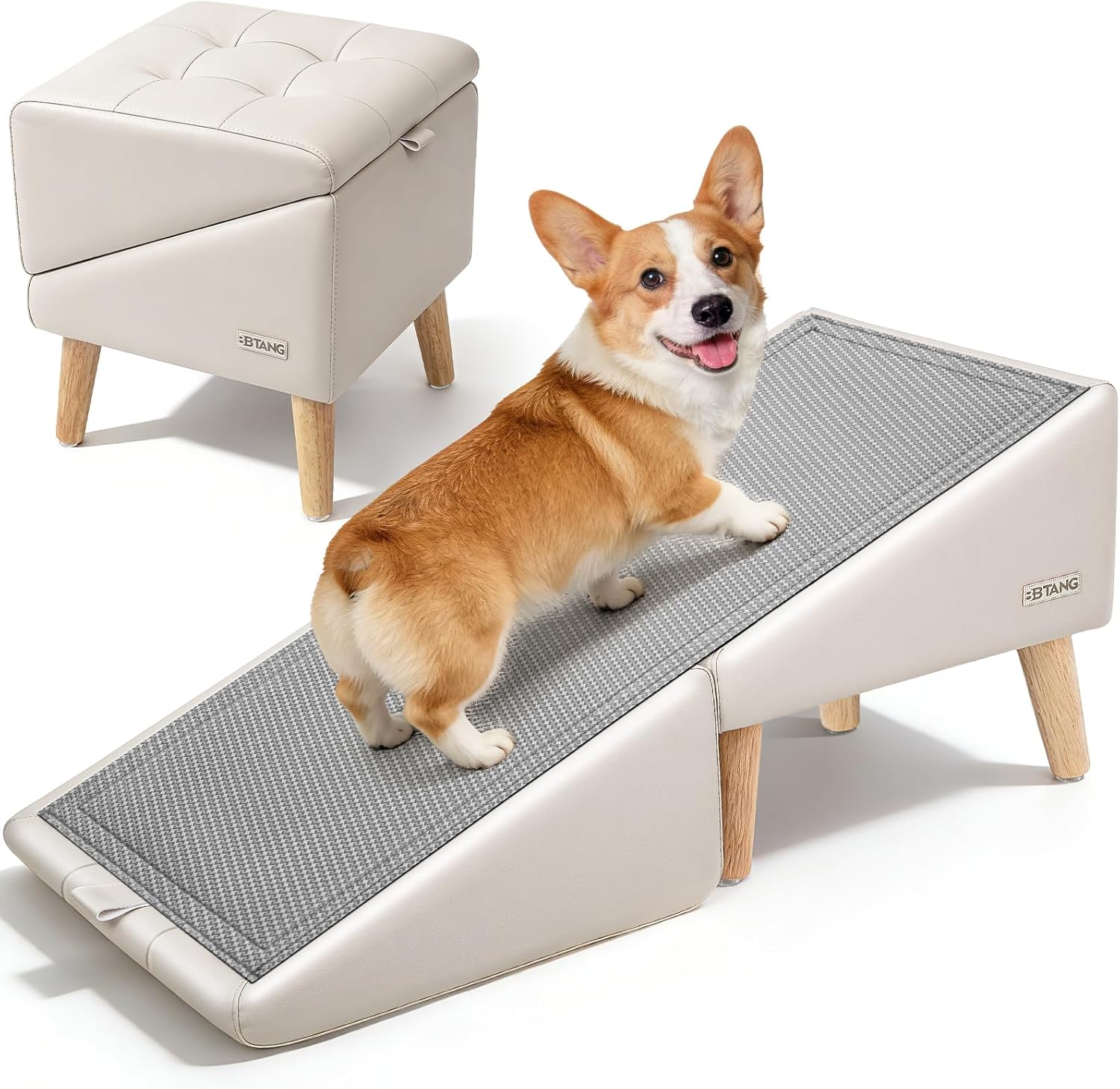
Dog Stairs for Small Dogs 16" H – Upgraded Non-Slip Dog Ramp for Couch
Lowest rise and a gentle continuous surface, the easiest shape for a small senior dog to learn
The 16 inch ceiling rules out beds, and the small dog sizing rules out large breeds
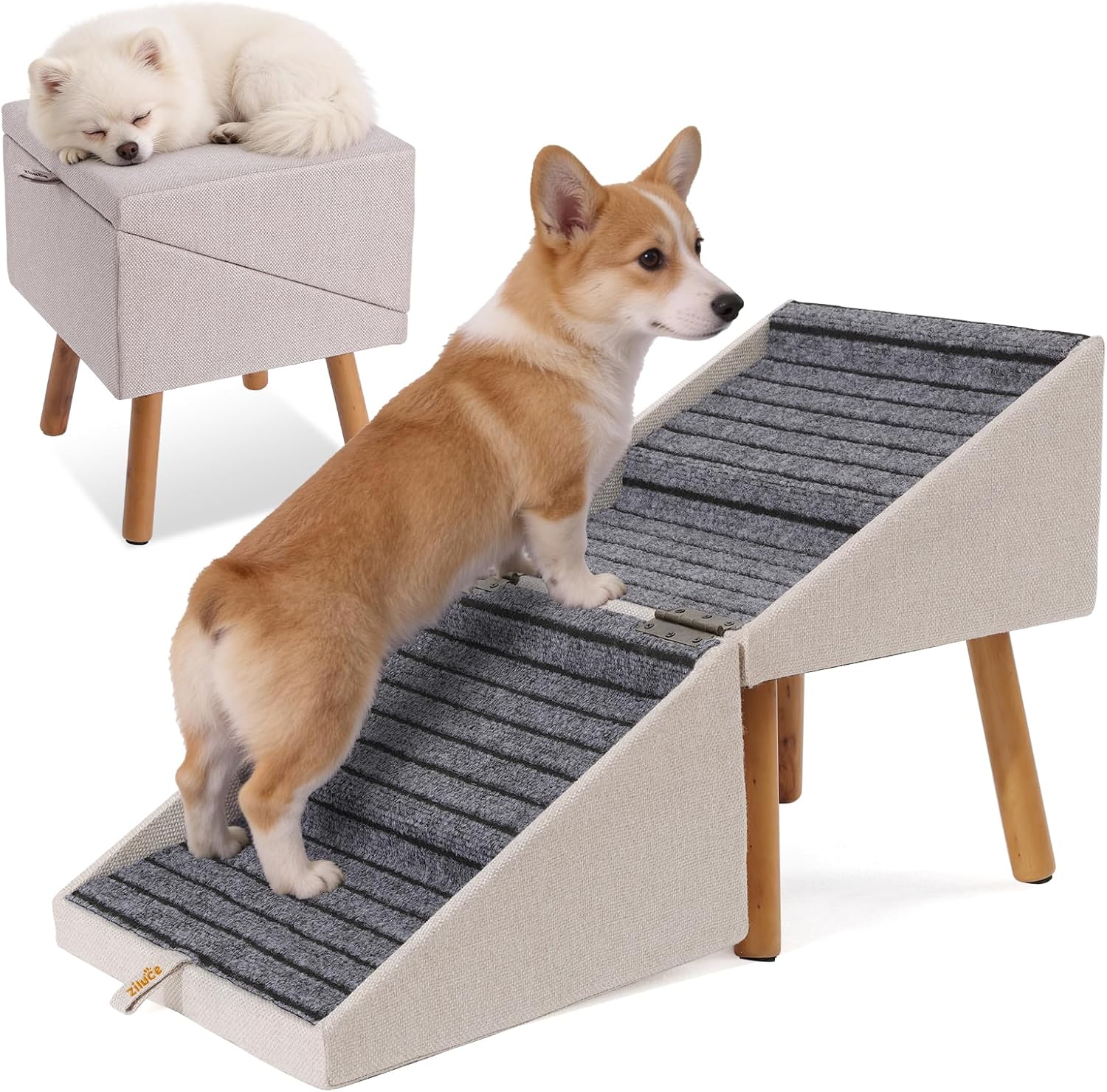
Dog Stairs for Small Dogs, 2-in-1 Dog Safety Ramp and Ottoman, 17.13" H
Doubles as an ottoman, so it earns its floor space instead of being stored between uses
Small dog footprint and a 17.13 inch height cap limit it to couches and low beds
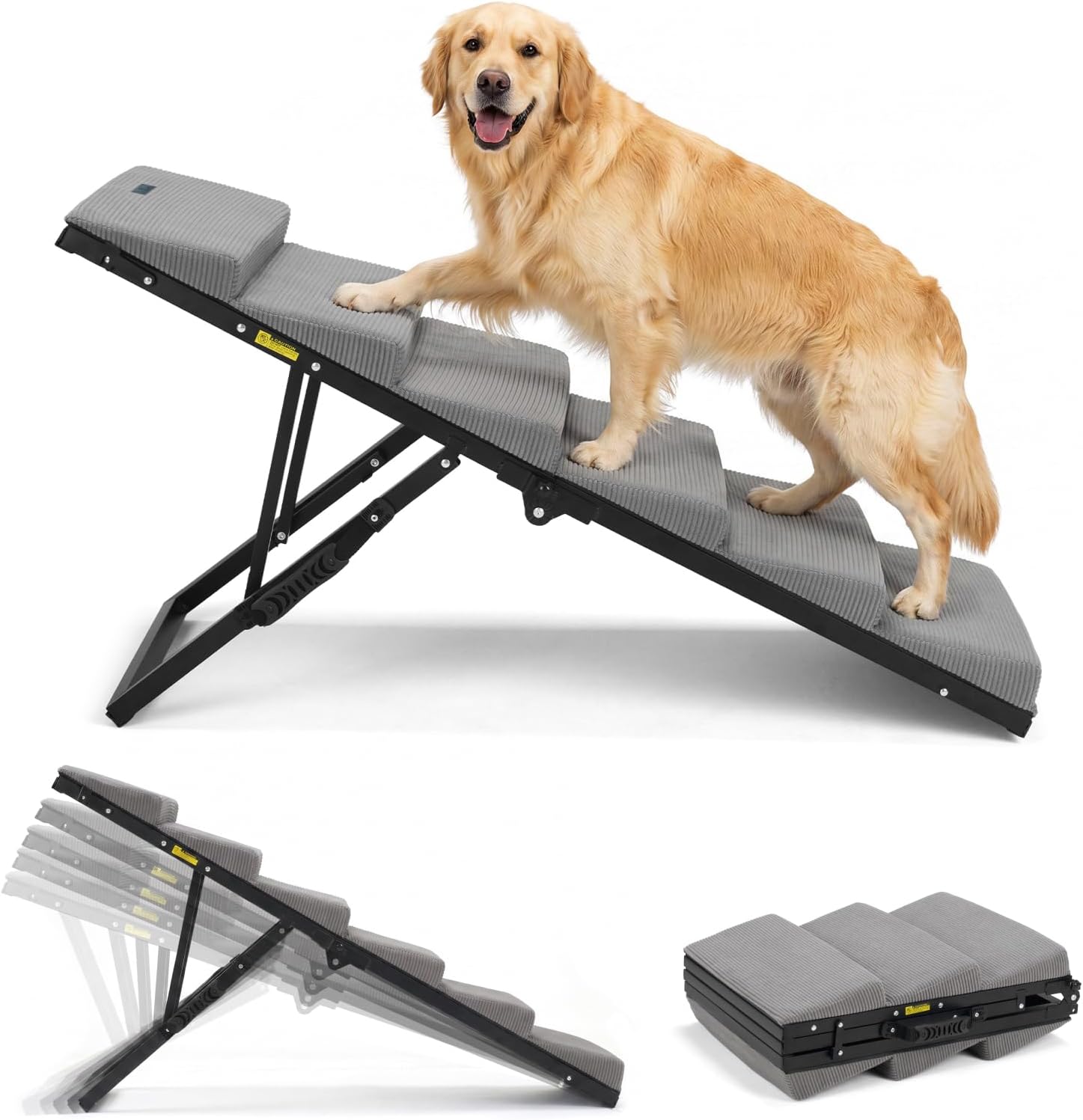
Veehoo Dog Ramp for Bed Couch, Foldable Pet Stairs for Large Dogs 17"-23" H
Adjustable 17 to 23 inch span, a foldable frame, and a rating aimed at large dogs
Hinges and folding hardware are extra parts to keep clean and tight
Prices and availability may change.
How the car ramp for dogs vs dog stairs for senior dogs decision works
Four variables do almost all of the work here.
Bed height. Every product is rated to a specific rise, and a mismatch is the most common reason a purchase fails. The ZOMISIA unit is rated up to 25 inches, which covers high beds. Two of the small dog designs top out at 16 inches and 17.13 inches, which is couch territory. The Veehoo spans 17 to 23 inches and adjusts inside that band.
Ramp angle. A ramp spreads the same rise across a longer run, which lowers the angle your dog climbs. That is the whole advantage for joint mobility. The trade-off is floor space, and a ramp forced to be steep to fit a tight room loses most of that advantage.
Weight capacity. A product marketed for small dogs is built around small dog loads. If you have a lab or a shepherd, the large dog option in this group is the one rated for it.
Non slip backing. A ramp or stair set that slides on hardwood is worse than no help at all, because a scrambling dog can hurt itself on the way down.
Lift capacity. This is the number owners underestimate. Lift capacity is not printed on a box, it is a limit on you. A 60 pound dog lifted twice a day, every day, for a year is an enormous amount of work, and a senior dog who needs help onto the couch in October will need more help by spring. The point of buying either product is to remove that lift, not to reduce it slightly.
Read enough forum threads and you will see the dog stairs for senior dogs vs car ramp for dogs argument framed as a matter of taste. It is not. It is a geometry problem with a behavioral component, and the behavior is usually a fear of the descent.
The four listings diverge sharply on two of these variables. Reach runs from 16 inches to 25 inches, a nine inch spread that decides whether a product fits your furniture at all. Weight capacity splits the group cleanly into small dog designs and one large dog design, with no overlap in the middle.
How this comparison was built
This guide works from the manufacturer specifications on each listing: stated height range, step count, the size of dog each product targets, and the surface it describes. Nothing here gets credit for a claim that is not in its own listing.
That means some things are deliberately absent from the table above. There are no lab measured slip numbers, because the listings do not publish any. There is no foam density figure for the step units, because none is given. And there is no single winner for every household, because a 16 inch couch and a 25 inch bed are not the same job.
The difference between car ramp for dogs and dog stairs for senior dogs shows up first on the way down, not the way up. Most dogs will climb whatever surface you put in front of them. Descending is where a steep set of steps turns into a controlled fall, and it is the half of the trip owners forget to watch.
The ramp-first designs: low profile and foldable
The Dog Stairs for Small Dogs 16" H, Upgraded Non-Slip Dog Ramp for Couch is the lowest rise in the group, and despite the word stairs in its name it is a ramp first. The 16 inch ceiling is the number to respect. It will not reach a tall bed, and stacking it on a cushion is not a fix, because a ramp on a soft base rocks under a moving dog.
For a small senior dog stepping up to a couch, a low, gentle surface is exactly the right shape of help. For a 70 pound shepherd it is the wrong product entirely, and the listing says as much in its own title.
The Veehoo Dog Ramp for Bed Couch is the other ramp-first option and the one built for size. The adjustable 17 to 23 inch span covers a couch at the low end and a standard bed at the high end, and the foldable frame is what lets it live in a small room. Folding is not a free win. A folding ramp has hinge points, and hinge points are where nails catch if the surface is not tight. If the ramp stays set up in one spot, that is a non-issue. If you fold it twice a day, check the hinge covers before you commit.
Surface material matters more on a ramp than on steps, because a dog's nails contact the same continuous plane the whole way up. A ribbed or carpeted surface gives nails something to bite. A smooth molded surface is easier to wipe down but offers less purchase, and a senior dog with weak rear legs will feel that difference on the descent. Neither ramp here publishes a foam density figure for its surface, so judge by the texture description and the photos rather than a number.
Both ramps share one requirement: the base has to be as stable as the surface. A ramp that walks across the floor while your dog is on it teaches the dog to avoid it, and that lesson is hard to unlearn.
The step-first designs: five steps and a two-in-one
The ZOMISIA Dog Stairs Ramp for High Beds Up to 25", 5 Step Pet Stairs Grey is the tallest option here, and the five step layout is why. Short steps are easier than one long incline for a dog with decent joint mobility and poor confidence, because each step is a small, predictable commitment. The cost is repetition. Five footfalls up and five down is a lot of work for hips that already hurt. This is the pick when the bed is genuinely high and the dog still moves well.
The 2-in-1 Dog Safety Ramp and Ottoman at 17.13 inches is the cleverest listing of the four, because it does a second job. Between uses it is an ottoman, which means it never has to be stored. That matters in a living room where a dedicated dog ramp would be an eyesore and a tripping hazard. The catch is in the name. The 17.13 inch height puts it in couch and low bed territory, and the ottoman footprint is sized for a small dog's stride rather than a large breed's.
Placement decides more of the outcome than the product does. A step unit set at an angle to the bed, or half tucked under the frame, gives a dog an unpredictable first step. Square it to the furniture, leave a landing zone at the top, and give the dog a few days to build the habit with treats on the second step. A ramp needs the same treatment plus a longer runway, which is the real cost of the ramp shape in a small room.
If you are choosing between these two, the question is whether your dog needs fewer, taller steps or more, shorter ones. Confidence favors short steps. Stiff joints favor fewer rises, which usually points back to a ramp.
What is non-negotiable: non slip backing and weight capacity
Two specifications are worth refusing to compromise on.
Non slip backing is the first. Look for a listing that describes grip in concrete terms rather than promising it. Then check the weight of the unit against your floor. A light ramp on smooth hardwood is a sled, and the dog pays for that, not the manufacturer.
Weight capacity is the second. Read the size of dog the product is aimed at and believe it. A step unit sized for small dogs will hold a small dog, and the height rating on that same unit assumes a small dog's stride length. Pairing a large breed with a small dog product is the most common mistake in this category, and it usually ends with the product returned and the dog still on the floor.
One more refusal: do not buy a product rated for a dog smaller than yours and plan to supervise. Supervision does not change a load rating. A step that flexes under a large dog is a step that fails eventually, and the failure happens with the dog on it.
What the specs say about ramp angle and bed height
Ramp angle is set by two numbers: the height the product reaches and the length of its run. A ramp that climbs 23 inches over a short run is steeper than the same ramp stretched out, which is why an adjustable design matters. You can trade floor space for a gentler angle in a way a fixed five step unit cannot.
Bed height is the other half of the same equation. Measure your furniture before you order, and measure the tallest surface your dog uses, not the one they use most. A ramp rated to 17 inches that meets a 22 inch mattress leaves a five inch jump at the top, and a five inch jump is still a jump.
Height ratings also assume a level floor and furniture that does not move. A bed with a soft, compressible edge is effectively shorter than its frame, and a couch sitting on a rug is a little taller than the same couch on tile. Measure to the surface your dog's feet actually leave, not to the top of the headboard.
Put those pieces together and you have the whole calculation: reach the surface, keep the angle shallow, and keep the base planted. That is the entire car ramp for dogs vs dog stairs for senior dogs decision in one line.
Should you buy a ramp or stairs first?
If your dog still moves well and the furniture is tall, stairs are the easier sell. Five short steps ask less of a nervous dog than one long incline, and a step unit is smaller and easier to store.
If your dog is stiff, heavy, or recovering from a joint issue, start with a ramp. A shallow ramp angle and a wide, stable surface give a dog a place to plant all four feet at once, which is what hip support actually means in practice. A step unit can offer the same thing through depth, but only if each step is wide enough for the whole dog, and that is rarely true of small dog designs.
The tiebreaker is the descent test. Watch your dog come down a set of stairs before you spend anything. If they hesitate at the top, look down, and take the steps one at a time, a ramp is the safer shape of help. If you are still weighing whether to buy a car ramp for dogs or dog stairs for senior dogs, that test answers the question faster than any spec sheet.
What I'm watching next
Adjustable height ranges are the feature to watch in this category. A ramp that fits one couch is a one room purchase, and a ramp that spans 17 to 23 inches moves between rooms and survives a furniture upgrade.
The other thing worth tracking is whether step units start publishing foam density. That number would tell a buyer far more about hip support and long term compression than the current marketing language does, and it would make the comparison between a ramp and a five step unit a genuinely fair fight.
Until then, buy for the surface your dog actually uses, keep the angle shallow, and make sure the thing does not move. Everything else in this category is decoration.