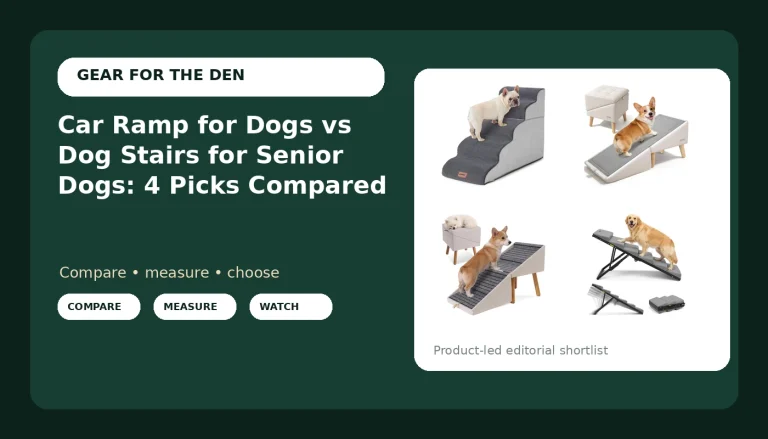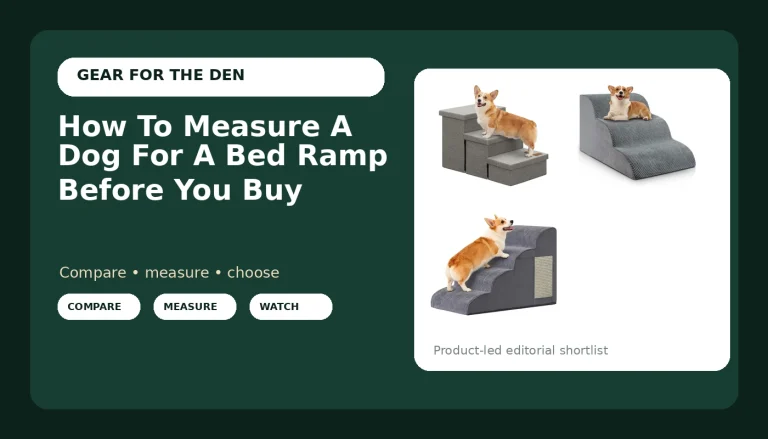
Few gear debates split a house of dog people faster than the dog bed ramp vs non slip dog mat question. One is equipment that changes how your dog gets onto the bed or the couch. The other is a flat pad that changes how safely they stand once they are up there. If your senior dog has started pausing at the foot of the bed, or if a big dog slides on hardwood every time they shift weight, you are probably weighing those two purchases right now. This comparison covers four options from the current lineup, explains the difference between dog bed ramp and non slip dog mat as categories rather than as single products, and helps you spend once instead of buying your way through three wrong answers.
For most senior dogs, buy in a specific order. Choose a ramp first if your dog still wants to be on the bed and cannot make the jump. Choose a mat first if the problem is slipping rather than climbing. If your dog has both problems, the ramp solves the height and the mat solves the landing, and buying them a month apart tells you which one is actually earning its place.
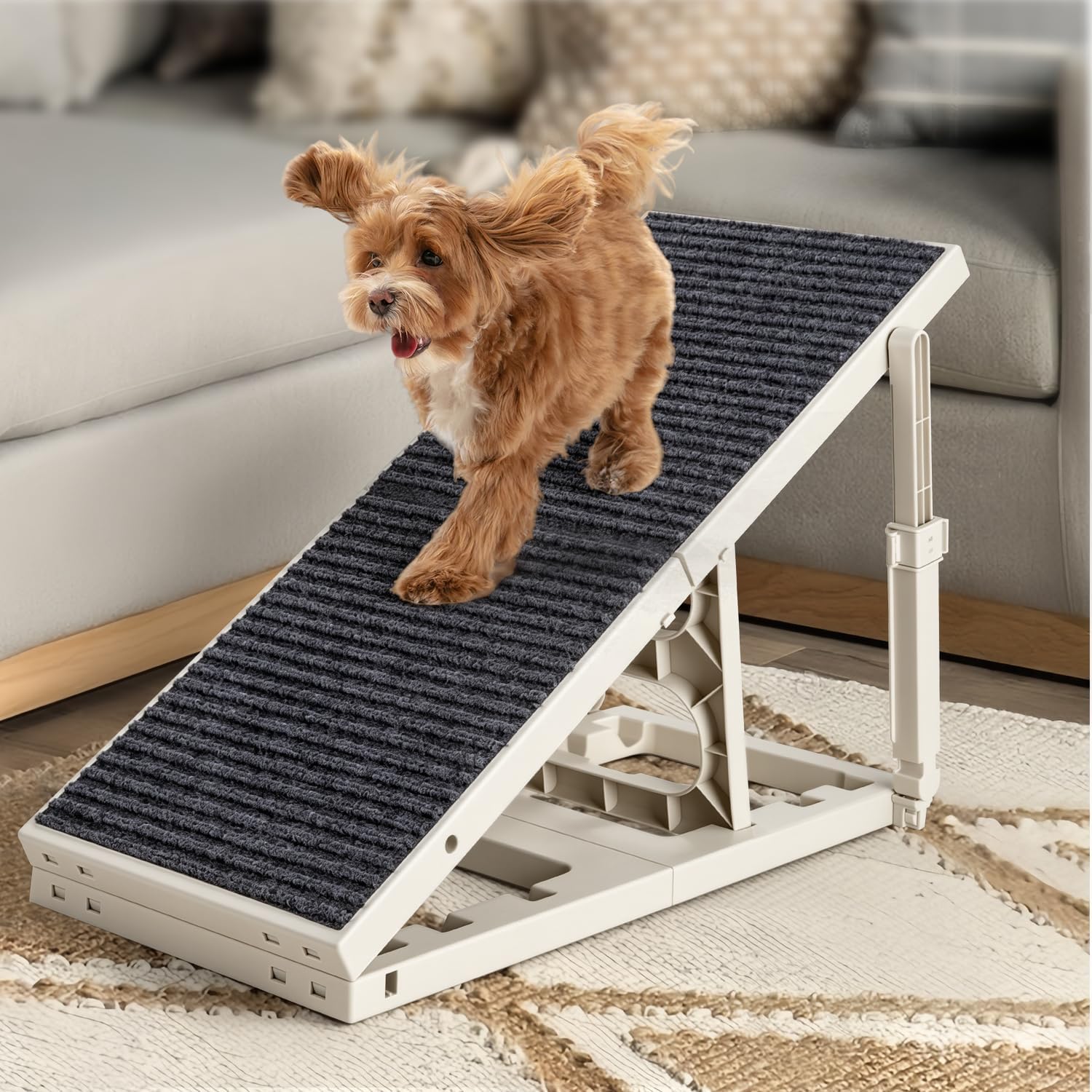
Pawzone Dog Ramp for Bed Couch
Adjusts through three heights from 14 to 18 inches, folds flat, and replaces the jump with a walking surface
Rated at 30 lbs of weight capacity, so it is not a large breed solution despite the senior dog framing
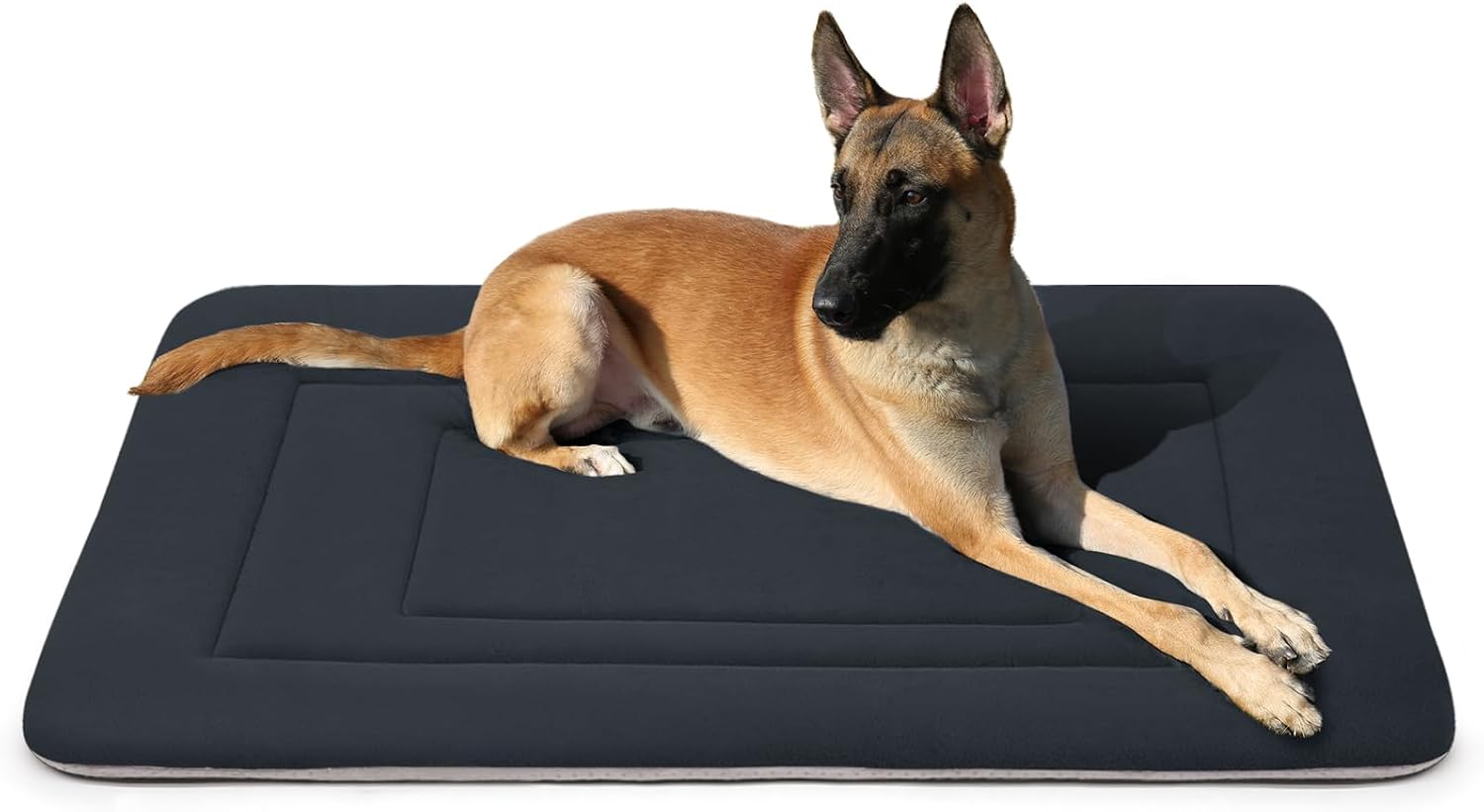
JoicyCo Dog Crate Bed Pad Mat, 42 in
A 42 inch pad with a non slip bottom and a washable build, sized for a large dog in a crate or kennel
It is a crate pad rather than an orthopedic bed, so do not expect deep hip support from a thin build
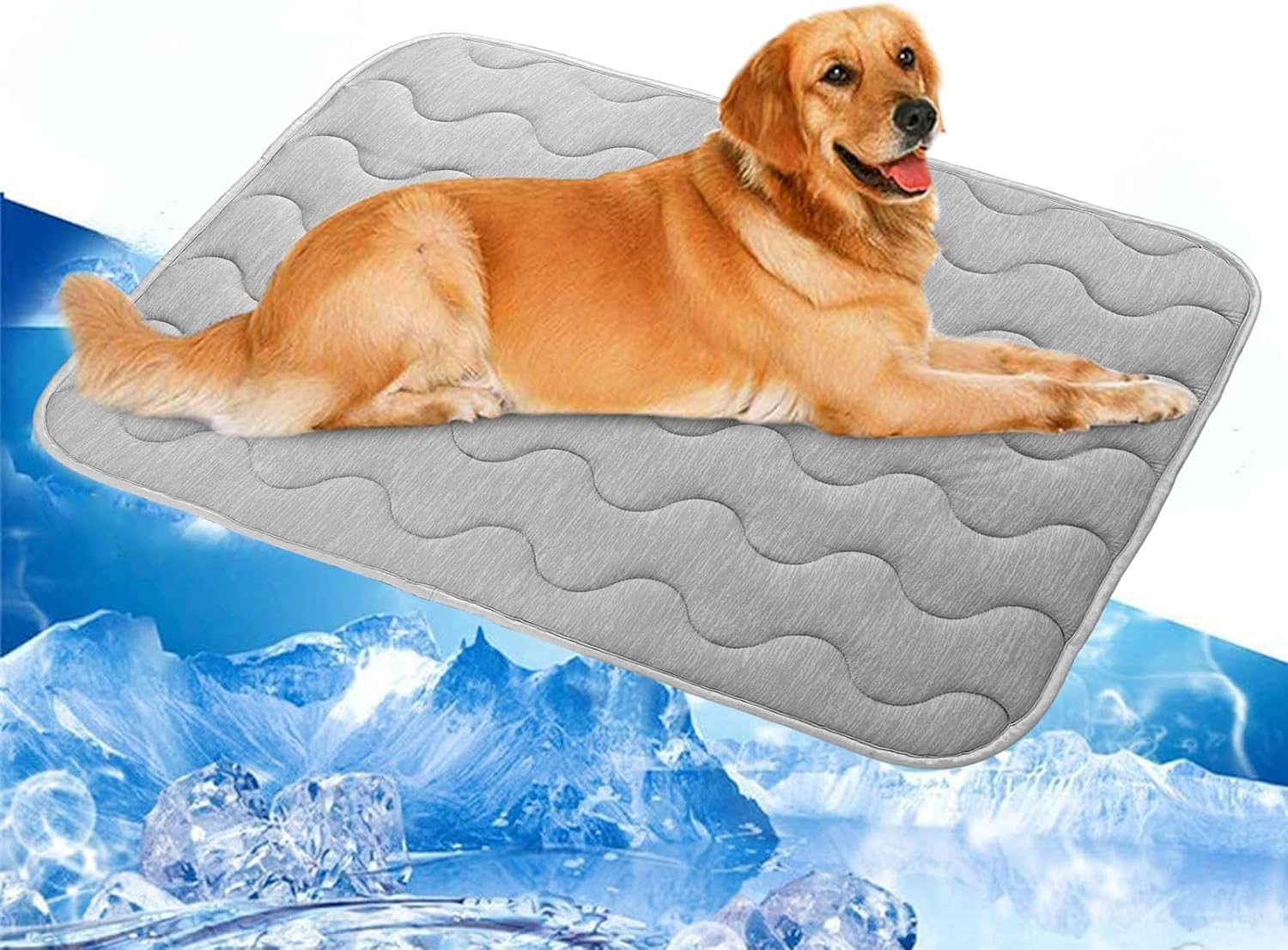
Nacaro Extra Large Dog Cooling Mat
A 39.4 by 27.6 inch footprint with a Q-MAX rating above 0.45, washable and portable for kennel, car, or tile
Cooling is a seasonal comfort job, and it adds neither traction nor lift
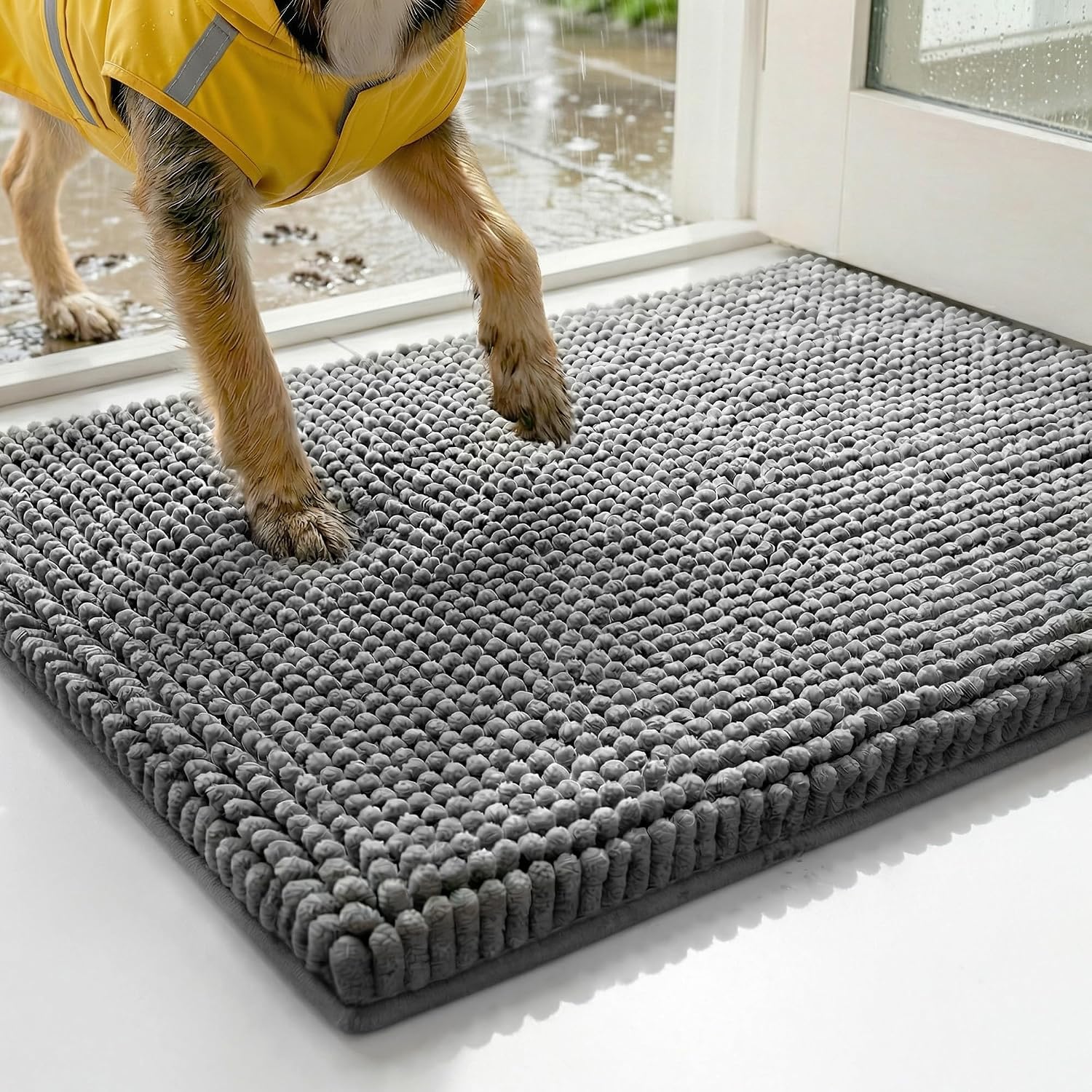
Deconovo Absorbent Chenille Dog Mat
Chenille pile traps mud and water at the door, and the TPR backing keeps it from skating on slick floors
It is a mud mat, not a sleeping surface, and it is small
Prices and availability may change.
The dog bed ramp vs non slip dog mat decision in one line
A ramp is a mobility device. A mat is a surface. That distinction is the whole comparison, and every other detail follows from it. A ramp changes your dog's route to the furniture, turning a jump into a walk. A mat changes the floor your dog stands on, turning a slide into a grip. Neither one covers for the other, and picking wrong usually shows up fast. The dog that needed a ramp still will not get on the bed. The dog that needed traction still scrambles on the rug.
The two get compared because they are sold under one banner. Search for help for an aging Labrador and you will see ramps, stairs, orthopedic beds, and traction mats on the same results page, all making the same promises about joint mobility. The dog bed ramp vs non slip dog mat choice is not really about brand or budget. It is about which half of the movement problem you are solving, the climb or the stand. Read the pairing the other way, non slip dog mat vs dog bed ramp, and the same logic holds: the mat handles the stand, the ramp handles the climb. Get that straight before you read a single spec, because specs only matter once you know which problem is yours.
Why joint mobility and hip support drive this for senior dogs
Hip support is the reason most people start shopping. An older dog with arthritic hips loses two things at roughly the same time: the strength to push up off a slick floor and the confidence to land a jump. Those are different losses with different fixes, and the order they arrive in tells you what to buy.
The jump does more damage than the climb. Going up, a dog commits and pushes. Coming down, they absorb the whole drop through the front legs, then the shoulders, then the hips. A ramp removes that drop entirely, which is why the mobility conversation usually starts with a ramp for dogs who still want furniture access. A mat does not remove the drop, but it removes the scramble at the bottom of it, and the scramble is what pulls a weak rear end out from under a dog.
If your dog can still climb onto the couch without help and only loses footing when they stand, you are looking at a traction problem. If they have stopped trying, or if you have started lifting them, you are looking at a mobility problem, and no pad on the market solves it.
Traction, non slip backing, and the floor you actually have
A non slip backing only earns its keep on a slick surface. On carpet, a mat mostly adds a washable layer and a place to sleep. On hardwood, tile, or vinyl, it changes what your dog can do.
Look at what the backing is made of rather than trusting the phrase. The Deconovo mat uses a TPR backing, the same family of rubberized grip you see on bath mats, and it is the right choice for a doorway where a wet dog skids. The JoicyCo crate pad runs a non slip bottom under a 42 inch pad, which keeps it from bunching when a large dog steps in and out of a kennel. Both approaches work. What matters is that the pad stays put when your dog pushes off it, because a pad that slides is worse than no pad at all.
One caution about washability: grip backings and hot dryers do not get along. If the care label says washable, follow the temperature, or the backing will stiffen and stop gripping within a few months.
Weight capacity, bed height, and ramp angle
This is where the ramp category gets honest. The Pawzone Dog Ramp for Bed Couch is rated for 30 lbs of weight capacity. That is a real limit, not a suggestion. If your dog is a 70 lb Labrador, this ramp is not the tool, no matter how the listing is written. Ramps built for large breeds exist, but they are a different purchase with a different frame, and a ramp that flexes under a heavy dog teaches that dog not to trust it.
Bed height and ramp angle are the other two numbers worth measuring before you buy anything. Measure from the floor to the top of your mattress, not to the frame. The Pawzone adjusts through three levels covering 14 to 18 inches, which suits a low couch, a platform bed, or a low mattress. The steeper the ramp angle, the more your dog has to trust it, and a nervous senior dog will refuse a steep ramp even when the physics are fine. A longer ramp at a shallow angle beats a short ramp at a steep one, every time.
The foldable frame is a genuine convenience in a small house. Fold it against the couch, unfold it at bedtime. The trade-off is that folding ramps tend to be lighter and less rigid than fixed ones, which is part of why the lift capacity on this model lands where it does.
The pads: three mats, three jobs
All three mats in this comparison are flat pads, and they are not interchangeable.
The JoicyCo Dog Bed Soft Dog Crate Bed Pad Mat is the closest thing here to a bed. At 42 inches it fits a large crate, the bottom is non slip, and it is washable, which matters more than most shoppers expect. It is a crate pad and a mattress pad rather than an orthopedic bed, so treat foam density as the spec to check if you want real hip support. A thin pad cushions. It does not support. For a dog who needs pressure relief on a bony hip, an orthopedic bed with a stated foam density is the better purchase, and this pad is the layer that keeps it clean.
The Nacaro Extra Large Dog Cooling Mat does one job: it pulls heat. The Q-MAX rating above 0.45 is a measure of how quickly the surface moves heat away from a body, and the 39.4 by 27.6 inch footprint is large enough for a big dog to stretch out. It is washable and portable, so it works in a kennel, a car, or on the tile in August. What it does not do is add traction or lift. A cooling mat is a summer comfort purchase, not a mobility purchase, and it should not be on your list if your dog is slipping.
The Deconovo Absorbent Chenille Dog Mat is the mud mat. Chenille pile absorbs water and traps grit, and the TPR backing holds it in place at the door. If your senior dog comes in from the yard with wet feet and then crosses hardwood, this is the cheapest fix in the entire comparison, and it protects the dog and the floor at the same time. It is not a sleeping surface and it is not large.
Which should you buy first?
Working through the dog bed ramp or non slip dog mat question honestly comes down to one test you can run tonight. Stand back and watch your dog get on the couch. If they hesitate, circle, or wait for you to lift them, the problem is the climb, and the ramp is the answer. If they hop up without trouble and then scramble or splay when they stand, the problem is the floor, and a mat is the answer.
Do not buy both on day one. Buy the one that matches the failure you can see, live with it for two weeks, and then decide whether the other problem is still there. That sequence matters because ramps and mats fail in different ways. A ramp fails if your dog refuses it, which is common with steep angles and nervous dogs. A mat fails if it slides or if it is too small for your dog to stand on fully. Two weeks tells you which failure you are dealing with while the return window is still open.
If your dog is over the ramp's weight capacity, skip it. A 30 lb limit rules out most Labs, Goldens, and Shepherds. For a large breed, the realistic combination is a wide, low set of stairs or a properly rated ramp plus a traction mat at the landing.
Should you buy both?
Sometimes, yes, and the case for both is stronger for a large dog than for a small one. A big dog carries more momentum, so the landing is where injuries happen. A ramp plus a mat at the bottom gives you a controlled descent and a surface that holds when they touch down. That pairing is also the one that ages well: as the dog slows down further, the mat stays useful even if the ramp gets retired.
What I would not do is buy a cooling mat or a mud mat thinking it solves mobility. Those are comfort and cleanup products. They are good at what they do, and neither one is a substitute for traction or a substitute for a ramp.
What I'm watching next
The dog bed ramp vs non slip dog mat question keeps getting muddier because the product pages borrow each other's language. Ramps get marketed with hip support claims. Mats get marketed with mobility claims. The next thing worth tracking is whether ramp makers start publishing honest weight capacity and ramp angle figures on the box, because those two numbers decide more purchases than any photo of a golden retriever on a staircase.
For now, match the product to the problem you can actually see, measure your bed height before you buy a ramp, and check the backing material before you buy a mat. That is the whole game.