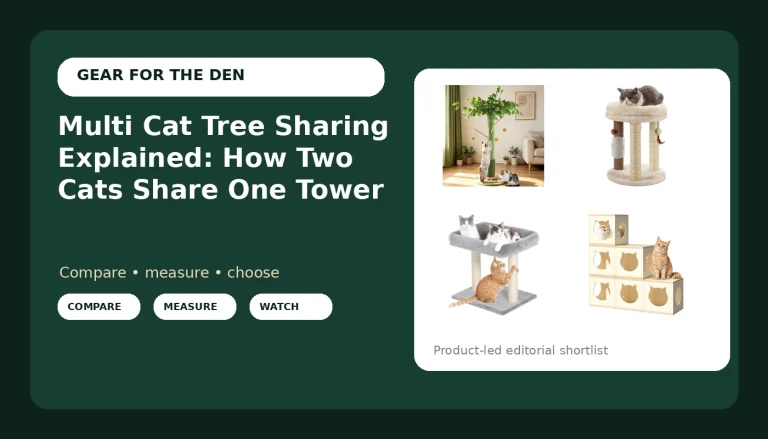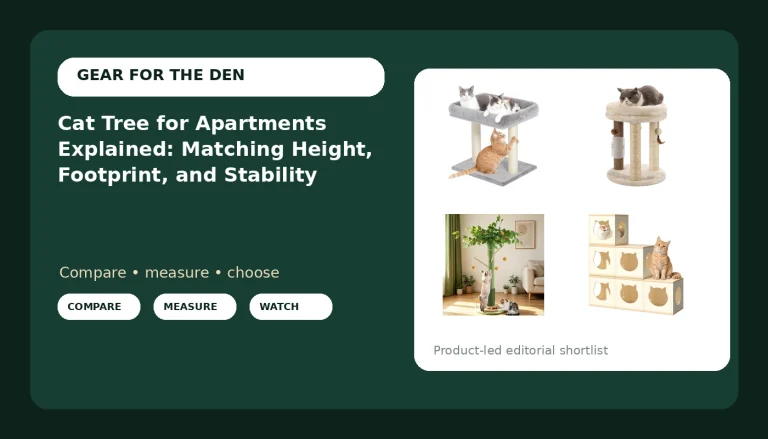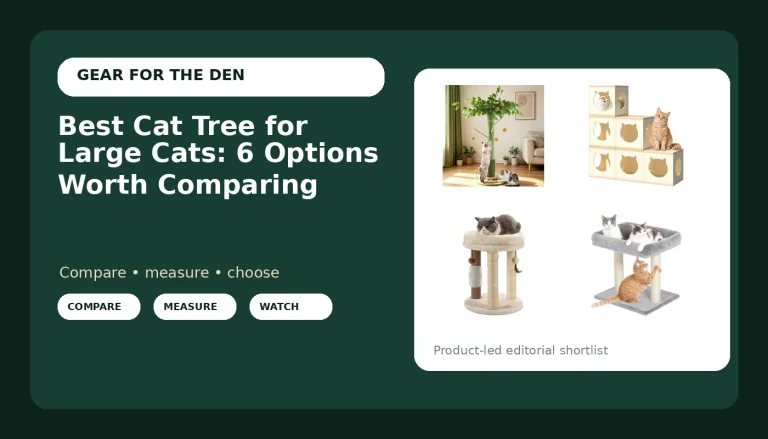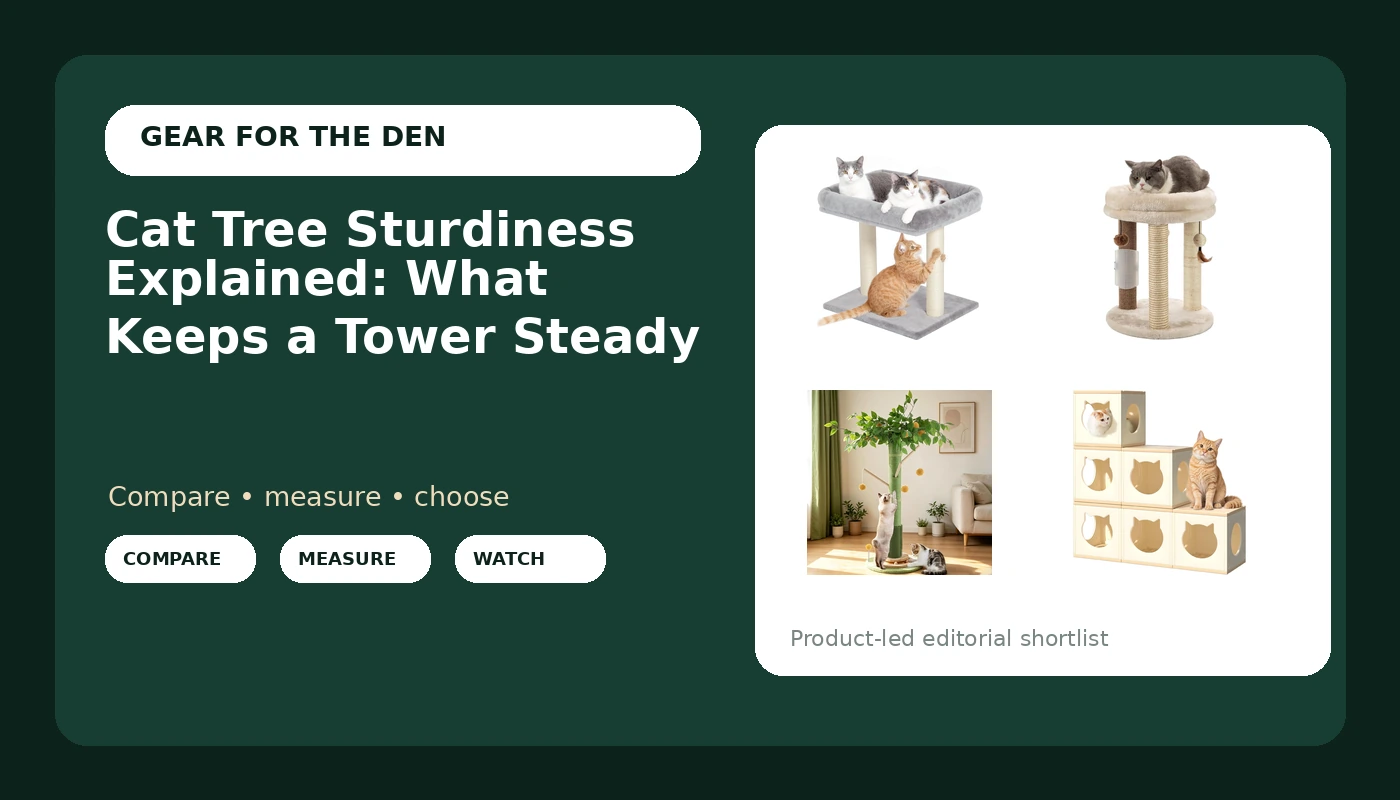
A cat tree fails in one of two ways: it tips over, or it wobbles enough that the cat stops trusting it and goes back to the sofa. Cat tree sturdiness explained in practical terms comes down to a short list of numbers you can check on any listing before you spend money: base footprint, platform height, post diameter, shelf depth, perch width, and the anchor type the manufacturer expects you to use. None of those numbers means much on its own. A 46 inch post on a broad base with a wall strap is stable. The same post on a narrow base with nothing holding it is a lever waiting for a cat to land on it wrong. The four products below sit at different points on that scale, from a 19 inch perch that barely needs anchoring to a six cube tower you can arrange to keep the weight low. Here is how to read the numbers, and how to tell which set matches your cat and your room.
Quick answer
The short version: stability comes from keeping the center of gravity low and the base wide relative to the highest platform a cat will land on. A tall post with a small footprint needs a wall anchor or a corner placement, while a short perch on a wide base usually does not. Post diameter controls how much the column flexes, shelf depth and perch width control how confidently a cat commits to a landing, and the stated weight limit tells you what the hardware is rated to hold. Match those figures to your largest cat rather than your smallest, and confirm the anchor type before you assemble anything.
Four useful options
| Model | Best fit | What stands out |
|---|---|---|
| KinoTail 19" Small Cat Tree with Scratching Post for Indoor Cats with Perch | Apartments and single-cat rooms | A 19 inch working height keeps the perch low, with the scratching post inside the same small frame |
| MECOOL 4in1 Small Cat Tree,Scratching Post with Tower Soft Bed, Sisal Carpet Jute Posts with Three Hanging Ball Toys and Massage Brush for Indoor Cats | Kittens and light-use corners | A soft bed, sisal carpet and jute posts, three hanging ball toys, and a massage brush in one unit |
| 46" Tall Cat Scratching Post, Natural Sisal Cat Tree for Indoor Adult Cats | Adult cats that stretch to full height | A 46 inch natural sisal column built for standing stretches rather than perching |
| 6-Cube Stackable Cat Tree Tower, Plastic Cat Tunnel for Indoor Cats | Multi-cat homes and rooms that get rearranged | Six stackable cubes plus a plastic tunnel, so you set the platform height yourself |
Compact perch: KinoTail 19" Small Cat Tree with Scratching Post for Indoor Cats with Perch
Platform height is the first number to think about, and this tree keeps it small. A perch at 19 inches gives a cat a landing it can reach from the floor without a long jump, which reduces the sideways force that pushes a tree across the room. The trade-off is capacity: one perch means one cat at a time, and a short column gives a large cat less room to stretch. If your cat likes to launch from a sofa onto the top of a tree, check the base footprint on the listing and consider a strap anyway, because a small base plus a sideways launch is exactly the case where a light tree slides rather than tips. Treat the scratching post here as a secondary surface rather than the main place your cat stretches.
Starter combo: MECOOL 4in1 Small Cat Tree,Scratching Post with Tower Soft Bed, Sisal Carpet Jute Posts with Three Hanging Ball Toys and Massage Brush for Indoor Cats
More parts mean more joints, and joints are where a tree loosens over time. A combo unit like this has the bed, the post, and the toy attachments all meeting the same frame, so the assembly step matters more than it does on a single post. Tighten every bolt at assembly, then check them again after the first week, because a soft bed sitting at the top of a short tower puts weight at the highest point of the structure. The hanging toys are on strings, and cats pull on strings, so those attachment points deserve a look during your monthly check. The massage brush is a grooming accessory rather than a structural part, so treat it as a bonus rather than a reason to pick this unit.
Full-height scratching: 46" Tall Cat Scratching Post, Natural Sisal Cat Tree for Indoor Adult Cats
A 46 inch post is the clearest example of how platform height and leverage interact. The taller the column, the longer the lever a cat creates when it pulls against the wrap or pushes off the base, and the more the base has to resist. Natural sisal holds up to repeated scratching better than loosely wrapped carpet in most cases, but the surface is only half the story: the mount between post and base is where tall posts fail first. Look for a base that spreads wider than the post is tall, or plan to use the anchor type the listing specifies, whether that is a wall strap or a furniture bracket. Because the post is sized for adult cats, a kitten may ignore it until it is big enough to reach the top third.
Modular tower: 6-Cube Stackable Cat Tree Tower, Plastic Cat Tunnel for Indoor Cats
Stackable modules put the two most important sturdiness variables in your hands. Build the cubes two high and three wide and you have a low, broad structure that is hard to tip. Build them six high and you have a tall tower with a small footprint, which is the arrangement that needs anchoring. The plastic tunnel adds a path between cubes, and because cats run through tunnels at speed, the joints between cubes take repeated lateral force. Push each connector fully home and check the weight limit the listing states for each level. In a multi-cat home, a wide low arrangement also gives each cat a separate cube, which reduces the traffic that shakes the structure in the first place.
Prices and availability may change. Product images, names, and retailer links are matched to verified listings. No current price, rating, stock status, or measured result is stated here without current evidence.
Cat tree sturdiness explained: the numbers that matter
Sturdiness is a ratio problem rather than a materials problem. A heavy tree is not automatically stable and a light tree is not automatically tippy. What matters is where the mass sits relative to the base, and how far the highest landing point sits from the center of that base.
Start with platform height. Every inch of height adds leverage to the force a cat applies when it jumps up or pushes off. A tree whose top platform sits 19 inches above the floor asks very little of its base. A 46 inch column asks a great deal.
Then look at the base footprint. The wider the base relative to platform height, the more the tree resists a sideways push. A useful rough rule for freestanding furniture is that the base should be at least half as wide as the structure is tall, and more than that if the top platform is where your cat lands.
Post diameter controls flex. A thin post bends under a cat's weight and springs back, which reads to a cat as instability even when the base holds firm. Thicker posts flex less. If a listing states post diameter, compare it against your cat's weight. If it does not, the photos usually show the ratio of post to base well enough to judge.
Shelf depth and perch width decide whether a cat commits to a jump. A cat lands more confidently on a platform deeper than its body length, and perch width matters for the same reason: a perch narrower than the cat means it lands half on and half off, and the correction that follows is exactly the movement that rocks a tree.
The weight limit is the manufacturer's rating for the hardware and the structure. It is usually stated per platform or for the whole unit, and it is the figure to compare against your largest cat rather than an average.
Anchor type is the final variable. Freestanding trees rely on mass and footprint alone. Trees that ship with a wall strap or a furniture bracket are designed to be tied to something solid, and a stud or a properly rated wall anchor is what makes that work. If the listing includes a strap, use it. If it does not, plan your placement so the tree sits in a corner where two walls limit how far it can travel.
Matching a tree to your cat and your room
- Measure your largest cat from nose to the base of the tail, and weigh it. Those two figures set the minimum shelf depth and perch width, and the weight you compare against the stated weight limit.
- Measure the floor space where the tree will live, including clearance behind it. A base footprint that fits with a few inches to spare in a corner gives you two wall contact points for free.
- Compare the platform height of the highest landing spot against the base footprint on the listing. If the height is more than twice the base width, plan to anchor.
- Confirm the anchor type in the box contents. A wall strap, a furniture bracket, and nothing at all are three different installation plans.
- Check post diameter and the material wrap. Thicker posts and tightly wrapped sisal hold up better under a cat that scratches every day.
Setting up a tree so it stays put
- Anchor the top of any structure taller than about three feet to a wall stud, or use a wall anchor rated for the load you expect.
- Assemble with the heaviest platform lowest and the lightest elements at the top, since a high soft bed moves the center of gravity up.
- Re-tighten every bolt after the first week of use, then monthly, because loosening shows up long before tipping does.
- Put the tree in a corner where two walls can stop sideways travel, and keep it off thick pile carpet when you can, since soft flooring lets a base settle unevenly.
- If a tree includes a hammock, check the hammock fabric and its attachment points, because a stretched hammock changes the load path and sags away from the frame.
Which option should you choose?
Choose the KinoTail 19" Small Cat Tree with Scratching Post for Indoor Cats with Perch when you have one cat, limited floor space, and no appetite for wall anchoring. Choose the MECOOL 4in1 Small Cat Tree,Scratching Post with Tower Soft Bed, Sisal Carpet Jute Posts with Three Hanging Ball Toys and Massage Brush for Indoor Cats when you want a bed, scratching surfaces, and toys in a single small unit and you are willing to check the joints monthly. Choose the 46" Tall Cat Scratching Post, Natural Sisal Cat Tree for Indoor Adult Cats when your cat stretches to full height against door frames and you want a dedicated vertical scratching surface rather than a climbing structure. Choose the 6-Cube Stackable Cat Tree Tower, Plastic Cat Tunnel for Indoor Cats when more than one cat shares the room and you would rather set the platform height and base footprint yourself.
Two caveats. These are structural recommendations based on listed dimensions and features, not on measured performance, and nothing here replaces reading the current listing, confirming the stated weight limit and anchor type, and checking your own floor and walls before you assemble. Also, this is about furniture that stays in one place: if you also need to move a cat, carrier size is a separate measurement, and the sturdiness of a tree tells you nothing about it.
The bottom line
There is no single ideal cat tree sturdiness figure, because the right numbers depend on the cat, the floor, and the wall behind the tree. What holds across every setup is the relationship: short and wide is the easiest arrangement to get right, tall and narrow is the one that needs a strap, and everything in between is a question of how much leverage your cat can generate. Matching the correct cat tree sturdiness to your household means checking platform height, base footprint, post diameter, shelf depth, perch width, and the stated weight limit against your largest cat, then anchoring anything tall and re-checking the bolts after the first week. Cat tree sturdiness is a maintenance habit as much as a specification, and the trees that stay steady for years are usually the ones somebody tightened twice a year.