When a senior dog starts pausing at the edge of the bed instead of hopping up, the mattress is rarely the whole story. Stiff hips and elbows turn a simple step into a decision. That is where the idea of a dog bed ramp for joint stiffness comes from: shorten the vertical distance between the floor and the sleeping surface so the dog stops launching itself twice a day. In practice, households solve it one of two ways. Either the bed itself gets lower, low enough to step into, or the bed stays raised and a ramp carries the dog up at a shallow angle. Both approaches aim at the same outcome, less impact through the hips, elbows, and spine at the start and end of every nap.
Quick answer
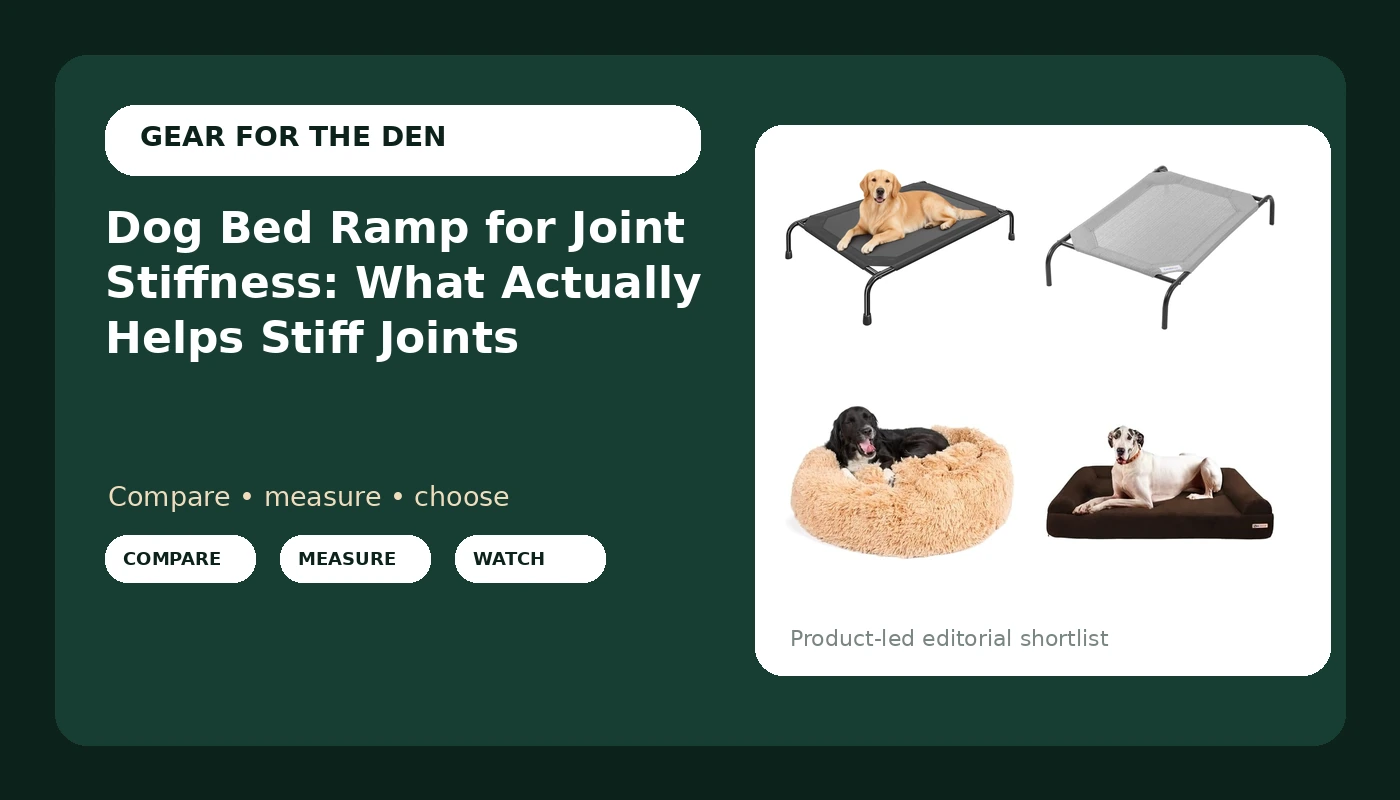
For most dogs with stiff joints, the practical fix is a bed low enough to step into, and a ramp only if the dog still wants a raised surface. The ideal dog bed ramp for joint stiffness is less about the ramp and more about the pair: a shallow ramp angle, a non slip backing under the dog's feet, and a bed height the dog can reach without a leap. If you would rather remove the jump entirely, a raised cot or a low platform bed does that on its own. The four beds below reduce the jump in different ways, and none of them asks the dog to climb.
Four useful options
| Model | Best fit | What stands out |
|---|---|---|
| Ekisemio Elevated Dog Bed for Large Dogs | Large dogs that overheat on a cushioned bed | Waterproof XL mesh cot on a raised frame, listed for indoor and outdoor use |
| Coolaroo Original Elevated Dog Bed | Smaller seniors that need an easy-clean, off-the-ground surface | Cooling fabric, moisture-resistant, 100 percent recyclable, medium, grey |
| BarkBox Dog Bed Memory Foam Donut Cuddler | Dogs up to 65 lbs that curl up to sleep | Memory foam donut, removable machine washable cover, waterproof lining, includes a toy |
| Barker Beds Giant Orthopedic Dog Sofa Bed | Very large dogs, listed from 100 to 300 lbs | 7 inch pillow top, 3 sided bolster, memory foam, washable, made in the USA |
Raised cot for large dogs: Ekisemio Elevated Dog Bed
A raised cot works on the joint problem from two directions at once. Air moves under the sleeping surface, which suits a large dog that gets warm on a cushioned bed, and the surface itself stays off the floor so a hose or a wipe handles most messes. The trade off is cushioning. A taut mesh deck has far less give than memory foam, so a dog with significant hip stiffness may want a softer surface to lie on even though the cot is easier to step onto. If your dog has always slept sprawled out in warm weather, this is the shape to start with.
Cooling cot for smaller seniors: Coolaroo Original Elevated Dog Bed
This is the same idea in a smaller footprint. A medium cot suits a senior that weighs less, and the low bed height means the step up is short enough that many dogs manage it without a ramp at all. Two things to weigh: the medium size limits who can use it, and a mesh deck still offers limited hip support compared with a foam base. It earns its place as the easy-clean option for a dog that has accidents, sheds heavily, or spends warm afternoons outdoors.
Donut bed for dogs that curl: BarkBox Dog Bed Memory Foam Donut Cuddler
Dogs that sleep curled in a ball get something a flat cot cannot offer: a rim to press their back against, which many anxious or older dogs use the way they used to lean on a littermate. The catch is the entry height. A donut with a thick rim asks a stiff dog to step over an edge rather than walk onto a flat surface, so a low-profile version is easier than a deep one. The removable cover and waterproof lining matter more than they sound, because a bed you can actually launder is a bed a senior dog can keep using after an accident.
Giant orthopedic sofa bed for very large dogs: Barker Beds
This is the option for a dog that is genuinely huge, the kind of dog whose weight bottoms out a flimsy bed within a season. The listed 100 to 300 lb range and the 7 inch pillow top are aimed squarely at that problem, and the 3 sided bolster gives a large dog something to brace against when it stands up, which matters more than it sounds for a dog with weak hindquarters. The obvious trade off is floor space: 60 by 48 inches is a real footprint, and a bed that thick creates a step the dog still has to take. For the largest dogs, a thick bed plus a shallow ramp is often the combination that finally works.
Prices and availability may change. Product images, names, and retailer links are matched to verified listings. No current price, rating, stock status, or measured result is stated here without current evidence.
What a dog bed ramp for joint stiffness actually changes
The hard part of a bed for a dog with stiff joints is not the climb up. It is the drop down. A dog that launches off a tall bed lands on its front limbs, and that landing is what owners usually notice first, a hesitation before the jump, or a hop that turns into a slide. A ramp changes the geometry of the trip. Instead of a vertical drop, the dog walks down a slope, and the load shifts from the front legs back into something closer to a normal walking gait.
Ramp angle is the number that decides whether that works. A shallow, long ramp is easier to walk than a short, steep one, and the steeper the ramp, the more the dog has to lean back and brace. Lift capacity matters too, because a ramp that flexes under a large dog is worse than no ramp at all. Bed height sets the whole equation: a ramp to a bed 30 inches off the floor has to be long to stay shallow, while a ramp to a bed 12 inches off the floor can be short and still gentle.
That is why many owners skip the ramp and change the bed instead. Removing the climb entirely is the most reliable version of a dog bed ramp for joint stiffness, and it is the approach the four beds above take. Each one keeps the sleeping surface reachable without a leap. If you are still weighing foam against a raised deck, our comparison of elevated and memory foam dog beds walks through the trade offs.
Foam density, bed height, and hip support
Three specifications do most of the work when you are choosing for a dog with arthritis or hip stiffness.
Foam density describes how much material is packed into a given volume of foam. Denser foam resists compression for longer, so a heavy dog does not sink through to the floor. When a listing does not publish density, thickness and layering are the next best clues. A thin layer of memory foam over a firmer base behaves differently from a thick slab of soft foam, even when two beds look similar in photos.
Weight capacity is the bed's stated limit, and it is worth comparing against your dog's actual weight rather than its breed's typical weight. A bed rated close to the dog's weight has less margin than one rated well above it, and margin is what keeps the foam from flattening in the spots a stiff dog leans on hardest.
Non slip backing keeps the bed or the ramp from sliding when the dog pushes off. On hard floors this matters more than the cover fabric, because a bed that skates away removes the dog's confidence in the surface, and a hesitant dog will go back to the sofa.
Hip support comes from all three working together. Foam that does not bottom out, a capacity with headroom, and a base that stays put give a stiff-hipped dog a surface it can trust. Bed height then decides how much of the day's climbing you have removed.
- Measure the sleeping surface of the bed your dog uses now, from the floor to the top of the cushion.
- Weigh your dog and compare it with the bed's listed weight capacity, leaving some headroom.
- Check the foam: look for a published density or, failing that, the thickness and the layering.
- Flip the bed over and inspect the base, since a non slip backing is what keeps it from sliding on hard floors.
- Decide whether a ramp is needed at all. Below roughly a foot of bed height, a step or a low platform bed usually replaces the jump on its own.
Practical guidance for the first two weeks
- Put the new bed where the old one sat. Dogs navigate by routine, and a bed in a new corner is a new problem to solve.
- Keep any ramp, step, or low platform in exactly the same position every day so the route stays predictable.
- Test the non slip backing on your actual flooring before the dog uses it, and add a rug underneath if the bed slides.
- Wash removable covers before first use, especially for a dog with sensitive skin or a history of allergies.
- Watch how your dog gets off the bed, not just how it gets on. The dismount is where stiffness usually shows first.
Which option should you choose?
Choose the Ekisemio Elevated Dog Bed for Large Dogs when your dog is a large breed that runs hot, the bed lives somewhere easy to hose down, and a raised mesh surface is simpler to keep clean than fabric. Choose the Coolaroo Original Elevated Dog Bed when you want the same off-the-ground idea in a medium size with a cooling fabric and a surface that wipes clean. Choose the BarkBox Dog Bed Memory Foam Donut Cuddler when your dog curls into a ball, weighs under 65 lbs, and you want a cover you can machine wash. Choose the Barker Beds Giant Orthopedic Dog Sofa Bed when your dog is genuinely giant, the floor space exists for a 60 by 48 inch bed, and you want a thick pillow top with a bolster to lean against.
None of these is a ramp, and that is deliberate. A ramp is an accessory to a bed, and the right ramp depends on measurements no listing can supply: the height of your bed, the length of the walkway, and how your dog prefers to move. Choosing the correct dog bed ramp for joint stiffness starts with the bed, because the bed sets the angle everything else has to work around. If your dog is already on a low bed and still struggles to rise, the missing piece is probably not a ramp but a conversation with your veterinarian about joint mobility.
The bottom line
For a dog with stiff joints, the goal is fewer landings, not more gear. Lower the bed first, and add a ramp only if the bed has to stay high. Match foam density and weight capacity to the dog you actually have, check that the base grips the floor, and give the dog a route it can repeat without thinking. The beds here cover the four common shapes of that problem: a raised cot for large dogs that overheat, a cooling medium cot, a donut for dogs that curl, and a giant sofa bed for the biggest dogs in the house. That is a dog bed ramp for joint stiffness explained without a single ramp in the list.