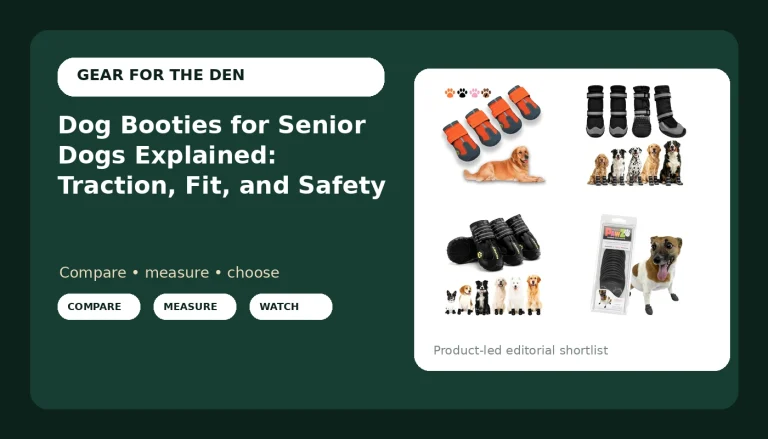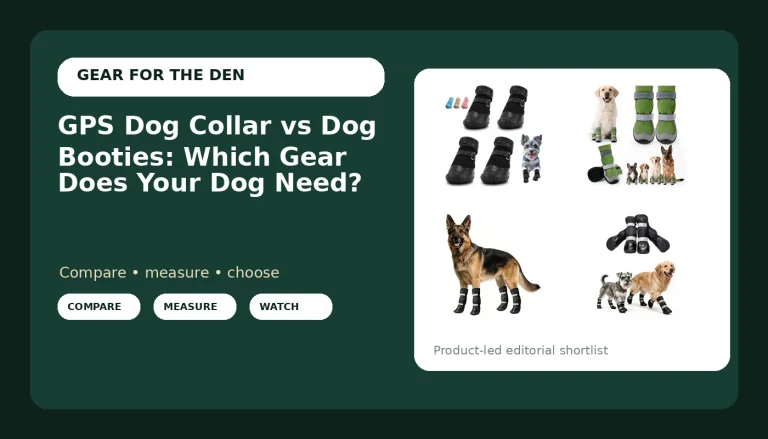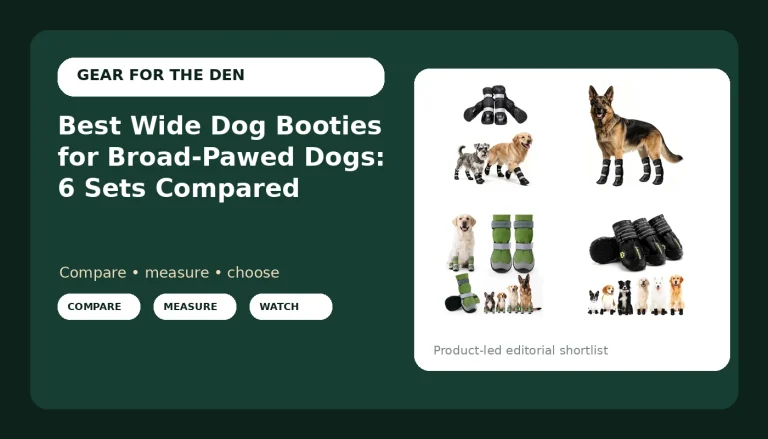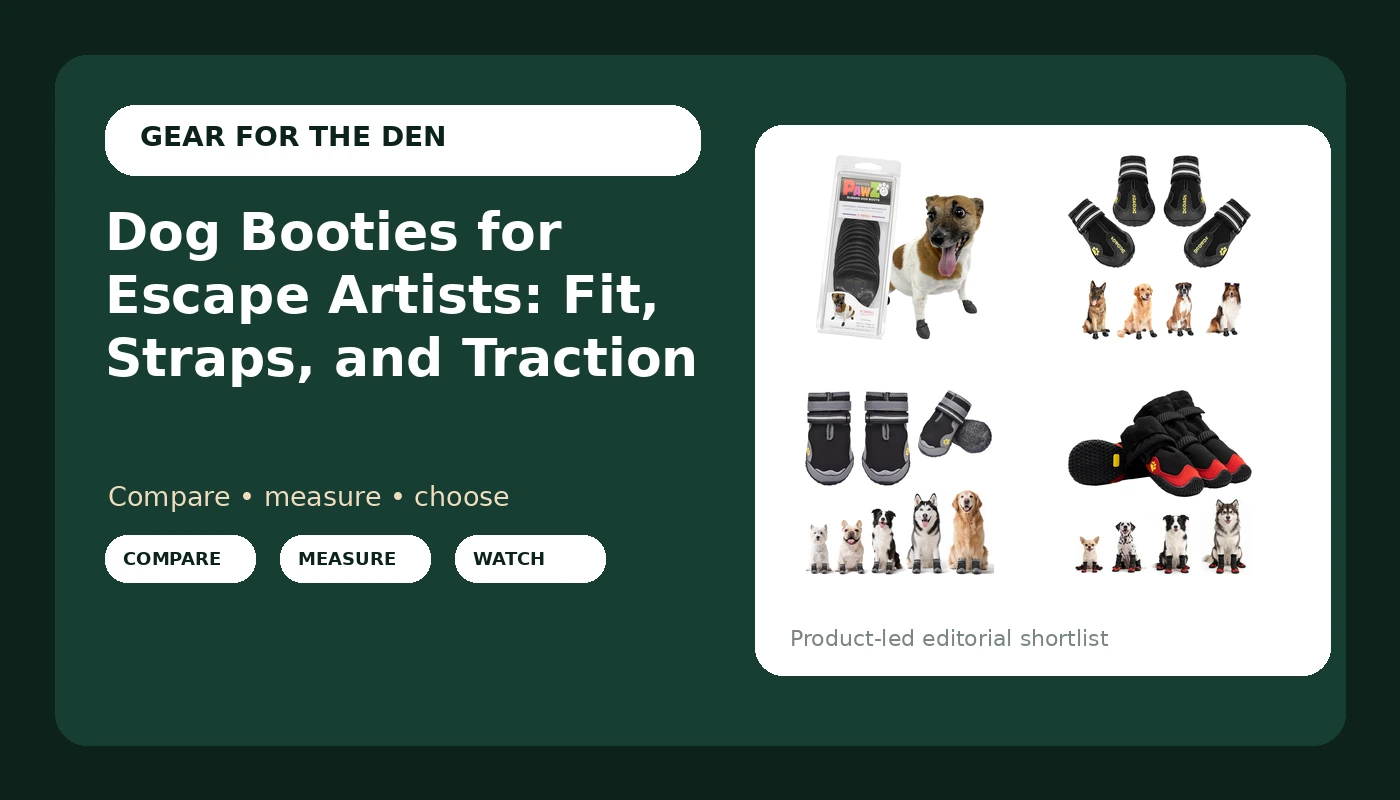
If your dog has learned to peel a boot off mid-block, an ordinary walk turns into a retrieval exercise: four boots on, half a block covered, one rubber shell lying on the sidewalk, and a bare paw heading for the nearest puddle. This dog booties for escape artists explained guide is about that exact problem. It is not about whether dogs should wear boots at all. It is about which design details make a boot genuinely hard to remove without making it uncomfortable, and how to tell the difference before you spend money on a full set.
Three things drive most escapes: boot sizing, how the boot closes above the paw, and how the sole behaves on the surface underfoot. Get those right and the escape attempts drop. Get them wrong and you will be replacing boots every month. The four options below cover the main construction styles on the market right now, from stretch rubber pull-ons to strapped winter boots, and each one suits a different dog and a different kind of walk.
Quick answer
Dog booties for escape artists stay on when the boot fits snug at the paw, closes with a strap that actually tightens above the knuckle, and has a traction sole that grips the ground instead of sliding across it. Rubber pull-on styles give a determined dog nothing to grab with teeth, while strapped boots give you more adjustment for wide, narrow, or oddly shaped paws. Buy one pair first, walk on dry pavement, and check the fit before you order boots for the whole season.
Four useful options
| Model | Best fit | What stands out |
|---|---|---|
| PawZ Rubber Dog Boots – Waterproof Non-Slip Dog Shoes & Booties, 12 Pack | Dogs that chew or paw at hardware | Rubber pull-on construction with no straps to grab, sold 12 to a pack |
| DcOaGt Dog Shoes Large Size Dogs, Anti-Slip Dog Boots Dog Booties | Large and heavy dogs | Built around large size dogs with an anti-slip sole |
| Hipaw Dog Booties for Winter,Snow Boots for Small Medium Large Dogs,Waterproof Dog Rain Shoes,Non-Slip Paw Protector for Outdoor Walking,Hiking,Indoor Hardwood Floors | Wet weather and dogs that slip indoors | Waterproof winter and rain booties offered for small, medium, and large dogs |
| Dog Booties for Winter Snow & Hiking, Black Dog Shoes, Size 3 in&Outdoor | Snow, hiking, and cold pavement | A single fixed size, described for indoor and outdoor use |
Hardware-free coverage: PawZ Rubber Dog Boots – Waterproof Non-Slip Dog Shoes & Booties, 12 Pack
A pull-on rubber boot has no adjustment, so the fit is decided entirely by boot sizing. That is a real trade: fewer parts to fail, and no way to tighten a boot that sits slightly loose. Measure the paw while the dog is standing, compare that number against the size chart, and expect the rubber to sit close to the skin. Because there is no closure to check, a loose rubber boot tends to rotate rather than fall off cleanly, and that rotation is usually what starts the escape. If your dog has very wide or very narrow paws, a strapped boot will often give a better result. The 12 pack does change the math for a dog that loses boots, since one disappearance does not end the season. This is also the style to try with a harness that has a chest strap and a front clip, so you are not tugging on the leash while your dog worries at a paw.
Large-dog sizing: DcOaGt Dog Shoes Large Size Dogs, Anti-Slip Dog Boots Dog Booties
Weight changes the forces at work on a boot. A light dog can wear a slightly loose boot for a whole walk without incident, while a heavy dog puts far more leverage through the toe on every stride, and a boot that shifts even a little will keep shifting until it is off. That makes large breeds the hardest group to fit and the group where measurement matters most. Measure the front paws first, since they are usually the widest, and check the back paws separately rather than assuming they match. On the walk itself, a shorter leash length and a harness with a front clip reduce the sideways drag that pulls a boot out of position, and keeping the dog moving at an even pace does more for fit than any tightening you can do mid-block.
Wet weather across sizes: Hipaw Dog Booties for Winter,Snow Boots for Small Medium Large Dogs,Waterproof Dog Rain Shoes,Non-Slip Paw Protector for Outdoor Walking,Hiking,Indoor Hardwood Floors
Waterproofing is what most people are shopping for in wet weather, but a wet boot is also a looser boot. Water adds weight to the shell, and a soaked strap holds tension differently than a dry one, so a fit that felt perfect on a dry morning can start slipping in the rain. Snow creates a second problem: packed snow balls up between the boot and the pad, which pushes the paw back and loosens the whole shell. Check the openings after every block in fresh snow. The indoor hardwood floor detail is worth noting for a different reason, since a dog that slips on smooth flooring often does better with a textured sole than with bare nails. Dry the boots between walks rather than leaving them in a bag, and re-check the strap tension before the next outing.
Snow and hiking in one fixed size: Dog Booties for Winter Snow & Hiking, Black Dog Shoes, Size 3 in&Outdoor
A fixed size number is a starting point, not a guarantee. Two dogs with the same paw length can differ in width, and a boot that matches in length but pinches in width will be worked off within a few minutes. If you hike off leash, this is also the category where a GPS tracker earns its place: check the tracker's gps range against the terrain you actually walk, and treat battery life as the limit on how long the walk can be. On cold pavement and packed snow, the failure mode to watch is a boot that comes off quietly rather than dramatically. A dog that is moving fast may not slow down for a missing boot, so a mid-walk count is worth the pause.
Prices and availability may change. Product images, names, and retailer links are matched to verified listings. No current price, rating, stock status, or measured result is stated here without current evidence.
How dog booties for escape artists come off
Escape attempts usually follow one of a few patterns, and each one points to a different fix.
The first is a boot that is simply too large. A loose boot does not slide off in a straight line. It rotates around the paw first, the pad ends up pressed against the side wall, and the dog feels that immediately. From there the dog either stops walking or starts biting at the shell.
The second is a closure that sits in the wrong place. A strap that tightens low, near the toes, does not stop a boot from rolling forward. The strap needs to sit above the knuckle, where the leg narrows, so the boot has something to catch against.
The third is a sole that slides. A boot with a slick sole makes the paw skate on smooth pavement or wet tile, and a dog that cannot trust its footing will kick and shake the foot to get the boot off. Traction is not a comfort extra here, it is part of what keeps the boot attached.
The fourth is the dog itself. Some dogs remove boots with teeth, some use a dewclaw, and some rub one boot against the other leg. If your dog is in that group, fewer parts is a real advantage, which is why a plain pull-on rubber boot often outlasts a strapped design with a curious chewer.
The fifth pattern is not an escape at all. A dog that freezes, hops, or refuses to move is telling you the fit is wrong. That is a fitting problem, not a stubbornness problem, and no amount of tightening will fix it.
Boot sizing, traction sole, and strap tension
Boot sizing is the part people rush, and it is the part that decides whether the whole purchase works. Measure the paw with the dog standing and weight on that foot, because a paw spreads under load. Take the length from the back of the pad to the tip of the longest nail, then take the width across the widest part. Write both numbers down and compare them against the size chart on the listing rather than against the size your dog wears in anything else.
The traction sole matters more than it looks. On wet pavement, smooth tile, and packed snow, a sole with a defined tread grips where a flat one skates, and grip is what stops the sideways drag that rolls a boot off. Strap tension is the last variable. Tighten until the strap is firm, then check that you can still slide two fingers underneath. If you cannot, the boot is restricting circulation, and a dog will work a too-tight boot off just as fast as a too-loose one.
A five-step fitting routine that covers most of it:
- Measure both front paws and both back paws while the dog stands, and note length and width for each.
- Match those numbers to the size chart, and if the chart gives only one measurement, size to the larger of your two numbers.
- Put one boot on and watch the dog walk on a hard floor for two minutes, looking for rotation rather than for a boot falling off.
- Set strap tension, then re-check it after five minutes of walking, since straps settle once the dog moves.
- Do a short loop near home before committing to a long route, and inspect every boot for grit, snow, or a shifted paw.
The ideal dog booties for escape artists are the ones that pass all five checks on your own dog, not the ones that look toughest in a product photo.
Practical guidance for the first week
- Check all four boots after the first ten minutes of every walk, then again at the end, for the first week of use.
- Carry a spare boot so a single loss does not cut a walk short, which matters most with a dog that has a history of removing them.
- Dry boots after wet or snowy walks, because a soaked shell and strap hold tension differently from a dry one.
- Use a harness with a chest strap and a front clip, and keep the leash length short on the first few outings so you are not dragging the dog sideways.
- Watch the surface, not just the weather: hot pavement in summer and road salt in winter are both reasons the boots go on, and a cooling fabric or a light-colored shell helps on hot days.
- Count paws at the turnaround point on off-leash hikes, and keep the tracker's battery life in mind before you extend the route.
Which option should you choose?
Choose the PawZ Rubber Dog Boots – Waterproof Non-Slip Dog Shoes & Booties, 12 Pack when your dog removes boots with teeth or dewclaws and you want a pull-on design with no hardware and spares in the box. Choose the DcOaGt Dog Shoes Large Size Dogs, Anti-Slip Dog Boots Dog Booties when you have a large or heavy dog whose boots roll off under load. Choose the Hipaw Dog Booties for Winter,Snow Boots for Small Medium Large Dogs,Waterproof Dog Rain Shoes,Non-Slip Paw Protector for Outdoor Walking,Hiking,Indoor Hardwood Floors when wet weather is the main problem and you want one listing that covers several size bands. Choose the Dog Booties for Winter Snow & Hiking, Black Dog Shoes, Size 3 in&Outdoor when you already know your dog's measurement and want a fixed-size winter boot for snow and trails.
The correct dog booties for escape artists are the pair that survives a full walk on your dog, and that is a question only your own measurements and a short test walk can answer. Nothing here is a substitute for checking the size chart on the listing, and fit can vary between two dogs with identical paw measurements.
The bottom line
Escapes are almost always a fit problem wearing a costume. Boot sizing that is too loose, a closure that sits below the knuckle, a slick sole, or a chewed strap will each produce the same result: a boot on the sidewalk and a dog looking pleased with itself. Start with one pair, measure the paws properly, run the five-step fitting routine, and only then decide whether you need a full set for the season. The four listings above give you a pull-on rubber option, a large-dog option, a wet-weather option across sizes, and a fixed-size winter boot, which is enough range to test a fit before you commit to a whole winter of walking.