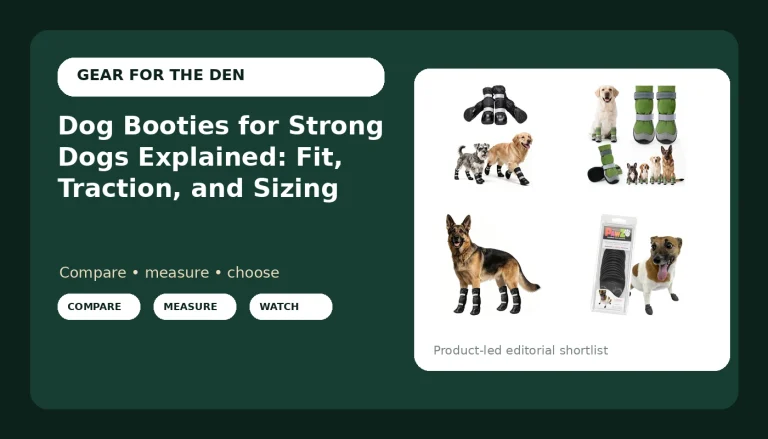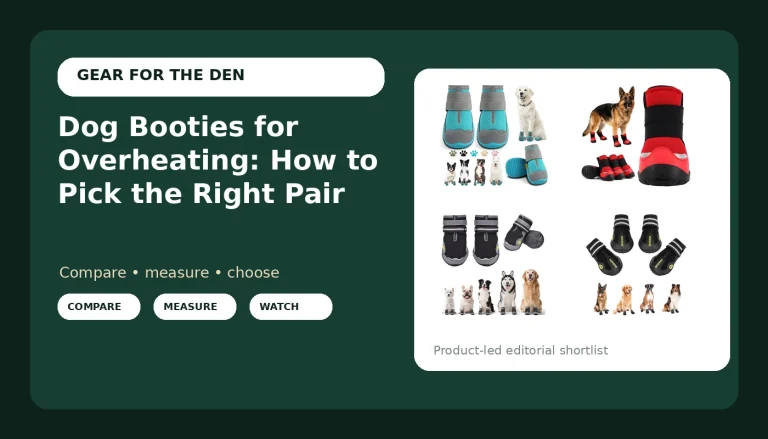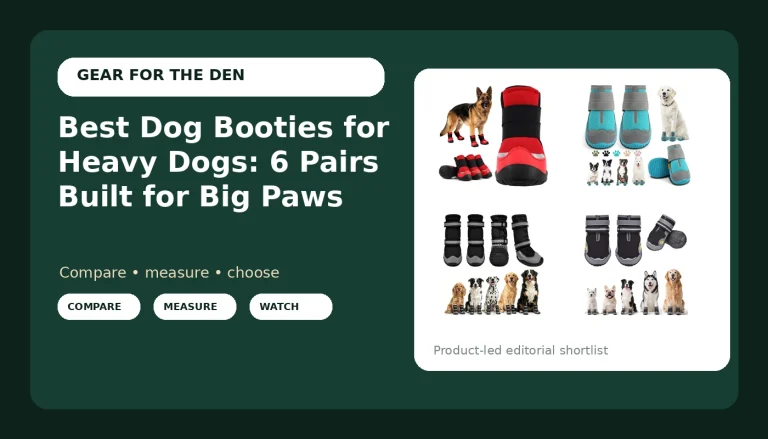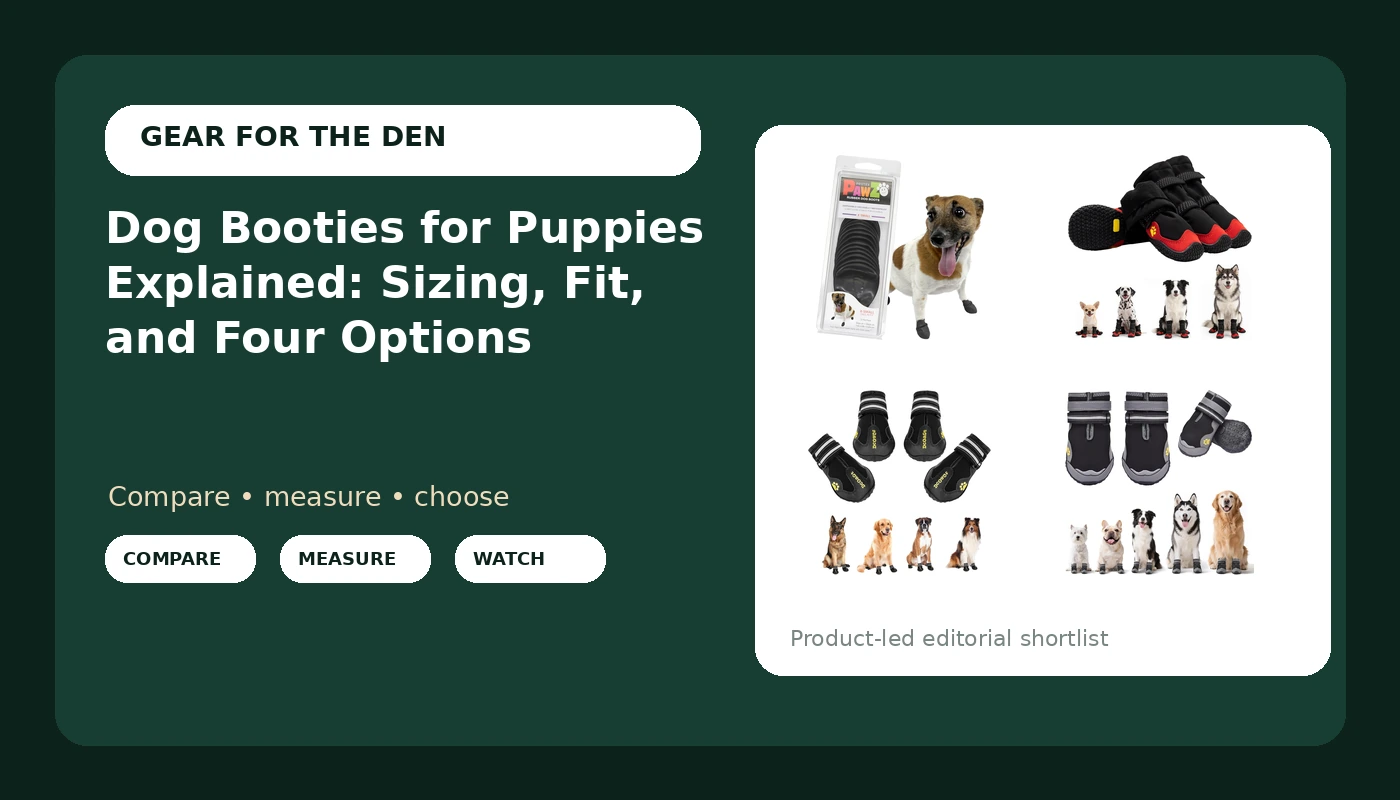
Puppy paws are small, soft, and still changing shape, which is why buying footwear for a young dog is a different exercise from buying it for an adult. Hot summer pavement, winter road salt, ice that balls up between the toes, and slick hardwood floors all give a puppy a reason to wear something on its feet. This article is dog booties for puppies explained in practical terms: what the gear actually does, how boot sizing works on a paw that grows, and which of the current listings suits the way you and your dog walk.
The catch is that a puppy usually outgrows a boot long before it wears one out. That changes the math. A flexible, low-cost boot that stays on for a fifteen-minute walk often beats a heavy technical boot built for an adult working dog, and it lets you re-measure and replace without much regret. What follows covers what to look for, then four current options and the conditions each one suits.
Quick answer
Dog booties for puppies are paw covers that protect against heat, cold, salt, ice, and rough ground, and many also add grip on smooth indoor floors. For a puppy, fit and retention matter more than durability, because the paw will outgrow the boot within weeks. Measure the standing paw, compare it to the listing's own size chart, and plan to re-measure every three to four weeks. Here is dog booties for puppies explained in one line: fit first, material second, everything else last.
4 useful options
| Model | Best fit | What stands out |
|---|---|---|
| PawZ Rubber Dog Boots – Waterproof Non-Slip Dog Shoes & Booties, 12 Pack | Puppies on wet grass, mud, and light slush | Twelve waterproof rubber boots with a non-slip sole in one pack |
| Dog Booties for Winter Snow & Hiking, Black Dog Shoes, Size 3 in&Outdoor | Cold-weather walks and trail time | A winter and hiking boot listed in a specific size and a black finish |
| DcOaGt Dog Shoes Large Size Dogs, Anti-Slip Dog Boots Dog Booties | Puppies expected to grow into a large frame | Sized for large dogs with an anti-slip sole |
| Hipaw Dog Booties for Winter,Snow Boots for Small Medium Large Dogs,Waterproof Dog Rain Shoes,Non-Slip Paw Protector for Outdoor Walking,Hiking,Indoor Hardwood Floors | Rain, winter walks, and slick indoor floors | Waterproof and non-slip, listed for small through large dogs |
Multi-pack starter option: PawZ Rubber Dog Boots – Waterproof Non-Slip Dog Shoes & Booties, 12 Pack
Rubber pull-on boots are the simplest design in this group: no zippers, no straps, and no laces to adjust. That simplicity is the reason they work as a first boot for a puppy, because there is nothing to break and nothing to tighten incorrectly. The trade-off is coverage. A rubber boot covers the paw and a little of the pastern rather than the leg, and it adds no insulation, so it suits wet grass, mud, slush, and short winter walks better than deep cold or long hikes. Because they arrive twelve to a pack, a puppy between sizes can wear the smaller pair for a week or two, and a boot lost in a snowbank is not a disaster. Compare the size chart against a standing paw measurement rather than a guess based on breed.
Winter and trail option: Dog Booties for Winter Snow & Hiking, Black Dog Shoes, Size 3 in&Outdoor
A boot sold for winter snow and hiking is a more structured piece of gear than a rubber pull-on. It is listed in a specific size and finished in black, and the listing describes it for both indoor and outdoor use. The reason to consider it is coverage: a taller boot keeps snow, salt, and grit away from more of the paw and tends to stay in place on uneven ground. The cost is fitting time. Structured boots have more material around the pastern, so a puppy feels them immediately and may need several short indoor sessions before walking normally. Read the size chart carefully, because a size that fits an adult of the same breed may be too long for a puppy's paw. Start on a dry sidewalk before you take them onto a trail.
Large-frame option: DcOaGt Dog Shoes Large Size Dogs, Anti-Slip Dog Boots Dog Booties
This listing is aimed at large dogs, which matters if your puppy is a breed that will be big. A mastiff or Great Dane puppy can have paws that already exceed the small sizes sold in multi-packs, and a boot designed around a large frame is more likely to have a size that fits now. The anti-slip sole is the other feature worth noting, because a heavy puppy on hardwood or tile often struggles for grip more than a small one does. The limitation is the opposite end of the range: a boot built for large dogs is unlikely to suit a toy or small breed puppy, and a puppy in a growth spurt may pass through a size in a matter of weeks. Measure before ordering, then measure again a month later.
Everyday rain and indoor option: Hipaw Dog Booties for Winter,Snow Boots for Small Medium Large Dogs,Waterproof Dog Rain Shoes,Non-Slip Paw Protector for Outdoor Walking,Hiking,Indoor Hardwood Floors
This is the generalist of the group. It is described as waterproof and non-slip, and the listing covers small, medium, and large dogs, winter and snow, rain, outdoor walking, hiking, and indoor hardwood floors. That breadth is the point. If you want one set that handles a wet sidewalk in November and a slick kitchen floor in the same week, a listing like this one is easier to justify than two specialist pairs. The trade-off is that a boot designed for many conditions is rarely the best at any single one. A dedicated winter boot will hold more warmth, and a thin rubber boot will be lighter for a puppy that is still learning to walk in footwear. Check the size range against your puppy's measured paw before you commit.
Prices and availability may change. Product images, names, and retailer links are matched to verified listings. No current price, rating, stock status, or measured result is stated here without current evidence.
What dog booties for puppies need to do differently
A puppy paw is not a scaled-down adult paw. The pads are softer, the nails are needle-sharp, and the whole foot is still growing, which means the measurement you take this month will be wrong next month. A boot that fits snugly in October can be tight by December, and a boot that stretches can end up loose enough to twist. That is the main reason a puppy does not need the most technical boot on the market. It needs one that goes on easily, stays on for a short walk, and can be replaced without a big spend.
Retention is the second difference. Many adult dogs accept boots and walk normally within minutes. Puppies frequently high-step, freeze, or try to chew the boot off, and a boot that slips or rotates during that learning phase makes the whole exercise worse. A boot that fits well and closes securely gives the puppy less to fight with.
The third difference is purpose. Puppy walks are short and usually close to home, so the conditions are the ones on your own street: hot asphalt in July, salt and ice in January, wet grass after rain, and smooth flooring indoors. A traction sole helps on tile and hardwood, and a cooling fabric or lightweight boot helps on hot days, but neither matters as much as getting the size right. There is no single ideal dog booties for puppies product, because the right boot depends on the ground you walk on and the paw in front of you.
Sizing, material, and the choices that follow
Boot sizing is the biggest source of returns in this category, and it is harder with puppies because the target keeps moving. Sizes are not standardized across brands. A size 3 from one listing may match a size small from another, and a boot listed for large dogs may start at a paw width a puppy will not reach for months. Always measure and compare against the specific chart on the listing you are buying.
Material follows the condition you walk in most. Rubber handles water, mud, and salt without absorbing anything. A lined fabric boot holds warmth for cold-weather walks. A light, breathable boot or a cooling fabric cover is the better choice for hot pavement, where the goal is a barrier between the pad and the ground rather than insulation.
- Measure both front paws while the puppy is standing, from the back of the pad to the tip of the longest nail, plus the widest point across.
- Compare that measurement to the size chart on the specific listing, not to the size you bought from another brand.
- Re-measure every three to four weeks until growth slows, and replace boots as soon as the fit is tight or the boot twists on the paw.
- Choose the material by condition: rubber for wet ground, insulated fabric for cold, breathable or cooling fabric for heat.
- Check the closure around the pastern and dewclaw, and confirm the boot cannot rotate when the puppy walks.
Practical habits for walking a puppy in boots
- Put the boots on in the same order every time and pair the routine with a treat, so the puppy learns what is coming next.
- Start indoors on a surface with good grip for two or three minutes, then move to the sidewalk once the puppy is walking normally.
- Keep the leash length short and the pace slow for the first few outings, because a puppy that high-steps needs room to think rather than a tight line.
- Check the pastern and the space between the toes for rubbing after every walk, and dry the boots before you store them.
- If your puppy wears a harness, recheck the chest strap and the front clip once the boots are on, since a harness that shifts can change how the front legs swing. On longer trail walks, a GPS tracker's range and battery life matter more than boot branding once you are off your usual route.
Which option should you choose?
Choose the PawZ Rubber Dog Boots – Waterproof Non-Slip Dog Shoes & Booties, 12 Pack when you want a simple, low-cost boot for wet grass, mud, and light slush and you expect to change sizes as the puppy grows. Choose the Dog Booties for Winter Snow & Hiking, Black Dog Shoes, Size 3 in&Outdoor when your walks happen in cold weather and on trails, and you are ready to spend a few sessions teaching a structured boot. Choose the DcOaGt Dog Shoes Large Size Dogs, Anti-Slip Dog Boots Dog Booties when the puppy is a large breed whose paws are already big, or when grip on smooth floors is the main problem. Choose the Hipaw Dog Booties for Winter,Snow Boots for Small Medium Large Dogs,Waterproof Dog Rain Shoes,Non-Slip Paw Protector for Outdoor Walking,Hiking,Indoor Hardwood Floors when you want one set that covers rain, winter walks, and indoor hardwood without buying a second pair.
None of these listings is a universal fit. Size charts vary between brands, and the correct dog booties for puppies choice is the one that matches the paw you measured today rather than the paw you expect in six months. Treat any single size recommendation, including the one printed on a chart, as a starting point and confirm it against your own measurement.
The bottom line
Dog booties for puppies are a fit problem before they are a gear problem. Measure the standing paw, buy for the size the puppy is now rather than the size you hope it becomes, and expect to replace the set at least once during the first year. A twelve-pack of flexible rubber boots is the least expensive way to start, a winter and hiking boot is worth the extra fitting time if your walks are cold and long, a large-frame listing is the practical pick for a big-breed puppy, and a waterproof all-rounder covers rain and indoor floors without a second purchase. Whatever you choose, check the fit after every walk during the first week, keep the sessions short, and let the puppy set the pace.