An itchy dog plus a wet undercoat is a bad pairing. A dog dryer for itchy skin is not a treatment for the itch, and no blower will clear up allergies or an infection. What a dryer does is end the part of bath day that makes itching worse: the long stretch where a thick coat stays damp against the skin. If your dog scratches, chews, or rubs along the flanks after every bath, the twenty minutes after the towel usually matter more than the shampoo that started it. This guide covers airflow, heat, coat type, and motor noise, then compares four grooming blowers built for different dogs and different bathrooms, so you can match a machine to your dog instead of to a spec sheet.
Quick answer
The short version of dog dryer for itchy skin explained: choose a machine that can run on cool or barely warm air, that you can hold at a distance for a long session, and that your dog will tolerate standing next to. Airflow does the work. Heat is optional, and it is often the first setting to switch off when the skin is already irritated. A small dog with a short single coat usually needs nothing more than a straightforward high-velocity blower. A thick double coat that traps water at the skin dries faster with a dual-motor machine that moves more air. A dog that panics at the sound of a vacuum needs a lower-noise unit far more than it needs horsepower.
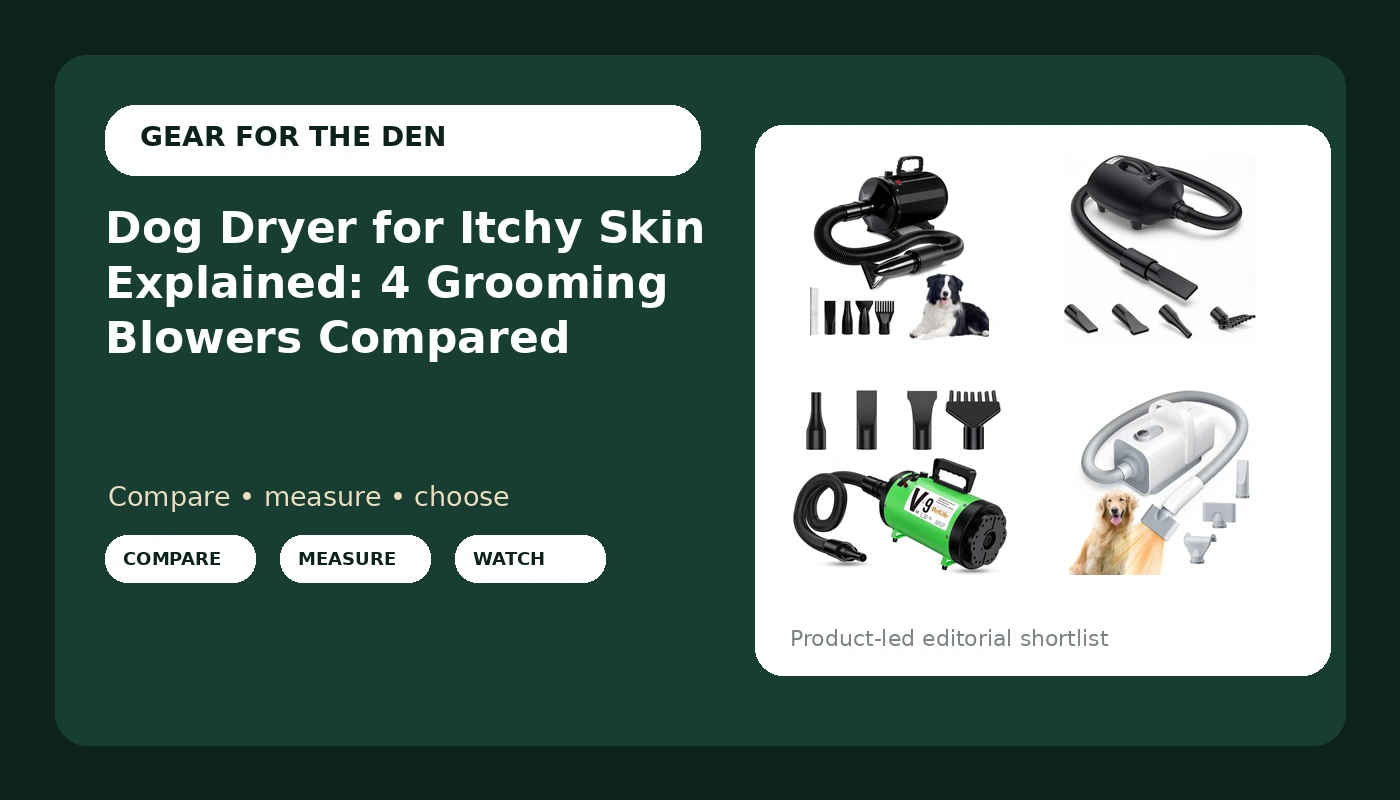
4 useful options
| Model | Best fit | What stands out |
|---|---|---|
| IVY&LANE Dog Hair Dryer for Pet Grooming, High Velocity Dog Blower, Black | Simple high-velocity drying for shorter or thinner coats | High-velocity grooming blower in a black finish |
| AETOS 6.2HP Dual Motors Dog Dryer, High-Velocity Pet Grooming Hair Blower | Thick double coats and long drying sessions | Dual-motor design with a 6.2HP rating in the product name |
| Dog Hair Dryer, 5.2HP High Velocity Pet Grooming Blower with Heater (Green) | Owners who want warm air available as an option | Built-in heater with a 5.2HP rating in the product name |
| HomeRunPet Dog Dryer for Grooming, 43dB Ultra Quiet Pet Blow Dryer | Noise-sensitive dogs and nervous first-timers | Product name carries a 43dB quiet claim |
Straightforward blower: IVY&LANE Dog Hair Dryer for Pet Grooming, High Velocity Dog Blower, Black
Velocity is the part of drying that most people underestimate. A moving wall of room-temperature air breaks the water film apart and drives it off the skin, and it does that without adding heat to skin that is already pink and uncomfortable. The trade-off is time and technique: you have to keep the nozzle moving, work in the direction the coat grows, and accept that a long-coated dog will take longer than a short-coated one no matter what the machine claims. On a dog with a dense undercoat, a single high-velocity blower can still leave the deepest layer damp, which is the layer that matters most when itching is the problem. Where this machine makes sense is on coats that give up their water quickly, and on owners who want one simple tool with one job.
Dual-motor option: AETOS 6.2HP Dual Motors Dog Dryer, High-Velocity Pet Grooming Hair Blower
The trade-off with this much airflow is everything around it. Bigger motors generally mean more motor noise, a heavier unit to hold, and a longer warm-up to your dog's tolerance. A dryer in this class is worth it when the alternative is a damp undercoat that keeps the skin warm and itchy for hours, which is exactly the scenario that sends owners looking for answers in the first place. It is not worth it if your dog will not stand still for it. Spend a week running the machine on its lowest setting with the hose pointed away from the dog, reward calm behavior, and build up from there. If that process goes badly, more power will not fix it; a quieter machine will.
Heated airflow option: Dog Hair Dryer, 5.2HP High Velocity Pet Grooming Blower with Heater (Green)
Heat and itch are a poor combination for a simple reason: warm air pulls moisture out of the skin's surface as well as out of the coat, and dry, tight skin tends to itch more. That does not make a heated dryer useless. It makes the heat control the feature you actually manage. Start on cool, dry the bulk of the water that way, and only bring in gentle warmth if the room is cold or the coat is exceptionally thick. Keep the nozzle moving, hold it well back from the skin, and test the air on the inside of your own wrist before you aim it anywhere near a dog's belly or armpits. If your dog starts nibbling at a spot you have just dried, that is a signal to drop back to cool air.
Quieter option: HomeRunPet Dog Dryer for Grooming, 43dB Ultra Quiet Pet Blow Dryer
Motor noise is the reason a lot of dryers sit unused in a cupboard. A dog that is frightened of the blower will not stand still long enough for the coat to dry, and a half-dried dog is exactly the outcome you were trying to avoid. Lower noise usually comes with a trade-off in raw airflow, so the session may take longer, and that is often a fair exchange for a dog that stays calm. Judge noise in two parts: the motor whine, which you can muffle with distance and a closed door, and the rush of air at the nozzle, which you cannot. Give the dog a mat, a chew, and a few sessions with the machine running on the floor before you ever point it at the coat.
Prices and availability may change. Product images, names, and retailer links are matched to verified listings. No current price, rating, stock status, or measured result is stated here without current evidence.
How a dog dryer for itchy skin changes the drying job
Coat type decides almost everything about how long drying takes. A short, single coat sheds water quickly and dries in a few minutes with almost any blower. A double coat with a dense undercoat holds water against the skin like a sponge, and that is the coat that keeps a dog damp and uncomfortable long after the towel has done its work. A dog with a long silky coat dries faster than people expect but tangles if you blast it in the wrong direction, so work with the growth of the hair rather than against it.
This is where airflow beats temperature. Moving air at room temperature lifts water off the skin and out through the coat, while heat mostly speeds evaporation at the surface and can leave the deeper layer wet. On itchy skin, that surface drying is the wrong thing to optimize. Warm, dry skin itches more, and a dog that scratches at a damp flank can quickly turn a small hot spot into a bigger one. Keep the air cool, keep the nozzle moving, and give the undercoat the time it needs.
It also helps to see the dryer as one step in a routine rather than the whole answer. The oatmeal concentration in a shampoo, the bristle type on the brush you use before the bath, and the blade guard on clippers all shape how much loose coat and how much irritation you are dealing with before the blower comes out. If the itching continues between baths, or the skin is red, crusty, or smells, that is a conversation for your veterinarian, not a gear decision.
Why noise and handling decide whether the dryer gets used
The best machine in the world is the one that actually gets switched on. Motor noise, weight, and the grip handle matter more than a horsepower figure for most households, because a dryer that frightens a dog creates a fight every bath time and eventually gets abandoned. A shaped handle and a hose long enough to let you work at arm's length give you control without leaning over a nervous dog, which keeps the session short and calm.
Acclimation is a real step, not a throwaway line. Leave the unit on the floor, switched off, for a day or two. Then run it on its lowest setting in another room while you feed dinner. Then run it near the dog, aimed away, and reward anything that looks like relaxed body language. Only after that do you dry a coat with it.
- Brush out loose coat before the bath, matching bristle type to coat length so you are not loosening hair into wet fur.
- Bathe with a gentle shampoo and rinse until the water runs clear, since residue left in the coat keeps the skin damp and irritated.
- Towel dry thoroughly, then let the dog settle for a few minutes before any machine comes out.
- Start the blower on its lowest setting, pointed away from the head, and work from the rear forward.
- Dry the undercoat first and check the skin with your hand every few minutes, finishing with a cool pass over the whole body.
Practical rules for drying a dog with itchy skin
- Hold the nozzle at least a hand's width from the coat, and further on thin-skinned areas such as the belly, armpits, and groin.
- Use cool or barely warm air, and never point heated air at one spot for more than a few seconds.
- Keep the air away from the face, ears, and eyes, and never aim it into an ear canal.
- Work in short sessions with breaks, especially on a first attempt, and stop while the dog is still relaxed.
- Dry all the way down, including between the toes, under the collar, and around the tail base, since trapped moisture is what keeps itchy skin itchy.
- If the scratching continues after the coat is fully dry, treat that as a veterinary question rather than a reason to buy another dryer.
Which option should you choose?
There is no single ideal dog dryer for itchy skin, because the right machine depends on coat and temperament rather than on a spec sheet. Choose the IVY&LANE Dog Hair Dryer for Pet Grooming, High Velocity Dog Blower, Black when you want one simple high-velocity tool for a short or thin coat and the drying job is quick. Choose the AETOS 6.2HP Dual Motors Dog Dryer, High-Velocity Pet Grooming Hair Blower when your dog has a dense double coat that holds water at the skin and you need the session to end faster. Choose the Dog Hair Dryer, 5.2HP High Velocity Pet Grooming Blower with Heater (Green) when you want warm air available for cold rooms but still need the option of running cool on irritated skin. Choose the HomeRunPet Dog Dryer for Grooming, 43dB Ultra Quiet Pet Blow Dryer when noise is the reason drying never happens in your house.
The correct dog dryer for itchy skin is ultimately the one your dog will stand still for, at a distance, on a cool setting, for as long as the undercoat takes. None of these machines treat itching, allergies, or infection, and the 43dB figure is a claim from the listing rather than a measured result. If the skin is broken, weeping, or worsening, book the vet visit before you shop for gear.
The bottom line
The point of a dog dryer for itchy skin is to shorten the window where a damp coat sits against warm skin, not to medicate the skin itself. Velocity, distance, and a cool setting do most of the work; heat is a winter convenience and noise is the factor that decides whether the tool gets used at all. Match the machine to your dog's coat type and temperament first, then to your budget, and plan on a week of slow introductions before the first real drying session. If your dog has a short coat and a calm temperament, the simplest high-velocity blower here will do the job. If the coat is thick and water-hungry, the dual-motor option earns its keep. If the sound of a motor sends your dog under the bed, start with the quieter machine and a bag of treats, because a dryer that never comes out of the box dries nothing.