Parrots, parakeets, cockatiels, and the smaller hookbills spend a large share of their waking hours working for food in the wild, and a bowl that gets refilled on schedule removes that work entirely. Foraging toys for birds put the effort back into eating: the bird has to pry, shred, tip, roll, or dig to reach a reward, and that problem solving is what keeps a captive bird occupied. What follows is foraging toys for birds explained from the hardware side, because a toy only functions when the bird has a stable, correctly sized place to stand while it works at it. The perch, platform, or stand underneath a foraging station decides whether the bird can grip, lean, and use both feet, so the options below are judged on how they support that job.
Quick answer
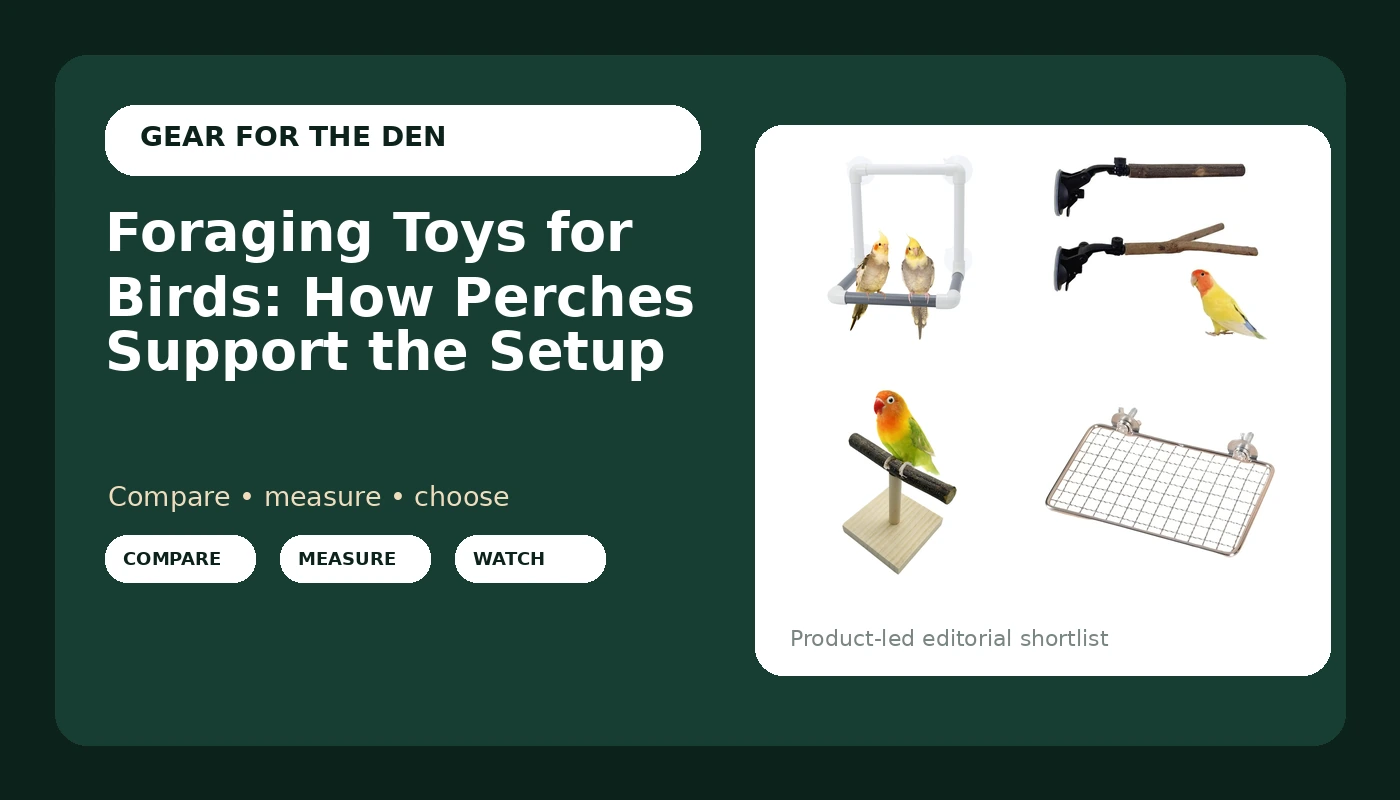
A foraging toy is only as useful as the surface the bird stands on while using it. The four products here are perches and platforms rather than toys: a suction cup window platform listed for larger parrots such as cockatoos, conures, cockatiels, and African greys; a two pack of 5.9 inch suction cup perches written for small birds and smooth glass; a free standing natural wood tabletop stand for parakeets, conures, finches, lovebirds, and cockatiels; and a stainless steel grid platform built around a moisture proof surface. Pick the one whose mounting method matches where the station will live, then scale foraging difficulty to the species. None of these is a foraging toy by itself, and none is the right answer for every bird.
Four options for a foraging station
| Model | Best fit | What stands out |
|---|---|---|
| Bird Portable Suction Cup Shower Perch Parrot Window Wall Standing Platform for Cockatoo Conure Cockatiel African Grey | Larger parrots, window or wall station | Suction cup platform listed for cockatoos, conures, cockatiels, and African greys |
| 2 PCS Parrot Perch Stand with Suction Cup, Window Perch for Birds, 5.9 Inch for Small Bird, Bird perches for Mirror Window | Small birds, glass at mirror height | Two 5.9 inch perches in one pack |
| Portable Tabletop Bird Perch, Parrot Training Stand, Natural Wood Bird Play Stands for Parakeets Conures Finches Lovebirds or Cockatiels | Free standing training and out of cage sessions | Natural wood stand that needs no mounting |
| Moisture Proof Metal Grid Perch Stand Bird Rest Platform, Multi-Function Stainless Steel Bird Perch Platform | Wet, messy, easy to clean stations | Stainless steel grid surface described as moisture proof |
The window-mount station: Bird Portable Suction Cup Shower Perch Parrot Window Wall Standing Platform for Cockatoo Conure Cockatiel African Grey
Suction cup platforms solve a space problem. Cage interiors fill up fast, and a window or a tiled wall gives a parrot a second territory that is easy to supervise. This platform is listed for cockatoos, conures, cockatiels, and African greys, so it is aimed at birds with enough strength to lean their whole weight onto the surface while they worry at a toy. That leverage is exactly why the mounting surface matters more than the platform itself. Suction cups hold best on clean, smooth, non porous glass and tile, and they release when dust, hard water film, or a textured wall breaks the seal. Wipe the glass, press each cup firmly, and check the hold every day before you leave the bird alone with the setup. Hang the first foraging toy within easy reach of the platform, then move it a little farther away once the bird is confident.
The small-bird pair: 2 PCS Parrot Perch Stand with Suction Cup, Window Perch for Birds, 5.9 Inch for Small Bird, Bird perches for Mirror Window
A two pack is more useful than it sounds. One perch can live on a mirror and the other on a window, or both can go up at different heights so the bird chooses where to eat. The listing puts these at 5.9 inches and describes them for small birds, which points to parakeets, lovebirds, and similar sizes rather than a cockatoo. For small species, perch diameter and bar spacing do more to decide comfort than platform size does: a bird should be able to wrap its toes most of the way around a surface without the feet overlapping. Because the suction cups are the weak point, mount these where a fall is short and soft, and never directly over a heat source, an open water bowl, or a hard floor. A mirror perch also gets the bird off the cage bars and into a spot you can actually watch.
The tabletop stand: Portable Tabletop Bird Perch, Parrot Training Stand, Natural Wood Bird Play Stands for Parakeets Conures Finches Lovebirds or Cockatiels
Not every foraging station has to hang on the cage or the glass. A free standing tabletop stand moves to the kitchen table, the desk, or the sofa, which makes it the natural base for training sessions and for supervised out of cage time. Natural wood gives the feet a texture to grip, and the stand's own footprint means it does not depend on a suction cup seal or a cage bar to stay upright. Because it sits at table height rather than cage height, it suits a bird that is learning to step up and stay put while you hide food inside a toy. Put a small dish or a food cup on or beside the stand so the reward has a landing spot, and set the whole thing on a tray liner if you would rather not wipe the table afterwards.
The easy-clean platform: Moisture Proof Metal Grid Perch Stand Bird Rest Platform, Multi-Function Stainless Steel Bird Perch Platform
Moisture is what kills cheap perches. A platform described as moisture proof and built from stainless steel with a grid surface is aimed at the messy end of bird keeping: soaked food, fruit, and the droppings that follow. A grid lets debris fall through instead of sitting under the bird's feet, and stainless steel wipes clean without soaking up water the way untreated wood does. That makes it a sensible base for a foraging station that uses wet or sticky rewards. Set it over a tray liner or a shallow tray so the crumbs land somewhere you can empty, and check the grid edges and the mounting hardware for wear as part of your weekly cleaning. It is a rest platform first, so pair it with a toy rather than expecting it to occupy the bird on its own.
Prices and availability may change. Product images, names, and retailer links are matched to verified listings. No current price, rating, stock status, or measured result is stated here without current evidence.
How foraging toys for birds fit into a daily routine
Foraging is the behavior, and the toy is only the container. In practice, keepers work with four broad types: shreddable items such as paper, palm leaf, and soft wood; hidden food containers the bird has to open or tip; puzzle and sliding toys that require one specific action; and hanging skewers or baskets that hold food in place while the bird works at it. The categories matter because they train different skills, and a bird that has seen only one type will often ignore a new one for days. The ideal foraging toys for birds are the ones that match the species' natural feeding behavior, not the ones with the most parts.
Foraging difficulty is the dial you turn. A beginner setup puts food in plain sight inside an open cup. The next step covers it with a single fold of paper. After that comes a container with a lid, then a puzzle with a latch, then a toy the bird must hold with a foot while it works. Move up only when the bird empties the current level quickly and without frustration, and step back down when it gives up and walks away. A bird that screams or plucks between meals is often a bird whose food arrives too easily, and a bird that ignores a toy completely is usually a bird whose toy is too hard. Choosing the correct foraging toys for birds starts with the bird's beak and feet, not with the price on the listing.
The perch underneath is part of that dial. Perch diameter decides whether the feet can grip, bar spacing decides whether the bird can reach the toy from the cage side, and cage height decides whether the station is somewhere the bird wants to spend time. A foraging station placed near the top of the cage, where most parrots already prefer to sit, gets used far more than one bolted at floor level. A swing mount is fine for a lightweight toy, but a heavy puzzle box needs a fixed point. Watch where the bird already eats, and build the station there.
What to check before you buy
Work through the checks in order, and the choice usually makes itself.
Mounting surface first. Suction cups need smooth, non porous, clean glass or tile. Painted walls, textured panels, and dusty windows hold for a while and then let go, which is a real risk with a bird that leans outward. Cage mounted perches instead depend on bar spacing: the gap between bars has to let the perch sit level without pinching toes or wobbling.
Bird size second. Every listing here names the species or size range it was written for, and that is the honest starting point. A perch sized for a parakeet will not carry a cockatoo's weight, and a platform aimed at a large parrot will look enormous in a finch cage.
Perch diameter third. Feet should wrap most of the way around a perch, with the toes not quite meeting underneath. Platforms are a different job: they are standing and resting surfaces, so the useful question is whether the bird can get on and off without slipping.
Cleaning fourth. Stainless steel and metal grid surfaces wipe down, natural wood needs to dry out between washes, and suction cups need the glass cleaned as often as the perch. A tray liner under the station catches what falls and makes the whole routine faster.
Food cup size and carrier size fifth. If the station will hold a dish of wet food, the cup needs to be shallow enough to reach and stable enough not to tip. If you plan to move the stand between rooms or into a carrier, measure the carrier size before buying a stand with a wide footprint.
- Measure the space and decide on the mounting surface: glass, wall, cage bars, or tabletop.
- Match the platform or perch to the bird's size using the species and dimensions stated in the listing.
- Set the station at a height the bird already chooses, usually the upper part of the cage or a window at eye level.
- Start with the easiest foraging difficulty and raise it only when the bird clears the current level quickly.
- Check suction cups, hardware, and the surface under the station daily, and clean on a fixed schedule.
Setting up a station that actually gets used
- Wipe the glass and the cups before mounting, and re-press the cups every morning.
- Put the first toy within easy reach, then move it one step farther once the bird is confident.
- Rotate two or three toys instead of leaving all of them in place at once.
- Use a tray liner or a shallow tray under wet or crumbly rewards.
- Watch the bird rather than the clock: a station ignored for a week needs an easier toy or a different spot.
Which option should you choose?
Choose the Bird Portable Suction Cup Shower Perch Parrot Window Wall Standing Platform for Cockatoo Conure Cockatiel African Grey when you want a window or wall station for a larger parrot and can check the suction cups daily. Choose the 2 PCS Parrot Perch Stand with Suction Cup, Window Perch for Birds, 5.9 Inch for Small Bird, Bird perches for Mirror Window when you keep small birds and want two low cost perches for a mirror or window. Choose the Portable Tabletop Bird Perch, Parrot Training Stand, Natural Wood Bird Play Stands for Parakeets Conures Finches Lovebirds or Cockatiels when training and supervised out of cage time matter more than cage real estate. Choose the Moisture Proof Metal Grid Perch Stand Bird Rest Platform, Multi-Function Stainless Steel Bird Perch Platform when wet food, fruit, and quick cleaning drive the decision.
A listing describes intended species and materials; it does not promise that a particular bird will use a station. None of these products is a foraging toy on its own, and none is described by the manufacturer as suitable for every species. Treat the mounting surface, the bird's size, and the foraging difficulty as the three variables you control.
The bottom line
Foraging toys for birds explained in one line: the toy is the puzzle, and the perch is the desk the bird solves it on. Start with the mounting surface you actually have, match the platform or perch to the bird's size, set it where the bird already spends its time, and raise foraging difficulty one step at a time. The suction cup window platform suits larger parrots, the two pack suits small birds on glass, the tabletop stand suits training sessions, and the stainless steel grid platform suits wet rewards and easy cleaning. Whichever you pick, the setup only works if the station stays clean, stable, and worth visiting.