Losing sight of your dog is a specific kind of panic, and the gear that gets them back is not the same gear that makes a walk pleasant. A gps dog collar for lost dogs is a small receiver that rides on the strap your dog already wears, reports a position to your phone, and gives you something better than a guess when a gate is left open. This is gps dog collar for lost dogs explained from the practical side: what the hardware actually does, where subscriptions enter the picture, and how to tell a tracker that suits your dog from one that only suits a product listing.
Quick answer
Most lost-dog recoveries come down to speed and line of sight, and a gps dog collar for lost dogs changes both by putting a position on your phone instead of leaving you to search blind. The practical answer is to buy by connection type rather than by feature list. Subscription models pay for the network that carries a position across distance. No-fee models avoid the recurring bill, and their listings explain how coverage is delivered instead. Add-on units extend a system you already run. Pick the failure you are most likely to face, then test the whole setup on an ordinary walk long before you need it. No tracker replaces a legible ID tag and a current microchip, so treat it as one layer of a plan.
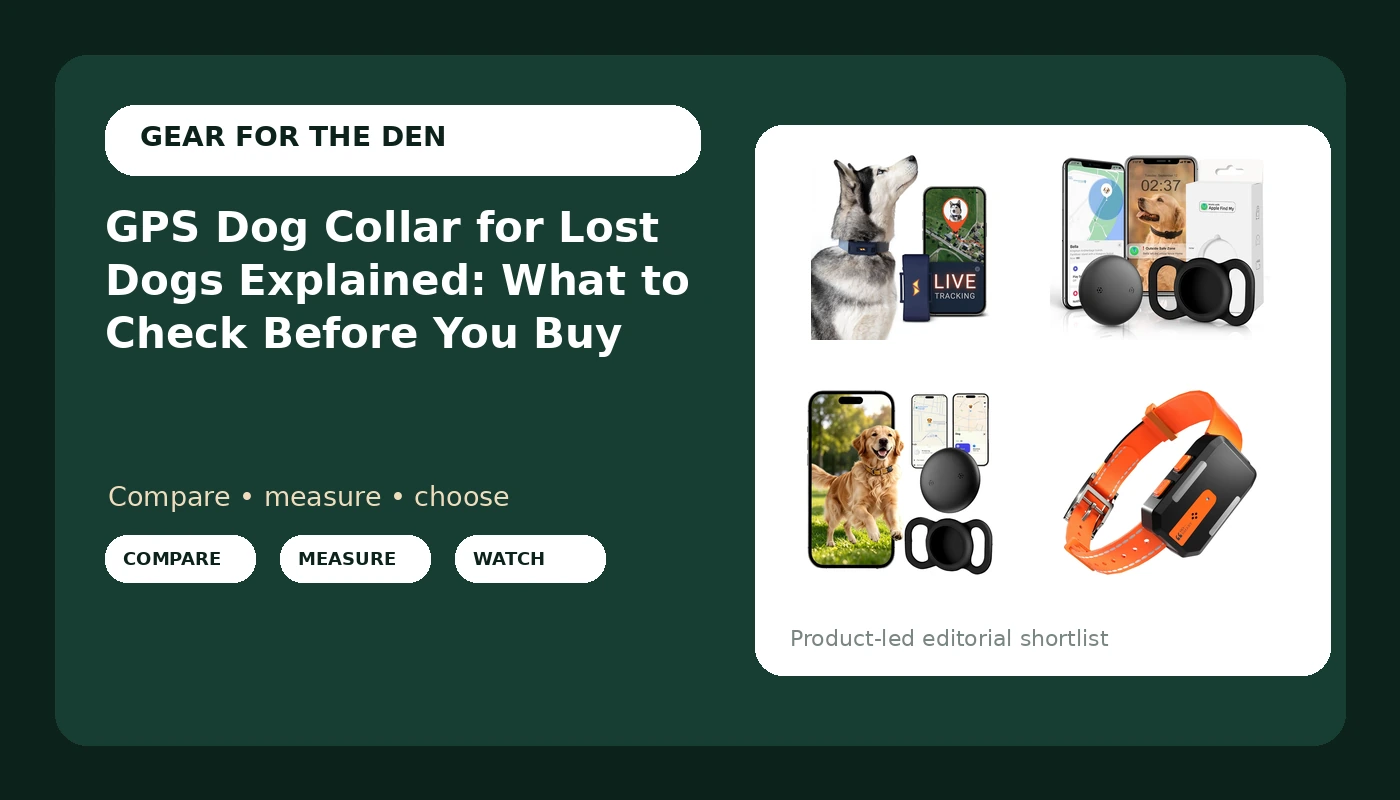
Four useful options
| Model | Best fit | What stands out |
|---|---|---|
| PAJ Dog GPS Tracker 3-Month Subscription Included, Real-time Pet Tracking | Owners who want service bundled at the start | Three months of subscription included with the tracker |
| iOS Smart GPS Dog Collar, Mini Pet Activity Tracker No Monthly fee 1 Pack | iPhone households that dislike subscriptions | No monthly fee, iOS pairing, mini housing with activity tracking |
| Dog Tracking for Collar – Smart Tracker Dog Collar D2 | Dogs already wearing a collar that fits well | Collar-mounted smart tracker sold as the tracking unit |
| No Monthly Fee Dog Tracker (Add‑On Unit Only), Off‑Grid GPS Collar Tracker | Owners extending a system they already own | Off-grid tracking with no monthly fee, add-on unit only |
Subscription included: PAJ Dog GPS Tracker 3-Month Subscription Included, Real-time Pet Tracking
A subscription is not automatically the wrong choice. A tracker that reports over long distances generally depends on a network that carries the position from the collar to your phone, and networks cost money to run. What the included three months buy you is a trial period with no separate activation step, which is genuinely useful, because the first week with any tracker is when you learn whether it fits your routine. The trade-off is the bill that arrives after the included term. Before you buy, find out what the service costs once the three months end, whether the tracker keeps working without an active plan, and whether the plan covers the areas you actually walk. A tracker you stop paying for is a piece of plastic on a collar, so treat the subscription as part of the purchase rather than an afterthought.
No monthly fee: iOS Smart GPS Dog Collar, Mini Pet Activity Tracker No Monthly fee 1 Pack
No monthly fee is the headline, and the details behind it are what decide whether it suits you. A tracker without a subscription has to move its position data another way, which often means a shorter working range, a handoff through your phone, or a base unit at home. This listing pairs the no-fee claim with iOS pairing, a mini housing, and pet activity tracking, so it reads as a device you leave on the collar all week and check for both location and daily movement. Two things are worth confirming in the listing before you order: how far tracking actually reaches in open ground and inside a house, and what your phone has to be doing for a position to appear. If your dog's likely escape route is a few streets, a no-fee unit can be enough. If it is a hundred acres of open field, it may not be.
Collar-mounted tracker: Dog Tracking for Collar – Smart Tracker Dog Collar D2
Collar-mounted trackers are the least disruptive design, because your dog keeps wearing the collar they already tolerate and you keep using the harness you already own. The trade-off is placement. Anything mounted on a collar sits exactly where a chest strap, a front clip, and a leash length all meet, so a chunky unit can change how a harness sits across the shoulders or catch on brush. Look at the dimensions and the attachment method, and think about whether the tracker will slide around the strap when the leash pulls tight. A tracker that ends up on the side of the neck is not a disaster, but one that swings under the chin will bother your dog on every walk, and a bothered dog is a dog that works at slipping a collar. Fit matters as much as the electronics here.
Off-grid add-on: No Monthly Fee Dog Tracker (Add‑On Unit Only), Off‑Grid GPS Collar Tracker
The add-on wording is the part to read twice. An add-on unit is a piece of a system rather than a starter kit, so it only makes sense if you already own the base hardware it pairs with, or if you are prepared to buy that hardware separately. In exchange, the listing describes off-grid tracking with no monthly fee, which is the combination people look for when they walk where cellular coverage is thin. Off-grid generally means the collar and the handset talk directly to each other over radio, which is why there is no network bill and why range becomes the number that matters most. Before ordering, confirm which system this unit extends and how far the radio link reaches. If you do not already own that system, the real cost is higher than this single listing.
Prices and availability may change. Product images, names, and retailer links are matched to verified listings. No current price, rating, stock status, or measured result is stated here without current evidence.
What a gps dog collar for lost dogs can and cannot tell you
A tracker does three separate jobs, and it helps to keep them apart: it works out where the dog is, it moves that information to you, and it shows it on a screen you can read while walking.
Positioning usually comes from satellite signals, which is why trackers work better outdoors with a clear view of the sky. Accuracy is a radius, not a dot. A position accurate to a few metres is good enough to spot a dog under a hedge. A position accurate to fifty metres in dense woodland is a starting point, not an answer.
Getting that position to you is the second job, and it is where the product categories split. Some trackers send data over a cellular network, which is why they charge a subscription. Some use a direct radio link between the collar and a handheld or a home base, which is why they can advertise no monthly fee and why gps range becomes the first number you check. Some use Bluetooth, which is fine inside the house and nearly useless two streets away.
The third job is the one people underestimate. A tracker tells you where the dog was when the last position was logged, not necessarily where the dog is now. Update frequency and battery life pull against each other: frequent updates drain the battery faster, and a long battery life usually means fewer positions. Neither setting is wrong. What matters is that you know which one you have before you need it, because a tracker that updates every few minutes is a very different tool from one that updates every few seconds.
Range, battery life, and the fit details that decide a purchase
The specification that decides whether a tracker helps you is gps range, meaning how far the collar can be from you, your phone, or your base unit and still report. Range figures are quoted for open ground, and houses, hills, and wet foliage all cut into them, so treat a quoted maximum as a best case. Think about the realistic distance your dog could travel: through a suburban block, down a ravine, across farmland.
Battery life is the second number. A tracker that needs charging every day will be flat exactly when you forget, so match the runtime to the longest stretch your dog spends outside and pick a charging habit you will actually keep.
Then there is fit, which is where a lot of trackers fail quietly. A collar-mounted unit should sit high on the neck, snug enough not to swing and light enough that your dog stops noticing it. If you walk in a harness, check that the chest strap and front clip are not crowded by the tracker, and that your leash length does not let the dog swing the unit into brush.
- Work out how far your dog could realistically travel if they bolted today.
- Choose the connection type: subscription network, direct radio, or Bluetooth.
- Match battery life to the longest stretch your dog is outside without you.
- Check the mount, size, and weight against the collar or harness you already use.
- Test the whole system on an ordinary walk, then keep ID tags and microchip details current anyway.
Practical setup and walking gear that supports the tracker
- Activate and register the tracker the day it arrives, then run a live test in the yard before you trust it.
- Build a charging routine around your longest walk of the week rather than around the low battery warning.
- Keep a legible ID tag on the collar and keep microchip details up to date; a tracker is a layer, not a replacement.
- Check harness fit before you add hardware: a snug chest strap, a front clip that does not pull sideways, and a leash length suited to the route.
- On hot pavement, boot sizing and a proper traction sole matter more than tracking does, and a bandana or harness liner in a cooling fabric helps on long summer walks.
Which option should you choose?
Choose the PAJ Dog GPS Tracker 3-Month Subscription Included, Real-time Pet Tracking when you want the service bundled at the start and you are comfortable with a recurring plan once the included term ends. Choose the iOS Smart GPS Dog Collar, Mini Pet Activity Tracker No Monthly fee 1 Pack when you use an iPhone and want location plus daily activity without a subscription. Choose the Dog Tracking for Collar – Smart Tracker Dog Collar D2 when your dog already wears a collar that fits well and you want the tracker to ride on it. Choose the No Monthly Fee Dog Tracker (Add‑On Unit Only), Off‑Grid GPS Collar Tracker when you already own a compatible system and walk where cellular coverage is thin.
There is no single ideal gps dog collar for lost dogs, because the correct gps dog collar for lost dogs is the one that matches your dog's size, your walking routes, and the way you want to pay. Listings describe features, not outcomes, and none of these units can be judged on recovery success from a product page. What you can check is the connection type, the range and battery claims, the mount, and whether the recurring cost fits your budget.
The bottom line
A tracker shortens a search; it does not guarantee an outcome. The decision that matters most is the connection model, because it sets the range, the recurring cost, and how often a position reaches you. Subscription units buy network coverage and an ongoing bill. No-fee units trade the bill for a different link, which is why their range claims deserve the closest reading. Add-on hardware is the cheapest way in only if you already own the system it extends. Whichever one you pick, run a live test on a normal walk, keep a legible ID tag and current microchip, and treat the electronics as one layer of a plan rather than the whole of it.