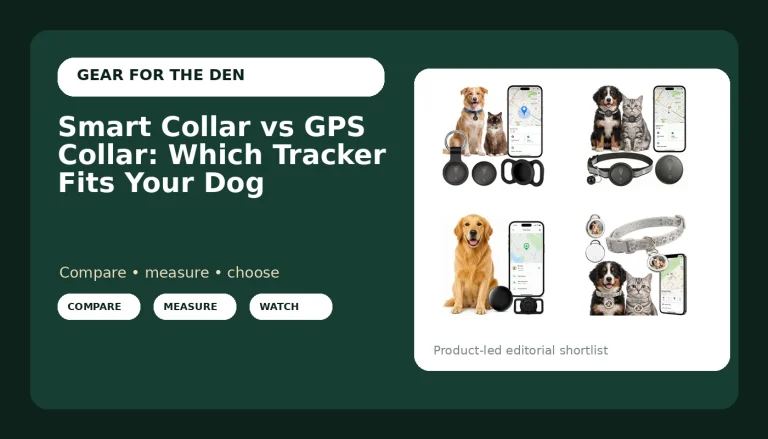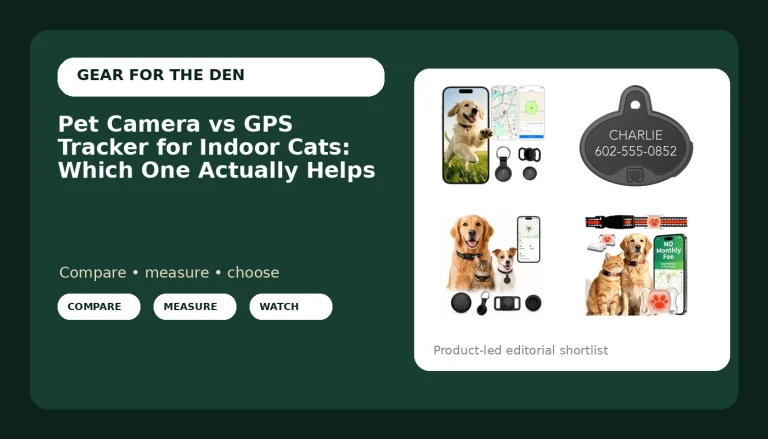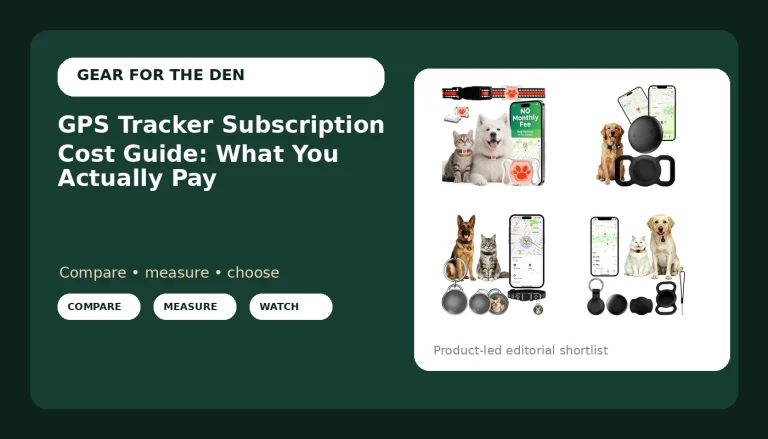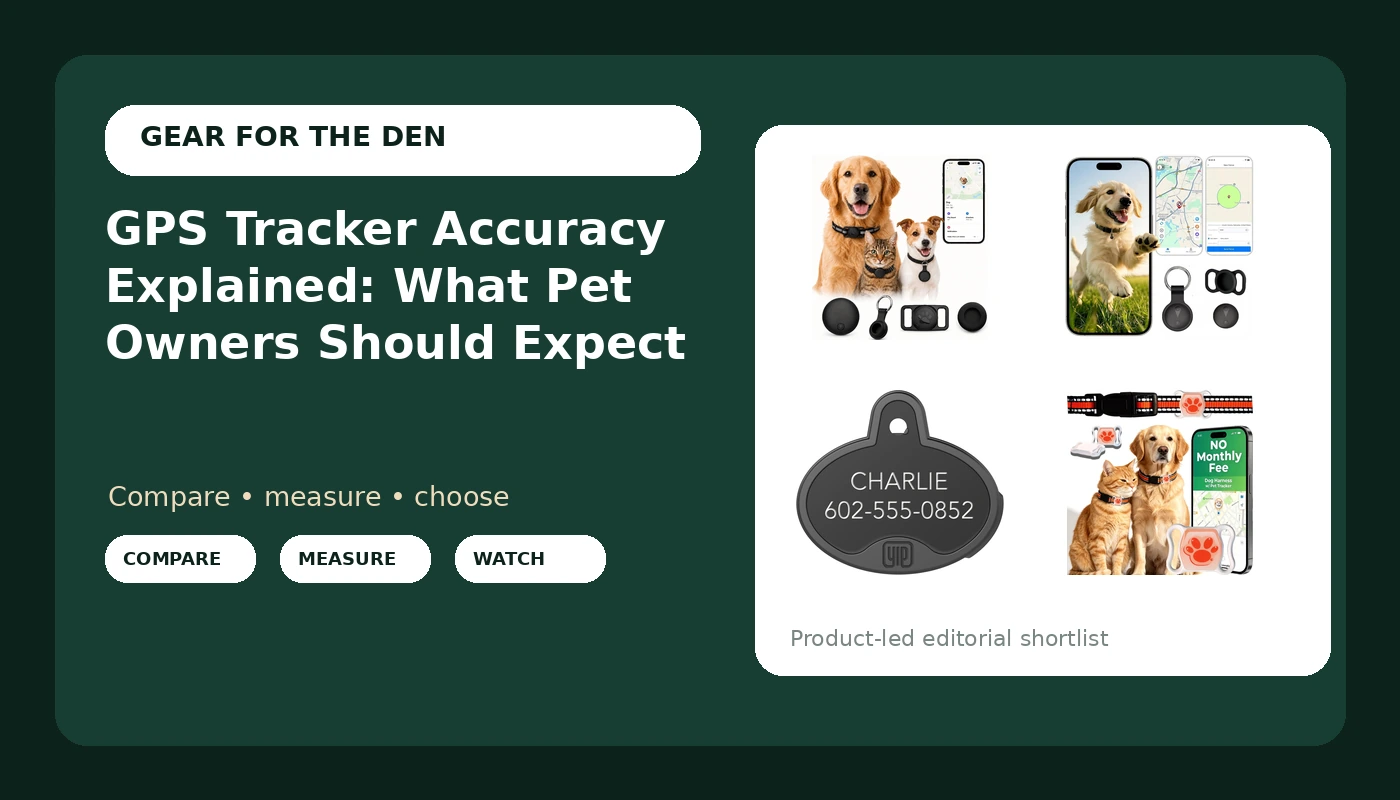
Losing a dog in tall grass, or watching a cat slip through a porch door and vanish under a parked car, is the moment most people start shopping for a tracker. The first question that follows is almost always about gps tracker accuracy, and it is the hardest question to answer honestly, because a pet tracker is not one device. It is a radio listening for satellite signals, a relay that hands that position to your phone, and an app that draws a pin on a map. Any of those three steps can be early, late, or slightly wrong. A tracker that puts the pin across a highway when your dog is in the next yard is worse than no tracker at all, because it sends you the wrong way at the moment you can least afford a wrong turn. This is gps tracker accuracy explained in plain terms: what the pin on the map actually represents, what moves it between walks, and how to match a tracker to the phone already in your pocket and the animal wearing it.
Quick answer
No single number describes gps tracker accuracy, and none of the four trackers below is the most accurate one in every situation. Accuracy shifts with sky view, with how often the device reports, with whether the animal is indoors or under heavy cover, and with which network your phone can join. A tag that reports through Apple Find My or a Samsung Galaxy relay behaves differently from a collar carrying its own receiver. Treat any advertised accuracy figure as a best case in open ground rather than a promise for your street. The practical measure is simpler: does the pin land close enough that you walk in the right direction within the first minute? That matters more than a tidy circle on the map five minutes later.
4 useful options
| Model | Best fit | What stands out |
|---|---|---|
| GPS Tracker for Dogs, Pet Location Tracker for Dogs & Cats, iOS Only(Black) | iPhone households that want a simple collar tag | Made for iOS devices only |
| Fecisumkeji GPS Pet Tracker for Dogs & Cats | Apple Find My Compatible | No Monthly Fee | IP68 Waterproof | Real-Time Location Tracking | Dogs and cats that get wet | Apple Find My compatible, no monthly fee, IP68 water resistance |
| YIP Smart Tag ID & Custom Engraved Dogs Tracker – Compatible with Samsung Galaxy (No GPS Subscription Or Monthly Fee) Pets Collar Location Oval Black | Galaxy owners who want engraving on the tag itself | Samsung Galaxy compatible, engraved ID, no subscription or monthly fee |
| Pet GPS Tracker for Dogs & Cats, Smart GPS Collar with Real‑Time Tracking | Owners who want the tracker built into a collar | Smart collar with real-time tracking |
iOS-only tag: GPS Tracker for Dogs, Pet Location Tracker for Dogs & Cats, iOS Only(Black)
A tracker that speaks only to iOS narrows the household to iPhones and iPads, and that is the whole trade. The upside is a simple setup: one ecosystem, one app, no second account to manage. The downside is that a partner, a dog walker, or a teenager carrying an Android phone cannot check the map on their own device. Decide up front whose phone will hold the app and whether that person is the one who walks the dog most days. If more than one person needs access, look at the Galaxy-compatible tag further down or a collar that carries its own receiver. The tag format also keeps the unit light, which suits cats and smaller dogs better than a bulky unit.
Waterproof Apple Find My tag: Fecisumkeji GPS Pet Tracker for Dogs & Cats | Apple Find My Compatible | No Monthly Fee | IP68 Waterproof | Real-Time Location Tracking
Water resistance is the spec that decides whether a tracker survives your routine. A dog that swims, rolls in wet grass every morning, or gets hosed off after a muddy walk puts a tag through more water than most electronics see in a year. An IP68 rating means the housing is sealed against dust and against prolonged immersion under the conditions the maker defines. It does not make the unit a dive computer, and it does not cover a charging port left open or a cracked shell. Inspect the seal whenever you wipe the tag down. If your winters drop well below freezing, check the stated working temperature too, because cold drains battery life long before it breaks anything.
Galaxy tag with engraving: YIP Smart Tag ID & Custom Engraved Dogs Tracker – Compatible with Samsung Galaxy (No GPS Subscription Or Monthly Fee) Pets Collar Location Oval Black
Engraved ID is worth more than most buyers expect. A tracker needs a charged battery and a working network to do anything at all, while an engraved name and phone number keeps working with no subscription and no power. For a cat that tours six gardens or a dog that backs out of a harness once a season, the pair covers both the fast local recovery and the slower digital search. The Galaxy compatibility is the real constraint: this fits the ecosystem you already use if your household runs on Samsung phones, and it does not help an iPhone household. A tag that reports through nearby phones also behaves differently in an empty park, which is worth knowing before you trust it.
Real-time collar: Pet GPS Tracker for Dogs & Cats, Smart GPS Collar with Real‑Time Tracking
Real-time tracking is the phrase to read carefully. It means the app refreshes the position on a schedule, not continuously, and every step down in update interval costs battery life. The collar form factor brings its own trade-off: a receiver sitting against the animal's body can have its antenna briefly blocked when the dog lies on that side or curls against a wall, so the fix can drop for a minute or two. A tag clipped to an existing collar has a smaller version of the same problem. What you see on the map is always the last successful report rather than a live view, so specs like camera resolution or portion accuracy, which belong to cameras and feeders, have nothing to do with it. Keep the collar fit rules for a small neck in mind if you are shopping for a cat or a toy breed.
Prices and availability may change. Product images, names, and retailer links are matched to verified listings. No current price, rating, stock status, or measured result is stated here without current evidence.
What gps tracker accuracy actually depends on
Two ideas get tangled together whenever tracking comes up: accuracy and precision. Accuracy is whether the pin sits in the right place. Precision is how small the reported circle around it is. A tracker can be precise and wrong, drawing a tight little circle two streets away from your dog, and it can be accurate but vague, drawing a wide ring that does happen to contain the animal. Apps rarely spell out which one you are looking at, so the first habit worth building is reading the uncertainty ring rather than the dot alone.
The second layer is delay. A pin is a snapshot from the last successful report, and that report may be a few seconds or several minutes old depending on how the device is configured. If your dog is trotting, a two-minute-old fix can be a block behind the animal. That is not a defect; it is the price of stretching battery life across a week rather than an afternoon.
Sky view matters more than most spec sheets admit. Open field, clear line to the horizon, and the fix settles quickly. A narrow street between tall buildings, dense tree canopy, the inside of a car, or a basement can all delay or bend the position. Radio signals bounce off hard surfaces, and a bounce the receiver accepts adds distance to the answer.
The animal itself is the last variable. A tag tucked under a collar, pressed against a warm body, or slid under a couch cushion does not hear the same sky as one hanging free. Battery life, signal range, and how the app handles a lost fix all shape what you actually see. There is no ideal gps tracker accuracy that covers every home, because the conditions change street by street and even hour by hour. None of this makes a tracker useless. It makes the map a strong hint that improves the moment you start walking toward it.
Subscription, battery life, and signal range: what moves the pin between walks
Subscription is the first thing to settle, because it changes the total cost of ownership more than any hardware detail. Some trackers include network access with the device and charge nothing monthly; others need a data plan to report a position at all. A no-subscription tag usually reports through phones that happen to be nearby, which works well in a busy neighborhood and less well on a quiet farm. Neither model is wrong. They are built for different places.
Battery life and update rate pull against each other in every design. A tracker that reports every few seconds gives you a smoother trail and needs charging far more often than one that reports every few minutes. If the collar only has to work on weekend hikes, a slower interval is a fair trade. If your cat bolts at dusk and you need a fast trail, plan a charging routine and keep a power backup by the door so a flat tag never catches you out.
Signal range depends on the path, not just the distance. A relay that hops through nearby phones can pass a position along from a surprising distance in a crowded area and can go quiet in an empty one. App pairing is the last piece: pair the tracker while you are calm at home, walk the route you use every day, and watch how the pin behaves before you rely on it during an actual escape.
- Confirm which phone ecosystem will hold the app, because an iOS-only tracker and a Samsung Galaxy tag are not interchangeable.
- Match the hardware to the animal: a light tag for a cat, a collar-mounted unit for a strong dog that pulls.
- Check water resistance against your real routine, not the one you wish you had.
- Decide whether you want a monthly subscription or a no-fee tag that leans on nearby phones.
- Pair the app at home, then test the live map on an ordinary walk before you need it in an emergency.
Practical guidance for the first week
- Fit the tracker so it cannot slide off the collar but also cannot press into the throat; two fingers of slack under the strap is a common starting point.
- Run a full charge cycle and note how long the battery actually lasts in your routine rather than trusting the box.
- Walk one familiar block and watch how far the pin drifts; that drift is your real working accuracy.
- Turn on any alert that tells you the tracker has stopped reporting, so a dead battery becomes a message rather than a surprise.
- Keep a plain engraved ID on the collar alongside the tracker, because electronics fail and engraving does not.
The correct gps tracker accuracy for your situation is simply the one that gets you walking in the right direction while the trail is still fresh. Chasing a perfect circle on a map is a waste of a Saturday.
Which option should you choose?
Choose the GPS Tracker for Dogs, Pet Location Tracker for Dogs & Cats, iOS Only(Black) when everyone who needs the map carries an iPhone and you want the simplest possible tag. Choose the Fecisumkeji GPS Pet Tracker for Dogs & Cats | Apple Find My Compatible | No Monthly Fee | IP68 Waterproof | Real-Time Location Tracking when your animal swims, works in wet weather, or destroys anything that is not sealed. Choose the YIP Smart Tag ID & Custom Engraved Dogs Tracker – Compatible with Samsung Galaxy (No GPS Subscription Or Monthly Fee) Pets Collar Location Oval Black when your household runs on Galaxy phones and you want the ID cut into the tag itself. Choose the Pet GPS Tracker for Dogs & Cats, Smart GPS Collar with Real‑Time Tracking when you want the receiver built into the collar rather than clipped onto one you already own.
Every performance figure on a product page is a maker's claim until it is measured on your street, and no listing here includes a verified accuracy figure, a live rating, or a current price. The sensible move is to buy where returns are straightforward, test the tracker on your own route, and send it back if the pin wanders further than you can live with.
The bottom line
The honest answer to gps tracker accuracy is that it depends less on the box than on where you walk, how often the tracker reports, and which network it can reach. Pick the ecosystem your phone already uses, check water resistance and battery life against a real week rather than a perfect one, and run the live map on a normal walk before you need it in a hurry. A tracker that puts you on the right street within the first minute is doing its job. One that draws a beautiful circle around the wrong garden is not, no matter what the listing says.