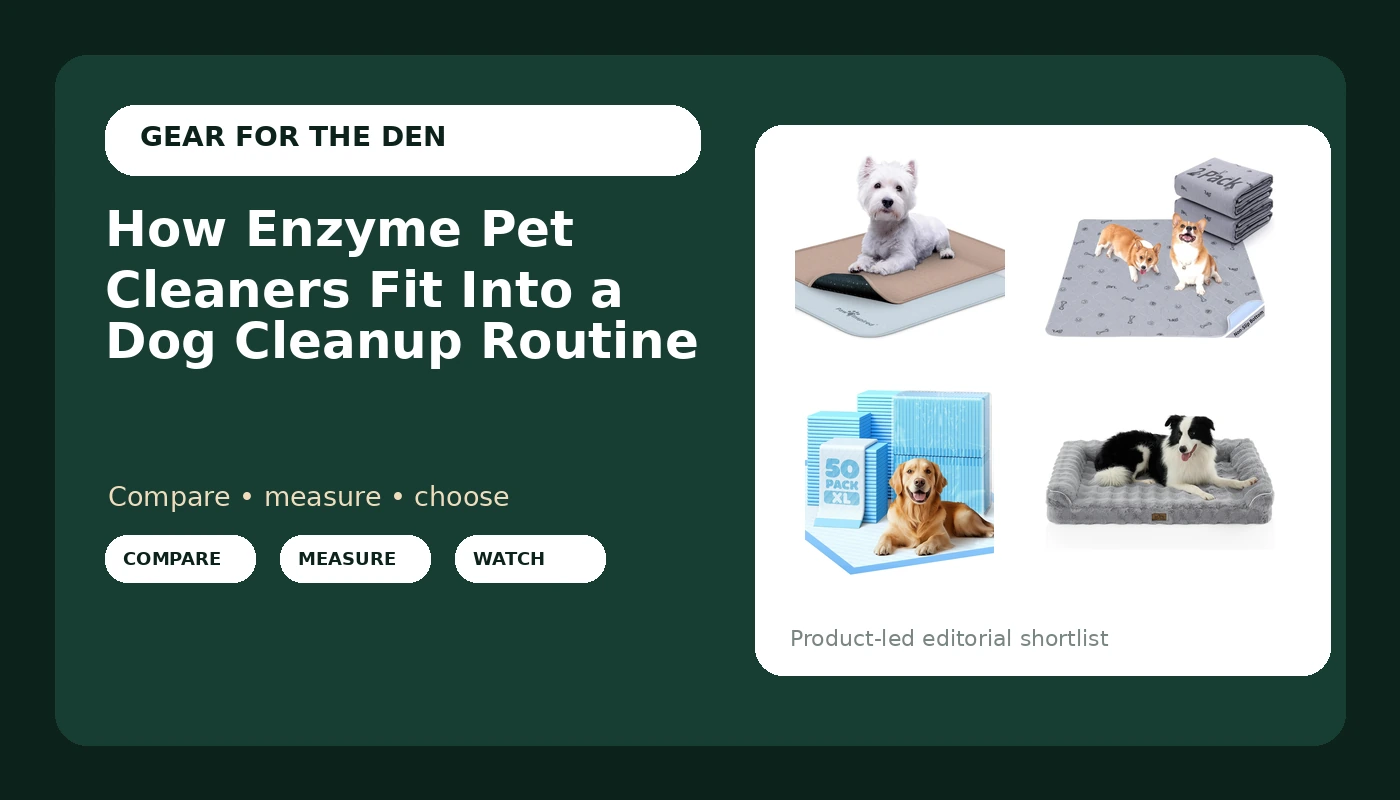
Dog messes are rarely a one-step problem. Urine soaks into fabric, odor lingers after the floor looks clean, and the gear that catches the worst of it has to survive repeated washing. That tangle sits behind most searches for enzyme pet cleaners, and it is also why this enzyme pet cleaners explained guide starts with the biology rather than with a shopping list. An enzyme cleaner is not a stronger version of a general household spray. It is a different category of product that depends on biological activity, contact time, and actually reaching the source of the smell. The absorbent layers around it decide how much of that source ever touches the floor, the couch, or the crate pan.
Quick answer
Enzyme cleaners use enzymes such as protease, amylase, lipase, and sometimes urease to break down the proteins, starches, fats, and uric acid crystals left behind by urine, feces, vomit, and similar organic messes. They work through contact time rather than force, so the treated area usually needs to stay wet for several minutes to a few hours, depending on the enzyme concentration and the directions on the label. They are not automatically disinfectants, and a product labeled only as an enzyme cleaner does not replace one labeled for sanitizing or disinfecting. The gear around the cleaner matters just as much: pad absorbency, pad size, liner waterproofing, and machine washable construction decide how much liquid ever reaches the surface you are trying to protect.
4 useful options
| Model | Best fit | What stands out |
|---|---|---|
| Paw Inspired Washable Crate Liners for Dogs, 24×18 Inch, 2 Pack | Crate floors and travel setups | Two washable liners listed at 24 by 18 inches |
| Washable Pee Pads for Dogs, 2Pack Puppy Pads Washable with Bone Print | Reusable floor and furniture protection | Two reusable 31 by 36 inch pads with a non-slip backing |
| Powools Puppy Pads for Dogs, 34×28 in, 6-Layer Leakproof, 50-Pack | Heavy-volume or temporary setups | 50 disposable pads with six-layer leakproof construction |
| COZY KISS Orthopedic XL Dog Bed for Large Dog, Washable Pet Bed | Senior and large dogs | XL orthopedic bed with a washable build |
Crate liner: Paw Inspired Washable Crate Liners for Dogs, 24×18 Inch, 2 Pack
Sizing is the first thing to get right with any crate liner. A liner that is too small leaves bare pan at the edges, and one that is too large bunches up under the dog. Liner waterproofing is the second detail worth confirming on a listing, because a washable top fabric that lets liquid pass straight through protects the dog from a cold pan and little else. For a heavy chewer or a determined digger, a fabric liner is a poor match no matter how well it washes.
Reusable pad: Washable Pee Pads for Dogs, 2Pack Puppy Pads Washable with Bone Print, Absorbent Reusable Whelping Pads Non-Slip Dog Mats for Floor Protector, Couch Cover, Crate, Potty Training 31×36
Reusable pads trade a purchase cycle for a laundry cycle. Pad absorbency and a non-slip backing are the two features that decide whether a pad stays where you put it and holds what it is given; the bone print is cosmetic. Because a 31 by 36 inch pad covers a generous area, it works as a couch cover or a whelping surface as well as a training pad. Follow the care label and keep both pads in rotation so one can dry while the other is in use.
Disposable pad: Powools Puppy Pads for Dogs, 34×28 in, 6-Layer Leakproof, 50-Pack
Disposable pads remove laundry from the equation but add waste and a recurring purchase. A multi-layer build is aimed at holding liquid rather than letting it wick to the floor, and with any pad the edges matter as much as the center, because that is where a puddle spreads first. For a puppy being carried outside every two hours, disposables keep the routine simple. For a settled adult dog with occasional leakage, a washable pad usually suits the job better.
Washable bed: COZY KISS Orthopedic XL Dog Bed for Large Dog, Washable Pet Bed
Bedding is the part of the cleanup routine people forget. A senior dog that leaks overnight soaks the bed, not just the pad, and an enzyme cleaner sprayed on the surface of a thick bed rarely reaches the filling inside. A washable cover or a fully washable bed lets you deal with the fabric properly instead of layering fragrance on top of it. Read the care instructions before buying, since some covers are machine washable while the inner cushion is spot clean only, and a bed that cannot be washed is a bed that keeps odor.
Prices and availability may change. Product images, names, and retailer links are matched to verified listings. No current price, rating, stock status, or measured result is stated here without current evidence.
What enzyme pet cleaners actually do
Enzymes are proteins that speed up specific chemical reactions. In a cleaner, a blend typically targets the compounds in pet waste: protease breaks down proteins found in urine, blood, vomit, and feces, amylase works on starches, and lipase addresses fats and oils. Some formulas also include urease, which acts on urea, while the stubborn part of an old urine stain is uric acid, a crystal that bonds to fibers and re-releases odor when humidity rises.
That crystal is the reason a spot can smell again weeks after it looked clean. A general purpose spray may remove the visible stain and cover the smell with fragrance, while an enzyme product works on the residue itself and functions as an odor neutralizer rather than a cover-up. This is also why enzyme pet cleaners are judged on dwell time rather than on how aggressively they foam.
Contact time is the whole mechanism. Enzyme concentration in the bottle is not the same as concentration on the surface, because dilution, how wet you leave the area, and how long it stays wet all decide how much work gets done. If the area dries in two minutes, the reaction stops. Many labels ask for the treated area to stay damp for ten minutes or longer, and some ask for considerably more with a damp towel placed over the spot.
Enzymes are sensitive to their surroundings. Hot water, bleach, and some strong disinfectants can deactivate them, which is why labels usually instruct you to clean the solid mess first, then apply the enzyme product to the residue. Storage matters too, since a bottle left in a hot garage may not perform the way it did when new. Labels often state that a formula is carpet safe and fabric safe for the materials listed, but that guidance is specific to those materials, and leather, suede, and untreated wood are usually excluded.
Reading a label and matching the gear to the mess
The differences that matter on a label are not the ones printed largest on the front. Look for which enzymes are listed, the stated dwell time, and any surface warnings. Then note what the product does not claim: an enzyme cleaner that says nothing about disinfecting leaves bacteria behind, and cleaning and disinfecting are separate steps that may need separate products. The ideal enzyme pet cleaners for a carpeted apartment with one senior dog are not the same as what suits a tiled whelping setup, because carpet holds residue and needs a longer dwell and more rinsing, while tile wipes clean quickly but sends liquid into grout lines.
Choosing the correct enzyme pet cleaners usually comes down to three details: the enzymes on the label, how long the surface must stay wet, and whether the formula is appropriate for the material you are treating. The routine around the product follows the same logic.
- Identify the mess before you treat it. Fresh urine, dried urine, feces, and vomit respond at different speeds, and old residue usually needs to be re-wetted before an enzyme product can reach it.
- Remove solids and blot standing liquid first. An enzyme cleaner is not a debris remover, and the enzymes need contact with the residue rather than with a puddle.
- Test in an inconspicuous spot on carpet, upholstery, or any surface you cannot replace.
- Apply enough product to reach the source, not just to dampen the surface, and keep the area wet for the full dwell time the label states.
- Let the area dry on its own rather than rinsing early or speeding it up with heat, then repeat if odor returns once the surface is dry.
Practical guidance for pads, liners, and bedding
- Match pad size to the surface, not to the dog. A pad that is smaller than the splash zone fails at the edges.
- Judge pad absorbency by layer count and construction rather than by thickness alone, since a puffier pad is not automatically more absorbent.
- Confirm liner waterproofing before trusting a liner to protect a crate pan or a car seat.
- Keep two washable items in rotation so one can be laundered while the other is in use, and check whether each item is machine washable or spot clean only.
- Store enzyme cleaners as the label directs, away from heat, so the enzyme concentration holds up between uses.
Which option should you choose?
Choose the Paw Inspired Washable Crate Liners for Dogs, 24×18 Inch, 2 Pack when accidents happen inside a crate and you want a layer you can pull out and launder. Choose the Washable Pee Pads for Dogs, 2Pack Puppy Pads Washable with Bone Print when you need reusable protection for floors, couches, whelping boxes, or a training area and you are willing to run a laundry load. Choose the Powools Puppy Pads for Dogs, 34×28 in, 6-Layer Leakproof, 50-Pack when volume is high, the setup is temporary, or laundry is not realistic right now. Choose the COZY KISS Orthopedic XL Dog Bed for Large Dog, Washable Pet Bed when the sleeping surface itself is getting soiled, particularly for a large or senior dog. If the mess is coming from a litter box rather than a crate, our guide to cat litter box odor control covers that side of the house.
None of these products replaces an enzyme cleaner, and none of them is a disinfectant. The cleaner handles the residue, while the pads, liners, and bedding handle the volume of liquid. If odor returns after a surface dries, that is a sign the residue was not fully reached rather than a sign that a stronger-smelling product is needed.
The bottom line
Enzyme pet cleaners work on a different principle from general purpose sprays. They rely on enzymes, contact time, and moisture, and they are only as good as the coverage and dwell time you give them. Choose the cleaner by the enzymes listed and the stated dwell time, and choose the gear around it by pad absorbency, pad size, liner waterproofing, and whether each item is machine washable. Get both halves of that routine right and cleanup stops being an emergency, whether the mess lands on a crate pan, a training pad, or the bed of a senior dog.