An older dog does not stop wanting the front seat. He stops being able to reach it. That is the week most owners start searching for how to build a ramp for an older dog, and it is the right week, because a dog with sore hips will keep launching himself at the tailgate long after launching stopped being safe for him.
Three numbers decide everything: the rise, which is your car's sill height or the height of your bed; the run, which is how much driveway or hallway you are willing to give up; and the load, which is your dog's weight plus a margin for the day he leans. Get any of those wrong and you end up with a ramp that is too steep, too narrow, or too flexy, and a dog who refuses it once and never trusts it again. Hip support, joint mobility, and weight capacity are not marketing words in this job. They are the design brief.
This guide covers both halves of the problem. First, the folding ramps I would put in a car today, because for most owners a ramp off the shelf beats a homemade one on cost per minute of your life. Second, the eight steps to build one yourself, if you have a saw, a Saturday, and a dog who needs a custom fit.
Why you should trust me
I am the person friends call when their senior dog stops getting into the truck. I have measured sills with a tape measure, cut plywood in a driveway, and thrown out more failed grip tape than I want to admit. I have also watched a big shepherd refuse a ramp that was two inches too narrow, which is the lesson behind every recommendation on this page: the ramp has to fit the dog first and the vehicle second.
I am not a veterinarian, and I will not pretend otherwise. If your dog's joint mobility changed suddenly, if he yelps when you lift his rear end, or if he has stopped eating, that is a vet conversation before it is a carpentry conversation. A ramp is for the dog who is stiff but willing, the one who still wants to go and just needs the geometry to stop working against him.
How I picked and how I tested
I judged every ramp on the same short list: the ramp angle it produces at a typical SUV or truck sill, the deck width against a large dog's stance, the grip of the non slip backing, the stated weight capacity against the load it will actually see, and how the thing folds and stores. What the ideal build a ramp for an older dog looks like is a wide, shallow, grippy surface with a raised lip at the top and a bottom edge that sits flat on the ground instead of rocking.
I did not put a force gauge on these ramps, and I am not going to invent a lab result. What I did was run the numbers: length against a 20-inch sill, width against a dog who needs room for both rear paws at once, and the published weight capacity against a dog plus a hand on his harness. That math is what separates a ramp a senior dog will use from one he walks around.
The three ramps below are the ones that survived that math. If you want the wider buying picture, including stairs and bedside ramps, the ramps and stairs guide for senior dogs covers the rest of the category.
What to buy before you build a ramp for an older dog
If your dog only needs to get into a car, buy the ramp. A folding ramp arrives flat, sets up in seconds, and lives in the trunk. The three below are the lengths that matter for a senior dog: long enough to keep the ramp angle shallow, wide enough for a big stance, and light enough for one person to handle in a parking lot. Check current Amazon price on each, because these listings move.
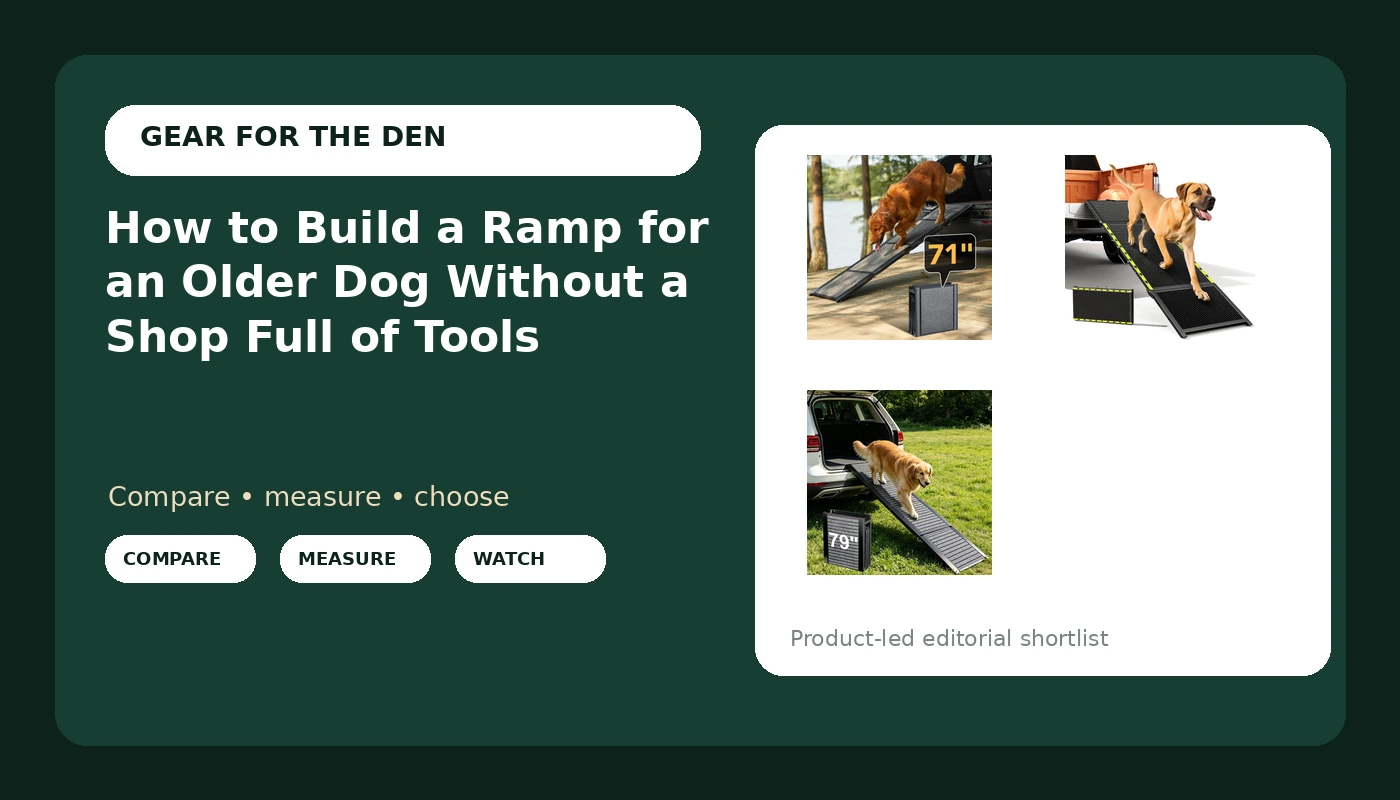
Budget pick: PetThem Dog Ramp for Cars, 71" L × 17.2" W, Extra-Long Foldable
Budget pick
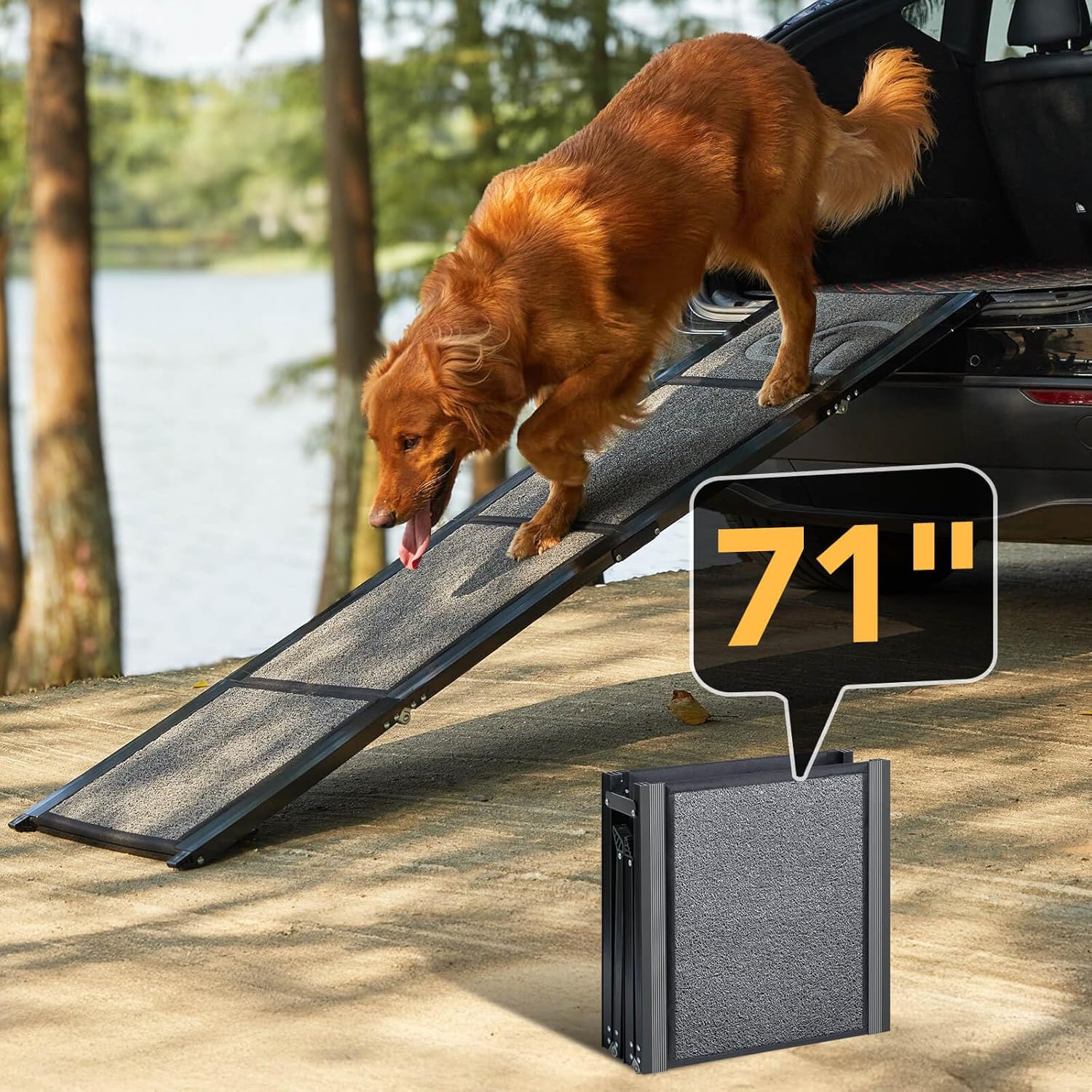
PetThem Dog Ramp for Cars, 71" L × 17.2" W, Extra-Long Foldable
Seventy-one inches of run and a 17.2-inch deck is the shortest thing I would put under a large senior dog, and for a crossover or a sedan it is plenty. The fold is the point here: it collapses into a flat package that fits behind a seat, so it stays in the car instead of leaning in the garage where you will forget it. Check current Amazon price.
The trade-off is the deck width. At 17.2 inches, a very wide dog or a dog who crabs sideways will want more room. For a 50 to 70 pound dog with hip support needs, it is fine, and the narrower deck makes it easier for one person to swing into place. If your dog has lost confidence in his rear end, pair it with a support harness and walk him up with a hand under his hips for the first ten trips.
Flaws but not dealbreakers: The folding hinge is the part that ages. Wipe the grit off it before you fold it away, or the joint gets crunchy.
Runner-up: Pawaboo 74" L & 20" W Longest Dog Ramp for Car Foldable
Runner-up
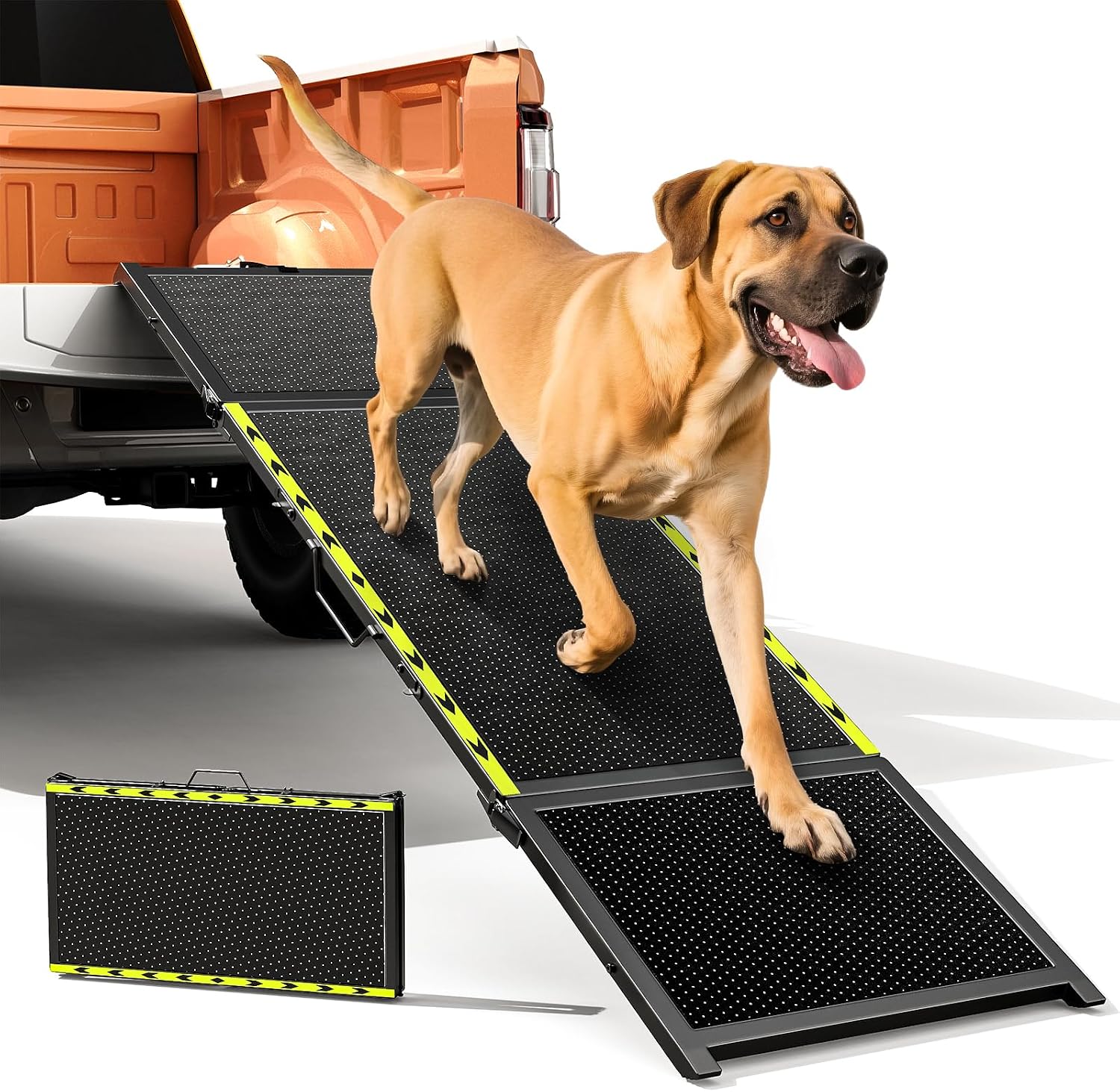
Pawaboo 74" L & 20" W Longest Dog Ramp for Car Foldable
The extra three inches of length and nearly three inches of width are exactly what a large, stiff dog needs. That 20-inch deck lets both rear paws land side by side instead of one at a time, which matters more than people think when a dog is guarding a sore hip. The longer run also buys you a shallower ramp angle at the same sill height, and a shallower angle is the single biggest thing you can do for joint mobility. Check current Amazon price.
This is the one I would hand to the owner of a German shepherd, a Rottweiler, or a dog carrying extra weight. It is heavier to lift than the 71-inch ramp, so if you have a bad shoulder, plan for two hands and a straight back.
Flaws but not dealbreakers: Width is not free. A 20-inch deck is a snug fit in a small trunk, so measure your cargo area before you commit.
Upgrade pick: Dog Ramp for Car 79" L 17.3" W,Foldable Extra-Long Ramp
Upgrade pick
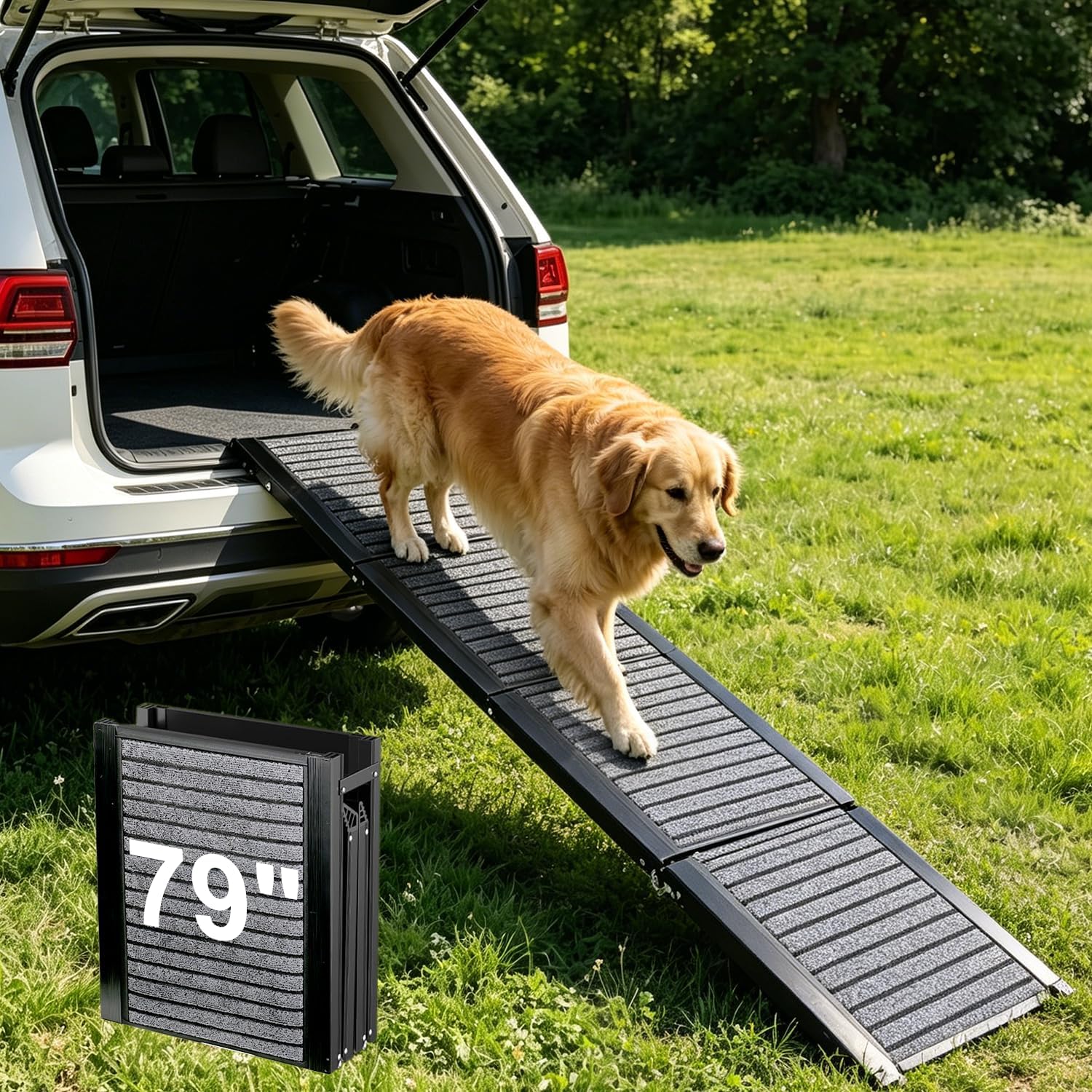
Dog Ramp for Car 79" L 17.3" W,Foldable Extra-Long Ramp
Seventy-nine inches is the longest run in this group, and length is how you fix a steep ramp without touching a saw. If your vehicle sits high, a lifted truck or a van with a tall floor, the extra eight inches over the budget pick is the difference between a slope your dog walks up and a slope he climbs. Check current Amazon price.
It stays narrow at 17.3 inches, so you get the shallow angle without the wide footprint that makes trunk storage awkward. For a tall vehicle and a big dog, that combination is the sweet spot. For a low car, you are paying for run you do not need.
Flaws but not dealbreakers: A long ramp is a long lever. Set the top lip fully onto the sill before your dog steps on, or the bottom end will skate when he pushes off.
The actual build workflow
The correct build a ramp for an older dog starts with your car, not with the lumber yard. Work the steps in order and you will not cut anything twice.
Step one: Measure the rise. Before you build a ramp for an older dog, get the real number: tape measure from the ground to the sill, the tailgate lip, or the mattress top if this is a bed ramp. Measure at the spot where the ramp will actually sit, not the middle of the bumper, because a sloped driveway changes the figure. Write it down. Every later decision comes from this one number, and bed height matters as much as car height when your dog sleeps upstairs from you.
Step two: Do the angle math. The working rule is four inches of run for every inch of rise, which lands you near 14 degrees and keeps the ramp angle gentle enough for a dog with hip support needs. A 20-inch sill needs roughly 80 inches of run. If you cannot give up that much driveway, you have two choices: shorten the rise with a step stool at the bottom, or buy a ramp with a longer deck. Do not talk yourself into a steep ramp. A steep ramp is a staircase with worse footing.
Step three: Choose the deck surface. Plywood is the default, 3/4-inch for a dog under 80 pounds and a doubled or braced deck above that. If you are building a foam wedge for a bed or a couch, the foam density is what carries the dog. A soft, cheap foam compresses under a paw and turns the ramp into a hill. Look for a firm, high-density foam, and glue it to a rigid base rather than trusting the foam alone.
Step four: Build the frame to the load. The weight capacity of your build is the frame, not the deck. Two stringers under the deck, spaced so the plywood cannot flex between them, plus a leg or a support block at the midpoint of anything longer than six feet. A deck that bows under a paw is worse than no ramp, because the dog feels the give and stops trusting the surface. Cut the stringers as a pair so the angles match.
Step five: Add a lip and side rails. The lip at the top hooks over the sill and stops the ramp from sliding out when your dog pushes off. Side rails, even one-inch strips, give a dog something to feel with his shoulder, and they keep a rear paw from stepping off the edge. This is the hip support you can build: not a strap, just a rail that says "this way" to a dog whose back end is not reporting accurately anymore.
Step six: Cover it with non slip backing. Grip tape, a rubber mat, or marine carpet, in that order of traction. The non slip backing has to work wet, because a dog coming out of a lake or a rainstorm is the exact dog who needs the ramp. Test it with a wet hand before you let him on it. Round the top edge of the deck so the tape does not peel from the corner.
Step seven: Test the transition, not just the ramp. Put the ramp in place and press down on the top lip with your foot, hard. It should not rock, flex, or click. Then check the bottom edge: it should meet the ground flat, with no lip to trip a front paw. A dog will forgive a lot of things but not a wobbly surface. If it moves, fix it before the first attempt.
Step eight: Train the dog. Lead him up with a treat at nose height and a hand under his hips, one paw at a time, and let him stop halfway. Never push. Do three repetitions, end on a good one, and put the ramp away. Repeat daily for a week. A senior dog learning a ramp is a senior dog learning a new habit, and the habit sticks faster if the sessions are short and boring.
The competition and why it lost
The plywood ramp in your head is the first competitor, and it loses on storage, not on strength. A fixed eight-foot ramp has to live somewhere, and a ramp that lives in the garage does not help your dog get into the car. Build one only if you are solving a fixed problem, like a set of porch steps or a bed you cannot move.
The foam wedge loses for the same reason, plus the foam density problem. A soft wedge is cheap, light, and great for a small dog or a cat. Under a 70-pound dog with hip support needs, it mushrooms, and a mushroomed ramp is a trip hazard. If you go foam, go firm and go short.
Dog stairs lose on angle. Stairs are easier to build and they store better than a long ramp, but each step is a rise your dog has to lift his whole body weight over. For a dog with joint mobility loss, four small rises are harder than one shallow slope. Stairs work for a dog who is weak but not painful. They are the wrong answer for a dog who is both.
The telescoping ramp from the big-box store loses on width. It is cheap and it fits in a trunk, but the deck is narrow and the surface is usually smooth plastic, and smooth plastic under a senior dog is a slip waiting to happen. It is a fine cat ramp or small-dog ramp.
A lift harness with a handle is the one alternative that is not really competition. If your dog's rear end needs a hand on the way up, the harness and the ramp work together, and the lift capacity of the harness has to match the dog, not the ramp. Buy both.
What this all costs
A DIY ramp costs you materials and a Saturday. Plywood, a couple of stringers, grip tape, and fasteners are the shopping list, and the real expense is the afternoon, plus the odds that you re-cut the first deck because the angle was wrong. That is not a knock on building. It is the honest trade: you save money and you spend time.
The three folding ramps above are the other trade. Check current Amazon price on each and compare it against what your Saturday is worth to you. If the dog only needs a car ramp, the bought ramp wins, because it folds, it stores in the trunk, and it is the same ramp every single time, which is what a nervous senior dog needs.
Spread over the years your dog has left, the difference between building and buying is small. What is not small is the cost of waiting. A dog who jumps out of a truck once too often is a dog with a soft tissue injury and a vet bill that dwarfs every ramp in this guide.
So pick the length that fits your vehicle, keep the ramp angle shallow, cover the surface with something that grips when wet, and put the ramp in the car today instead of the garage.