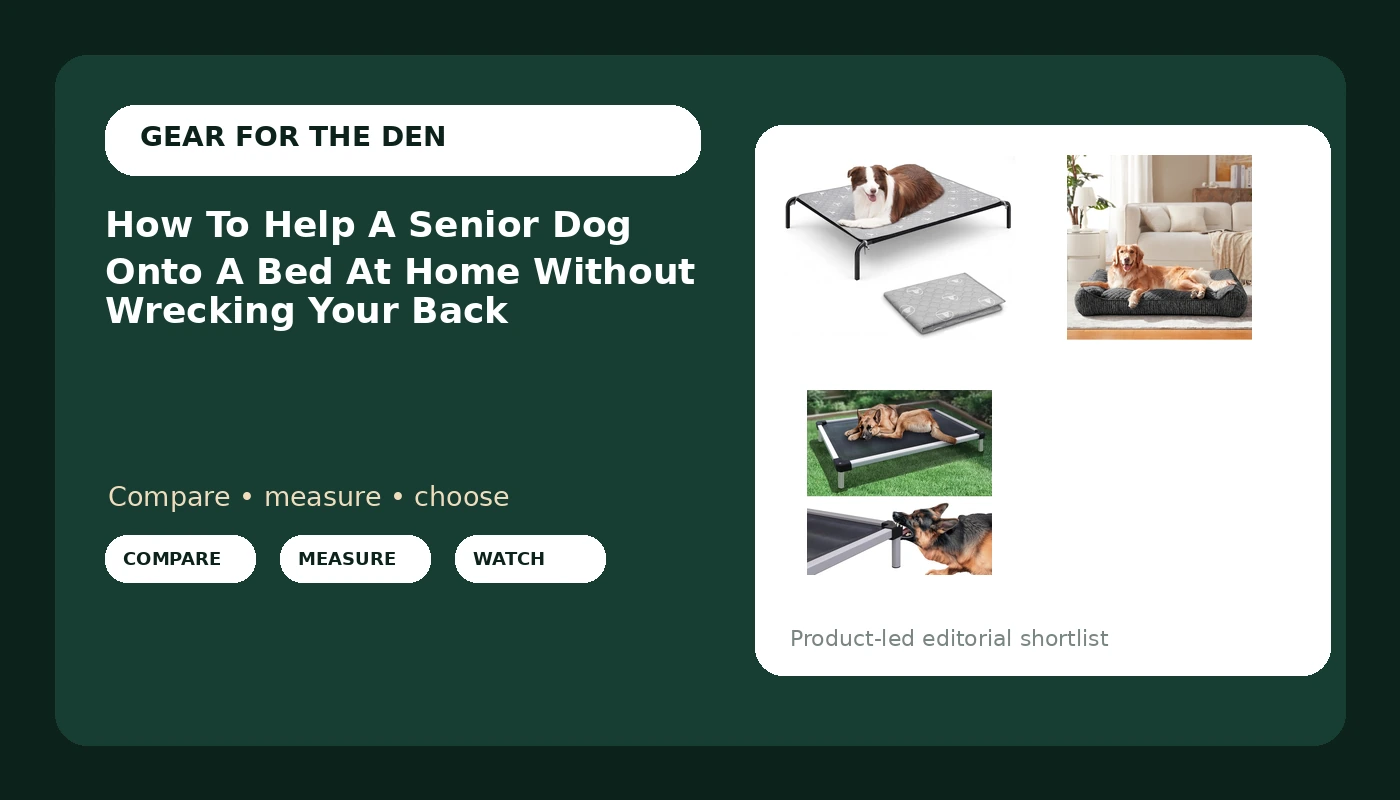
If your senior dog has started standing at the edge of the mattress, doing the arithmetic, and then walking away, you already know the problem. The hips are willing, the hind legs are not, and the jump that worked at six is a coin flip at twelve. Learning how to help a senior dog onto a bed at home is mostly about removing the jump, not about getting stronger. Almost all of the work happens before your dog ever leaves the floor.
The mistake most owners make is buying a ramp first. A dog that has never been asked to walk a narrow, moving surface will not trust one at 10 p.m. when it is tired and sore, and a refused ramp is just a tripping hazard beside the bed. The order that works is the bed, then the approach, then hands-on help as the last resort.
There is no single ideal help a senior dog onto a bed at home answer, because joint mobility, weight capacity, and how much your dog still wants to try all shift from month to month. What follows is the sequence I use to set up a room, plus the three beds that cover the three most common situations: a dog that can still step up a little, a dog that cannot step up at all, and a dog that chews through fabric or overheats on foam.
Why you should trust me
I cover senior and large dog gear for Gear for the Den, which means most of my week is spent reading spec sheets and then reading the verified buyer reviews that contradict them. The patterns repeat. Foam that flattens within a season. Covers that slide across hardwood. Elevated beds whose fabric sags to the floor under a big dog. Cooling claims that do not survive a humid August.
I am not going to tell you that I own all three beds on this page, because I do not. What I can do is tell you which numbers on a listing mean something, which ones are decoration, and how to match a bed to a dog whose joint mobility has already changed once this year. In a category where every product page promises the same thing, that is the useful part.
How I picked and how I tested
There is no lab test that tells you whether a dog will use a bed, so I did the next best thing: I screened the field against four hard requirements and dropped anything that failed one of them.
First, a stated weight capacity that leaves room above your dog's actual weight. A bed rated exactly at your dog's weight is a bed that will sag, and a sagging surface is a surface a sore dog will not step onto twice.
Second, foam density or frame construction that survives daily use. An orthopedic bed lives or dies on foam density, and "extra thick" without a density number is a marketing phrase, not a spec. On elevated beds, look at how the frame joins and whether the fabric is tensioned or just draped.
Third, bed height. This is the requirement owners skip and the one that matters most. If your dog has to lift a leg over a rail to get on, the bed is too tall no matter how good the foam is. Measure your dog standing and subtract.
Fourth, a cover or pad that comes off and washes, plus a non slip backing or feet that grip. A senior dog on joint medication drinks more and leaks more, and a bed you cannot clean is a bed you will throw away.
For the floor-level side of this, our guide to orthopedic beds for arthritic dogs goes deeper on foam. The three beds below are what survived the screen for this particular job.
Budget pick: PJYuCien Elevated Dog Bed with Washable Pad for Large Dogs, Gray
Budget pick
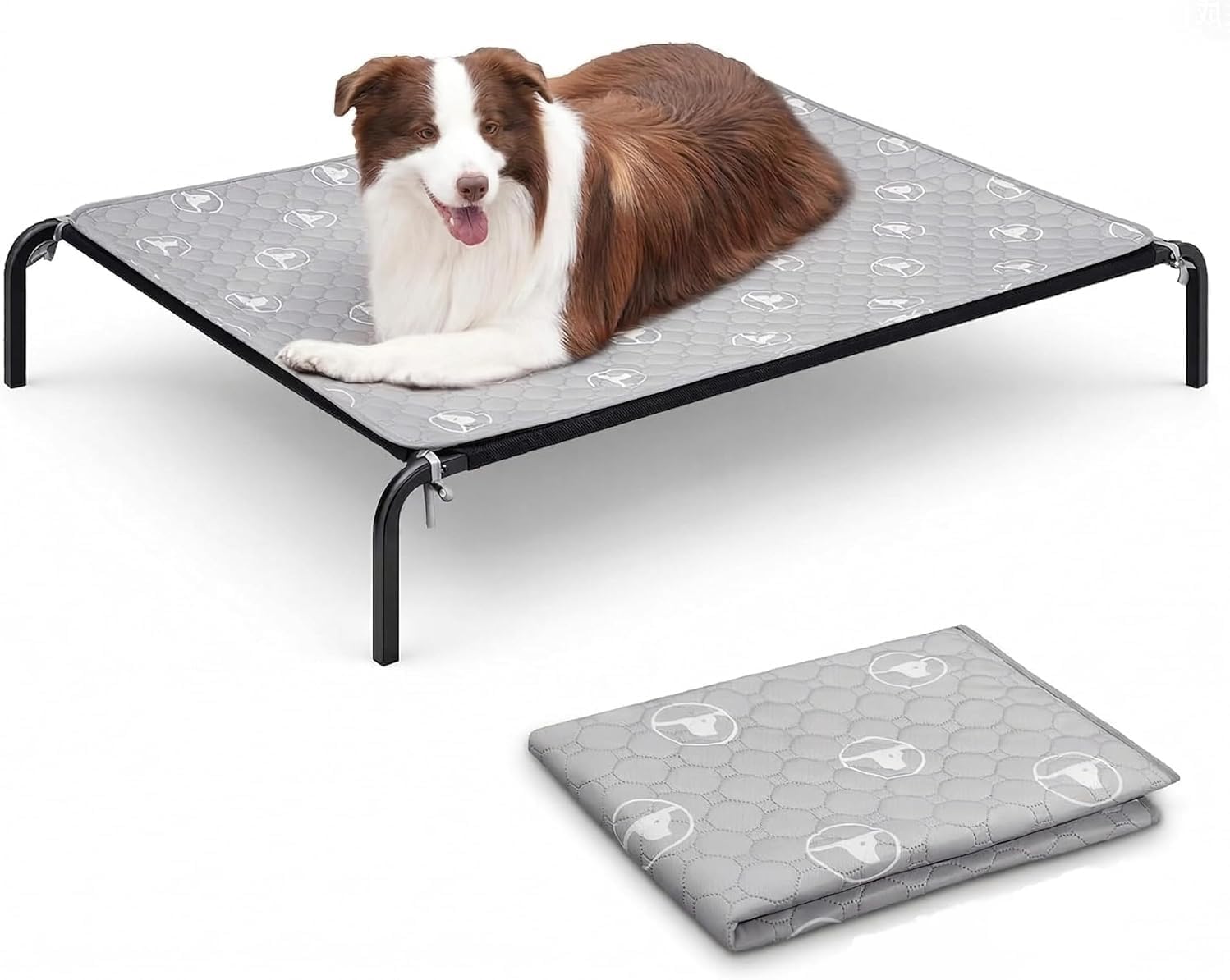
PJYuCien Elevated Dog Bed with Washable Pad for Large Dogs, Gray
Check current Amazon price
This is the first thing I would buy for a dog that can still manage a low step but cannot manage your mattress. It is an elevated cot with a washable pad on top, which puts the sleeping surface a short hop off the floor instead of up at mattress height. That single change solves the problem for a lot of dogs, because the step-over is short enough that the hind legs do not have to generate a jump.
The washable pad is the feature I care about most. A pad you can pull off and launder beats a foam slab you have to spot-clean, and for a dog on joint medication that difference shows up within a month. The gray fabric also hides the inevitable, which sounds like a small thing until you own a light-colored bed and a senior dog.
Two things to verify before you order. Check the stated weight capacity against your dog's current weight and add a margin, because a dog that has stopped running has usually added a few pounds. Then check the height. If the rail sits high enough that your dog would need to lift a leg to clear it, look at the floor-level option below instead, or use this cot as the intermediate step beside your mattress rather than as the destination.
Flaws but not dealbreakers: Elevated cots are not orthopedic. There is no meaningful foam density here, so a dog with serious hip support needs will do better on foam. Use this one as the step, or as the main bed for a dog with mild stiffness.
Anyone with a large dog that still steps up on its own but will not jump anymore should start here.
Our pick: JOEJOY XL Orthopedic Dog Bed for Large Dogs, Extra Thick Foam Pet Bed Sofa
Our pick
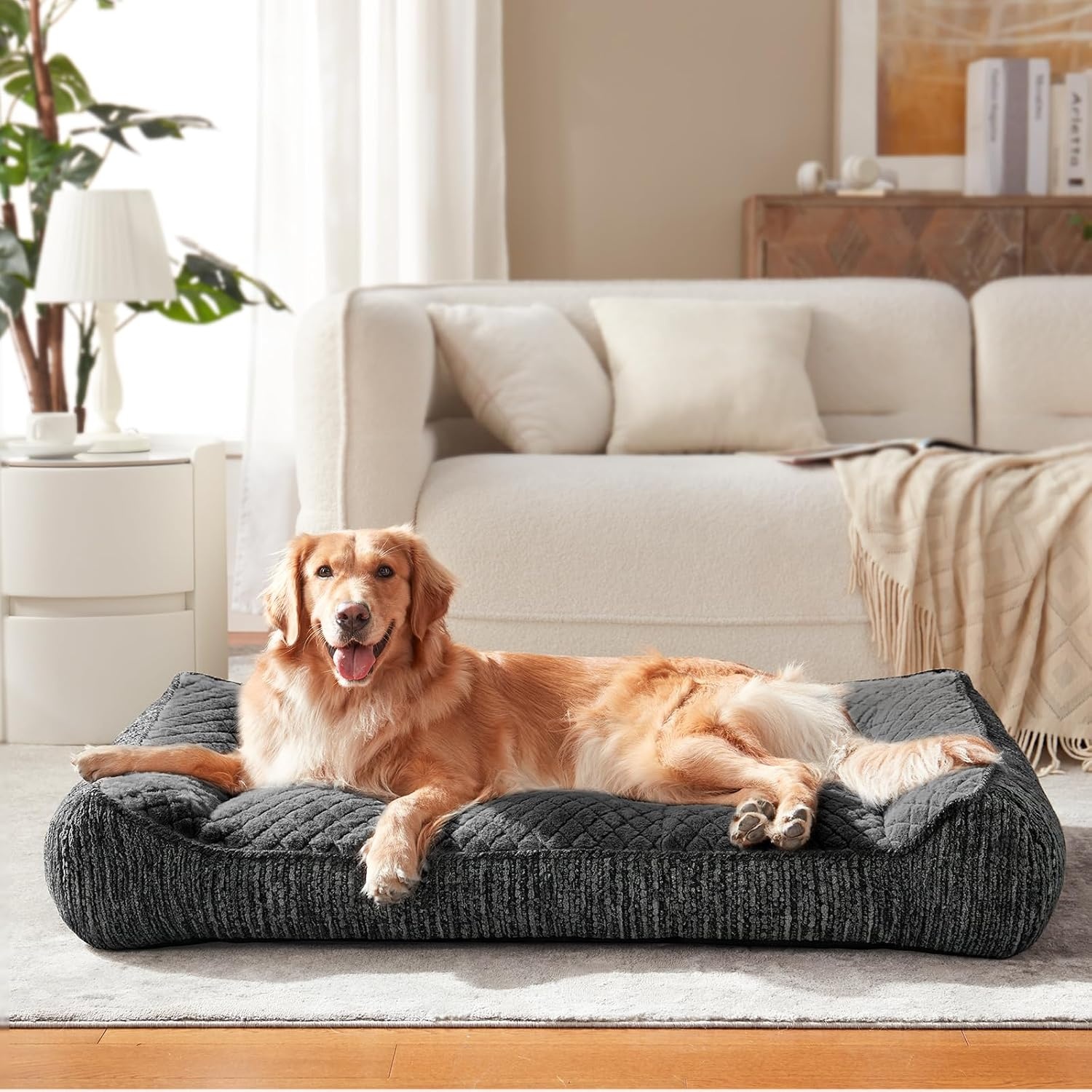
JOEJOY XL Orthopedic Dog Bed for Large Dogs, Extra Thick Foam Pet Bed Sofa
Check current Amazon price
If your dog has stopped stepping up entirely, stop fighting it. This is a floor-level orthopedic sofa bed with thick foam and a bolster, and it asks nothing of the dog except walking forward and lying down. No step-over, no lift capacity required, no trust in a moving surface. For a dog with real hip support needs, that is worth more than any clever design.
The tradeoff is honest and unavoidable: you are now getting down on the floor to check on your dog, and your dog is not sleeping up beside your head anymore. Some owners solve that by putting this bed directly against the mattress so the dog is at least in the same room and within reach of a hand hanging over the edge. Others park it at the foot of the bed as the landing pad and let the dog decide where the night ends.
What to look for when you read the listing: the foam thickness relative to your dog's weight, and whether the cover is removable. Extra thick is meaningful up to a point, but a heavy dog compresses foam that a lighter dog floats on, so match the bed to the dog rather than to the product photo. A removable cover matters for the same reason it does on the cot above.
Flaws but not dealbreakers: A sofa-style bed with bolsters is harder for a stiff dog to climb into than a flat mat, and bolsters lose their shape faster than the base foam. If your dog likes to sprawl, a flat orthopedic mat does the same job with less to climb over.
Anyone whose dog has quit stairs and quit the couch will get the most out of this one.
Upgrade pick: FXW TitanNest Cooling Chew-Proof Elevated Dog Bed for Large Dogs
Upgrade pick
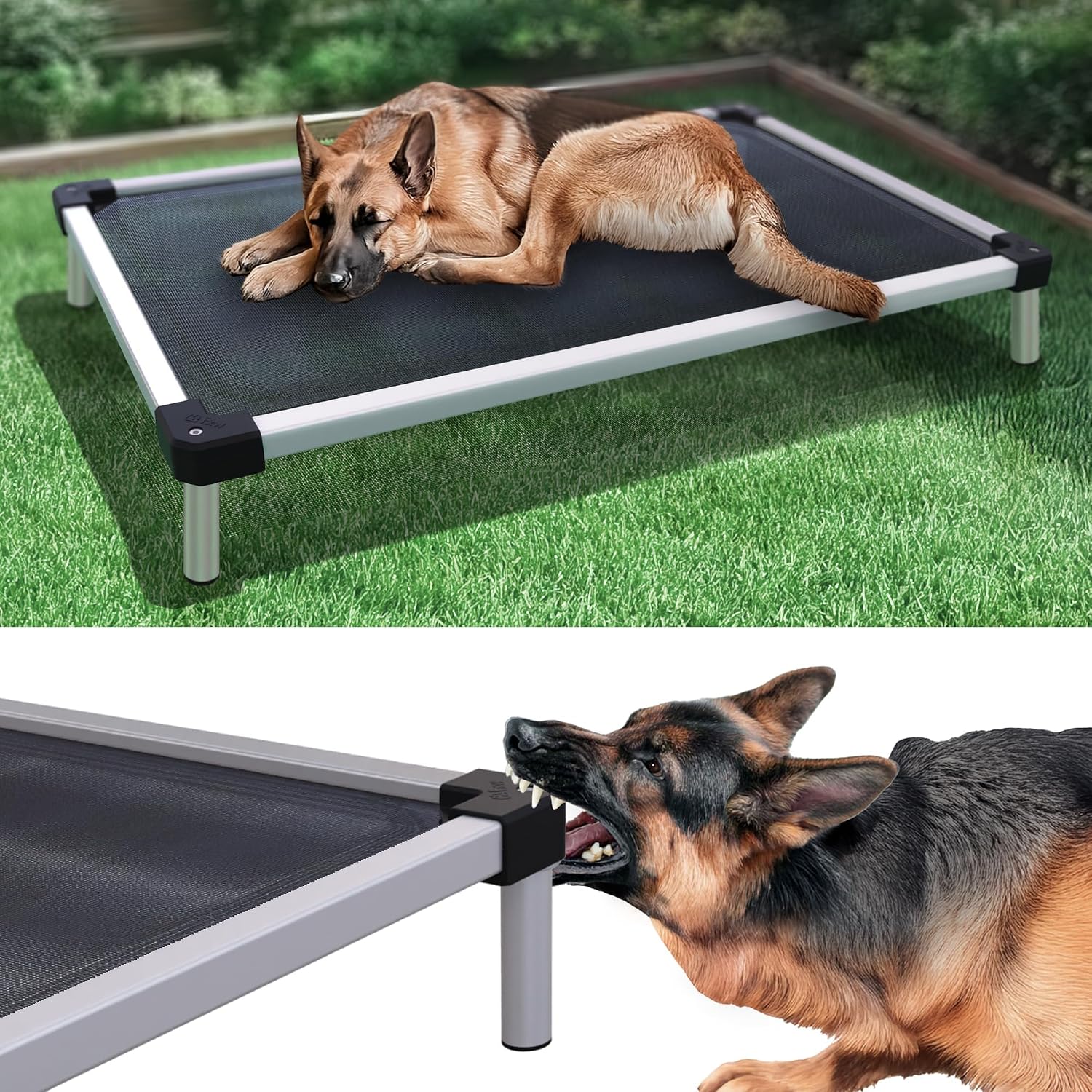
FXW TitanNest Cooling Chew-Proof Elevated Dog Bed for Large Dogs
Check current Amazon price
This is the bed for the two situations the cheaper options cannot handle: the dog that runs hot, and the dog that has destroyed every fabric bed you have brought home. It is an elevated cot built around cooling fabric and a chew-resistant frame, which means it keeps your dog off the floor, off the foam, and off the pile of shredded cover you would otherwise be cleaning up.
An elevated bed also solves a problem foam cannot. Air moves under the dog, which matters for a thick-coated breed in a house without central air, and it keeps the sleeping surface away from a cold floor in winter if you add a pad on top. The frame height also makes it a natural intermediate step at the side of a human bed, the same role the budget cot plays, just with more weight capacity and a surface that will not shred.
The reason this sits at the top of the list is durability. Chew-resistant construction is not a marketing word when the alternative is buying a third bed in eight months. If your dog is a dedicated chewer, the math works out quickly in favor of paying once.
Flaws but not dealbreakers: Cooling fabric is a comfort feature, not a medical one. It will not replace a vet's plan for a dog with real joint disease. And chew-resistant is not the same as chew-proof against a determined dog, so supervise the first few nights.
Anyone with a heavy dog that overheats, or a chewer that has already outlived one bed, should look here first.
The actual workflow to help a senior dog onto a bed at home
Now the part you came for. What counts as the correct help a senior dog onto a bed at home method depends on how much lift capacity your dog still has, so run the steps in order and stop at the first one that solves it.
Step one: Measure the gap. Stand your dog beside the bed and measure two things: floor to the top of the mattress, and floor to the top of your dog's shoulder. The difference between those two numbers is the height you are solving for. If your dog could once hop that gap and cannot now, that gap is your problem, not your dog's attitude.
Step two: Lower the target if you can. If your mattress sits on a frame and a box spring, dropping it to the floor for a couple of weeks removes most of the height difference instantly. A senior dog will happily use a low bed that it would never jump onto. Put the frame back when the dog is used to the route, or leave it low and stop worrying about it.
Step three: Put a landing pad in the path. The intermediate surface is the whole trick. An elevated cot at the side of the bed cuts one big hop into two small ones, and two small ones are dramatically easier on hips than one large one. This is where the budget cot earns its place even if your dog sleeps on your mattress.
Step four: Stabilize everything the dog touches. Non slip backing, grippy feet, a rug under the step. A bed that slides when the dog pushes off teaches the dog that the route is dangerous, and one bad slip can end the whole plan. Check this before you teach anything.
Step five: Teach the route in daylight, with food. Do this before meals, not at bedtime. Lure the dog onto the step, reward, then onto the bed, reward, then let the dog get down and do something else. Three repetitions and stop. A tired dog at 10 p.m. is a dog that will refuse, and it will remember refusing.
Step six: Support, do not hoist. When you do help, use a sling or a folded towel under the belly, just in front of the hind legs, with your other hand steadying the chest. Keep the dog level from front to back and let it walk while you take some of the weight. Never lift by the front legs alone and never pull on a collar. If your dog yelps or stiffens, stop and call your vet.
Step seven: Check your ramp angle before you buy a ramp. A ramp is only useful if the angle is gentle and the surface grips. A steep, slippery ramp is worse than a step, because the dog has to commit its whole body to a surface it does not trust. If the ramp you already own is short and steep, a low step is the better answer.
Step eight: Reassess every month. Joint mobility is not a fixed number. What your dog could do in October it may not manage in January. Watch for the dog stopping at the edge of the bed again, and re-run the list from the top when you see it.
If you reach step eight and your dog still will not climb, that is information rather than failure. Move to a floor-level orthopedic bed and put it beside your mattress. The goal was never the mattress. The goal was your dog sleeping comfortably in the same room as you.
The competition and why it lost
Four other things come up in every conversation about this problem, and all four lost to the setup above.
Folding pet stairs. They are narrow, they wobble, and a senior dog that cannot see well at night will not trust them. Width is the killer: a large dog's paw barely fits the tread, and a dog that misses once will not try again.
A memory foam topper on your existing mattress. It does nothing about the jump, and it makes the sleeping surface softer, which is the opposite of what a dog with hip trouble needs to push off from. Softer is not better for a dog that has to stand up again in the middle of the night.
A belly sling used as the primary solution. Slings are excellent, and step six above uses one. But a sling puts the entire job on your back every night, twice a night, and most owners quit within a month. Use it as support, not as a staircase.
A cooling mat with no frame. It solves heat and nothing else. If the dog cannot reach the bed, a cool surface on the floor is just a mat on the floor.
What this all costs
Three tiers, three different problems, and the spread between them is real. The washable-pad cot is the cheapest of the three and does the most for the least, which is why it is the first thing to try. The floor-level orthopedic sofa sits in the middle. The cooling, chew-resistant elevated bed is the most expensive, and it is the one you buy when you have already replaced a cheaper bed once.
Check current Amazon price on each listing before you commit, because these listings move and the tier boundaries shift with them. The better way to think about it is cost per night. Take the listing price, divide it by the number of nights you expect the bed to last, and compare that against what a single vet visit for a soft tissue injury from a bad landing runs. The bed wins that comparison every time.
The other cost is the one nobody budgets for: the intermediate step. If your dog sleeps on your mattress, you may end up buying two beds, one for beside the bed and one for the floor, and that is still less than one rehab consult.
Do the measuring first, spend once, and stop moving furniture every night. That is the whole job.