A dog who used to launch onto the couch in one motion now stands in front of it, shifts weight from one back leg to the other, and waits to be lifted. That pause is the reason this guide exists. Learning how to choose a bed for a dog with hip pain starts with accepting that the dog is not being stubborn, and that the cheap round bed in the corner is now part of the problem.
Hip pain in older dogs changes the geometry of rest. A dog with sore hips cannot sprawl the way a young dog does, cannot push up out of a deep-sided nest without a running start, and cannot climb onto the furniture to be near you. At that point the bed is not a luxury item. It is the surface your dog spends most of the day on, and it either supports the joint or fights it.
This is the method I use to choose a bed for a dog with hip pain: match the surface to the dog's weight, match the bed height to the dog's reach, and remove every jump between the dog and the place it wants to be.
Why you should trust me
I write the senior and large dog coverage for Gear for the Den, which means my week is spent comparing foam density, weight capacity, and lift capacity rather than photographing puppies. I have lived with aging dogs for most of the last decade, including a shepherd mix who needed a ramp onto the bed for his last three years, and I have watched how fast a bad sleeping surface turns into a dog who stops getting up.
I do not own a pressure-mapping rig and I am not going to pretend I do. What I do is compare the numbers manufacturers publish, cross-check them against the load ratings and materials in the listing, and then decide whether a design actually solves a hip problem or only looks like it does. A bed that claims orthopedic support but publishes no foam density is a marketing page, not a bed.
The other half of the job is knowing when the bed is not the answer at all. Sometimes the problem is the jump onto the mattress, not the pad on top of it. I keep both answers in the same drawer, and this article uses both.
How I picked and how I tested
Three products made the list: a large elevated bed, a small indoor/outdoor bed, and a ramp that removes the jump. I picked them on five criteria, in this order.
First, hip support. The surface has to let a dog lie flat with a neutral spine, which means a firm, flat sleeping deck rather than a hammock-shaped nest the dog has to climb out of. Second, bed height. A dog with sore hips should step onto the sleeping surface, not hop onto it and not need to be lifted. Third, weight capacity and lift capacity. The load rating has to clear the dog's weight with room to spare, because a dog pushing up off a collapsing edge is a dog who learns not to try. Fourth, a non slip backing or a base that stays put, since a bed that slides across hardwood turns every stand into a small slip. Fifth, foam density, the number that separates a bed that holds its shape for a year from a bag of flattened fill in three months.
How I tested is a fair question, and the honest answer is that I do not run a lab. I compared the published specs side by side, read the load ratings and material descriptions, and checked whether the dimensions line up with the dogs these products claim to serve. Then I ran the same three-question filter on every one of them: can a stiff dog get on it, can a stiff dog stay comfortable on it, and can a stiff dog get off it without help.
If you want a one-line version of how to pick a bed for a dog with hip pain, it is this: firm, flat, low, and not going anywhere. You cannot pick a bed for a dog with hip pain off a photo of a sleeping puppy on a fluffy donut.
If you want the longer version of that work, I have already ranked the best orthopedic dog beds for senior dogs elsewhere on the site.
The gear that helps you choose a bed for a dog with hip pain
Before the workflow, here is the gear I would actually buy and the order I would buy it in. The bed comes first, because the bed is where the dog spends the day. The ramp comes second, because it solves a different problem: the jump onto furniture the dog still wants to reach.
Our pick: PJYuCien Elevated Dog Bed with Washable Pad for Large Dogs, Gray
Our pick
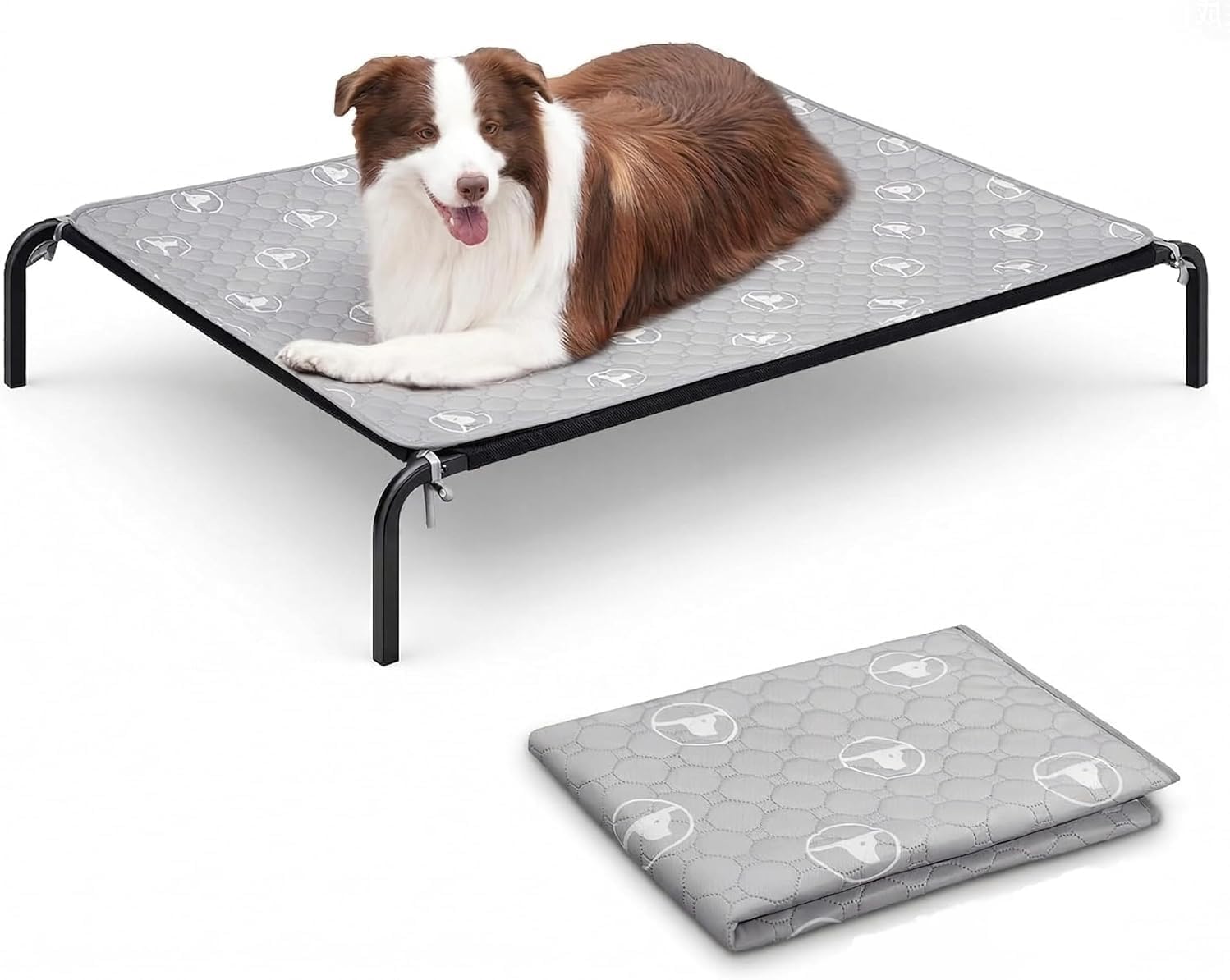
PJYuCien Elevated Dog Bed with Washable Pad for Large Dogs, Gray
A flat deck instead of a nest. That is the most useful thing about an elevated bed for a dog with hip pain. The dog steps onto a level surface, lies down without digging a hollow in loose fill, and pushes up off a firm edge instead of fighting a wall of polyester. The frame holds the sleeping deck off the floor, so air moves under the dog, which matters for a large dog who runs warm and for anyone trying to keep a senior dog dry in a humid room.
The washable pad is the part that gets used. Senior dogs leak, drool, and have the occasional accident they cannot help, and a cover you can pull off and put in the machine is the difference between a bed that lasts and a bed that smells like the last two years. The gray fabric is a small thing and a real one: it does not show dirt the way a cream cover does.
For hip support, the deck is what counts. It is flat, it does not sag into a valley, and it lets the dog choose a position instead of trapping it in one. Check the weight capacity in the listing against your dog's weight before you order, and check current Amazon price.
Flaws but not dealbreakers: An elevated bed has no side wall to lean against, and some dogs want to press their back into something. If yours does, push the bed against a wall.
Anyone with a large dog who runs hot, or a dog who needs a firm, flat surface under the hips, should start here.
Runner-up: Best Friends by Sheri Dura-Tuff Indoor/Outdoor Dog Bed for Small Dogs
Runner-up
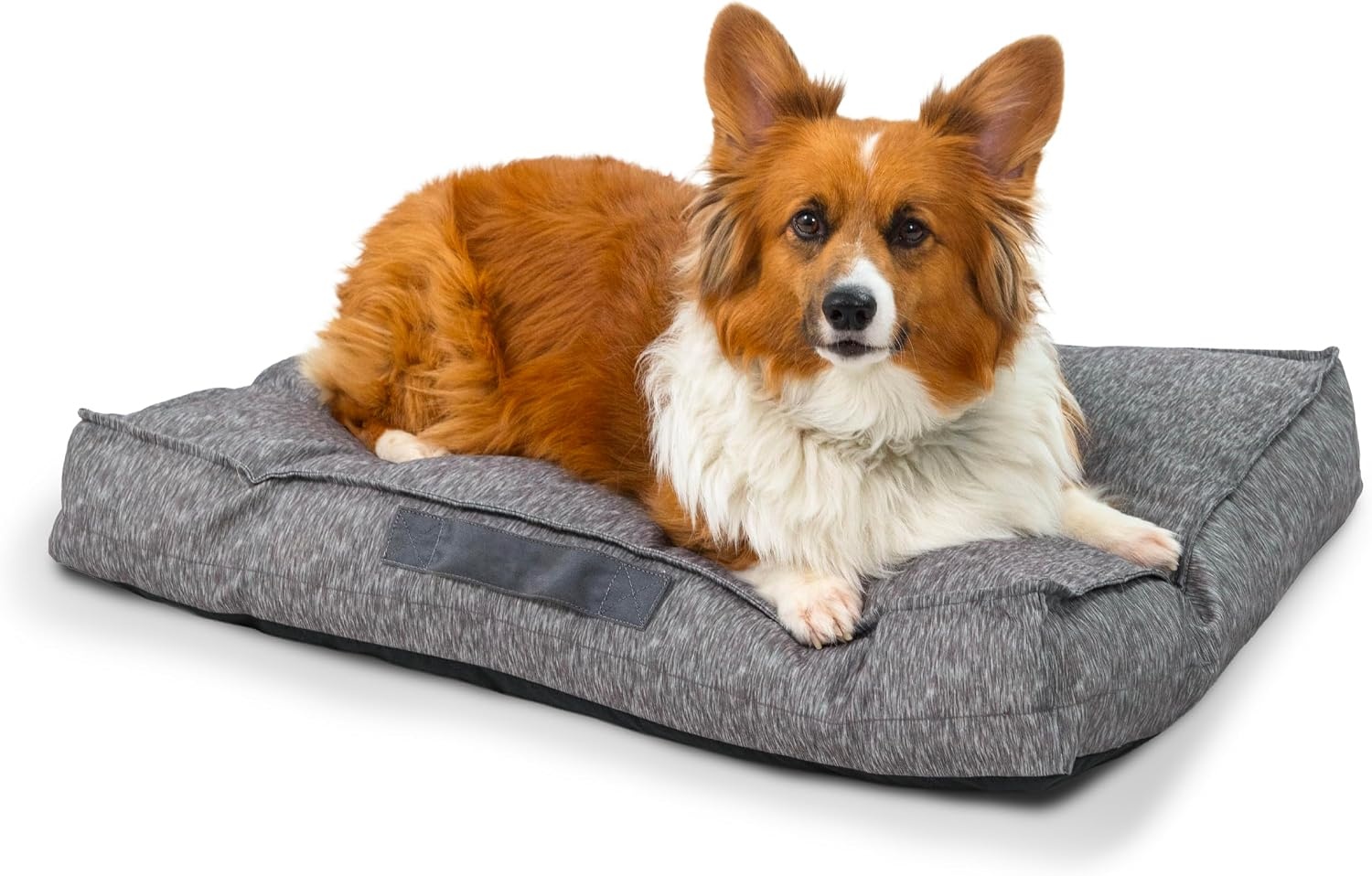
Best Friends by Sheri Dura-Tuff Indoor/Outdoor Dog Bed for Small Dogs
The Dura-Tuff line is built for a dog who is hard on beds. The indoor/outdoor cover is the selling point: it wipes down, it handles a damp dog coming in from the yard, and it does not hold odor the way a plush cover does. For a small senior dog with hip pain, that durability matters more than it sounds, because the alternative is a bed you wash so often that it stops holding its shape.
Small beds are where the hip-pain math gets tricky. A small dog does not need a thick slab of foam the way a large dog does, but it still needs a surface that does not collapse under the hips when the dog stands up. If the listing does not publish a foam density, treat this as a comfort bed rather than an orthopedic one, and put it on a rug if there is no non slip backing on the base. Check current Amazon price.
The flip side is obvious: this is a small-dog bed, and no amount of good design makes it right for a large dog. If your dog is a lab or a shepherd, go back up to the elevated bed.
Flaws but not dealbreakers: Indoor/outdoor fabric is not as soft as fleece, and a few dogs care about that. Most do not.
Anyone with a small senior dog, a messy sleeper, or a dog who naps on a porch or in a garage will get their money's worth out of this one.
Upgrade pick: TIMHAKA Dog Ramp for Bed with 7 Adjustable Heights, Supports Up to 150lbs
Upgrade pick
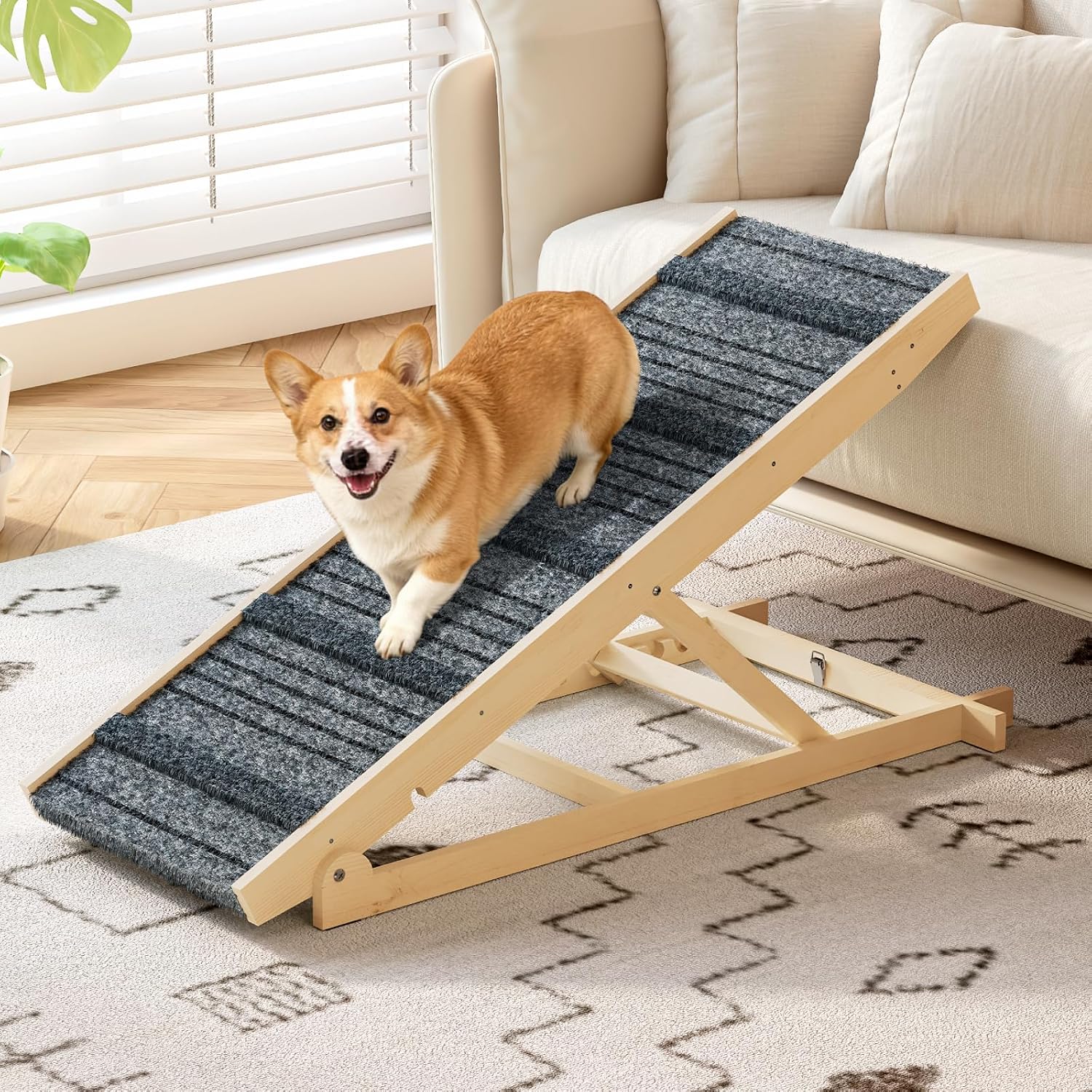
TIMHAKA Dog Ramp for Bed with 7 Adjustable Heights, Supports Up to 150lbs
This is not a bed. It is the thing that stops your dog from having to jump onto one, and for a lot of dogs with hip pain it does more good than a new mattress.
The ramp has seven adjustable heights, and that is the feature that matters, because ramp angle is what decides whether a dog will use it at all. Too steep and a stiff dog looks at it once and walks away. The right angle is shallow enough that the dog walks up with the back legs doing normal work instead of pushing off. Seven positions let you match the ramp to the height of your bed or couch rather than matching your furniture to the ramp.
The 150 pound lift capacity covers most large dogs, and it covers a dog plus a handler steadying the dog on the way up. The ramp also solves the 4 a.m. problem. A dog who cannot get onto the bed is a dog who paces, and a dog who paces is a dog whose hips are worse by morning.
Check the deck for grip before you commit. A ramp with a slick surface is worse than no ramp, because a slip on an incline is how a sore hip becomes an injury. Check the folded dimensions too, since a ramp that lives in the middle of the bedroom floor gets tripped over at night. Check current Amazon price.
Flaws but not dealbreakers: A ramp takes up floor space, and it is not a one-handed carry. Measure the gap between the bed and the wall before you order.
Anyone with a dog who still wants to sleep on the bed but cannot make the jump should buy this before they buy anything else.
The actual workflow
Now the part you came for. This works for any dog, any size, and it works whether you are buying your first orthopedic bed or replacing the third one this year.
Step one: Watch before you measure. Spend a day noticing where the dog lies, how it gets up, which leg it favors, and whether it circles before lying down. Circling is a dog searching for a position that does not hurt. That information tells you more than any spec sheet, and it costs nothing but attention.
Step two: Measure the dog, not the bed. You need the dog's weight for weight capacity, its length from chest to tail for sleeping surface, and its standing shoulder height if you are shopping for a ramp. Then measure the floor space you are willing to give up, because the best bed in the world is useless if it blocks the doorway.
Step three: Set the height first. Bed height is the constraint that rules out more beds than anything else. The dog should step onto the sleeping surface, not hop onto it. If you cannot lower the surface, raise the dog's path instead with a ramp, and keep the ramp angle shallow.
Step four: Choose a surface, not a shape. A flat deck with firm fill beats a deep nest with high bolsters. A dog with sore hips has to be able to lie down and stand up without climbing, and a bolster the dog has to push over is a daily obstacle.
Step five: Ask about foam density. If the listing does not publish it, assume the fill is soft. Higher density holds its shape under the hips, while low density compresses into a trench and leaves the dog lying in a divot. That divot is where hip support goes to die.
Step six: Check the load ratings. Weight capacity should exceed your dog's weight with margin, and lift capacity matters if a person will be helping. A bed or ramp rated at exactly the dog's weight is a bed or ramp that is already at its limit on the first cold morning.
Step seven: Check the base and the floor. A non slip backing, or a rug under the bed, keeps the surface still while the dog pushes up. Hardwood plus a sliding bed equals a small slip every time the dog stands, and small slips add up to a dog who stops trying.
Step eight: Stage the room and recheck in a week. Put the bed in a warm, draft free corner with a wall to lean against, water within reach, and the ramp at the shallowest angle that works. Then watch for a week. If the dog avoids the bed, the height or the surface is wrong, and you have your answer for the next purchase.
The competition and why it lost
Not everything that looks like a solution is one. A few categories I ruled out, and why.
Deep bolster nest beds are the most common bed on the shelf and the worst fit for a dog with hip pain. They look like a hug, but the dog has to climb over the wall every time it stands, and the wall is exactly where a stiff hip fails.
Heated beds and heated mats feel good on a sore joint, and for some dogs they help. But heat does nothing about a soft fill that collapses under the hips, and a heated surface is worth a conversation with your vet before you leave it on all day.
Human grade memory foam toppers are great foam in the wrong shape. Most of them sit too high off the floor, and a topper is not a bed, it is a slab that slides. If you go that route, build it low and put something under it that will not move.
A second cheap bed in every room is a fine idea, but only after the main bed is right. Two bad beds do not make a good one.
And the couch or the bed you already own is not the enemy. The jump onto it is. That is what the ramp is for.
What this all costs
The three items here sit in the budget to mid tier, and none of them is the expensive part of hip pain. The readers who ask me how to choose a bed for a dog with hip pain usually start with the price tag. Check current Amazon price on each and you will see what I mean: the differences are real but small.
What drives the cost of a bed is mostly the foam density and the weight capacity. A dense, flat deck for a large dog costs more than a bag of loose fill with a cute cover, and it lasts longer than three of them. A washable cover adds a little and saves a lot, because a cover you can wash is a bed you do not replace.
The ramp is the item people skip and then buy a year later, after the dog has stopped sleeping in the bedroom. It is also the cheapest fix on the list when you compare it to a vet visit for a slip injury.
What you are really buying is joint mobility. A dog who can get on the bed, get comfortable, and get off again without help moves more during the day, and a dog who moves more keeps more of the muscle that protects the joint. That loop runs in both directions.
The math on the other side is the one nobody wants to run. A dog who cannot get comfortable at night paces, and a dog who paces loses condition, and a dog who loses condition cannot get up. Buying the right surface early is the cheapest thing in this article.
That is the job. The dog is not asking for much, just a flat place to land and one less jump between it and you.