If your dog has started stopping at the edge of the bed and staring down at the floor, the jump is the problem, not the attitude. A dog with sore hips has to launch its whole rear end upward and land on a hard surface, and that one motion asks the hip joint to do the thing it is least able to do comfortably. This is the dog bed ramp for hip pain explained in practical terms: what a ramp actually changes about that motion, which measurements decide whether the change is real, and how the four listings below differ from one another. Nothing here replaces a veterinarian's diagnosis of hip pain, arthritis, or anything else. It is about hardware, and hardware has numbers you can check before you buy.
Quick answer
The goal is a shallow, stable walking surface, not a staircase that happens to be shorter than a jump. The correct dog bed ramp for hip pain is the one whose rise and run produce a gentle angle, whose stated weight capacity covers your dog with room to spare, and whose surface does not slide or compress when your dog pushes off it. If your bed is high, a long folding ramp usually produces the shallowest angle because length buys you a shallower slope. If your dog is small or the bed sits low, a compact step unit is easier to place and store. None of these products is a medical device, and none of them will work if your dog refuses to stand on it.
4 useful options
| Model | Best fit | What stands out |
|---|---|---|
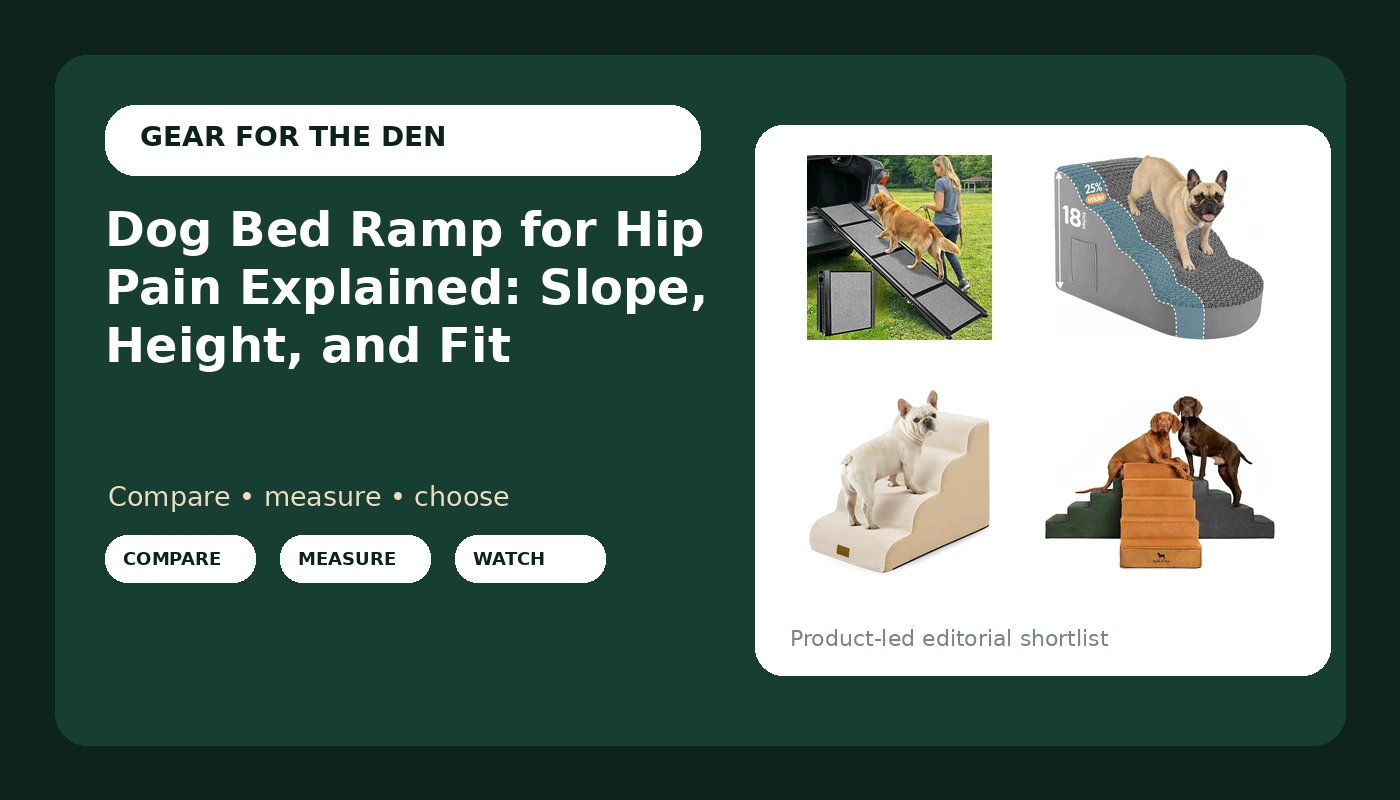
| Dog Ramp for Cars 71"Long x 20"Wide SUV & Trucks, Non-Slip Surface Aluminum Pet Ramps for Small & Large Dogs, Heavy Duty Foldable Lightweight Portable Ramp for Senior Dogs High Bed Couch Outdoor 250lbs | High beds and vehicles, medium to large dogs | 71-inch length and 20-inch width with a stated 250 lb capacity |
| PRIMEPATIO Dog Stairs for Large Dogs, Extra Wide 20" Dog Ramp for Bed | Large dogs stepping onto a bed | Extra-wide 20-inch surface, bed-first design |
| COZY KISS Dog Stairs for Small Dog 19.7" H, 4 Step Pet Ramp for Bed | Small dogs and lower beds | Four steps with a stated 19.7-inch height |
| Noah & Paw Dog Stairs for Large Dogs, Up to 150lb, Wide Dog Ramp for Bed | Large dogs that prefer steps | Wide step surface with a stated capacity up to 150 lb |
Longest run for high beds: Dog Ramp for Cars 71"Long x 20"Wide SUV & Trucks, Non-Slip Surface Aluminum Pet Ramps for Small & Large Dogs, Heavy Duty Foldable Lightweight Portable Ramp for Senior Dogs High Bed Couch Outdoor 250lbs
The trade-off here is floor space and furniture. A 71-inch ramp has to land somewhere, and in a small bedroom that landing space may not exist without moving a dresser or blocking a door. Folding hardware also means there is a hinge in the middle of the walking surface, and a dog that feels any flex underfoot may slow down or stop. The payoff is real for a high bed: the longer the run, the less vertical lift each stride requires, which is the entire reason a ramp helps a sore hip in the first place. If your bed is low, this is more ramp than you need.
Extra-wide bed ramp for large dogs: PRIMEPATIO Dog Stairs for Large Dogs, Extra Wide 20" Dog Ramp for Bed
The listing does not state a length, so you cannot calculate the ramp angle from the name alone. That matters: a wide surface on a short run can still be steep, and steep is what hip pain punishes. Treat the width as the strength of this option and verify the slope against your own bed height before you commit. It is also worth checking how the base meets the floor, because a wide ramp that slides on hardwood is worse than a narrow one that stays put.
Compact step unit for small dogs: COZY KISS Dog Stairs for Small Dog 19.7" H, 4 Step Pet Ramp for Bed
Here is the honest limitation of any step unit: each step is a small jump. Four steps at 19.7 inches total means roughly five inches of rise per step, which is far kinder than a bed-height leap, but it is still a lift rather than a walk. Small dogs often prefer steps to slopes, and a dog that already uses a sofa stair will usually accept this shape quickly. If the step surface is foam-filled, ask what the foam density is, because soft foam compresses under a paw and turns a stable step into a wobbly one.
Wide step unit with the highest stated capacity: Noah & Paw Dog Stairs for Large Dogs, Up to 150lb, Wide Dog Ramp for Bed
This and the PRIMEPATIO unit are aimed at the same dog: large, heavy, and stepping onto a bed. The difference is shape. Steps mean short, repeated lifts and a smaller footprint. A ramp means one continuous slope, which is easier on a hip but needs a longer run to stay gentle. If your dog has already learned to use steps, switching shapes can undo that training. Pick the shape your dog already trusts, then check the numbers.
Prices and availability may change. Product images, names, and retailer links are matched to verified listings. No current price, rating, stock status, or measured result is stated here without current evidence.
How to judge a dog bed ramp for hip pain
Hip support is not something you can see in a product photo. What a sore hip needs is less vertical lift per movement, a surface that does not shift under a paw, and a landing that does not require a twist or a turn. Both ramps and stairs can deliver that, and neither is automatically better. Stairs split the total rise into short repeated lifts. A ramp converts the whole rise into one continuous slope, which is usually gentler on a joint but only if the run is long enough to keep the ramp angle shallow.
The vocabulary in the listings is worth decoding. Weight capacity is the load the maker states the unit supports, and you want it comfortably above your dog's weight because a dog that pushes off or leans briefly loads the unit harder than its standing weight. A non slip backing is what keeps the unit from skating across hardwood or tile, and a unit that slides is worse than no unit at all, because the dog loses confidence after one bad step. Foam density only applies to foam-filled steps, and it decides whether a paw sinks or rests; if the listing does not state it, treat it as unknown. Joint mobility changes day to day, so a dog that trots up a ramp on a good morning may refuse it on a bad afternoon, and that is normal.
Ramp angle, bed height, and joint mobility
Angle is rise divided by run, and it is the single number that decides whether a ramp helps. A 71-inch ramp climbing to a 30-inch mattress top produces a far shallower slope than a step unit with a stated 19.7-inch height used on that same bed, simply because the ramp has more distance to cover the same climb. You do not need a protractor. Measure the height from the floor to the top of the mattress where your dog steps off, measure the floor distance you can spare in front of the bed, and compare the two against the lengths and heights printed in the product names above.
Lift capacity matters in a different way, and it is about you rather than the dog. A folding ramp that lives in one spot only needs to be light enough to reposition for cleaning. A ramp you fold and carry to the car every weekend needs to be light enough to lift repeatedly. Aluminum folding ramps are generally the easier of the two to move, while step units tend to stay where you put them, which is fine if they stay in one room.
- Measure the bed height from the floor to the top of the mattress, not the top of the frame.
- Measure the floor space available in front of the bed, and decide whether a 71-inch run fits without blocking a walking path.
- Weigh your dog and compare that number with the stated weight capacity, leaving margin for leaning and pushing off.
- Watch your dog climb a sofa or a low step: a dog that plants one paw at a time may prefer steps, while a dog that walks a gentle slope without pausing will usually accept a ramp.
- Check the floor surface. On hardwood, tile, or laminate, a non slip backing or a grippy base is not optional.
Measuring your bed and your dog before you buy
- Measure to the top of the mattress where the paws actually land, since that is the height your dog has to cover.
- Leave a level landing at the bottom of the ramp, ideally a body length, so your dog is not turning immediately onto a hard floor.
- Compare your dog's weight to the stated capacity with margin, not to the nearest pound.
- On hard floors, prioritize a base that grips, and consider a thin rug under the bottom edge.
- Introduce the unit at floor level with treats before you raise it, and keep it in the same spot so the route becomes routine.
Which option should you choose?
Choose the Dog Ramp for Cars 71"Long x 20"Wide SUV & Trucks, Non-Slip Surface Aluminum Pet Ramps for Small & Large Dogs, Heavy Duty Foldable Lightweight Portable Ramp for Senior Dogs High Bed Couch Outdoor 250lbs when your bed is tall, your dog is medium to large, and you have the floor space for a long shallow run. Choose the PRIMEPATIO Dog Stairs for Large Dogs, Extra Wide 20" Dog Ramp for Bed when you want the extra-wide surface and a bed-first design for a big dog, and you will confirm the slope against your own bed height before buying. Choose the COZY KISS Dog Stairs for Small Dog 19.7" H, 4 Step Pet Ramp for Bed when your dog is small, your bed is low enough for a four-step unit at a stated 19.7-inch height, and steps suit your dog better than a slope. Choose the Noah & Paw Dog Stairs for Large Dogs, Up to 150lb, Wide Dog Ramp for Bed when you want wide steps for a heavy dog with a stated capacity up to 150 lb.
One caveat that no listing can answer: none of these four products states a measured ramp angle, a foam density, or a tested result, so the only figures you can rely on are the ones printed in the names, such as lengths, widths, step counts, heights, and stated capacities. Whether your dog will use the unit is a training question, not a specification question. And because hip pain is a medical issue, ask your veterinarian whether a ramp, a lower bed, or another approach is the right first step.
The bottom line
There is no universal ideal dog bed ramp for hip pain, only the one that fits your bed height, your floor space, and your dog's weight with enough margin to feel secure. If your bed is high and you have room, a long folding ramp gives the shallowest walking surface. If your dog is large and prefers steps, a wide step unit with a stated capacity above your dog's weight is the safer shape. If your dog is small and the bed is low, a compact four-step unit keeps the footprint manageable. Measure first, confirm the stated weight capacity and the non slip backing, and introduce the unit slowly, because the best ramp in the world only helps once your dog walks up it.