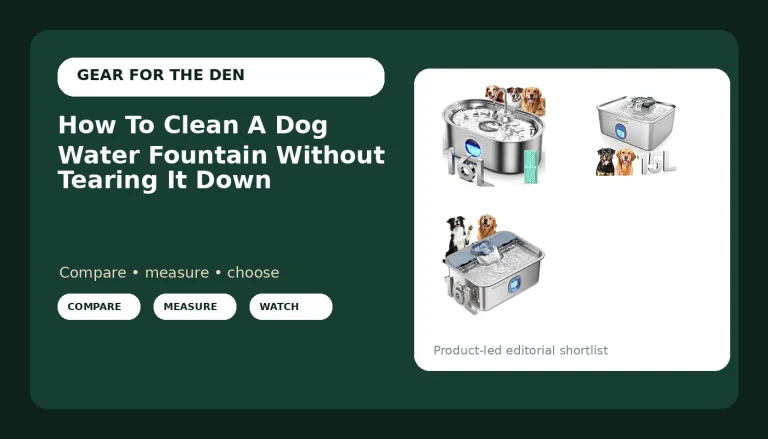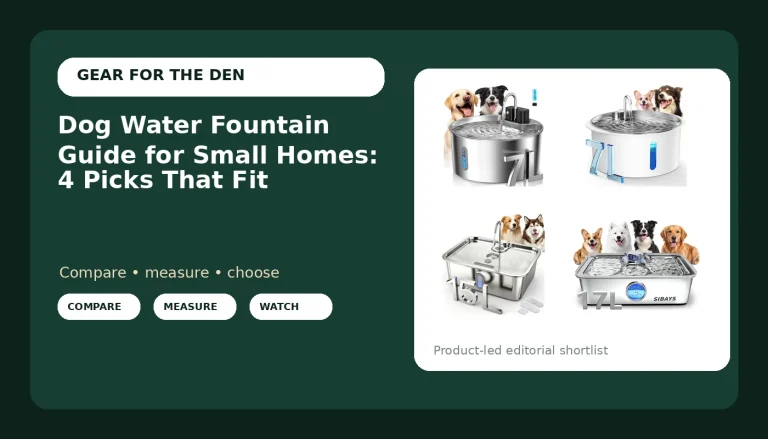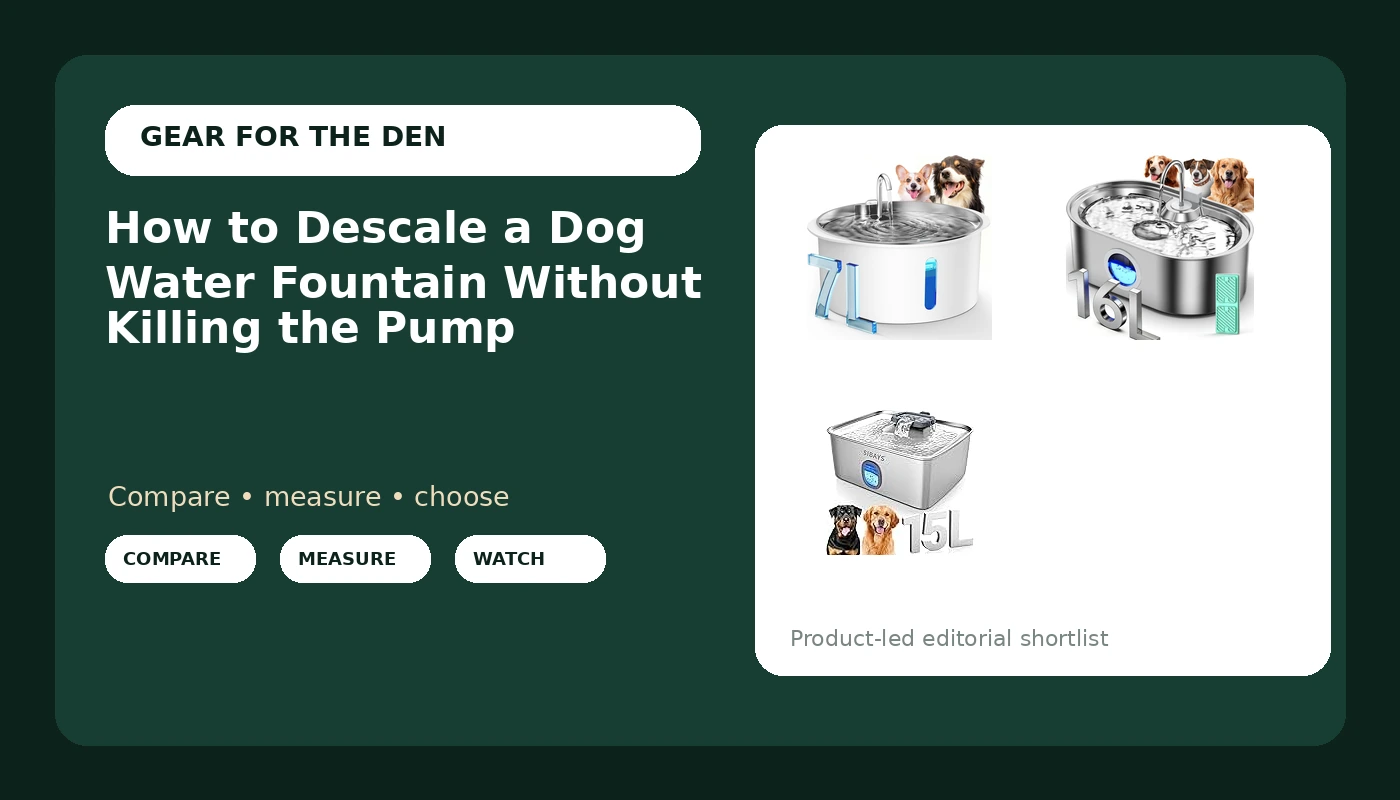
Mineral scale is the quiet killer of every dog fountain. It starts as a cloudy film on the stainless tray, hardens into a chalky ring at the water line, and then moves into the pump intake, where it slows the impeller until the motor whines and quits. Learning how to descale a dog water fountain is really learning how to keep that ring from ever getting hard, and the good news is that it takes about half an hour with supplies you already have in the kitchen.
I have lived with very hard water for years, which means I have replaced pumps, scrubbed trays, and tried more descaling solutions than I care to admit. What works is boring: warm water, food-grade citric acid, a soft brush, and a rinse you actually finish. What does not work is vinegar left to sit overnight on a coated surface, bleach anywhere near a pump you plan to keep, and running the fountain until the noise stops on its own.
The routine below is written around the three stainless fountains I recommend for this job, and it works on most others. Stainless steel gives scale less to grab onto, and a pump you can pull out and soak is the difference between a ten-minute chore and a fountain you throw away in a year.
Why you should trust me
I am not a vet and I am not a plumber. I am a dog owner in a hard-water house who got tired of buying pumps. Over the years I have kept a running log of every descale: what the water line looked like, how long the soak ran, whether the flow came back to full, and how many months the pump survived afterward. That log is the only reason I know that a monthly soak beats a quarterly deep clean, and that a filter cartridge left in during descaling is a filter cartridge you throw away.
I also keep notes on the parts that fail first: the impeller chamber, the gasket around the pump housing, and the seam where the tray meets the reservoir. Those three spots are where scale does its damage, and they are the three spots most owners never look at. A pump does not usually die because it was cheap. It dies because the chamber around the rotor filled up with calcium while nobody was watching.
Everything below comes from that experience plus what each listing actually says about materials and capacity. If you would rather start with the shortlist than with the process, the large-dog fountain roundup is the place to begin.
How I picked and how I tested
Three things decided which fountains made this article. First, the water-contact surfaces: a stainless steel tray and a stainless reservoir, because plastic scratches, and scratched plastic holds scale and biofilm in a way you cannot scrub out. Second, the pump: it has to come out of the housing without tools, because a pump that cannot sit in a bowl of descaling solution cannot really be descaled. Third, the water capacity measured against how many animals drink from it. A four-gallon reservoir with one dog means water sits for days, and standing water is where the ring forms first.
Beyond that I looked at the boring details: whether the tray and reservoir are dishwasher safe, whether the base is a non slip base that will not skate across tile when a Labrador leans on it, whether replacement filter cartridges are actually sold, and whether the tray sits at a feeding height that works for a large dog without the neck craning to the floor.
The test that matters is a soak and rinse, and it is the same one I would run on any fountain before trusting it with a dog that drinks a lot. Fill the reservoir with a warm citric acid solution, run the pump so the solution moves through the impeller chamber instead of just sitting in the basin, then take everything apart and look at the three failure points. What you are checking for is simple: flow that matches the day the fountain was new, a pump that runs without the rattle of a mineral chip bouncing in the impeller, and water that tastes clean after a full rinse. A fountain whose finish dulls or whose seals swell after one soak is not one I would recommend to anyone. There is no single ideal descale a dog water fountain schedule either, because the interval depends on your water hardness and on how many animals are drinking.
Gear that makes it easier to descale a dog water fountain
You can descale almost anything with a pump in it, but some fountains turn the job into a ten-minute chore and others turn it into a fight. The three below are the ones I would choose for a household that has to descale on a schedule, because each one lets you reach the parts that scale attacks.
Budget pick: Pektaco Dog Water Fountain for Large Dogs, Stainless Steel Tray, 1 Filter
Budget pick
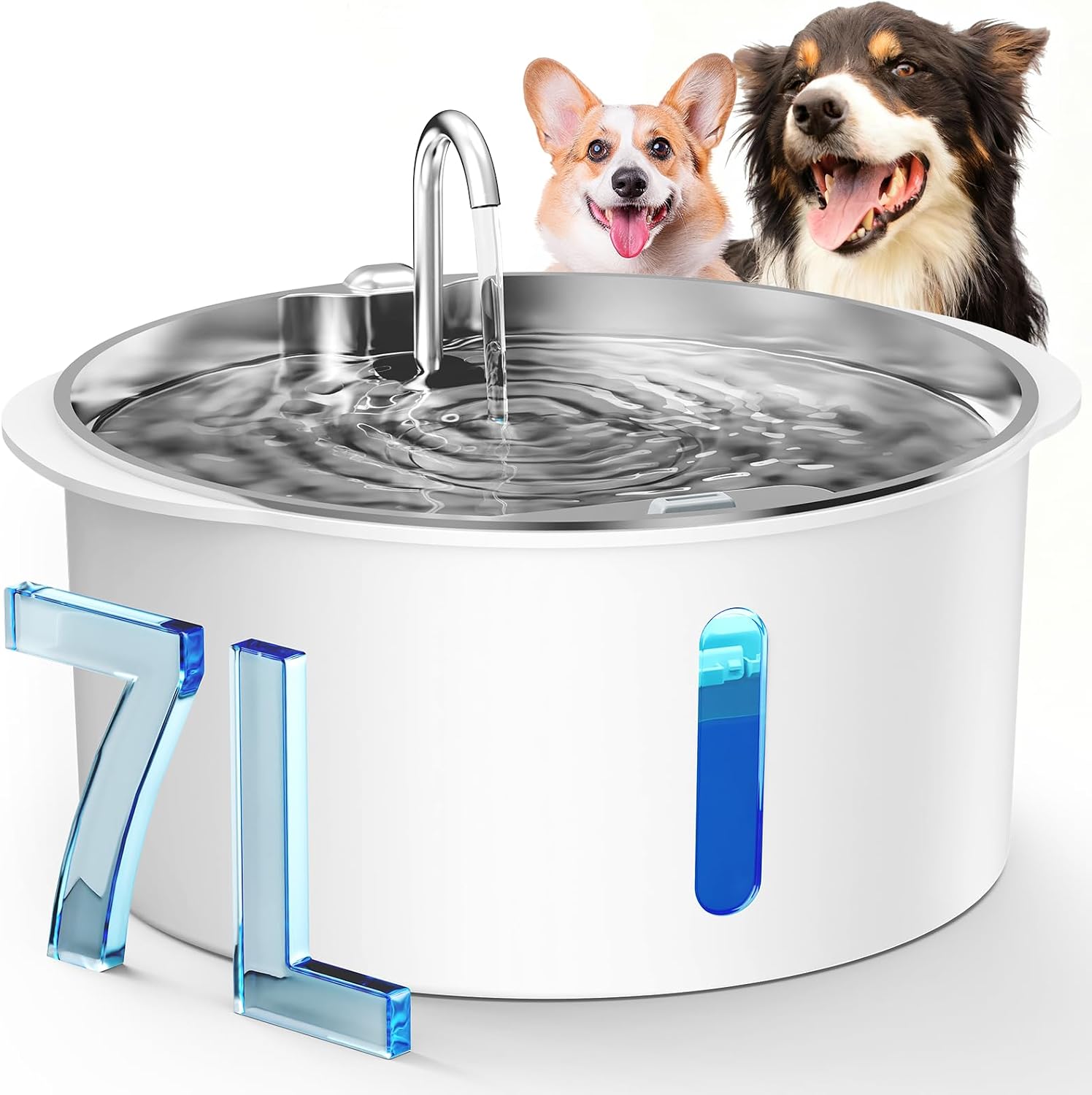
Pektaco Dog Water Fountain for Large Dogs, Stainless Steel Tray, 1 Filter
This is the cheapest way into a fountain you can genuinely descale. The stainless steel tray lifts off the base, so the part your dog's tongue touches goes straight into the sink, and the tray is where the visible scale collects first. It arrives with one filter cartridge, which tells you who it is for: a single large dog or a pair of smaller ones, not a four-dog household. Check current Amazon price.
The tray is the whole argument here. A fountain with a plastic tray is a fountain where the scale ring stains permanently, and no amount of citric acid brings that surface back.
Flaws but not dealbreakers: There is no water window and no light, so you check the level by lifting the lid, which is exactly how scale sneaks up on you. Set a reminder instead of relying on your eyes. Anyone with one big dog and hard water will get their money's worth.
Runner-up: 4.2Gal Extra Large Dog Water Fountain, Stainless Steel Pet Water Fountain
Runner-up
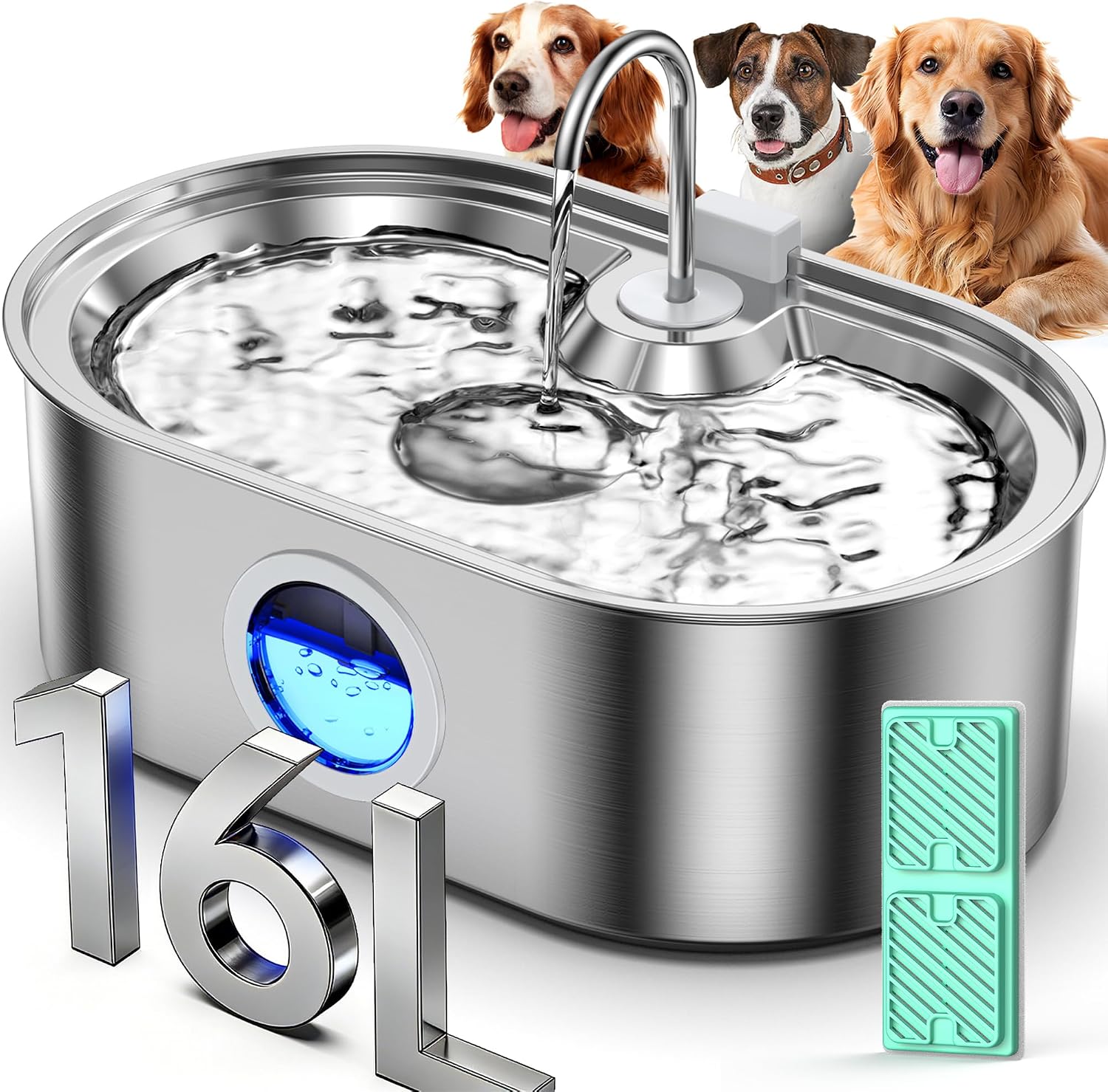
4.2Gal Extra Large Dog Water Fountain, Stainless Steel Pet Water Fountain
The 4.2-gallon reservoir is the reason this one is here. If you have two large dogs, the water capacity means fewer refills and less chance of the fountain running dry while you are at work, which is hard on any pump. Stainless contact surfaces throughout. Check current Amazon price.
The trade-off is real, and it is the thing nobody mentions about a big reservoir: more standing water means more surface area for scale to form and more time for it to harden. In a hard-water house, a fountain this size needs the descale every two to three weeks rather than monthly, and each soak takes more solution because you are filling a bigger basin. Bowl capacity is only a convenience if you can still get the whole reservoir into the sink.
Flaws but not dealbreakers: It is a large footprint on the kitchen floor, and the reservoir eats sink space while it soaks. Anyone with multiple dogs, or one dog that drains a bowl overnight, should start here.
Upgrade pick: SIBAYS 4Gal/15L Large Dog Water Fountain, Stainless Steel Pet Fountain with Water Window & LED Light, Ultra Quiet Automatic Dog Water Bowl Dispenser for Large Dogs & Multi-pet, Easy to Clean FS76
Upgrade pick
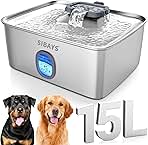
SIBAYS 4Gal/15L Large Dog Water Fountain, Stainless Steel Pet Fountain with Water Window & LED Light, Ultra Quiet Automatic Dog Water Bowl Dispenser for Large Dogs & Multi-pet, Easy to Clean FS76
The water window is the feature that earns the upgrade, and it has nothing to do with looks. A window lets you see the water line without opening anything, which means you catch the ring while it is still a film you can wipe away instead of a crust you have to soak off. The LED light does the same job in a dim hallway. Check current Amazon price.
The pump is billed as ultra quiet, and that is a descaling feature too: when a quiet pump starts humming, you know something is growing in the impeller chamber. It is built for large dogs and multi-pet homes, and the listing calls it easy to clean, which in practice means the parts come apart without a screwdriver.
Flaws but not dealbreakers: Every extra feature is another seam to rinse, and the window and light housing want a soft brush, never a scouring pad. Anyone who would rather see the problem before it becomes a pump replacement will appreciate this one.
The actual descaling workflow
Here is the routine. Plan on about thirty minutes of hands-on time, most of it soaking. Work at the kitchen sink, not on the carpet, and keep the dog out of the room while the citric acid is out. The correct descale a dog water fountain solution is food-grade citric acid and warm water, nothing else, and the sequence is the same whether you clean the fountain twice a month or twice a year.
Step one: Unplug and drain. Pull the cord before anything else, then pour the old water out. If the fountain uses a filter cartridge, take it out now and set it aside; a cartridge that goes into descaling solution is a cartridge you are replacing, so do not bother trying to save it.
Step two: Take it apart as far as it goes. Tray, reservoir, pump housing, impeller cover, spout, water window. The impeller is the small magnetic rotor inside the pump, and it usually sits under a cover you can twist off with a thumbnail. If a part will not come off without force, leave it in place and clean around it.
Step three: Mix the solution. Food-grade citric acid, one to two tablespoons per quart of warm water. Warm speeds up the reaction; boiling water can warp plastic and soften the airtight seal around the pump housing. If you do not have citric acid, plain white vinegar works at full strength, but it smells and it is harsher on some finishes. Never bleach, and never dish soap mixed with acid.
Step four: Soak the stainless. Submerge the tray, the reservoir, and any stainless parts for fifteen to thirty minutes. Scale lifts off as a white cloud in the water. If nothing happens after fifteen minutes, your solution is too weak. Do not soak overnight; long soaks can dull a finish and swell gaskets.
Step five: Run the pump in the solution. This is the step most owners skip and the one that matters most. Put the pump in a separate bowl of the same solution and let it run for ten to fifteen minutes so the solution moves through the impeller chamber instead of just sitting in the basin. Then rinse the pump under running water and spin the impeller with a finger; it should turn freely with no gritty feeling.
Step six: Scrub the tight spots. A soft brush or a retired toothbrush, plus the solution you already mixed. The seam where the tray meets the reservoir, the water window, the spout, the intake slots, and the rubber feet on the non slip base all collect scale that a soak alone will not lift. Rinse the brush between parts so you are not moving grit from one piece to another.
Step seven: Rinse, inspect, reassemble. Rinse everything in fresh water, then rinse it again. Citric acid residue is acidic, and a fountain that smells like lemon is a fountain a dog will avoid. Check the airtight seal and the pump gasket while everything is apart; if a seal is chalky, stretched, or cracked, replace it before the fountain goes back together. Then install a fresh filter cartridge. If your tray and reservoir are dishwasher safe, a hot rinse cycle is a fine substitute for hand rinsing, but the pump never goes in the dishwasher.
Step eight: Refill, restart, and set the schedule. Fill with fresh water, plug in, and confirm the flow looks like it did when the fountain was new. Then write the date somewhere you will see it: a note on the fridge, a phone reminder, a mark on the calendar. In hard water, descale every two to four weeks. In soft water, every six to eight. While you are at the sink, wipe down the rest of the feeding station. A food bowl with slow feed ridges collects the same film, and if the bowl or the fountain sits on a raised stand, check the feeding height so your dog drinks with the neck level rather than crouching.
The competition and why it lost
Not every water source earns a descale routine, and a few that look like fountains do not survive one.
Gravity waterers, the jug-on-a-bowl kind, have no pump and no impeller to scale, which sounds like a win. It is not. The valve and the seam where the jug meets the bowl grow biofilm you cannot reach with a brush, and the plastic jug scratches, which gives that biofilm somewhere to live. Fine for a weekend trip, wrong for a hard-water kitchen.
Plastic fountains are the cheapest option and the one I would skip. Scratched plastic holds scale and slime in a way stainless does not, and the pump is usually sealed inside a housing you cannot open, which means the impeller chamber never gets cleaned at all.
Ceramic bowls on a raised stand are excellent for feeding height and easy to clean, but there is no circulation, so the water sits and grows a film. They belong beside the fountain, not instead of it.
Replacement submersible pumps sold as fountain pumps are useful as spares, but a pump is not a fountain: no tray, no filter cartridge, no reservoir, no non slip base. The three fountains above won because they let you reach the scale before it reaches the motor.
What this all costs
The three fountains here sit at three different points on the price ladder, and the number on each listing is the one that matters. Check current Amazon price on the listing rather than trusting a figure printed in an article, including this one.
The recurring cost is not the fountain. It is the filter cartridges, which need replacing on the schedule the manufacturer gives you, and the citric acid, which is the cheapest part of the whole operation and the part that saves the pump. A bag of food-grade citric acid lasts most owners a year or more, and one pump replacement costs more than every descaling supply you will buy in five years.
Spread over the years you will own it, the fountain itself is the small line item. The pump you do not have to replace is the big one, and the thirty minutes a month is the only real currency you spend. Do it on a schedule, keep the log, and the fountain you bought this year will still be running when the dog is gray in the muzzle.