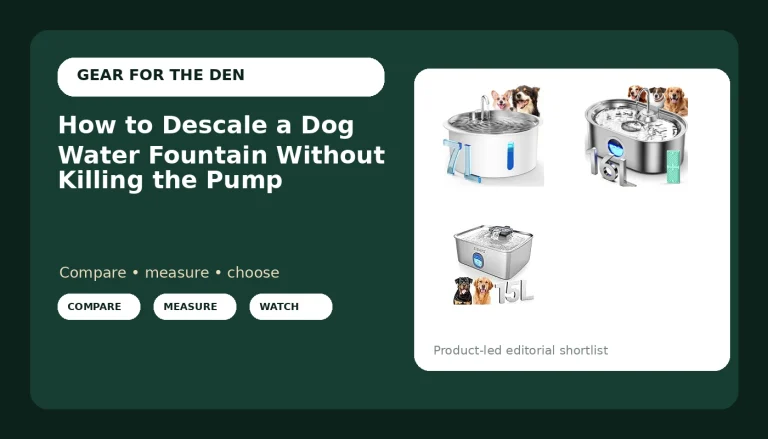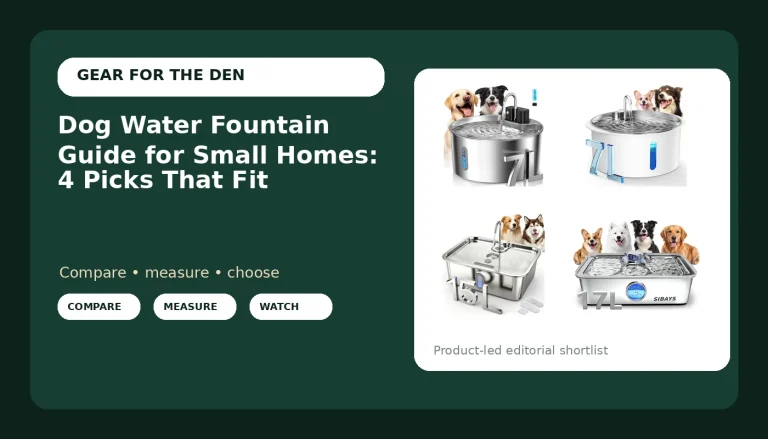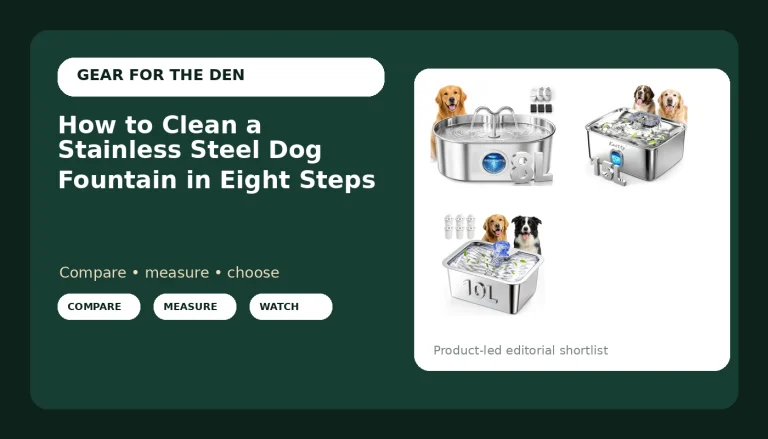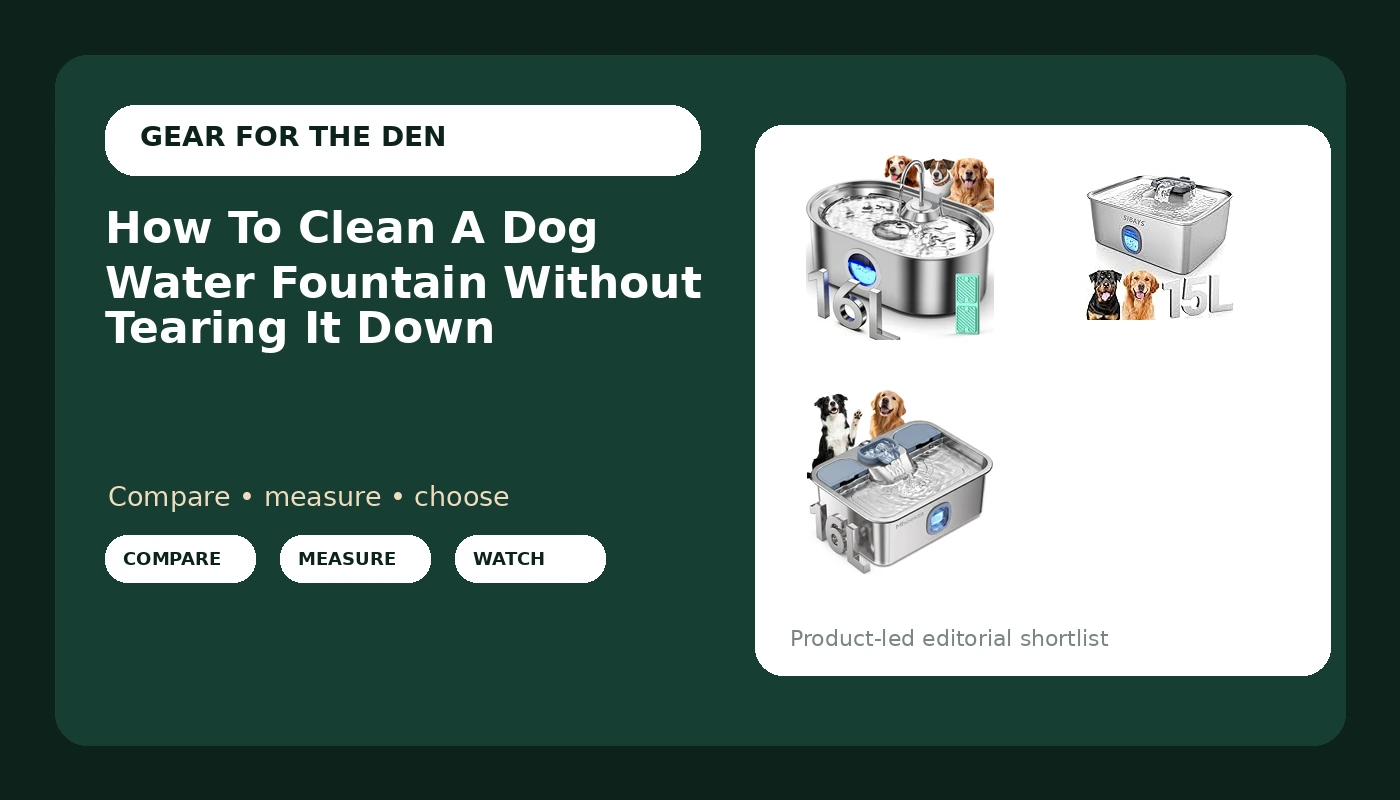
Most dog water fountains do not die of old age. They die of neglect. The pump keeps running, the level drops, the basin looks fine from across the room, and three weeks later the whole thing smells like a pond. Learning how to clean a dog water fountain is less about scrubbing hard and more about knowing which four parts hold the gunk and how often each one needs attention.
The gunk is biofilm, a slick layer of bacteria and saliva that coats every wet surface. It builds fastest in the reservoir, the basin, and the pump intake, and it stays invisible until you run a finger along the inside wall. A filter cartridge slows it down, but a filter is not a cleaning. The cartridge catches hair and grit. The biofilm still has to come off by hand.
Twenty minutes a week is the honest number, and most of that is soaking time. What follows is the routine, the five checks that separate a fountain you will actually keep clean from one you will resent, and three stainless fountains that pass them.
Why you should trust me
I run stainless steel fountains in a house with two large dogs, and I have replaced more pumps than fountains, because the pump is the cheap part and the teardown is the free part. Fountain maintenance is the one job where the box copy and reality disagree most. Every listing says easy to clean. Almost none of them mention that the impeller housing is where the hair goes.
I learned this the hard way: bleach in a reservoir once (never again), a filter cartridge left in three weeks past its date, a pump run dry for an afternoon while the dogs napped through it. The honest rules for how to clean a dog water fountain come from that maintenance side, not from the box. No bleach, no soap residue, no shortcuts around the pump. Warm water, white vinegar, a soft brush, and a schedule handle almost everything.
How I picked and how I tested
I did not pick these three by capacity alone. Water capacity matters, but a big reservoir you cannot reach inside is a bigger problem than a small one you can. Every fountain here was judged on five checks that decide whether a weekly clean stays a twenty-minute job or turns into a Sunday project.
One: can you reach the impeller and the intake screen with a bottle brush, without tools? Two: how many parts need hand scrubbing, and which of them the maker calls dishwasher safe? Three: is the filter cartridge a standard shape you can keep buying, or a proprietary one that disappears in six months? Four: does the lid seal, or does it dump a quart of water on your foot when you lift it? Five: does the base stay put on tile when a dog bumps it?
Each fountain below went through the same eight-step teardown: full disassembly, a warm soapy wash on the stainless, a vinegar soak on the scaled parts, a pump scrub, a filter change, and a reassembly finished with a one-minute listen for rattles. The notes that follow are about the parts, not the marketing.
Fountains that make the weekly teardown easy
Three fountains, three roles. One is the plain stainless workhorse, one has the features that make daily topping off easier, and one adds real filtration for a multi-dog house. All three take the same routine in the next section.
Budget pick: 4.2Gal Extra Large Dog Water Fountain, Stainless Steel Pet Water Fountain
Budget pick
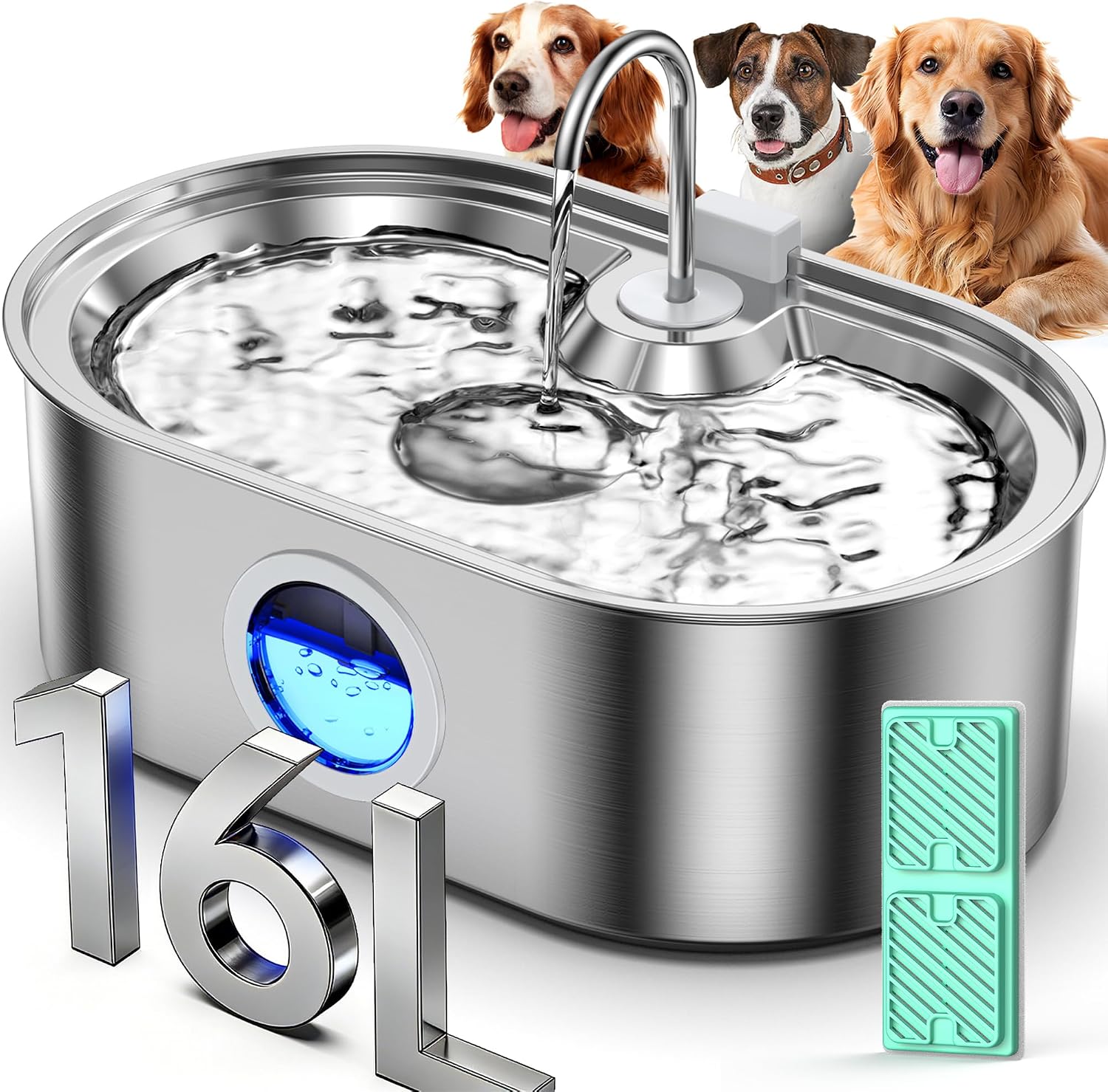
4.2Gal Extra Large Dog Water Fountain, Stainless Steel Pet Water Fountain
Check current Amazon price.
This is the one I point people to when they want a stainless basin, a big water capacity, and nothing else to think about. A 4.2 gallon reservoir covers a two-dog house through a workday and then some, and stainless does not hold a smell the way a scratched plastic basin does, which matters more than any feature on the box when you are the one scrubbing it.
The trade is features. There is no water window, so you check the level by lifting the lid or by watching how your dog drinks. That extra handling is also extra chances to knock the lid out of place, and it is the reason I would rather have a window, but it is a small thing if the fountain sits where you walk past it ten times a day.
Flaws but not dealbreakers: a plain fountain lives or dies on the pump, so the intake screen needs a brush every week, no exceptions. Plan on the filter cartridge as a recurring line item.
Best for a household that wants capacity and simple parts, and will do the weekly teardown without being nagged.
Our pick: SIBAYS 4Gal/15L Large Dog Water Fountain, Stainless Steel Pet Fountain with Water Window & LED Light, Ultra Quiet Automatic Dog Water Bowl Dispenser for Large Dogs & Multi-pet, Easy to Clean FS76
Our pick
SIBAYS 4Gal/15L Large Dog Water Fountain, Stainless Steel Pet Fountain with Water Window & LED Light, Ultra Quiet Automatic Dog Water Bowl Dispenser for Large Dogs & Multi-pet, Easy to Clean FS76
Check current Amazon price.
The water window is the feature that earns this one the top spot. Being able to see the level without lifting the lid means fewer disassemblies, fewer chances to seat a lid wrong, and a faster daily top-off, which is the habit that keeps a fountain clean in the first place. The LED light is useful in a hallway or a corner at night, and ultra quiet matters more than it sounds, because a fountain that hums gets unplugged and an unplugged fountain is a bowl.
Easy to clean is doing real work in that name too: fewer seams and a basin you can reach into with a sponge make the weekly routine shorter. For a multi-pet house, the capacity keeps up, which means fewer refills and less standing water sitting warm.
Flaws but not dealbreakers: a window and a light add seams, and seams collect biofilm, so the corner around the glass gets a soft brush every week, not just a rinse. If the fountain sits in direct sun, any light inside a reservoir invites algae, so keep it out of the window.
Best for a multi-dog or multi-pet home that wants the level visible at a glance.
Upgrade pick: 16L Stainless Steel Dog Water Fountain with Dual 5-Layer Filtration System
Upgrade pick
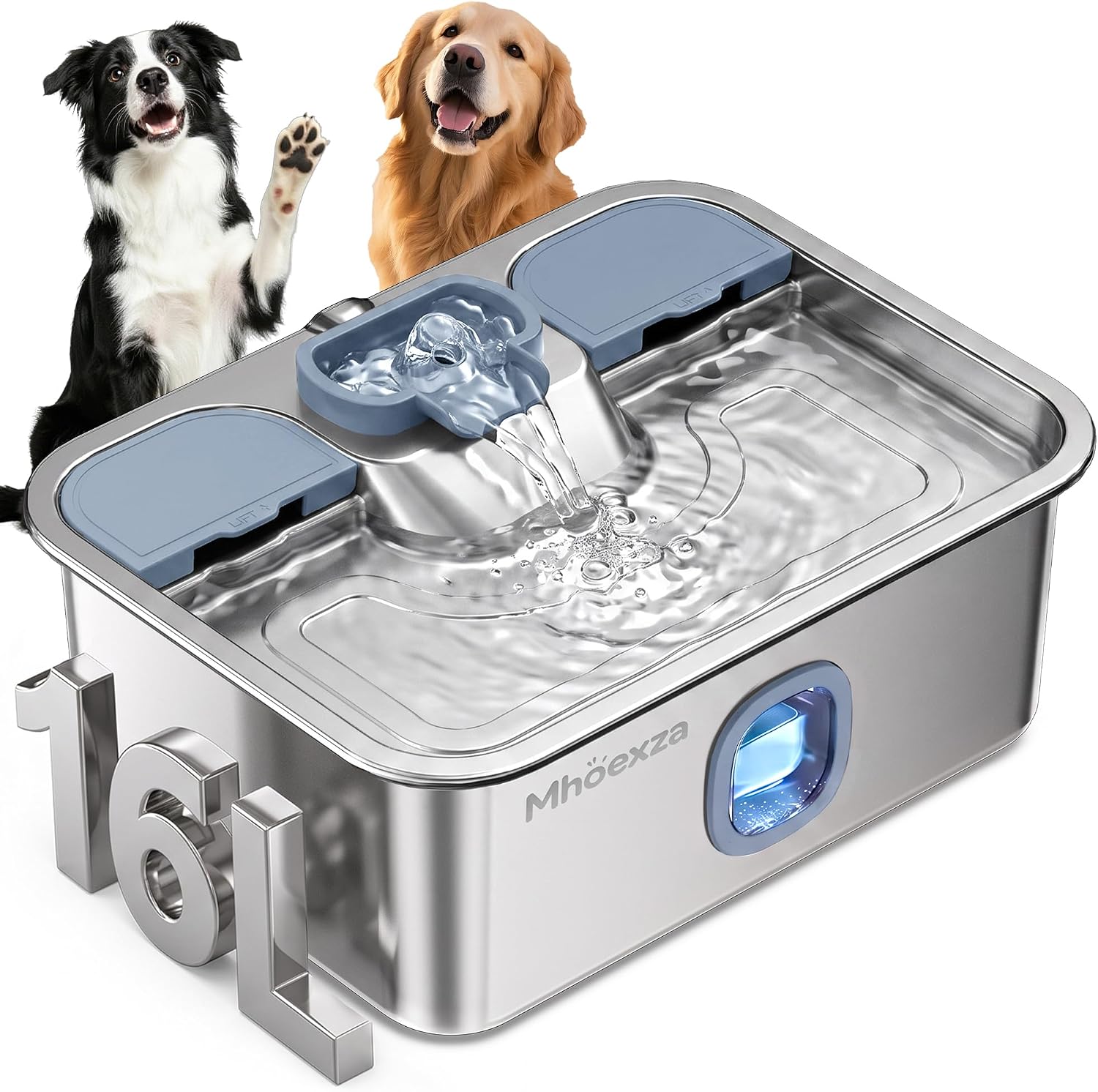
16L Stainless Steel Dog Water Fountain with Dual 5-Layer Filtration System
Check current Amazon price.
Dual 5-layer filtration means two stages of media, which is the right answer for a house where two or three dogs drink and drool into the same reservoir all day. More media means more hair and grit pulled out of the water before it reaches the pump, and a cleaner pump runs quieter and lasts longer. The 16 liter reservoir is in the same range as the others here, so the upgrade is really the filtration, not the capacity.
The cost of that upgrade is maintenance surface. Two stages mean two things to rinse, two things to replace, and a schedule you have to actually keep, because a loaded cartridge stops filtering and starts slowing the flow. Stainless still means no lingering smell and no staining, and the basin takes a sponge without scratching.
Flaws but not dealbreakers: the filter cartridge becomes a real recurring cost, and if you let it go too long the pump works harder for less water movement. Buy the cartridges in a pack so you are never out.
Best for a multi-dog home that wants filtration as the main event.
How to clean a dog water fountain in eight steps
Here is the whole job, start to finish. Set a timer if you like. The soaking does most of the work while you do something else.
Step one: Unplug it and take it apart. Kill the power at the outlet before your hands go into the water. Lift the lid, pull the filter cartridge tray, remove any ramp or spout, and work the pump off its suction cups. Lay the parts on a towel in the order they came off. Reassembly is where people rush, and a lid seated crooked is how a fountain leaks across a kitchen floor overnight.
Step two: Dump the old water and read it. Tip the reservoir into the sink and watch what settles out. A little grit is normal. Rope-like slime or a pink film on the walls means the schedule slipped. Run a finger around the inside of the basin: a squeak means you caught it in time, a slide means biofilm, and biofilm needs soap and a soft cloth, not a rinse.
Step three: Wash the stainless parts. Warm water, a drop of unscented dish soap, a soft sponge. Skip abrasive pads, which scratch stainless and give biofilm a place to hide. Dishwasher safe means the maker says that part is dishwasher safe; if the listing is vague, hand wash it. Rinse twice.
Step four: Clean the pump, which is the part that matters. Pull the intake screen, open the housing if it comes apart by hand, and get a soft bottle brush or an old toothbrush onto the impeller. Hair wraps the impeller shaft, slows the flow, and makes the motor hum. If the stream weakens and the fountain gets louder, the pump is the first suspect, not the filter cartridge.
Step five: Descale with white vinegar. Tap water leaves mineral crust on the spout, the ramp, the pump housing, and any silicone gaskets. Plain white vinegar dissolves it. Soak the scaled parts twenty to thirty minutes, then scrub the soft spots with the brush. Never use bleach on any part a dog drinks from.
Step six: Rinse until it smells like nothing. Soap residue and vinegar both put dogs off water, and a dog that stops drinking from the fountain is the expensive failure mode. Rinse every part under warm running water, then smell it. Stainless should smell like stainless. If it smells like salad dressing, rinse again, and check the gaskets for cracks while you are in there.
Step seven: Change the filter cartridge. Filtration is not cleaning. A cartridge traps hair and grit, and once it is loaded it slows the flow instead of polishing the water. Replace it on the maker's schedule, which in a multi-dog house means checking it every couple of weeks. Rinse a new cartridge under cold water before it goes in.
Step eight: Reassemble, refill, and listen. Seat the pump, confirm the lid's airtight seal is sitting flat, set the fountain back on its non slip base, and fill with fresh water. Plug it in and stand there for a full minute. You are listening for a steady hum with no rattle and watching for a steady stream with no seep at the seams. If the stream sputters, the impeller is not seated.
The schedule that keeps this from becoming a weekend project: top off the water daily, do the full teardown once a week, and soak the pump in vinegar once a month. In summer, or in a house with a heavy drooler, twice a week for the teardown is not overkill. People ask how often they should wash a dog water fountain and the answer is more often than the manual says, because the manual assumes one tidy dog and a bowl that never gets bumped. If you have ever searched how to wash a dog water fountain at 10 p.m. with a smelly basin in the sink, this is the routine that keeps you from getting there.
The competition and why it lost
Not every water setup needs this routine, and a few popular ones lose to a fountain for reasons that have nothing to do with the pump.
The standard stainless bowl is the honest competitor. It is dishwasher safe, it has no pump to clog, and a daily rinse is thirty seconds. What kills it in a two-dog house is the refill, not the cleaning. A bowl's capacity is sized for a meal, and water disappears faster than food, so you are filling it three times a day in summer. Bowl capacity matters for kibble. Water capacity is the number that matters here.
Gravity dispensers hold a lot of water and are miserable to clean. The bottle neck is too narrow for a sponge, the trough is shallow, and everything sits in the same plastic. Plastic scratches, and a scratched plastic surface holds smell no matter how well you wash it. That is why stainless wins this category.
Elevated bowls have a real place, and feeding height genuinely helps a senior dog with a stiff neck, but that is a food conversation. I keep that list separate in our guide to elevated bowls for big and senior dogs. Slow feed bowls lose here for the simplest reason: slow feed ridges slow down a dog that gulps its dinner, and they have nothing to do with water.
What all of them share is the mistake this article exists to fix. Standing water grows biofilm whether it is moving or not. A fountain just makes the biofilm harder to see.
What this all costs
The fountain itself is the one-time cost. Check current Amazon price on each of the three above, and remember that the stainless basin is the part you keep; the pump and the filter are the parts you replace.
Ongoing, there are exactly three lines: the filter cartridge, a jug of white vinegar, and eventually a new pump. The cartridge is the only real subscription, and the schedule depends on how many dogs drink from the reservoir, so a single dog might go longer than a multi-dog house. Vinegar is the cheapest item in the whole routine and it does the most work. Pumps last longer than people expect when they are cleaned monthly and never run dry.
The hidden cost is neglect. A pump choked with hair runs hot, a loaded cartridge slows the flow, and a fountain that hums gets unplugged, which puts you back to a bowl, which means three refills a day and the same biofilm problem with none of the filtration. Clean a dog water fountain on a weekly schedule and the only money you spend after the initial purchase is consumables. Skip it and you buy the fountain twice.