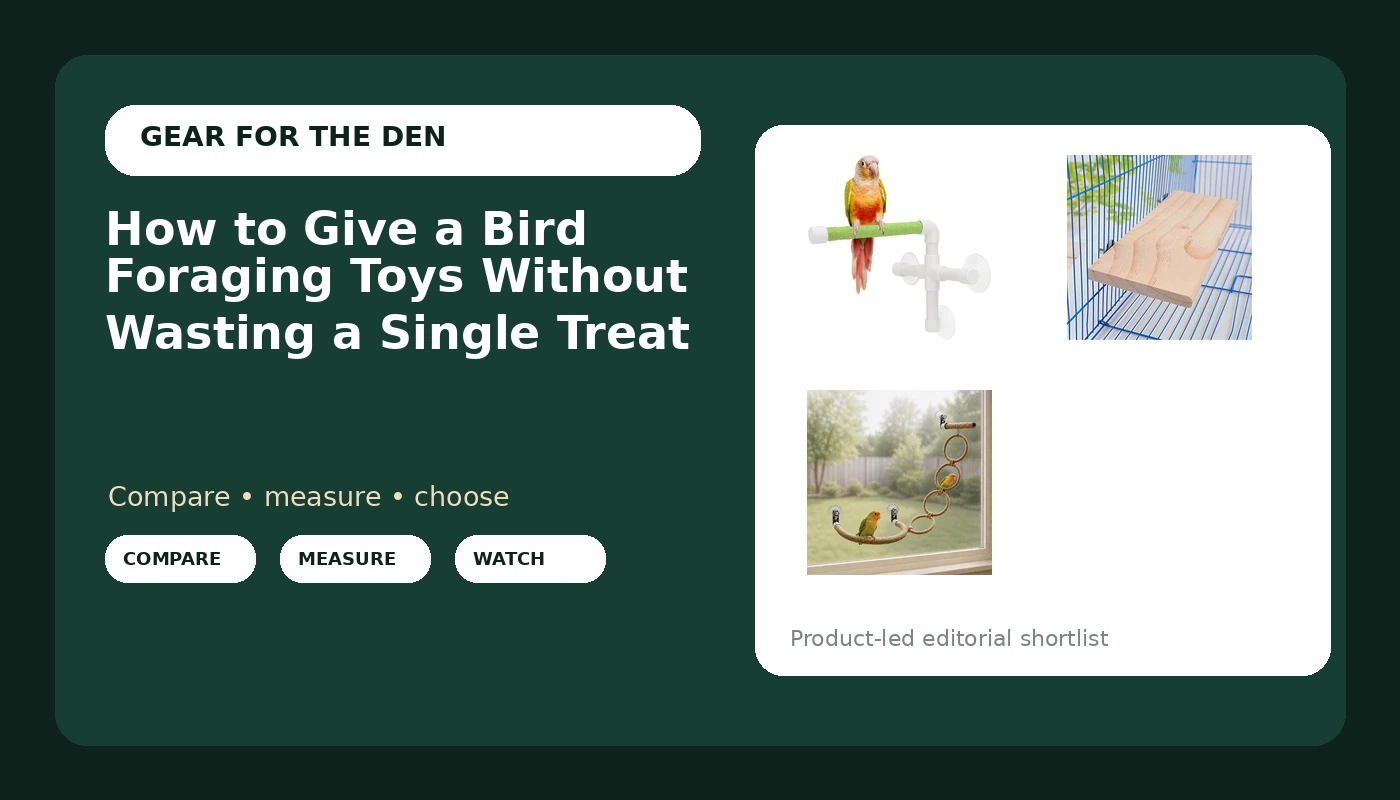
Most bird owners buy a foraging toy, clip it to the cage bars, and then watch it hang there untouched for a month. If you want to give a bird foraging toys that actually get worked, the toy is the last thing to think about. The first thing is where the bird stands while it works.
That is why this guide is mostly about perches. A suction cup window perch or a flat wood platform gives a bird a station outside the cage where food can be hidden, wedged, and picked apart. Without a station, foraging is a cage-floor chore that ends the moment the food cup is empty.
Get the setup right and you can move a bird from a cup it empties in ten minutes to a puzzle that keeps it busy for an hour. Get it wrong and you have a bored bird, a streaked window, and a toy you wasted money on.
Why you should trust me
I have kept budgies, cockatiels, and one very loud Senegal parrot for over a decade, and I have rebuilt my birds' foraging setups more times than I can count. Along the way I have watched a lot of keepers make the same mistake: they buy the toy first and think about the station last, then blame the bird when nothing happens. I have cleaned up after enough failed foraging attempts to know which failures belong to the bird and which belong to the setup. Almost always it is the setup.
I do not sell birds or bird gear, and nothing below is a paid placement. What follows is the order that actually works, plus the perches I would put that station on and the reasons the other options did not make the list.
How I picked and how I tested
These picks are about the station, not the toy. I compared the three perches below on the things that decide whether a foraging setup works: the mounting surface, the perch diameter, how the mount holds weight, and how quickly the surface wipes clean after a messy session.
The testing here is comparison rather than lab work. I compared the published dimensions against the sizes that actually work for a budgie, a cockatiel, and a small conure, and I checked the mounting method against the surfaces in a normal home: glass, tile, and painted wall. I looked at whether the bird gets enough flat room to hold a treat with a foot, and how the surface handles a wet mash or a chunk of fruit. For suction cup mounts, the deciding factor is the glass: clean, smooth, and out of direct sun. For a platform perch, it is the flat area and the edges, because a small lip is what keeps a treat from rolling off onto the floor.
The three things I weigh most are perch diameter, mount rating, and cleaning time. A perch that is too narrow for the feet means the bird will not settle long enough to work at anything. A mount that lets go at the wrong moment teaches the bird that the station is not safe. And a station that takes twenty minutes to clean will get used twice and then ignored, by you more than by the bird.
If you are still sorting out the cage itself, my budgie cage setup guide covers bar spacing and cage height, which matter before any of this.
Perches you'll need before you start
You cannot hand a bird a puzzle and expect it to work on a wobbly perch. Build the station first, then add the food.
Budget pick: Hypeety Portable Suction Cup Bird Window and Shower Perch Toy Parrot Stand
Budget pick
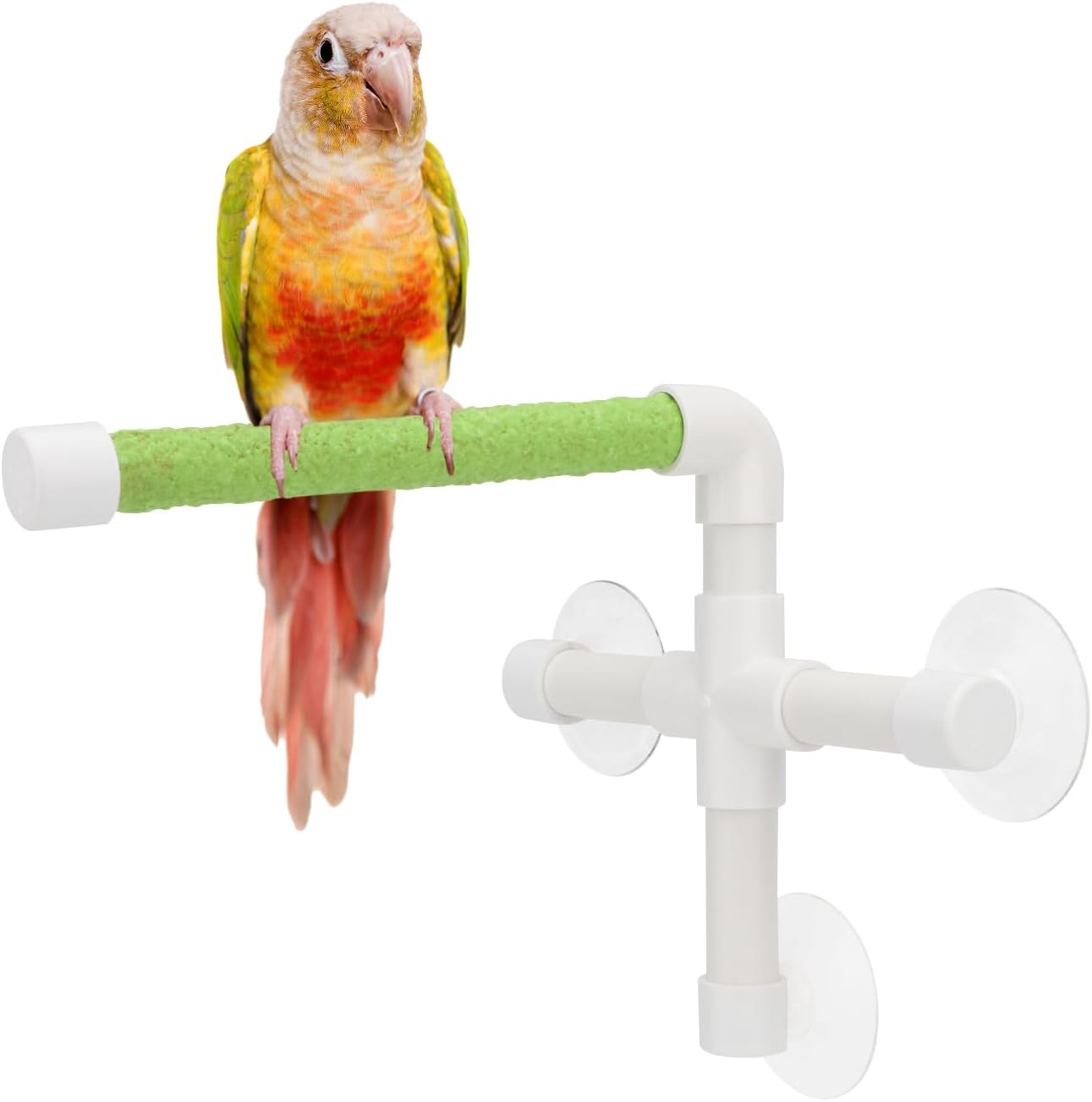
Hypeety Portable Suction Cup Bird Window and Shower Perch Toy Parrot Stand
Check current Amazon price.
This is the cheapest way to give a bird a station that is not the cage. The Hypeety presses onto a window or a shower wall with suction cups, which means you can move it around the house without drilling anything and without committing a wall to a bird. For a budgie or a cockatiel that is enough. A small bird does not need much real estate; it needs a stable place to stand while it works a piece of millet or a slice of apple. It also packs down flat, so it doubles as a travel perch when you want your bird to have somewhere familiar to stand in a hotel room.
The trade-off is that the cups are the entire mount. The glass has to be clean, smooth, and flat, and a textured window or a painted wall will not hold. Press it on, wait a minute, and give it a firm tug before you let the bird near it. That single habit prevents most of the crashes people complain about.
Flaws but not dealbreakers: Suction cups are a wear item. Expect to wipe and re-press them, and expect them to give up faster in a hot, sunny window. Keep the perch out of direct afternoon sun and they last far longer.
Anyone with a single small bird and a kitchen window will get a lot out of this for very little money.
Runner-up: Litewoo Parrot Bird Wood Perch Platform Large Stand Shelf for Budgie, 1PC
Runner-up
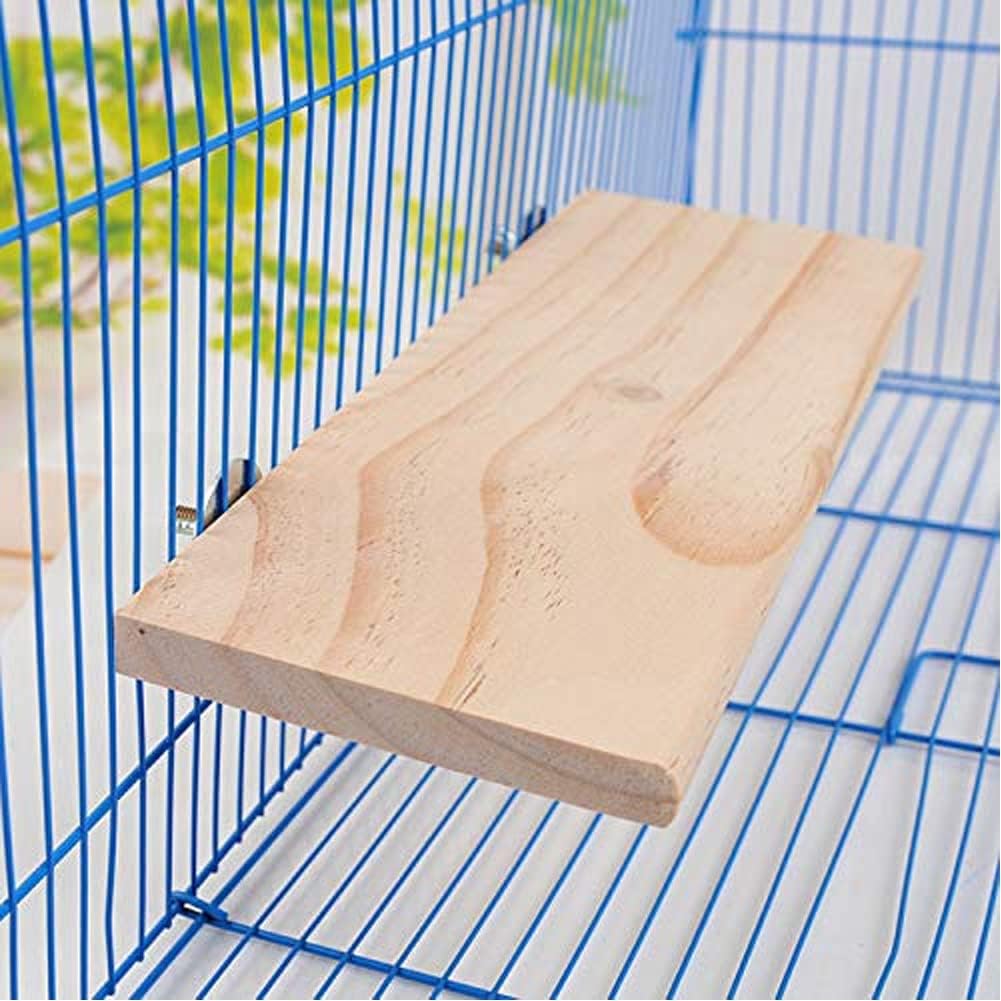
Litewoo Parrot Bird Wood Perch Platform Large Stand Shelf for Budgie, 1PC
Check current Amazon price.
A flat wood platform is the single best surface for foraging, and this is the one I would hand to most people. It is a shelf, not a branch, which means you can set a food cup on it, scatter a few pieces of chop, or lay down a wrapped treat and let the bird figure it out. Flat beats round when the food has to stay put.
One more thing in its favor: because it is flat, you can start a bird on it with food simply scattered across the surface. That is the gentlest possible introduction to foraging, and it works even with a bird that has never worked for food before.
The perch diameter here is generous, so a budgie or a small conure can stand comfortably and still have room to hold something in a foot. The wood wipes down, and a paper tray liner underneath catches the mess, which is the difference between a station you use daily and one you avoid.
Flaws but not dealbreakers: Wood needs to dry out between scrubbings. If you soak it and put it straight back, it stays damp. Wipe it, let it air, and rotate in a second surface if your bird is a messy eater.
Anyone who wants a dedicated foraging surface rather than a hang point should start here.
Upgrade pick: Window Perch for Birds, Suction Cup Bird Perch Stand with Climbing Rings
Upgrade pick
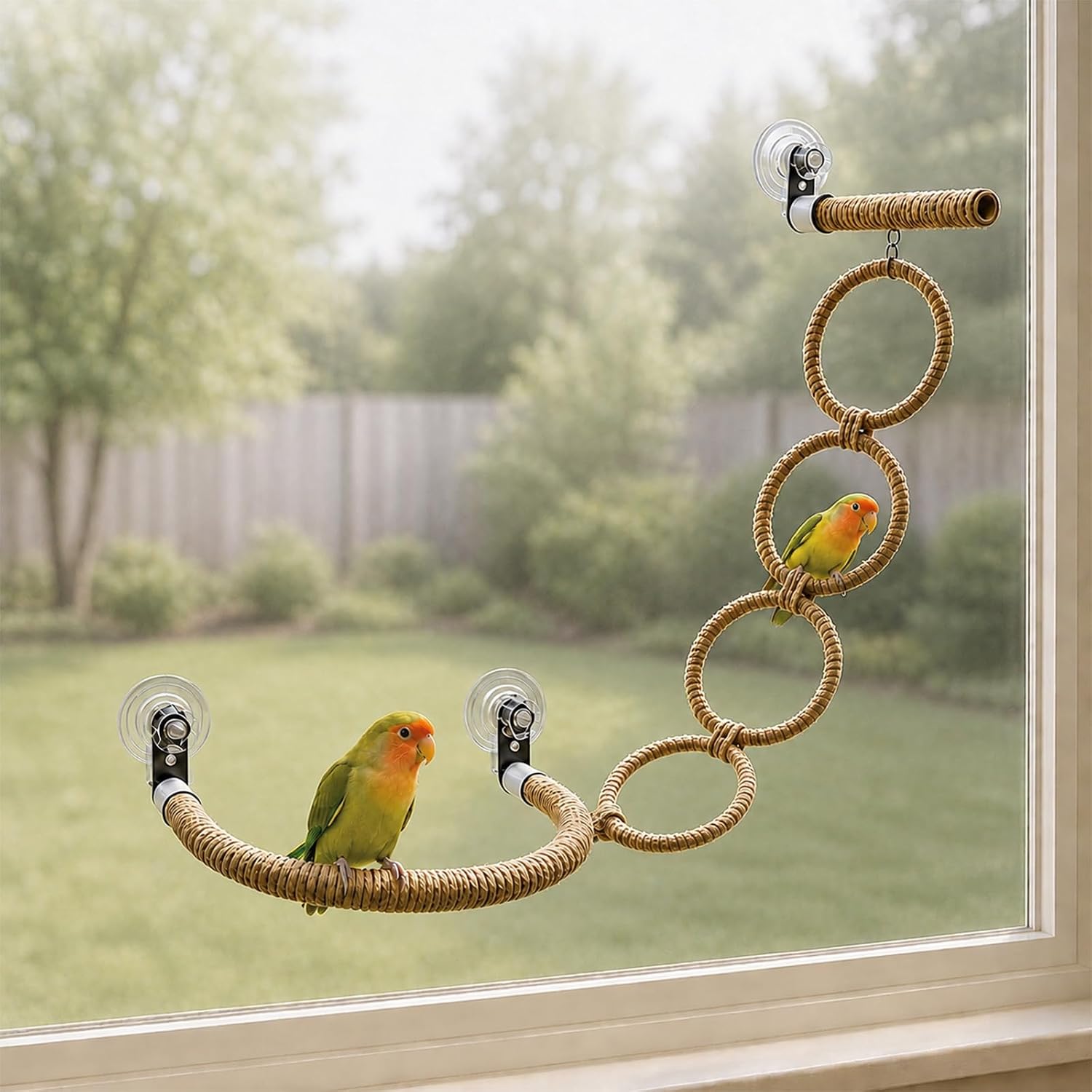
Window Perch for Birds, Suction Cup Bird Perch Stand with Climbing Rings
Check current Amazon price.
This is the one that does both jobs. It is a suction cup window perch with climbing rings built in, so the bird gets a window seat and you get hang points for skewers, vine balls, and paper-wrapped treats. That makes it the easiest station to raise foraging difficulty on, because you can add a new challenge without buying a new perch.
The rings also give you a swing mount in a pinch. Clip a foraging toy to a ring instead of the cage bars and the bird has to reach, balance, and work at the same time. That is exactly the kind of effort a foraging setup is supposed to produce.
Flaws but not dealbreakers: More surface area means more to clean, and the rings collect seed husks. A quick brush at the end of the day keeps it from becoming a chore.
Anyone with a bird that already forages and needs somewhere harder to work should look here first.
How to give a bird foraging toys, step by step
Now the part you came for. The order matters more than the toys.
Step one: Build the station before the toy. Clean the glass or the cage bars, mount the perch, and let the bird use it empty for two or three days. No food, no puzzle. You are teaching one lesson first: this thing is safe and it is mine.
Step two: Match the perch to the bird. Perch diameter is the quiet make-or-break number. Too narrow and the bird grips hard and will not settle; too wide and it slides. Watch where your bird chooses to sit and copy that. Hold a pencil against the foot if you want a quick read: the toes should wrap roughly two thirds of the way around, not meet underneath. If your bird avoids the new perch entirely, the diameter is usually the reason.
Step three: Start with a food cup, not a puzzle. Put the bird's normal food in a small cup on the new station and nothing else. Food cup size matters here: small enough that the bird finishes and looks for more, large enough that it is not frustrated in ten seconds. This is the easiest foraging difficulty there is, and it is where every bird should start.
Step four: Wrap the first treat. Once the bird eats from the cup without hesitating, wrap a favorite treat in a square of paper and drop it on top of the food. The bird has to tear the paper to get the good thing. That single step turns eating into working.
Step five: Add the first real foraging toy. A paper cup stuffed with shredded paper, a vine ball with a few seeds inside, or a skewer of fruit. Clip it to a ring or hang it beside the platform so the bird can reach it from the station it already trusts. Set the toy where the bird can reach it from a standing position at first. Once it is working the toy from the perch, you can hang it lower or further out and make the bird climb for it. Do not move the station and add the toy in the same week.
Step six: Raise foraging difficulty one notch at a time. When the bird empties the toy in under a minute, make the next one slightly harder: fold the paper once more, use a tighter weave, hide the treat deeper. If the bird gives up and walks away, you went too far. Drop back a level for a few days and try again. The ideal give a bird foraging toys progression is boring on purpose.
Step seven: Rotate the station, not just the toys. Move the perch to a different window, swap a platform for a swing mount, or set up a second station in another room. New places make old toys interesting again, and a second station solves the bird that has stopped working a toy it used to love. If you travel with your bird, a small foraging toy clipped inside a carrier does the same job, though you will want to check carrier size before you plan on hanging anything inside.
Step eight: Keep a routine and clean as you go. Same time each day, same station, fresh food. Sweep the perch, replace the tray liner, and wipe the suction cups while the bird is elsewhere. A station that is clean and predictable is a station the bird returns to. The correct give a bird foraging toys habit is the one you will still be doing in six months.
The competition and why it lost
The cage-top play stand, the rope boing, and the hanging foraging wheel are all good bird gear, and I have recommended each of them in other articles. They are not what this piece is about. A play stand is a place to perch, not a place to work, and a boing is for bouncing. Neither one gives you a flat surface for food.
The stainless steel skewer and the acrylic foraging wheel are the two toys I get asked about most. Both are excellent, and both assume the bird already has a station to work from. If you hang a wheel in the middle of the cage with no perch close enough to reach it, you have built a decoration. Add the perch first.
The travel carrier and the sleep cage are the other two things people ask about. A carrier is for transport, not for daily foraging, and a sleep cage is for sleeping. The station belongs where the bird spends its waking hours.
What this all costs
The perch is the cheap part. A suction cup window perch and a wood platform both sit at the low end of bird gear, and neither one wears out quickly if you keep the surface clean. Check current Amazon price on each before you commit, because these listings move.
The toys are where the money actually goes, and they are also where the money is easiest to waste. You do not need ten of them. You need two or three that you can make harder, plus a roll of paper and a bag of the bird's favorite treat. The birds that forage best are not the ones with the biggest toy box; they are the ones whose owner rotates three toys and hides food in new places.
The other cost is your attention. A foraging setup is not a thing you install and forget; it is a thing you refill, rearrange, and clean. If you can give it five minutes a day, a bird will get hours of work out of it. If you cannot, no perch on this list will fix that, and the bird will go back to the food cup.
Run the math on time instead of dollars. A foraging station that keeps a bird busy for thirty minutes a day is thirty minutes it is not screaming, plucking, or pacing. Over a year that is more than a hundred and eighty hours of occupied bird. No toy you can buy does that on its own.
Start with the station. Let the bird learn it empty. Then add one cup, one wrap, and one toy, and raise the difficulty only when the bird beats you. That is how to give a bird foraging toys that get used instead of ignored.