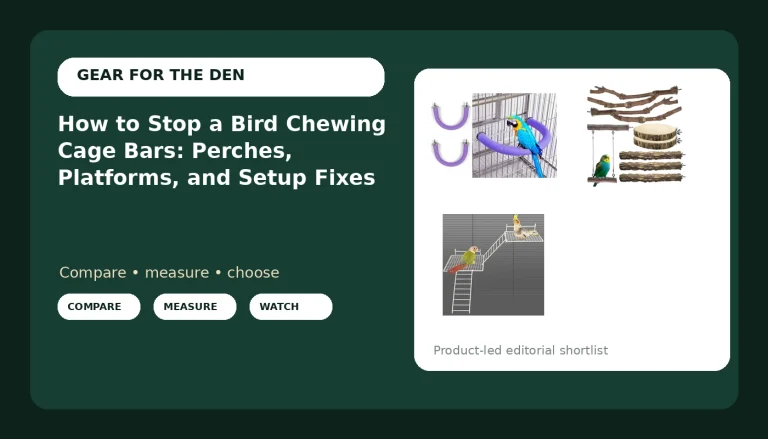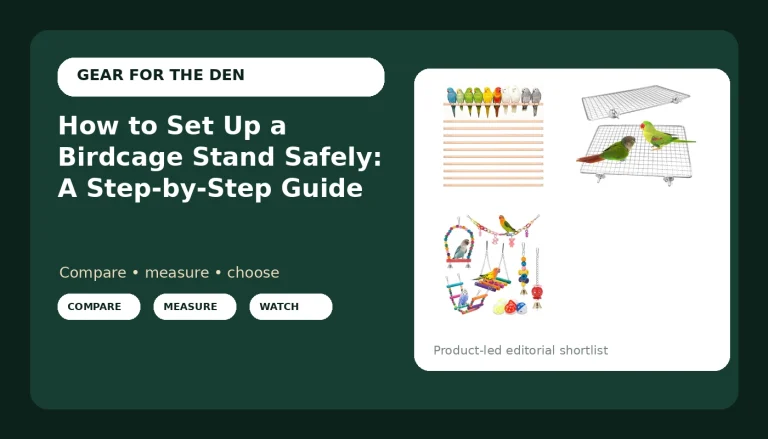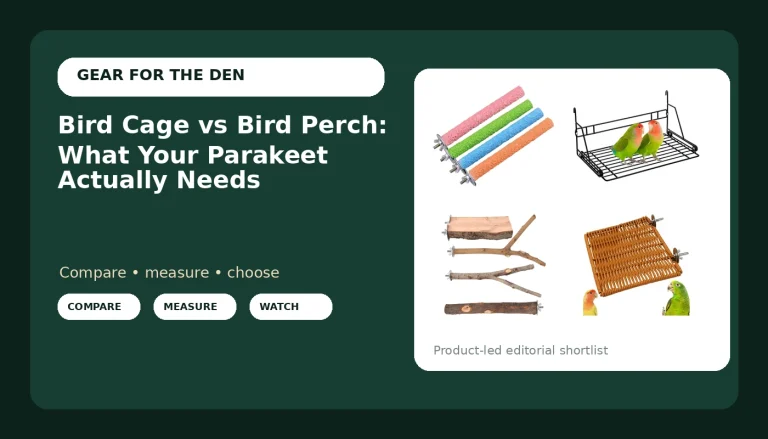
Knowing how to set up a parakeet cage is less about buying a bigger cage and more about arranging the space your bird actually lives in. A parakeet spends most of its life on its feet, so the perches, food cup, and tray liner matter as much as the cage dimensions. Get the interior right and you avoid the two most common problems: sore feet and a bored bird.
The mistake I see most often is an empty cage with one dowel perch and a plastic cup bolted to the bars. That setup is easy to clean, but it gives a parakeet nothing to climb, nothing to shred, and no reason to move between meals. A proper parakeet cage setup uses varied perch diameters, a feeding platform, and a layout that forces the bird to hop and stretch.
This guide is not about the cage itself. It is about what goes inside, how to place it, and which accessories are worth buying. I used three specific accessories as the working examples, and I explain the order I would install them.
Why you should trust me
I have spent the last several years researching small-bird housing for Gear for the Den. That means reading keeper forums, manufacturer specifications, and avian vet guidance instead of trusting packaging claims. I do not run a lab, and I do not pretend that a product photo tells you how a parakeet will use something. What I do is compare each accessory against the way a small bird actually moves: it climbs, it shifts its grip, it investigates edges, and it spends a lot of time on the highest perch it can find. My bias is toward simple wood, shallow cups, and mounts that do not require a toolbox. If a product fails those basics, it does not belong in a cage.
I also keep an eye on the parts that are easy to overlook. A tray liner sounds boring until you have scraped dried seed off a metal tray for the third time in a week. A swing mount sounds like a small detail until the swing drops in the middle of the night. The best parakeet gear is the gear that disappears into the routine.
How I picked and how I tested
My test was a fit check, not a lab bench. I compared each accessory against the numbers that matter in a parakeet cage: bar spacing, cage height, perch diameter, food cup size, tray liner fit, and mount style. I looked for perches with natural variation, because a parakeet's feet need different grips across the day. I rejected anything that would be difficult to clean while a bird is watching. I also checked whether each item could be removed and reset without taking the whole cage apart.
If you are still choosing the cage itself, our bird cage buying guide covers bar spacing and door size in more detail. For this article, I focused on three accessories that solve the interior setup: a natural grape wood perch, a multi-pack of small wood perches, and a perch with an integrated feeding cup. The ideal parakeet cage setup is not the one with the most toys. It is the one where every perch and cup has a purpose. I also looked at what each accessory does not do. A perch cannot fix a cage that is too small. A feeding platform cannot fix a diet that is all seed. Those are separate problems, and I do not pretend a product list solves them.
What you need to set up a parakeet cage
The three accessories below cover the perching and feeding layer of a parakeet cage setup. You still need the cage, a tray liner, and a carrier for vet visits, but these are the pieces that turn a wire box into a habitat.
Budget pick: PINVNBY Parrot Perches Natural Birds Stand Wild Grape Stick Grinding Paw Climbing Wood Cage Accessories and Toy for Parakeet, Lovebirds,Budgies,Cockatiels and Finches
Budget pick
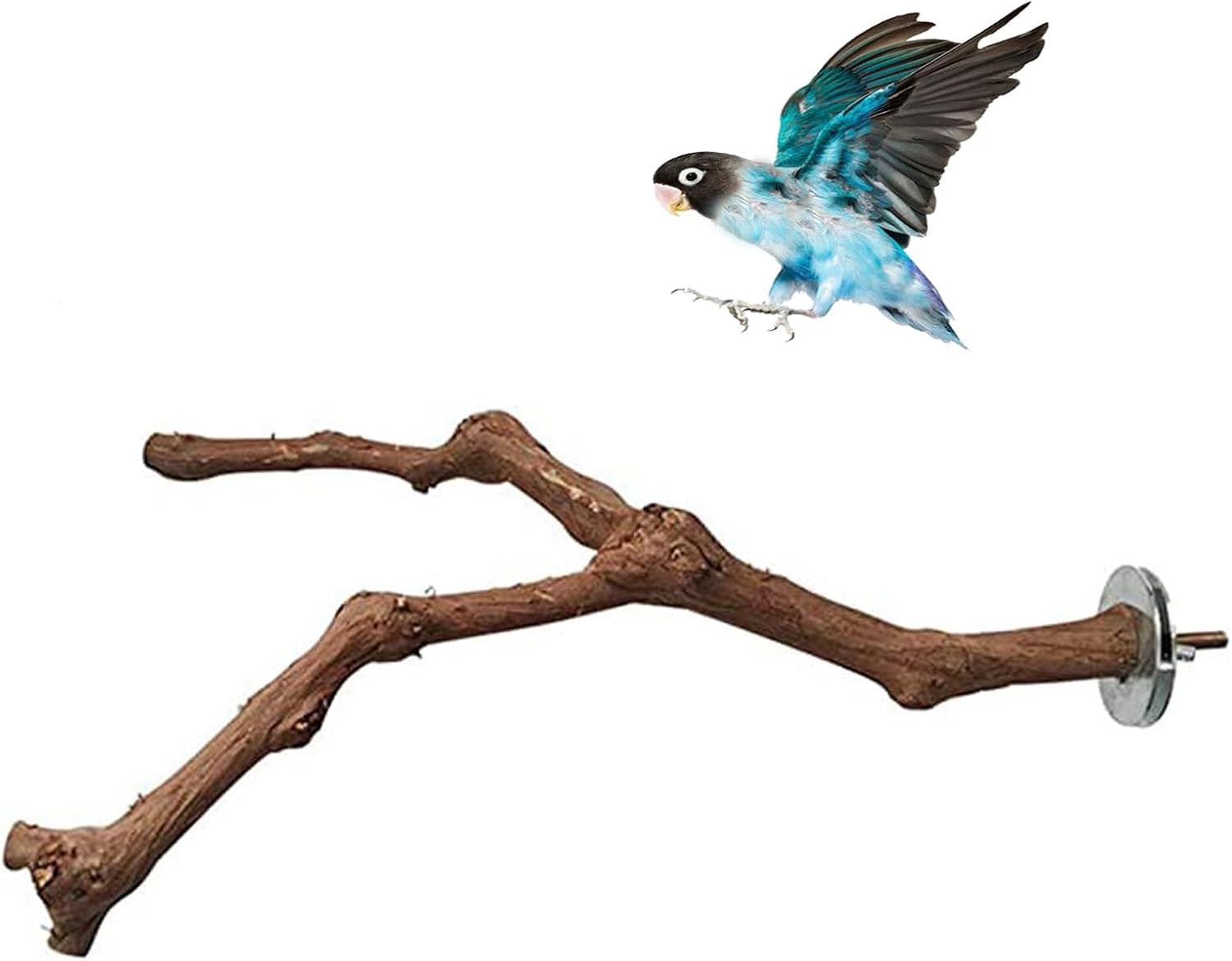
PINVNBY Parrot Perches Natural Birds Stand Wild Grape Stick Grinding Paw Climbing Wood Cage Accessories and Toy for Parakeet, Lovebirds,Budgies,Cockatiels and Finches
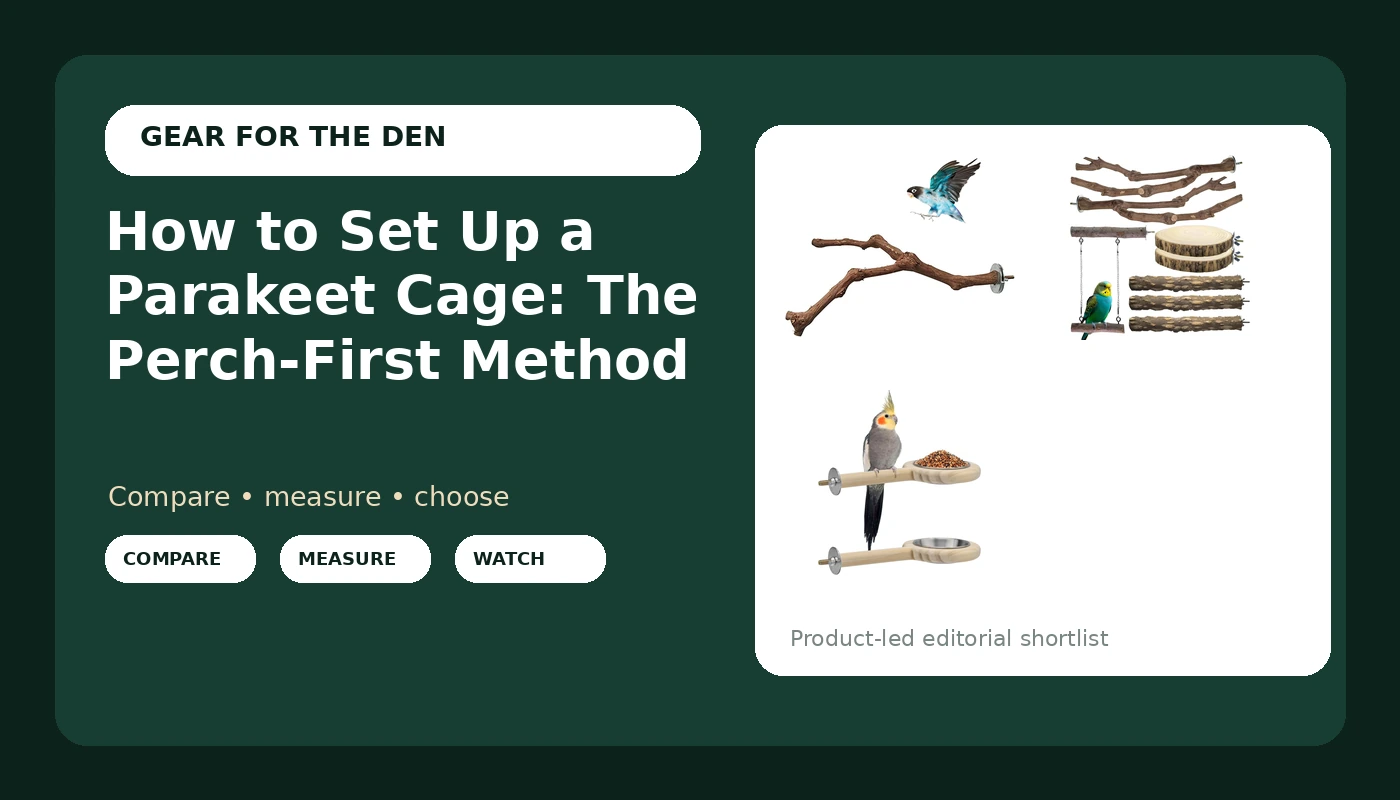
This is the single perch I would start with if you are replacing a dowel. The listing describes it as a natural grape wood perch for parakeets, lovebirds, budgies, cockatiels, and finches. Wild grape wood has uneven thickness, so a parakeet has to shift its grip as it moves along the branch. That variation is the whole point: it exercises the foot and gives the nails something to work against. The grinding paw claim is marketing language, but natural texture does more than a smooth dowel. Check current Amazon price. If the branch is longer than your cage allows, you can usually reposition it rather than force it into a corner.
Flaws but not dealbreakers: natural wood means every piece is different, so you may get a fork that does not fit where you planned. Rotate it or move it to another corner. Anyone with a single parakeet in a standard cage should start here. Pair it with a smaller secondary perch so the bird has a choice between a thick branch and a thin stick.
Value pick: CAMATET 8pcs Natural Bird Perches for Cage, 5.9“ Small Wood Bird Perch for Parakeet/Cockatiel, Bird Cage Stick, Bird Branches for Cages, Birdcage Accessories for Parrot Conure
Value pick
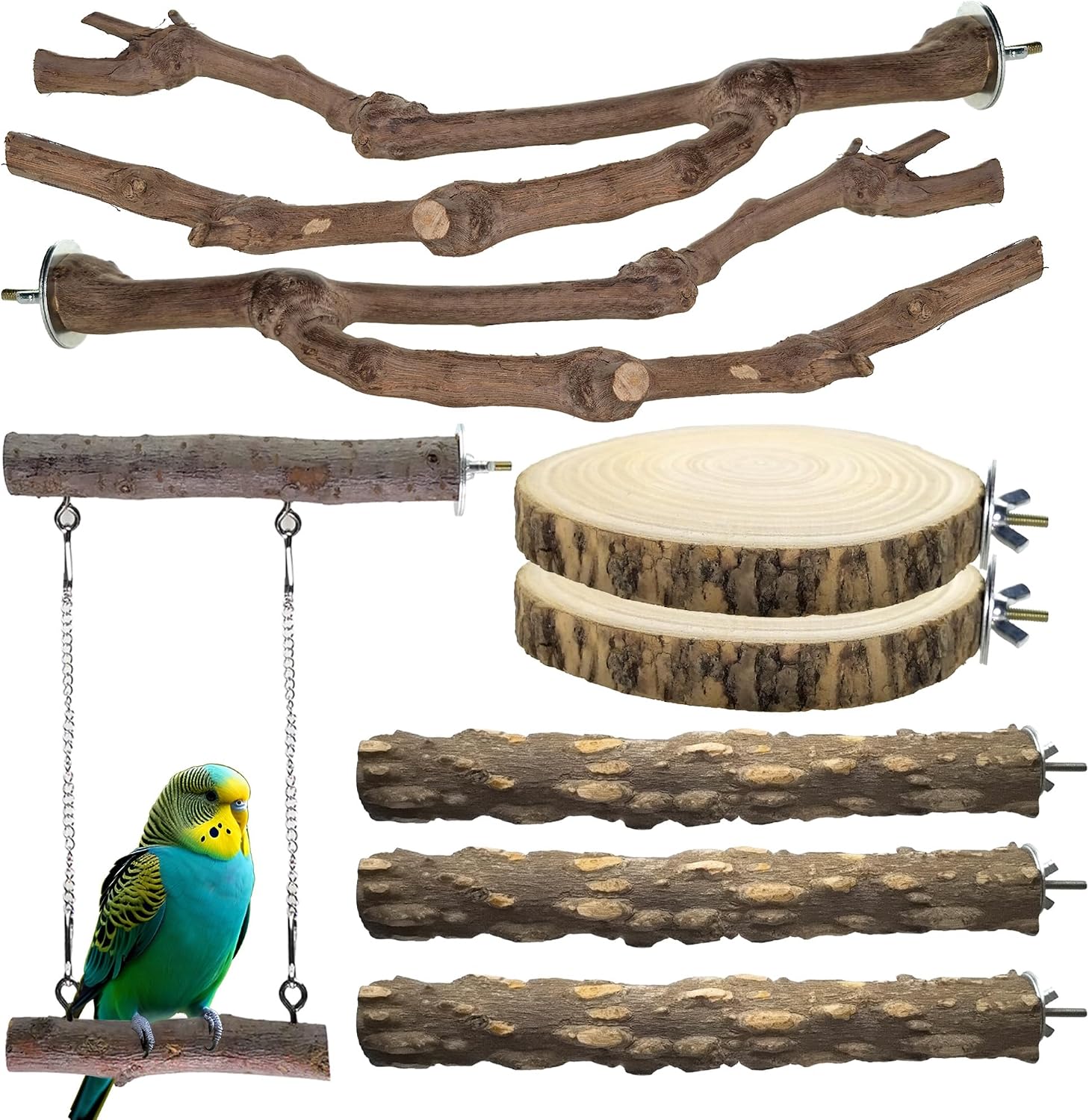
CAMATET 8pcs Natural Bird Perches for Cage, 5.9“ Small Wood Bird Perch for Parakeet/Cockatiel, Bird Cage Stick, Bird Branches for Cages, Birdcage Accessories for Parrot Conure
Eight small wood perches in one pack is the fastest way to fill a parakeet cage with options. The listing calls them 5.9 inch small wood bird perches for parakeets, cockatiels, conures, and similar birds. That length suits a small cage or a secondary perch around a thicker main branch. Because you get multiple pieces, you can place one near the food cup, one near the swing mount, and one higher up for sleeping. Check current Amazon price. The natural wood has some variation, though not as much as a single thick grape branch.
Flaws but not dealbreakers: the pack may include pieces with similar diameters, so you still want one thicker main perch. Anyone setting up a new cage from scratch will appreciate having spare perches for cleaning day. You can also use one in a travel carrier so the bird has a familiar surface on the road.
Feeding station pick: KATUMO Bird Perch Feeding Cup Birds Platform Parrot Wood Perch Stand Toy Cage Accessory for Parakeet Lovebird Cockatiel Conure Budgie Small Parrots (L Perch (Pack of 2))
Feeding station pick
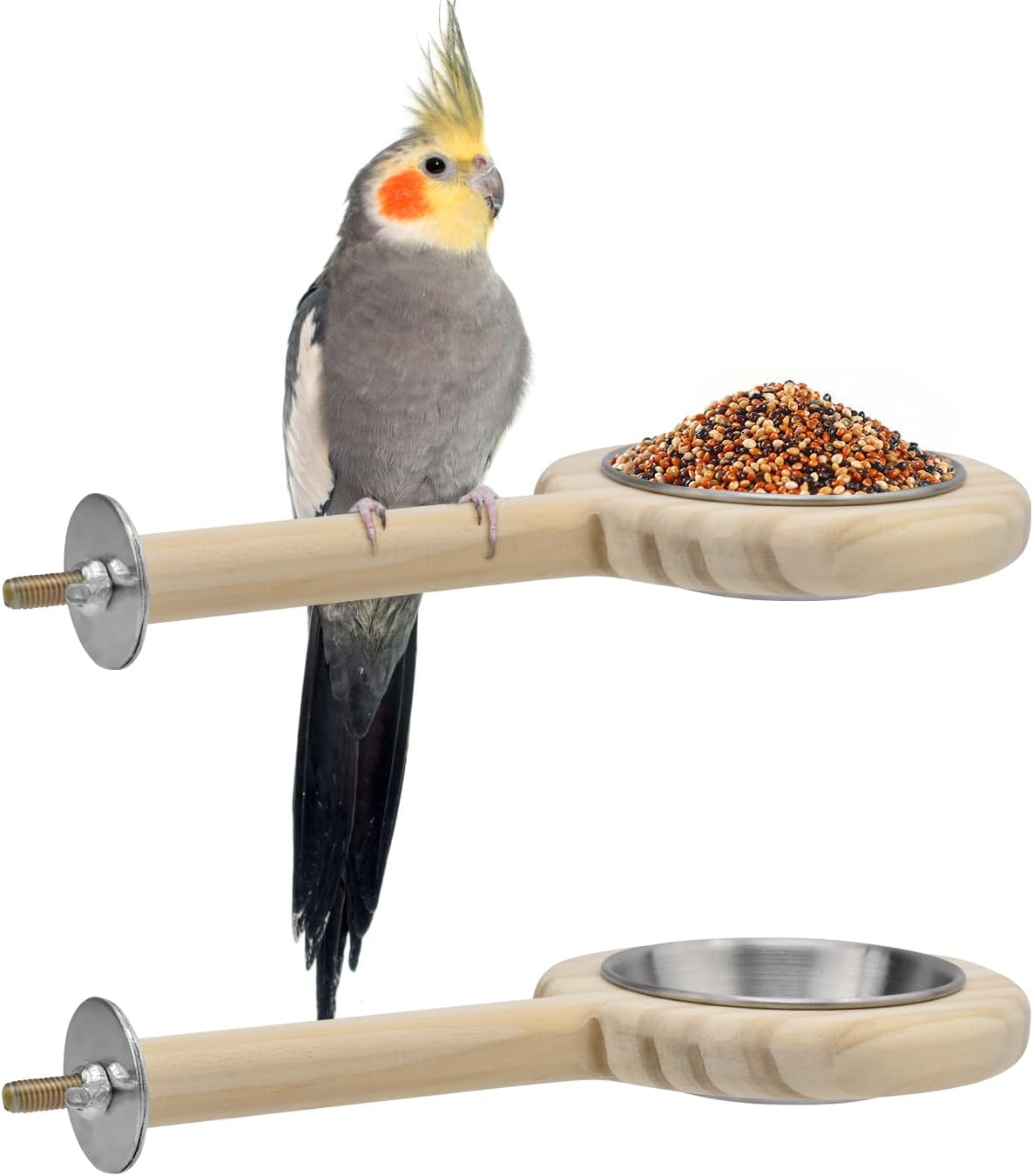
KATUMO Bird Perch Feeding Cup Birds Platform Parrot Wood Perch Stand Toy Cage Accessory for Parakeet Lovebird Cockatiel Conure Budgie Small Parrots (L Perch (Pack of 2))
This is the accessory that solves the food cup size problem. Instead of bolting a deep plastic cup to the bars, the KATUMO perch puts a feeding platform right where the bird stands. A parakeet can hop onto the L-shaped perch and eat without stretching down into a cup. Check current Amazon price. The pack of two means you can use one for food and one for water, or keep a spare for the carrier.
Flaws but not dealbreakers: an open platform is easier for a bird to kick seed out of, so expect some mess. It is also not a perch for a large parrot. Anyone whose parakeet currently eats from a cup mounted too high or too low should look at this first. If your bird is a messy eater, place the platform over a tray liner that you can shake out daily.
The actual setup workflow
This order works for a new cage or a full reset. Do the work before the bird is in the cage, or move the bird to a carrier while you rearrange. Rushing this step is how people end up with a cage that looks full but gives the bird nowhere comfortable to stand.
Step one: Check the cage before you add anything. Look at bar spacing, cage height, and door size. For a parakeet, bar spacing should be narrow enough that the bird cannot stick its head through. Cage height matters more than width because parakeets like to climb and sleep high. If the cage has a deep tray, plan for a tray liner that you can swap without dismantling the whole setup. If the door is too small for your hand and a perch at the same time, you will avoid cleaning the cage as often as you should.
Step two: Pick the room and the spot. Place the cage against a wall, away from kitchen fumes, drafty doors, and direct afternoon sun. Parakeets are social, so the cage should be in a room where people spend time, but not in the middle of a walkway. Leave enough space above the cage for a swing mount and enough space around it to clean. A cage in a busy hallway is a cage that gets ignored. A mirror or a window nearby can cause a parakeet to think it has a companion, which sometimes leads to hormonal behavior. If your bird gets fixated, move the cage or cover one side.
Step three: Clean and line the tray. Before any perch goes in, wipe the cage bars and the tray. Use a tray liner that fits the tray with a little overhang, so seed and droppings do not stick to the metal. A liner is not a luxury. It is what makes the weekly reset take five minutes instead of thirty. If you have a second liner, you can swap them and wash the dirty one outside. Avoid scented cleaners around birds. Their respiratory systems are sensitive, and a strong smell is a warning sign.
Step four: Install the main perch. Put the thickest natural perch near the top of the cage, but not so high that the bird's head touches the roof. This is where perch diameter matters. A parakeet's foot should wrap around the perch, not sit flat on top. The PINVNBY grape wood perch is a good main branch because it is uneven. If you use the CAMATET perches, save one of the thicker pieces for this spot. Avoid smooth dowels here. If the main perch wobbles, tighten the mount or move it to a different bar. A stable perch is more important than a perfect view.
Step five: Add secondary perches at different heights. Use the remaining CAMATET perches to create a climbing route. Put one near the food station, one near the water, and one lower down for a change of scene. Avoid placing perches directly above the food cup, because droppings will land in the dish. This is the step where a parakeet cage setup starts to feel like a habitat instead of a cage. Different heights also encourage the bird to move rather than sit in one spot all day. Leave a clear flight path between the door and the highest perch. Parakeets do not fly much in a small cage, but they still need to hop without hitting a branch.
Step six: Set the feeding station and cup size. Mount the KATUMO feeding perch at a height where the bird can stand on it and reach the cup without crouching. A shallow cup is better than a deep one for parakeets because they can see the food and will not bury their heads. If you use two cups, put food on one side and water on the other, and check both daily. Wash the cups with hot water every day, because parakeets are messy eaters and bacteria builds up fast. If the bird ignores the new cup, try putting a few seeds on the platform by hand. Curiosity usually wins.
Step seven: Add foraging and a swing. Increase foraging difficulty by wrapping food in paper, using a foraging wheel, or scattering seed in a shallow tray. Hang a swing from the ceiling of the cage using a secure swing mount, but keep it away from perches so the bird can enter without hitting a branch. Rotate toys every week so the cage does not become boring. Parakeets are smart enough to lose interest in the same setup, and a bored bird can develop feather-picking habits. Start with easy foraging and make it harder over time. Foraging difficulty should match the bird's confidence, not the owner's hopes.
Step eight: Acclimate the bird and plan for a carrier. Let the bird explore the new layout with the cage door closed. Watch where it chooses to sleep and adjust the highest perch if needed. Keep a carrier size that fits your parakeet and is easy to clean, because vet visits and emergency moves are part of cage ownership. A good setup includes a carrier that lives near the cage, not in the garage. Give the bird a few days to settle before you change anything else. If the bird is quiet and fluffed for more than a day, call an avian vet. Setup stress is normal, but illness is not.
The competition and why it lost
The competition here is not another brand. It is the default gear that comes in a starter cage. The plain dowel perch loses because every inch of it has the same diameter. A parakeet's foot grips the same way all day, which can lead to pressure sores and weak grip over time. Sandpaper perch covers lose because they are abrasive. They can wear down the bottom of the foot, and they do not fix the real problem, which is lack of variation. Plastic perches lose because they are slippery and cold, even if they wipe clean in seconds. Suction cup perches lose because parakeets are light but active, and a suction cup that pops off at night is a fall risk. Fabric happy huts lose because loose threads can wrap around toes or be swallowed. Deep plastic food cups lose because the bird cannot see the bottom, so it either overeats the top layer or ignores the rest. A cage with no tray liner loses because cleaning takes long enough that owners put it off.
The three accessories in this guide win because they solve a specific job: natural grip, multiple perch positions, and a feeding platform at the right height. They are not the only way to set up a parakeet cage, but they are the simplest way to fix the most common mistakes.
What this all costs
The three accessories here are inexpensive compared with the cage itself. Because prices change and I cannot print them, use the links above and check current Amazon price on each listing. The cage is the biggest line item. Perches, cups, and tray liners are the cheap part, and they are also the parts that determine whether your parakeet is comfortable. A carrier is a one-time buy that you hope to use rarely. Over the life of the bird, the accessories cost less than a single vet visit, which is why it makes sense to replace a bad dowel instead of waiting.
If you are setting up a parakeet cage for the first time, buy the cage, the liner, and one natural perch first. Add the multi-pack and the feeding platform when you know where the bird likes to sit. The ideal parakeet cage setup grows with the bird, not with a shopping cart. Start simple, watch how your parakeet moves, and adjust one perch at a time. That is the whole method. Your bird will spend years on those perches, so make them worth standing on.