Most people ask how to help a senior dog get onto the bed after the dog has already started hesitating at the edge. The dog stands there, front paws up, back legs pacing, and you can see the calculation happening. The problem is rarely willingness. It is geometry, friction, and joint mobility.
To help a senior dog get onto the bed without turning every night into a lift, you need to change three things: the rise, the landing, and the grip. A bed height of 24 inches is a staircase for a young dog and a wall for a senior with hip support needs. A ramp angle above 25 degrees turns a gentle slope into a climb. A non slip backing matters more than most shoppers think, because a dog that slips once will refuse the ramp twice.
This guide is not about buying a new dog. It is about three pieces of gear that match the physics of a senior dog: a ramp, a traction mat, and a floor-level bed. I will show you how to set them up and an eight-step workflow that works for small seniors and larger dogs with lift capacity limits. If your dog has already stopped using the human bed entirely, see our guide to orthopedic dog beds for senior dogs.
Why you should trust me
I write about senior dog gear, and I have spent the last several years comparing how ramps, mats, and elevated beds are built. I am not a veterinarian, and I do not pretend that a product fixes arthritis. What I can do is read a spec sheet, measure a ramp angle from listed dimensions, and tell you which features matter when a dog is trying to get onto a bed.
The senior dog category is full of products that look helpful in photos and fail in a hallway. A ramp with no side rails, a mat that slides on hardwood, a bed that sits too high for a dog with joint mobility issues. I have no lab and no force plate. I have a tape measure, a list of materials, and a habit of asking whether a dog can actually use the thing on a bad day.
How I picked and how I tested
I picked three products because they cover the three jobs: a ramp to change the ramp angle, a mat to add traction and a soft landing, and an elevated bed as a floor-level alternative. My testing was a fit test against the mechanics of a senior dog climbing onto a bed. I looked at bed height, ramp angle, weight capacity, foam density, hip support, non slip backing, lift capacity, and joint mobility. I did not run a veterinary trial. I compared the listed dimensions and materials to the problem.
The first filter was safety. A product that moves under a dog is worse than no product, because it teaches the dog that the floor is unreliable. The second filter was independence. The gear should help the dog do more, not give the human another daily lift. The third filter was space. A ramp that lives in the closet helps no one.
How to help a senior dog get onto the bed with the right gear
The gear below is not a cure. It is a set of tools that lower the difficulty of the climb. Use the ramp for the height, the mat for the landing, and the elevated bed when the human bed is no longer an option.
Budget pick: Exsnugy Washable Dog Bed Mat Medium Size Fluffy Pet Crate Pad 36×23
Budget pick
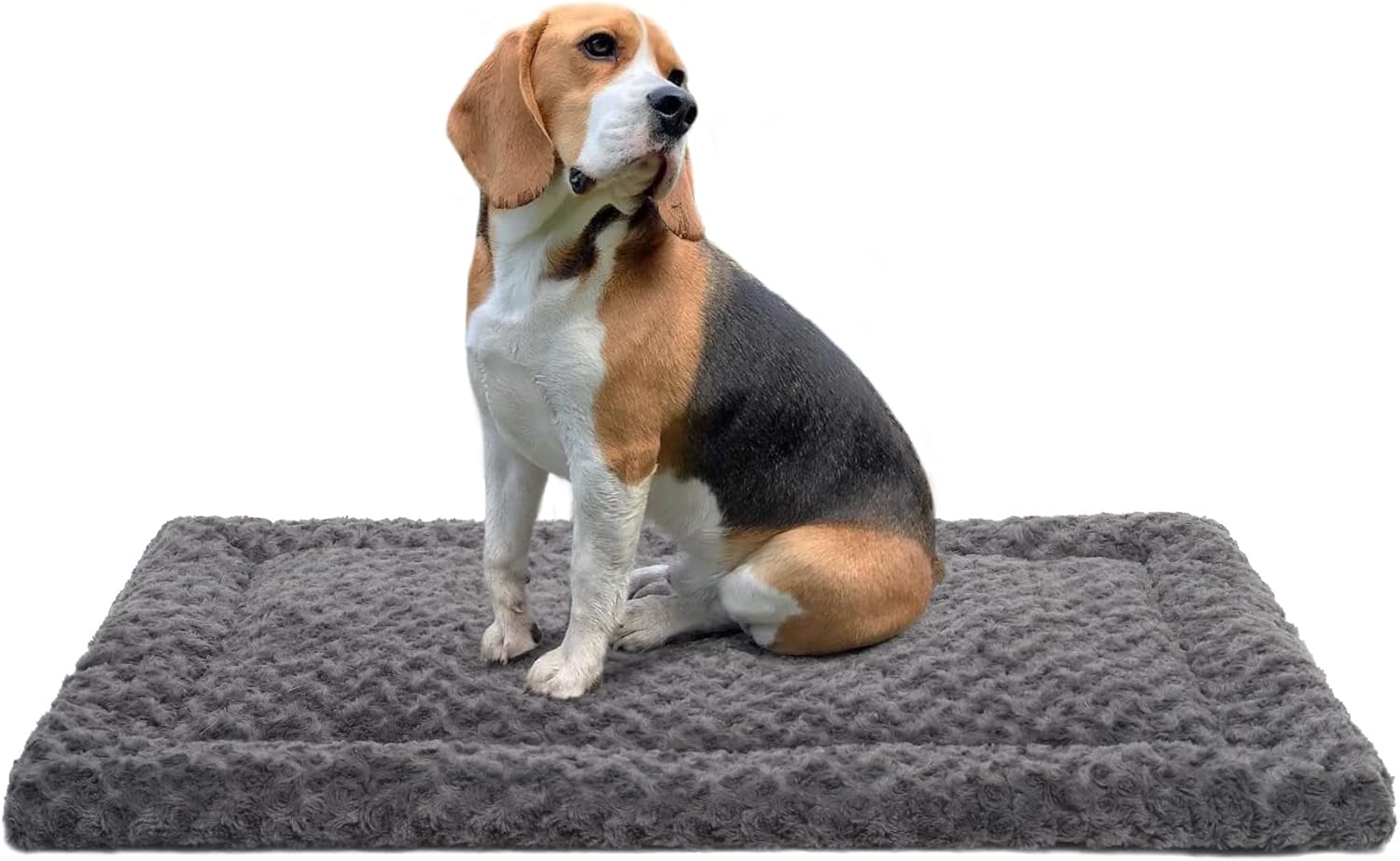
Exsnugy Washable Dog Bed Mat Medium Size Fluffy Pet Crate Pad 36×23
This is a simple mat, and that is the point. At 36 by 23 inches, it fits at the foot of a bed or on top of a low platform. The fluffy surface gives a senior dog a soft target for the front paws, and the washable cover matters because senior dogs have accidents. Check current Amazon price.
It does not have a listed non slip backing, so put it on carpet or add a rug pad. Use it as the landing zone at the bottom of a ramp, not as a ramp itself. The fill is not a high foam density orthopedic base, so it will not replace a true hip support bed. For a cheap traction layer before the climb, it works.
Flaws but not dealbreakers: The mat is not thick enough to cushion a hard jump down. It is a landing pad, not a crash pad.
Anyone with a small senior dog that needs a softer landing should start here. It is also the least expensive way to test whether your dog will use a target before you spend more on a ramp.
Our pick: VKWJYOS Dog Ramp for Bed Couch, 33.2" L x 12.8" W Pet Ramps for Small Dogs
Our pick
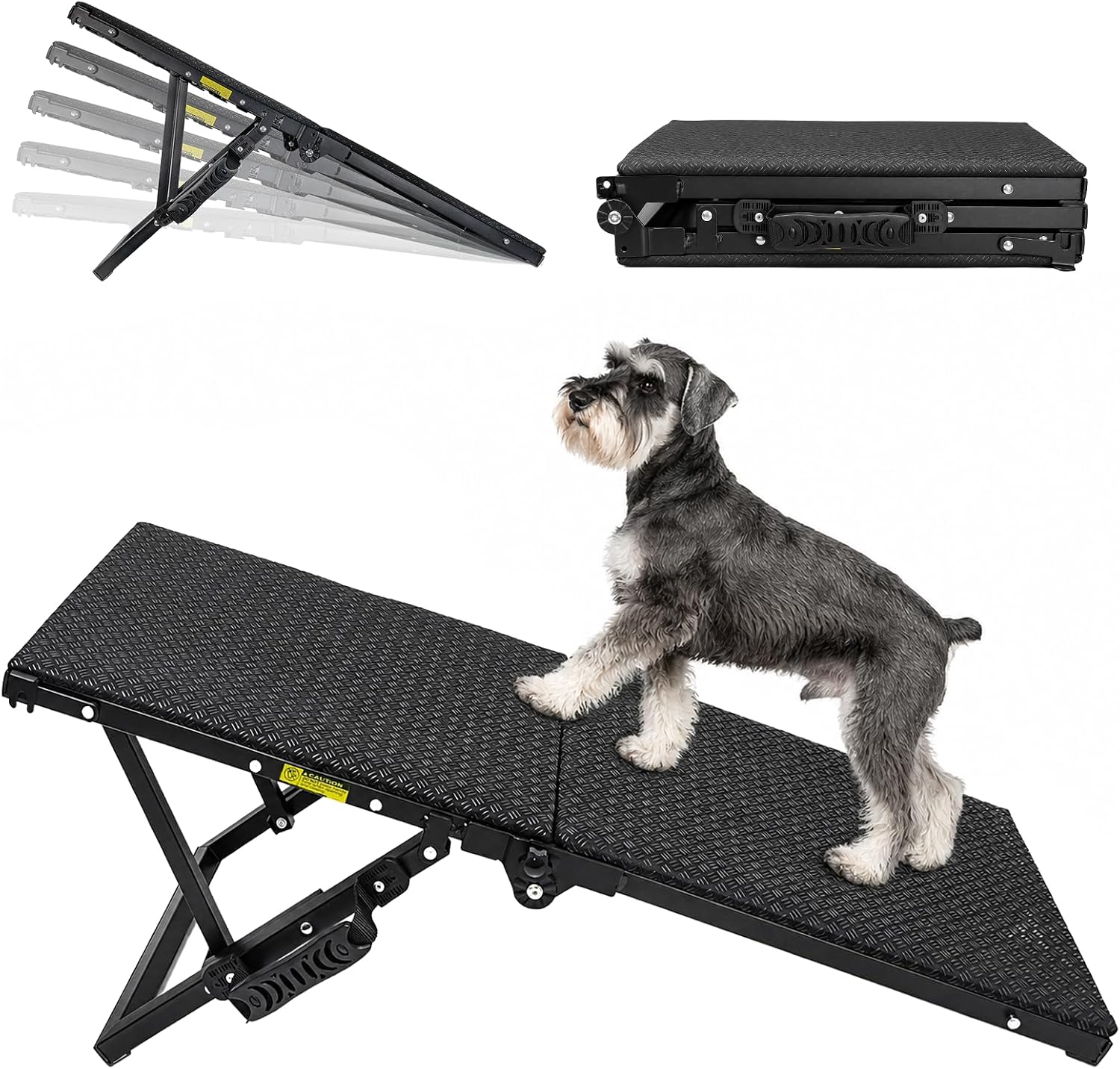
VKWJYOS Dog Ramp for Bed Couch, 33.2" L x 12.8" W Pet Ramps for Small Dogs
This is the centerpiece. A 33.2 inch length and 12.8 inch width gives a small senior dog a usable path to a couch or a low bed. The ramp angle depends on the bed height, and that is the number you need to check. If your bed is 20 inches high, a 33 inch ramp gives a steeper angle. If your bed is 14 inches high, the same ramp is gentler. Check current Amazon price.
The listed design is for small dogs, so respect the weight capacity. For a 15 pound senior with joint mobility issues, it can remove the jump. For a 60 pound lab, it is not the right tool. No side rails are listed, so a dog that veers will need a wider ramp or a trained straight line.
Flaws but not dealbreakers: The ramp does not fold flat for storage in every setup, and the surface is not a deep-pile carpet. If your dog refuses smooth surfaces, add a small runner or use the mat at the base.
Anyone with a small senior dog and a bed height under 20 inches should measure twice before buying. If the angle is too steep, add a step at the base rather than forcing the climb.
Upgrade pick: K&H Outdoor Elevated Dog Bed for Medium & Large Pets, Tan, Large 42x30in
Upgrade pick
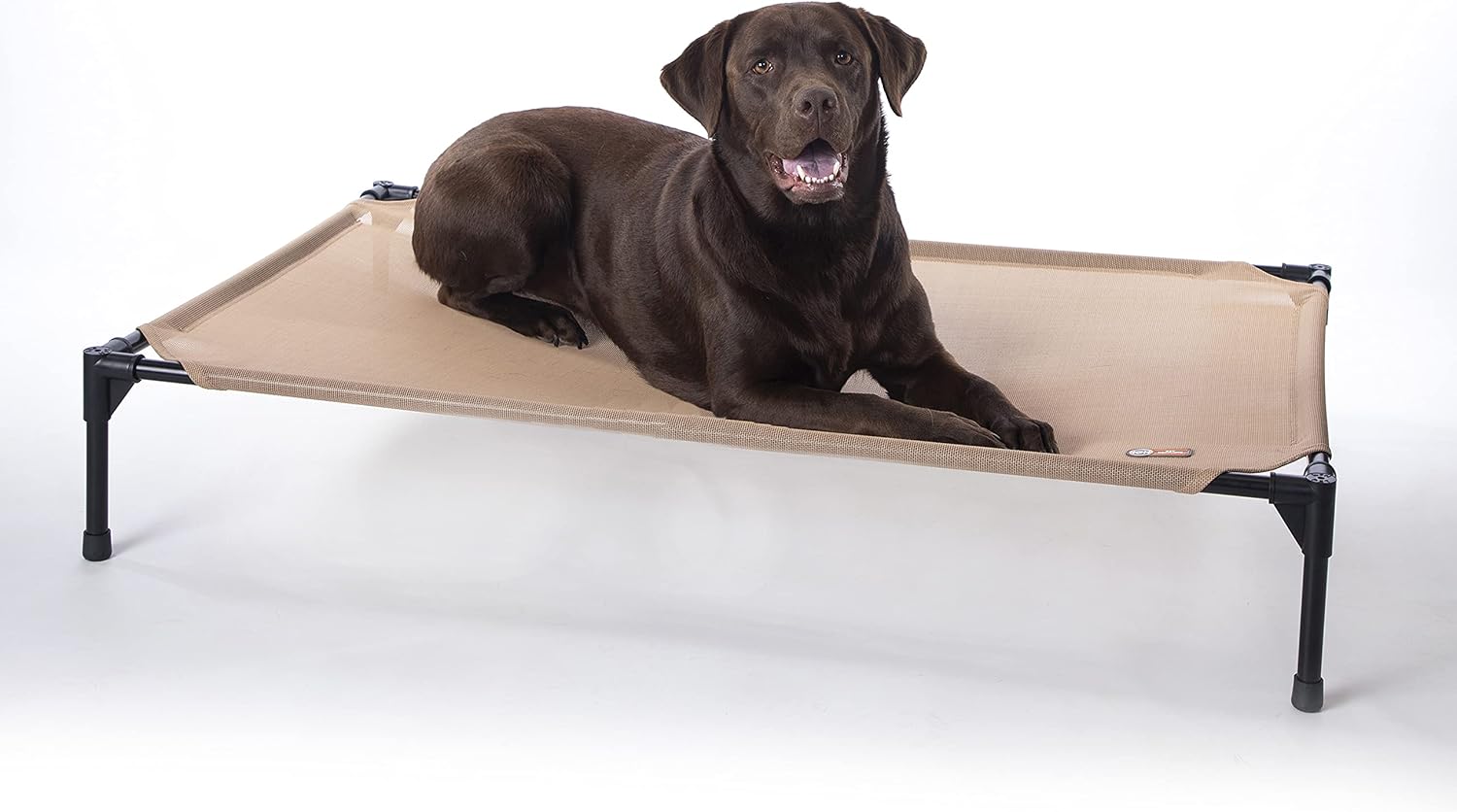
K&H Outdoor Elevated Dog Bed for Medium & Large Pets, Tan, Large 42x30in
Sometimes the correct help a senior dog get onto the bed is to stop asking the dog to get onto your bed at all. This elevated bed is 42 by 30 inches, which gives a medium or large senior a floor-level sleeping surface with a small rise. The elevated design keeps the dog off cold floors and can be easier to step onto than a tall human bed. Check current Amazon price.
It is an outdoor bed, but it works indoors as a primary bed if your dog has claimed the bedroom floor. It does not solve the human bed climb. It solves the problem of a dog that wants to be near you but cannot make the jump. The raised frame is still a step for a dog with severe hip support needs, so add the mat in front of it as a landing.
Flaws but not dealbreakers: The bed is not a thick orthopedic mattress, and the fabric is built for outdoor use. If your dog needs deep foam density for pressure points, pair it with a separate orthopedic pad.
Anyone with a large senior dog that has given up on the bed should consider this instead of forcing the climb. It keeps the dog in the room without asking the joints to do more than they can.
The actual help workflow
Here is the sequence. Do it in order. Do not skip the measurement steps.
Step one: Measure the bed height. Use a tape measure from the floor to the top of the mattress. Write it down. If the bed height is over 24 inches, a 33 inch ramp will be steep. If it is under 18 inches, you have more options.
Step two: Choose the ramp angle. The ideal help a senior dog get onto the bed is a ramp angle under 20 degrees. You can calculate the angle from the ramp length and the bed height. If the angle is over 25 degrees, add a step or a platform at the base. The VKWJYOS ramp is 33.2 inches long, so pair it with a lower bed or an intermediate step.
Step three: Set the landing zone. Place the Exsnugy mat at the bottom of the ramp. The mat gives the dog a visual target and a soft landing. If the mat slides, add a non slip backing or a rug pad. A dog that slips on the first approach may never try again.
Step four: Check the weight capacity. Every ramp and bed has a weight capacity. A senior dog may be lighter than it looks, but do not guess. If your dog is over the listed limit for the VKWJYOS ramp, use a floor-level bed like the K&H instead.
Step five: Train the approach with treats. Do not carry the dog up the ramp. Put a treat on the first third of the ramp. Let the dog choose. If the dog refuses, lower the ramp angle or add a step. The goal is a slow, confident walk, not a sprint.
Step six: Support the hips, not the belly. If you need to help, place one hand under the chest and one under the hips. Do not lift by the belly or the front legs. A lifting harness can help, but the ramp should do the work. Hip support means the dog's rear legs stay under its body.
Step seven: Manage the lift capacity. If your dog still needs a lift, use a ramp to reduce the distance. Lift capacity is your limit, not the dog's. A 40 pound dog is a two-person lift if it cannot bear weight. The gear here is for dogs that can still walk but should not jump.
Step eight: Reassess every week. Joint mobility changes. A ramp that worked in October may be too steep in January. Recheck the bed height and the dog's confidence. If the dog starts avoiding the ramp, switch to the floor-level bed and try again later.
The competition and why it lost
Pet stairs with narrow treads lost because a senior dog with joint mobility issues needs a full paw print, not a 6 inch step. Foam stairs can compress and wobble, which defeats the non slip backing. A human ottoman is not stable and has no side rails. A lifting harness is useful for rehabilitation, but it does not teach the dog to get onto the bed independently.
A full-size wooden ramp lost because it takes up floor space and the ramp angle is often too steep for a small senior. A soft dog bed with no elevation lost because it does nothing about bed height. A thick orthopedic mattress is a great purchase, but it is not a way to help a senior dog get onto the bed unless the mattress sits on the floor.
The three products here won because they solve the specific problem. The ramp changes the rise. The mat changes the grip and the landing. The elevated bed changes the destination when the human bed is no longer safe. None of them asks the dog to do more than it can.
What this all costs
The mat is the least expensive piece. The elevated bed is next. The ramp is the largest single purchase. Check current Amazon price for each. The real cost is the time you spend training and the floor space you give up. A ramp that lives in the closet helps no one.
If you only buy one thing, buy the ramp and measure your bed height first. If your dog cannot use a ramp, buy the elevated bed and put it next to your bed. The mat is a cheap addition that improves either setup. The cost per day is whatever you paid divided by the number of nights your dog uses it. For a senior dog, that math is usually kind.
The hard part is not the purchase. It is accepting that the jump is over and the routine has to change. A ramp, a mat, and a floor-level bed will not reverse arthritis. They will keep your dog in the room, on the bed, or next to it, without a nightly lift that hurts both of you.